

Form 3115 Missed Depreciation Catch-Up: 2026 Steps
How to use Form 3115 for missed depreciation on a rental property. Learn §481(a) catch-up steps, CPA documentation, filing timing, and 2026 bonus rules.
Read  See why we're the best option for look-back studies
Every year without a study left depreciation on the table. A look-back study claims it all on this year's return. No amended returns.
Never had a cost segregation study on a rental you already own? Form 3115 lets your CPA claim the missed depreciation on this year's return. No amended returns.

The missed depreciation goes on this year's return as one Section 481(a) adjustment. Prior years stay closed. How the catch-up works

There's no cutoff on how long you've owned it. The catch-up reaches back as far as MACRS itself, which began in 1987, and picks up renovations along the way. Form 3115 after a study

A look-back is the standard engineering report at $2,200 flat, with Form 3115 provided on request. Renovations, revisions, and audit support are included.
Even if you bought your property in previous years, a look-back study applies the bonus depreciation rate that was in effect when the property was placed in service. A Section 481(a) catch-up recovers the accelerated depreciation you missed.
You bought a $500,000 property with $100,000 in accelerated assets that were never identified. Here's what you might be missing out on:
| Placed in service | Bonus rate | What you claim this year |
|---|---|---|
| 2025 | 100% | $96,364 |
| 2024 | 60% | $52,727 |
| 2023 | 80% | $69,091 |
| 2022 | 100% | $85,455 |
| 2021 | 100% | $81,818 |
| 2020 | 100% | $78,182 |
| 2019 | 100% | $74,545 |
| 2018 | 100% | $70,909 |
Rates are those in effect when the property was placed in service. The 2025 row assumes the property was acquired after January 19, 2025; property acquired earlier gets 40%. Current law is 100% for property acquired and placed in service after January 19, 2025. Illustrative example; results vary.
We itemize the assets from your acquisition and renovations from past years, so you can claim the missed tax deductions this year.
2024
You bought a property and started claiming standard depreciation. Without a cost segregation study to identify short-life assets, you miss out on bonus depreciation.
You missed $145,000 in deductions
2025

Whether you redid the kitchen or built a pool, you didn't get a cost segregation study to itemize tax deductions for the construction or land improvements.
You missed $65,000 in deductions
Now
Don't worry, you didn't miss out on the savings. We look at your acquisition and construction documents to itemize all of the deductions you missed. We give you a Form 3115 so you can claim the missed depreciation as a Section 481(a) catch-up.
You claim the missed $210,000
Illustrative figures for a hypothetical property. Your deductions and catch-up depend on your property's components, condition, and purchase details, and your CPA confirms what you're eligible to claim.
A look-back study takes the documents you already have and comes back with everything your CPA needs.
Closing documents, photos or listing links, and your appraisal or inspection report if you still have them. If you have renovations, you can send us the invoices. If you don't have an appraisal, we can pull the county assessor's record.
The engineering report, with every component itemized and its cost source named, plus Form 3115 provided on request, in 3 to 5 business days.
The Section 481(a) catch-up goes on this year's return. No amendments needed. How we work with CPAs

Audit support included
Our reports are built to the IRS Audit Technique Guide's own criteria for a quality study, so you can check our work against it. If the IRS questions your study, we respond at no additional cost with the documentation and methodology behind it. What Audit Support covers
The mechanics, the filing, and the timing, explained.
How to use Form 3115 for missed depreciation on a rental property. Learn §481(a) catch-up steps, CPA documentation, filing timing, and 2026 bonus rules.
Read
Form 3115 catches up missed depreciation after a residential cost segregation study without amending returns. Learn when it applies in 2026.
Read
When should a CPA file Form 3115 after a residential cost segregation study? 2026 rules on Section 481(a) catch-ups, automatic changes, and bonus depreciation.
Read
See the exact cost segregation documents your CPA needs from a rental owner in 2026, from closing statements to STR activity logs and Form 4562.
Read
Time a cost segregation study before year end right: placed-in-service date, 100% bonus depreciation, and the 2026 deadline that actually matters.
Read
Cost segregation study vs CPA estimate compared for 2026: which one survives an IRS audit and which one is just a guess on your depreciation schedule.
Read
Cost segregation llc owned property still passes through to your 1040 or K-1. See how single vs multi-member LLC structure changes the 2026 depreciation math.
Read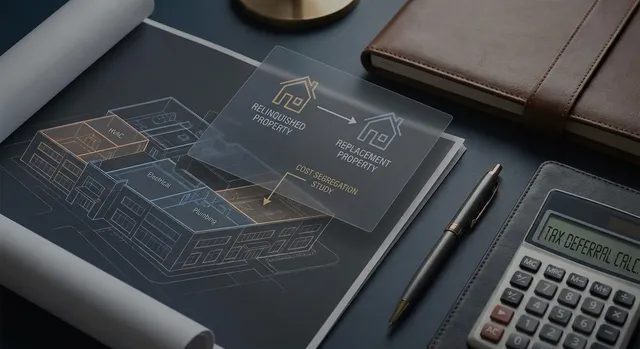
Combine cost segregation and a 1031 exchange the right way in 2026: basis rules, bonus depreciation eligibility, and the filing steps CPAs actually use.
ReadCost segregation studies for residential investment property and short-term rentals.
Itemized asset schedule
Every component is listed with quantity, cost source, and valuation
Full depreciation schedule
Year by year MACRS depreciation schedule
CPA-ready executive summary
Formatted for your CPA to work from at filing
Delivered in 3 to 5 business days
Submit your documents and get your completed report
No fees. Taxes included.
3 or more properties? 10% off every study
Still have questions? Get in touch
While other firms keep up-charging, we focus on quality service at one inclusive price.
Audit support
If the IRS questions your study, we respond at no additional cost. What Audit Support covers
Included

Renovation invoices
Send us your invoices and construction documents for even more deductions.
Included
Form 3115 catch-up
Bought in a previous year? Catch up on missed depreciation without amending prior returns.
Included

Tax assessment record search
No appraisal? We pull the county tax assessor’s record to source your land value.
Included

Revisions
Forgot a document? Send it within one week of receiving your study and we revise it.
Included
With other firms, you'll pay more upfront, or in hidden costs later.
Price
Who does the work
Turnaround
Site visit
Documentation
Audit support
Form 3115, Section 481(a), and what owners of existing rentals ask before catching up.
As far back as MACRS itself, which began in 1987. The catch-up is filed as a change in accounting method on Form 3115, and the IRS lets you take the whole missed amount as a single Section 481(a) adjustment on your current return, however many years it covers. In practice the older the purchase, the more depreciation has accumulated and the larger the catch-up. How the Form 3115 catch-up works.
No. That is the point of the look-back method. Instead of reopening old returns, your CPA files Form 3115 with your current return and claims the missed depreciation as one adjustment, called a Section 481(a) adjustment. Prior years stay closed. We provide Form 3115 on request with your study, so your CPA has the form and the numbers together.
Filing Form 3115 for depreciation is a routine, IRS-recognized procedure, and this particular change is one the IRS grants automatically. What matters is that the study behind it holds up. Ours is built to the IRS Audit Technique Guide's own criteria for a quality study, so you can check our work against it. If the IRS questions your study, we respond at no additional cost with the documentation and methodology behind it. Representation before the IRS stays with your CPA.
It corrects it, the IRS's way. Depreciating a property straight-line when parts of it belong in shorter MACRS classes is treated as an impermissible method. Form 3115, filed under DCN 7, the automatic-consent change from an impermissible depreciation method to a permissible one, fixes it going forward and captures everything you missed as a single Section 481(a) adjustment on this year's return. It is automatic consent under the IRS's annual list of automatic changes, not a negotiation. What the IRS guide says.
The rate that was law when the property, or each renovation, actually went into service, not today's rate. Bonus depreciation ran at 100% under the TCJA through 2022, then stepped down to 80% in 2023, 60% in 2024, and 40% in 2025 for property acquired before January 20, 2025. The OBBBA restored 100% for property acquired and placed in service after January 19, 2025, which is the rate for property you buy today. A look-back study applies the rate for each vintage, and the Section 481(a) catch-up still recovers the regular accelerated depreciation you missed whatever the rate. Your CPA confirms which rate governs your property.
Your CPA can file it. Form 3115 for a depreciation change is a standard filing, and the report is formatted so they can work from it directly: an executive summary, the full asset schedule, and a year-by-year depreciation schedule. If your accountant has questions about the analysis, we support them at no additional cost. Are you a CPA? See how we work with firms.
One study, one Form 3115, and years of missed depreciation on your next return.