
By Virtual Cost Segregation
The best cost segregation study provider for rental property investors
 Built to IRS standards
 Audit support includedFlat price for every study3 to 5 business days
Ordinary-income recapture under Section 1250 generally does not apply to a rental building depreciated entirely using the straight-line method because there is no depreciation above straight line to recapture. Cost segregation does not eliminate tax on depreciation: the building can still generate unrecaptured Section 1250 gain, while reclassified assets can trigger Section 1245 recapture or other Section 1250 consequences when sold.
- Why does 1250 recapture generally no longer apply? Straight-line building depreciation usually creates no excess depreciation to recapture.
- Unrecaptured Section 1250 gain still applies, with a maximum federal rate of 25% for individuals.
- Cost segregation changes asset classifications; it does not erase depreciation-related tax when you sell.
- Virtual Cost Segregation provides residential cost segregation studies; your CPA determines the sale's tax treatment.
Why doesn't 1250 recapture apply after cost segregation?
The reason is straight-line depreciation, not cost segregation. Section 1250 generally recharacterizes gain as ordinary income to the extent of additional depreciation, meaning depreciation above the applicable straight-line amount. For property held longer than one year, a building depreciated entirely using straight line generally has no additional depreciation for this purpose.
For your 2026 sale analysis, separate that ordinary-income rule from the capital-gain category called unrecaptured Section 1250 gain. The names sound similar. Their tax effects differ.
The federal framework comes from Internal Revenue Code Sections 1250, 1245, and 1(h), applied here to individual owners of residential rentals. This is general educational guidance for 2026, not individualized tax advice.
| Tax category | What triggers it | What cost segregation changes |
|---|---|---|
| Ordinary Section 1250 recapture | Gain attributable to depreciation above straight line, subject to statutory rules | Accelerated depreciation on certain Section 1250 assets needs separate review |
| Unrecaptured Section 1250 gain | Qualifying long-term gain attributable to real-property depreciation, not already ordinary income | The building's remaining basis and depreciation determine part of the calculation |
| Section 1245 recapture | Gain on Section 1245 assets, generally up to depreciation allowed or allowable | Reclassified personal property creates separate asset-level recapture calculations |
The Virtual Cost Segregation residential cost segregation service supplies the engineering-based classifications your CPA uses. The study itself does not determine your final sale tax.
Why this matters
Treating all depreciation-related gain as one category produces a misleading exit estimate. A rental sale can contain ordinary income, unrecaptured Section 1250 gain, and other Section 1231 gain at the same time.
Your planning question is not whether recapture disappears. It is which assets generate gain, how that gain is characterized, and whether earlier deductions justify the later tax.
For 2026 planning, ask your CPA to model both sides: the deductions you can actually use during ownership and the tax consequences of a sale. A large deduction is not the same as permanent tax savings.
Ordinary Section 1250 recapture: excess depreciation matters
Section 1250 focuses on depreciable real property that is not Section 1245 property. Its ordinary-income recapture rules generally target depreciation exceeding straight line, subject to holding-period and other statutory provisions.
A long-term residential rental building generally uses a 27.5-year recovery period. Its straight-line depreciation reduces adjusted basis, but ordinarily does not create the excess depreciation targeted by Section 1250.
Do not confuse the physical appearance of a house with its federal depreciation classification. Under the short-term-rental framework discussed here, a building with average stays under 30 days uses a 39-year recovery period rather than the long-term residential period; your CPA must confirm treatment from the property's actual use.
Both building recovery periods use straight-line depreciation. The building structure does not qualify for bonus depreciation.
That distinction explains why an owner can owe tax attributable to building depreciation without having ordinary Section 1250 recapture. Depreciation still lowered basis. A different gain category accounts for that result.
Unrecaptured Section 1250 gain: a 25% maximum rate
Unrecaptured Section 1250 gain is not the same as ordinary Section 1250 recapture. For individuals, it is a category of long-term capital gain attributable to real-property depreciation, subject to a maximum federal rate of 25%.
The 25% rate is a ceiling, not a flat rate imposed on every rental sale. Your actual calculation depends on taxable income, recognized gain, depreciation, and the applicable gain-netting rules.
The amount cannot simply be assumed to equal every depreciation deduction you took. Your CPA first determines the gain and its character, then applies the relevant limitations and netting rules.
Other federal taxes and state income tax can affect the total liability. The 25% ceiling does not describe your entire tax bill.
In a 2026 sale projection, keep this category separate from ordinary-income recapture. Calling both categories “1250 recapture” hides the distinction that answers the original question.
Section 1245 recapture: reclassified assets need separate calculations
Cost segregation identifies components that qualify for treatment separate from the building. Depending on function and documentation, certain furnishings, appliances, and other assets qualify as Section 1245 personal property with shorter recovery periods.
When you sell a Section 1245 asset at a gain, ordinary-income recapture generally equals the smaller of the recognized gain or depreciation allowed or allowable. That depreciation includes applicable accelerated deductions.
A fully depreciated asset does not necessarily generate recapture equal to its original cost. The gain recognized on that asset limits the recapture calculation.
Your sale allocation therefore matters. A sale of a furnished rental is not just a single building calculation: your CPA needs a supportable allocation among land, building, and separately identified assets.
Do not assign every dollar of sale proceeds to the building simply because the purchase contract uses one total amount. Preserve the study's asset detail and give it to the professional preparing your disposition calculations.
Land improvements: 15-year treatment needs another check
Certain land improvements, such as qualifying paving, fencing, pools, and site lighting, use 15-year recovery periods. Classification depends on the asset's function and supporting documentation; an entire amenity project does not automatically receive one treatment.
Many land improvements remain Section 1250 property even though they depreciate faster than the building. Accelerated depreciation on those assets can create additional depreciation requiring ordinary Section 1250 recapture analysis.
This is the important exception to the broad statement that “1250 recapture no longer applies.” That statement is generally about straight-line building depreciation, not every asset remaining within Section 1250.
Land itself is different. It is not depreciable, so your allocation must keep land separate from depreciable site improvements.
Why recapture treatment varies
For a residential rental sale in 2026, these factors determine why one owner's result differs from another's:
- Asset classification: Section 1245 personal property and Section 1250 real property follow different recapture rules.
- Depreciation method: Straight-line building deductions differ from accelerated deductions on shorter-life assets.
- Adjusted basis: Depreciation allowed or allowable reduces basis, affecting the gain calculation.
- Sale allocation: Proceeds and selling expenses must be allocated among the disposed assets using supportable values.
- Holding period: Long-term gain treatment and aspects of Section 1250 depend on how long you held the property.
- Taxpayer facts: Income, prior Section 1231 losses, ownership structure, and applicable limitations affect the final result.
The recovery period alone does not answer the recapture question. You need both the asset's tax classification and its depreciation history.
How should you prepare a rental sale after cost segregation?
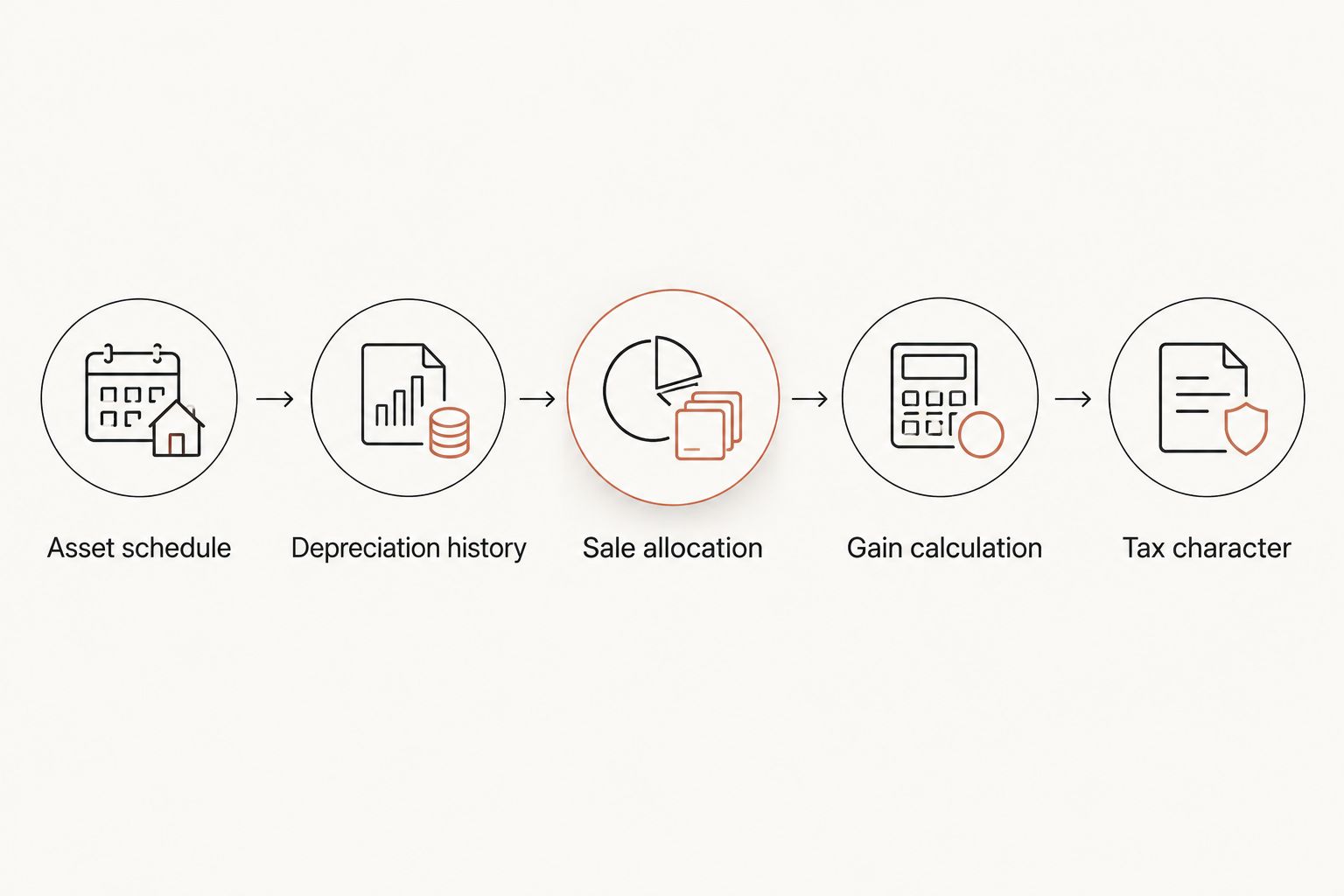
Build the sale calculation from the asset schedule rather than from the property's total accumulated depreciation. Use this sequence with your CPA before finalizing your 2026 sale projection.
- Asset schedule: Provide the original study, subsequent additions, replacements, and any assets already removed from service.
- Depreciation history: Reconcile depreciation allowed or allowable, including accelerated deductions and accounting-method adjustments.
- Sale allocation: Support the allocation of proceeds and selling expenses among land, building, personal property, and improvements.
- Gain calculation: Calculate adjusted basis and gain or loss separately for the relevant assets.
- Tax character: Apply Sections 1245, 1250, and 1231, then complete the individual capital-gain calculations where applicable.
Your CPA generally uses Form 4797 to report business-property dispositions and related recapture calculations. Relevant amounts then flow into other parts of the return, including Schedule D when required.
Keep acquisition documents, invoices, the study, depreciation schedules, and sale records together. A missing asset schedule makes it harder to reconcile the deductions claimed during ownership with the property sold.
How should you compare the deduction with the eventual sale tax?
Start with timing, not a promise of permanent savings. Cost segregation moves eligible deductions earlier; a later taxable disposition can bring some depreciation-related gain into income.
For an illustrative planning assumption, use 25% of depreciable property value reclassified and a 37% marginal federal bracket for a high earner. These are modeling assumptions, not predicted study results or a determination that the deductions are currently usable.
The 25% reclassification assumption is unrelated to the 25% maximum rate on unrecaptured Section 1250 gain. One describes an assumed asset allocation. The other describes a federal capital-gain rate ceiling.
Apply the 37% bracket only to deductions that actually reduce income taxed at that marginal rate. Passive-activity, at-risk, and other limitations can delay or restrict the benefit.
Then model a sale using asset-level values rather than assuming every accelerated deduction reverses at one uniform rate. Compare the earlier usable deductions with the projected later tax and your expected holding period.
Virtual Cost Segregation is best for residential rental owners who want an engineering-based cost segregation study for their CPA to apply. Its studies cover residential properties of 1 to 4 units, require no site visit, and include audit support. The limitation is equally important: the study is not a CPA service, and your own CPA applies it to the return and evaluates disposition tax.
Does a look-back study remove recapture?
No. A look-back study changes the timing and classification of depreciation; it does not remove the sale rules attached to the assets.
For an eligible accounting-method correction, missed depreciation is claimed on the current return with Form 3115 through a Section 481(a) adjustment, and prior returns are not amended. Your CPA determines eligibility and files the form.
Virtual Cost Segregation provides Form 3115 on request; your CPA handles filing. The corrected depreciation history must remain connected to the asset schedule used for any later sale.
Can I avoid recapture by not claiming depreciation?
No. Depreciation allowed or allowable generally reduces basis even when you failed to claim the deduction.
Skipping depreciation can leave you without the earlier tax benefit while still affecting the sale calculation. Ask your CPA to address missed depreciation rather than treating omission as a recapture strategy.
Does holding the rental longer eliminate recapture?
No. A longer holding period does not automatically erase Section 1245 recapture or unrecaptured Section 1250 gain.
Holding period affects several tax rules, but there is no general rule under which depreciation-related gain disappears merely because you held a rental for many years. Keep the records for as long as they remain relevant to basis and disposition reporting.
FAQ
Why does 1250 recapture generally no longer apply?
Ordinary Section 1250 recapture generally does not apply to a building depreciated entirely using straight line because there is no depreciation above straight line to recapture. Unrecaptured Section 1250 gain can still apply, and accelerated depreciation on other Section 1250 assets needs separate analysis.
Is unrecaptured Section 1250 gain always taxed at 25%?
No. The 25% rate is a maximum federal rate for individuals, not an automatic flat rate. Taxable income, gain calculations, and applicable netting rules determine the result.
Does cost segregation turn the entire rental into Section 1245 property?
No. Cost segregation identifies assets separately; it does not convert the entire building into Section 1245 property. The building generally remains Section 1250 property, while qualifying personal property receives separate treatment.
Can 15-year land improvements have Section 1250 recapture?
Yes. Accelerated depreciation on Section 1250 land improvements can create depreciation above straight line that requires ordinary-income recapture analysis. Your CPA must confirm the asset classification and depreciation history.
Do I owe recapture equal to every depreciation deduction?
No. Recapture depends on the applicable asset-level gain and statutory rules, not just total depreciation. Section 1245 recapture is generally limited to the smaller of recognized gain or depreciation allowed or allowable.
Who calculates recapture after a residential cost segregation study?
Your CPA calculates recapture and the other tax consequences of the disposition. The study supplies asset classifications and cost allocations, but it is not a tax return or an individualized sale-tax calculation.
One last thing
The word “unrecaptured” does not mean untaxed. It distinguishes a capital-gain category from ordinary Section 1250 recapture, which is exactly why a straight-line rental building can avoid one treatment and still generate depreciation-related tax under another.
Before you sell, request an asset-by-asset disposition estimate. That calculation is more useful than a single assumed “recapture rate” applied to the entire property.