
By Virtual Cost Segregation
The best cost segregation study provider for rental property investors
 Built to IRS standards
 Audit support includedFlat price for every study3 to 5 business days
Unrecaptured section 1250 gain is reported on Schedule D, line 19, using the Unrecaptured Section 1250 Gain Worksheet in the Schedule D instructions. It is included in the capital gain that flows to Form 1040, not entered again as a separate item of income. For a residential rental sale, Form 4797 generally supplies the underlying sale and depreciation calculations; the applicable Schedule D tax worksheet handles the special maximum 25% rate.
- Where does unrecaptured section 1250 gain get reported on 1040? Schedule D identifies it; Form 1040 receives the total gain.
- IRS Schedule D, line 19, identifies unrecaptured section 1250 gain after the worksheet calculation.
- Form 4797 generally reports the underlying rental property sale and separates ordinary depreciation recapture.
- The 25% rate is a maximum federal rate, not an automatic flat tax.
Where does unrecaptured section 1250 gain get reported on 1040?
Use Schedule D to identify the gain's tax character, then Form 1040 to report the resulting total capital gain. Schedule D, line 19, is a rate-category entry. It does not create additional gain beyond the amount already included in the sale calculation.
The reporting path for a directly owned residential rental generally follows these steps:
- Report the sale. Enter the disposition and asset-level information on Form 4797 as applicable.
- Separate ordinary recapture. Calculate any ordinary income required by the depreciation recapture rules before determining the remaining gain's treatment.
- Complete the worksheet. Use the Unrecaptured Section 1250 Gain Worksheet in the IRS Schedule D instructions.
- Identify the category. Carry the worksheet result to Schedule D, line 19.
- Calculate the tax. Follow Schedule D's instructions for the applicable tax worksheet, and carry the return's total capital gain to Form 1040.
For your 2026 return, match each transfer to the final IRS forms and instructions for that tax year. Follow the field labels rather than copying a prior return's screen positions.
The broader connection between accelerated deductions and a later sale is explained in cost segregation and depreciation recapture when selling a rental.
Why this matters
A rental sale can produce several tax categories from one closing. Building depreciation, separately classified personal property, and appreciation do not necessarily receive the same treatment.
Do not report the same gain twice. The amount identified on Schedule D, line 19, is already part of the gain included elsewhere in the return's capital-gain calculation. Entering it again as additional income overstates the sale's taxable result.
For a 2026 sale, your first task is to reconcile the depreciation schedule with the assets sold. The closing statement alone does not show which dollars belong in each tax category.
Which form does what?
These forms perform different jobs. They are parts of a reporting sequence, not interchangeable places to enter the entire transaction.
| Form or worksheet | Function | What to watch |
|---|---|---|
| Form 4797 | Reports business and rental property dispositions and applicable recapture calculations | Separate assets and ordinary recapture before transferring the remaining gain |
| Unrecaptured Section 1250 Gain Worksheet | Determines the amount assigned to the special capital-gain rate category | Do not substitute total depreciation without completing the instructions |
| Schedule D, line 19 | Identifies unrecaptured section 1250 gain | This entry does not add another sale to total proceeds |
| Schedule D Tax Worksheet | Calculates tax when the Schedule D instructions require it | The maximum 25% category is not automatically taxed at a flat 25% |
| Form 1040 | Receives the total capital gain and resulting income-tax calculation | There is no separate income line labeled unrecaptured section 1250 gain |
The IRS Instructions for Schedule D are the primary procedural source for the worksheet and line transfer. The IRS Instructions for Form 4797 address the underlying disposition and recapture calculations. Apply the final 2026 instructions to your transaction's facts.
Unrecaptured section 1250 gain: maximum 25% federal rate
Unrecaptured section 1250 gain generally concerns the depreciation-related portion of qualifying long-term gain on section 1250 real property. For a residential rental building depreciated using the straight-line method, a sale at a gain can create this category even when no ordinary section 1250 recapture applies.
The 25% figure is a ceiling, not a separate flat tax imposed on every seller. Your taxable income and the applicable tax worksheet determine the federal income tax attributable to this portion of gain.
The calculation also does not simply equal every depreciation deduction ever claimed. Recognized gain, ordinary recapture, section 1231 treatment, and the worksheet's netting rules affect the result.
Use the worksheet rather than multiplying depreciation by 25% and entering that product on Form 1040. One calculation determines the amount of gain in the category; another determines the tax.
Ordinary recapture is not the same reporting category
Ordinary depreciation recapture and unrecaptured section 1250 gain are often grouped together in casual discussions. Your return must distinguish them.
Section 1245 property, such as qualifying separately classified rental appliances or furniture, generally has ordinary-income recapture rules. Section 1250 property has different rules, including the unrecaptured-gain category for qualifying long-term capital gain attributable to depreciation.
| Gain category | General treatment | Reporting distinction |
|---|---|---|
| Section 1245 ordinary recapture | Ordinary income to the extent required by the recapture rules | Calculated through Form 4797 rather than treated as Schedule D, line 19, gain |
| Unrecaptured section 1250 gain | Long-term capital-gain category subject to a maximum 25% federal rate | Identified through the Schedule D worksheet and line 19 |
| Remaining qualifying long-term gain | Subject to the applicable capital-gain rules | Included in Schedule D totals after relevant netting and recharacterization |
Asset classification depends on function, documentation, and the taxpayer's facts. Do not assume that every asset with a shorter recovery period is section 1245 property, or that every depreciation-related dollar receives the same treatment.
Why the reported amount varies
The amount on Schedule D, line 19, depends on the transaction and depreciation history, not just the property's selling amount.
- Adjusted basis. Depreciation allowed or allowable generally reduces basis, affecting gain even when you failed to claim a deduction.
- Recognized gain. Depreciation history alone does not establish how much gain the transaction recognizes.
- Asset classification. Building components and separately classified assets can produce different recapture treatment.
- Holding period. Property held more than 1 year generally enters the section 1231 framework when the other requirements apply.
- Prior section 1231 losses. The 5-year lookback can recharacterize current net section 1231 gain as ordinary income.
- Transaction structure. Installment sales and pass-through ownership change the reporting steps and source documents.
For 2026 planning, ask your CPA to prepare an asset-level sale projection before closing. That separates the classification question from the cash you expect to receive.
How should you prepare the rental sale records?
Give your CPA a reconciled file, not a collection of depreciation totals copied from different returns. The file should connect the original acquisition, later improvements, depreciation deductions, and disposition.
Establish basis
Provide the acquisition closing statement, land allocation, capital-improvement records, and prior basis adjustments. Land is not depreciable, so the land allocation must remain separate from the depreciable assets.
Reconcile depreciation
Provide the complete depreciation schedules and any engineering-based cost segregation report. Your CPA needs accumulated depreciation and asset classifications, not only the current year's deduction.
Allocate proceeds
Provide the sale closing statement and any documented allocation among the assets sold. Your CPA must apply the appropriate allocation rules rather than treating the entire transaction as a single undifferentiated building sale.
Review transfers
Ask your CPA to trace Form 4797, the unrecaptured-gain worksheet, Schedule D, and Form 1040 together. Review both the income transfers and the tax calculation.
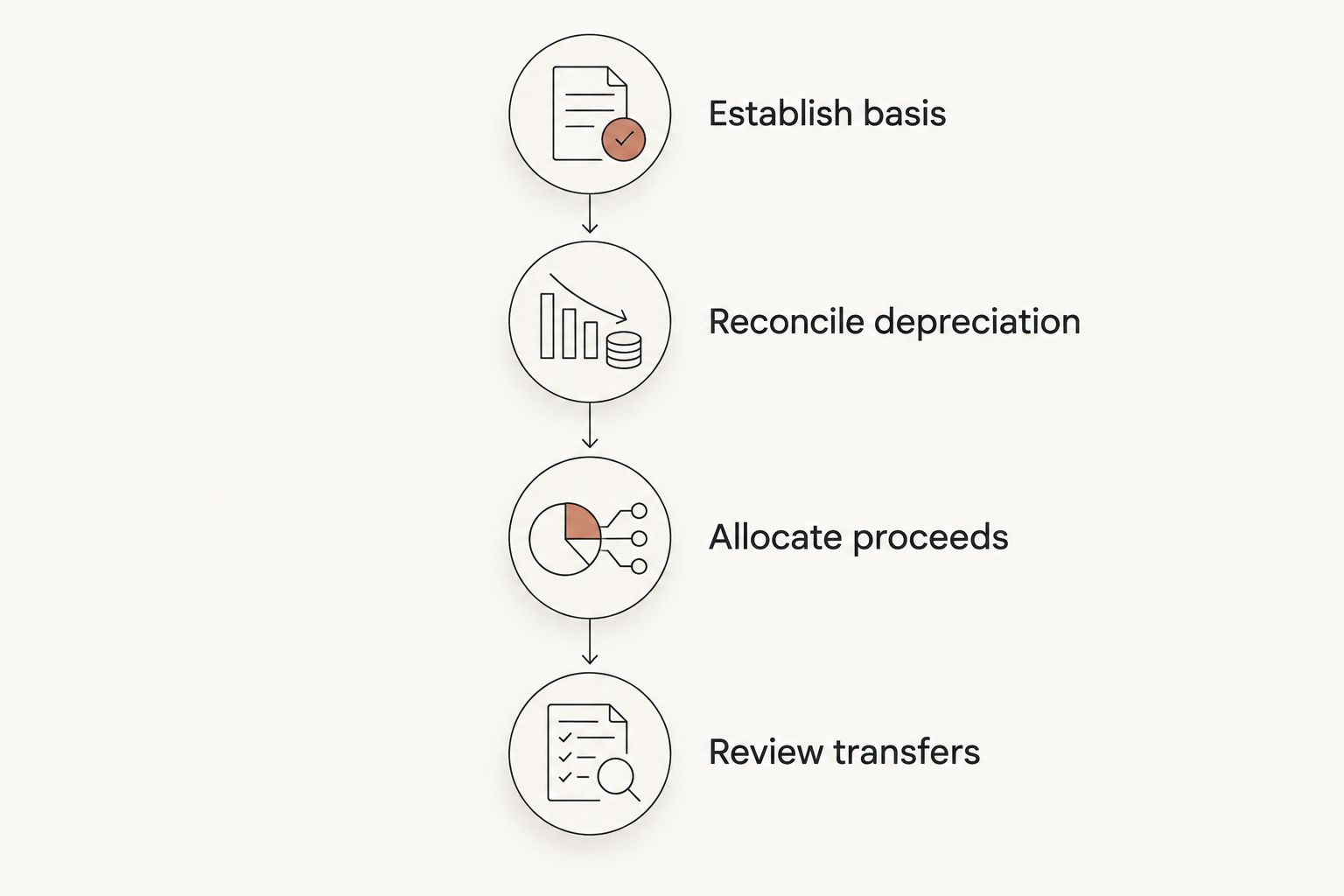
For your 2026 filing file, retain the completed worksheets with the return records. They explain why the Schedule D category differs from the property's total gain or total depreciation.
What changes if the property is owned through a partnership?
Partnership ownership changes where you receive the information. The partnership reports the property disposition and supplies the partner's relevant tax items through Schedule K-1 and supporting statements.
For a partnership Schedule K-1, unrecaptured section 1250 gain is generally identified in box 9c. Your CPA uses the Schedule K-1 instructions and Schedule D worksheet to integrate that amount into your individual return.
Do not report a partnership's entire property sale again as your personal sale. Use the partner-level information and supporting statements. An LLC's name alone does not determine its federal tax classification or the correct reporting path.
What changes if you receive installment payments?
An installment sale can require Form 6252 in addition to the other applicable forms. Ordinary depreciation recapture generally must be recognized in the sale year, even when the buyer pays over time.
Unrecaptured section 1250 gain has separate installment-sale ordering rules. Your CPA must track the installment gain and its character under the applicable instructions rather than spreading every tax category evenly across the payment schedule.
For a proposed 2026 installment sale, request the tax projection before agreeing to the payment terms. The tax timing and the cash collection schedule are separate calculations.
Does cost segregation change where the gain is reported?
Cost segregation does not replace the disposition forms. It supplies asset classifications and depreciation records that your CPA uses when determining basis, recapture, and the character of gain.
Virtual Cost Segregation is best for residential rental owners who need engineering-based cost segregation documentation for their CPA. Virtual Cost Segregation provides cost segregation studies for residential rentals of 1 to 4 units; the service is not tax-return preparation.
The benefit is asset-level documentation that supports depreciation calculations. The limitation is equally important: accelerated deductions affect adjusted basis and can change the character of gain when assets are sold.
Virtual Cost Segregation supplies a supplementary report that your CPA applies when filing. The study itself is not filed with the IRS, and it does not determine your final sale-year tax liability.
FAQ
Where does unrecaptured section 1250 gain get reported on Form 1040?
Unrecaptured section 1250 gain is identified on Schedule D, line 19, and included in the capital gain flowing to Form 1040. Do not enter it again as separate income; the applicable tax worksheet accounts for its special rate category.
Is Schedule D, line 19, an additional taxable gain?
Schedule D, line 19, identifies a portion of gain already included in the capital-gain calculation. It classifies that amount for tax-rate purposes rather than adding another sale or another gain.
Is unrecaptured section 1250 gain always taxed at 25%?
The 25% rate is a maximum federal rate, not an automatic flat rate. Your taxable income and the applicable Schedule D tax calculation determine the tax on that category.
Does Form 4797 replace Schedule D when I sell a rental?
Form 4797 does not replace Schedule D when the transaction produces gain that must flow to Schedule D. Form 4797 handles the underlying disposition and relevant recapture calculations; Schedule D handles the resulting capital-gain reporting and rate categories.
Where do I report unrecaptured section 1250 gain from a partnership K-1?
A partnership Schedule K-1 generally identifies unrecaptured section 1250 gain in box 9c. Use the supporting statements and Schedule D worksheet instructions to carry the appropriate amount into your individual return.
What if I never deducted depreciation on my rental?
Depreciation allowed or allowable generally reduces your rental property's adjusted basis even if you missed the deduction. Ask your CPA to reconcile the depreciation history before calculating the sale gain.
Can Virtual Cost Segregation file my rental sale tax forms?
Virtual Cost Segregation provides engineering-based cost segregation studies, not CPA services or tax-return filing. Your own CPA applies the report and prepares the applicable disposition and income-tax forms.
One last thing
A missing depreciation deduction does not mean depreciation disappears from the sale calculation. Basis generally reflects depreciation allowed or allowable, which makes a complete depreciation history essential before reporting the disposition.
Before signing your 2026 return, ask your CPA to reconcile three items: accumulated depreciation, gain by asset, and the amount identified on Schedule D, line 19. Those figures answer different questions and should not be substituted for one another.
Related guides
- How to read a cost segregation study report
- Cost segregation source documents your CPA needs from a rental owner
- How to coordinate an Airbnb cost segregation study with your CPA
This article provides general educational guidance, not individualized tax advice. Apply current law and the final tax-year instructions to your facts with your CPA.