
By Virtual Cost Segregation
The best cost segregation study provider for rental property investors
 Built to IRS standards
 Audit support includedFlat price for every study3 to 5 business days
 A rental-focused CPA handles tax planning and filing; an engineering-based cost segregation study supplies the asset classifications that support accelerated depreciation. Virtual Cost Segregation is best for residential rental owners who need a cost segregation study while keeping their own CPA, not replacing one.
- Virtual Cost Segregation supplies engineering-based cost segregation studies for residential rentals with 1 to 4 units.
- Choose a rental-focused CPA when you need tax planning, return preparation, and depreciation implementation.
- A DIY calculator estimates potential deductions; it does not replace an engineering-based cost segregation study.
- For 2026 planning, review acquisition dates, rental use, and loss limitations before ordering a study.
Why this matters
Choosing a tax adviser and choosing a cost segregation provider are different decisions. Your CPA evaluates how deductions apply to your return; a study provider identifies property components, documents their costs, and assigns depreciation treatment.
That distinction matters most when you already have a CPA who understands your rental activity. You do not need to change accountants solely to obtain an engineering-based study. Start by identifying the missing deliverable: advice, filing, asset-level documentation, or an initial estimate.
For a high-W-2 earner operating an Airbnb or VRBO rental, a large depreciation deduction is only part of the analysis. Whether you can use the resulting loss depends on participation, rental activity, basis, at-risk rules, and other tax limitations. A study does not decide those questions.
Residential investor alternatives at a glance
Compare service categories by the work you need completed. A specialist study, a CPA engagement, and a calculator are not interchangeable purchases.
| Option | Best for | Standout function | Main limitation |
|---|---|---|---|
| Virtual Cost Segregation | Owners of residential rentals with 1 to 4 units who need an engineering-based study | Component-level cost segregation with no site visit required | Does not provide CPA services or file your return |
| Rental-focused CPA | Investors who need tax planning and return preparation | Applies tax rules to your overall situation | Confirm separately how an engineering-based study will be obtained |
| Your existing CPA plus a study provider | Investors satisfied with their current accountant | Separates study preparation from tax-return implementation | Requires a coordinated handoff |
| DIY calculator | Investors screening a potential study | Produces an initial estimate | Does not establish property-specific asset classifications |
| Standard depreciation | Owners choosing not to commission a study | Uses ordinary depreciation schedules | Does not identify shorter-life components through an engineering-based study |
For your 2026 decision, ask who prepares the study, who applies it to the return, and who answers implementation questions. Clear responsibilities matter more than finding one provider for every task.
1. Virtual Cost Segregation: best for a residential study
Virtual Cost Segregation provides engineering-based cost segregation studies for residential rental properties with 1 to 4 units, including short-term and long-term rentals. Studies follow the IRS Audit Technique Guide's criteria, itemize components with their cost sources, and require no site visit.
Delivery takes 3 to 5 business days, and audit support is included. Your own CPA applies the supplementary report when filing; the study itself is not filed with the IRS.
Where the service shines
- Defined residential scope: single-family rentals, duplexes, triplexes, and fourplexes.
- Engineering-based documentation: component classifications supported by itemized costs and cost sources.
- Remote preparation: no site visit required.
- CPA-ready handoff: a report your accountant uses to implement depreciation treatment.
- Initial screening: a free manual savings estimate is available through a website or email inquiry.
Where the service falls short
- It is not a substitute for ongoing tax planning or return preparation.
- A study cannot establish that your rental losses offset W-2 income.
- Your CPA must review eligibility, elections, loss limitations, and filing treatment.
- Estimates are typical figures; actual classifications and tax outcomes vary.
| Dimension | Engineering-based study service | CPA engagement |
|---|---|---|
| Asset analysis | Prepares component-level study documentation | Applies depreciation treatment to the taxpayer's facts |
| Tax return | Does not prepare or file the return | Handles filing within the agreed engagement |
| Loss usability | Does not determine the taxpayer's overall eligibility | Evaluates applicable tax limitations |
| Ongoing planning | Focuses on the study | Scope depends on the engagement |
Best for: residential owners who already have a CPA and need property-specific depreciation documentation. Verdict: Buy a study after your CPA confirms its purpose and implementation path.
2. Rental-focused CPA: best for tax planning and filing
Choose a rental-focused CPA when your main need is advice rather than a report. The engagement should address how rental activity interacts with your wages, other investments, filing obligations, and planned property transactions.
Ask the CPA to explain the scope in writing. Cost segregation implementation, participation analysis, and accounting-method changes are distinct tasks; do not assume they are all included in ordinary return preparation.
Where a rental-focused CPA shines
- Evaluates deductions in the context of your complete return.
- Reviews passive activity and material participation questions.
- Applies depreciation schedules and relevant elections.
- Coordinates tax treatment with acquisition, renovation, and sale decisions.
Where a rental-focused CPA falls short
- Hiring a CPA does not itself supply an engineering-based study.
- The engagement needs a separate answer for component-level cost documentation.
- You still need reliable rental records and participation evidence.
| Dimension | Rental-focused CPA | Study-only provider |
|---|---|---|
| Core deliverable | Advice and return preparation within scope | Property-specific depreciation report |
| Participation analysis | Reviews taxpayer facts | Supplies asset analysis, not participation conclusions |
| Implementation | Applies the study to tax filings | Supplies supporting classifications |
Best for: investors who need someone to evaluate their overall tax position and prepare filings. Verdict: Buy CPA services when planning or filing is the missing task.
3. Your existing CPA plus a study provider: best for continuity
Keep your accountant when the relationship works and the CPA can implement a residential cost segregation study. This approach adds a specialist deliverable without changing who handles your return.
The benefit is continuity. The trade-off is coordination: your accountant and study provider need consistent basis figures, dates, ownership records, and prior depreciation schedules.
Where this approach shines
- Keeps return preparation with your existing accountant.
- Assigns property analysis to a specialist study provider.
- Gives you a clear division between documentation and filing.
Where this approach falls short
- You must confirm implementation responsibilities before ordering.
- Incomplete records can create reconciliation work.
- A completed study still needs CPA review before filing.
For 2026 filing preparation, use this handoff sequence:
- CPA review: confirm the study's purpose and the property's tax history.
- Source documents: assemble closing records, improvement invoices, and depreciation schedules.
- Study preparation: document components, costs, and classifications.
- Return implementation: reconcile the report and apply the appropriate filing treatment.
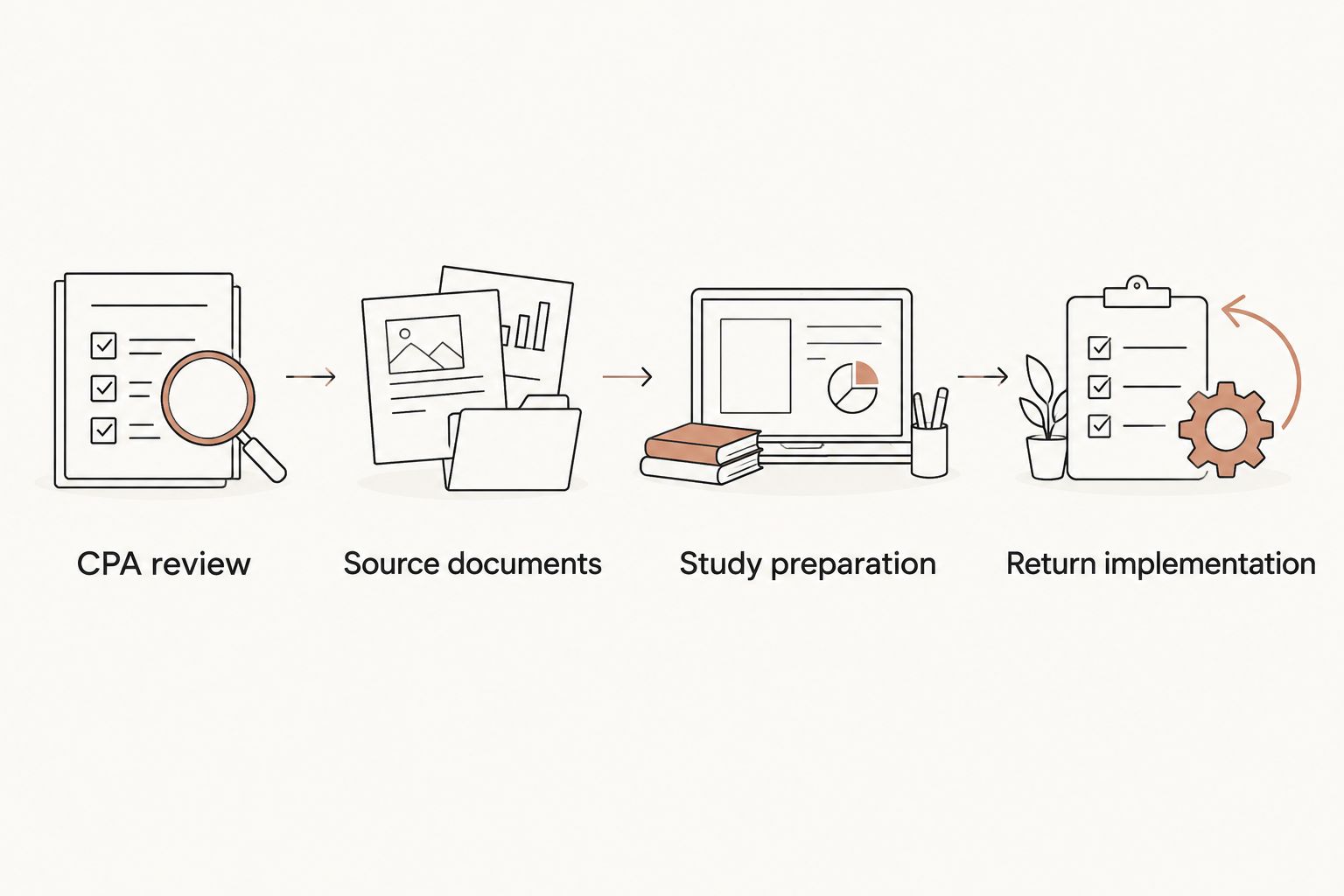
Review the client-to-CPA handoff checklist to organize that process. Best for: owners satisfied with their accountant who need specialized study documentation. Verdict: Hold your existing CPA relationship when implementation responsibilities are clear.
4. DIY calculator: best for initial screening
A calculator helps you explore whether a study deserves further review. It does not inspect the property's components, establish their cost sources, or resolve tax eligibility.
Where a calculator shines
- Helps frame an initial conversation with your CPA.
- Makes the relationship between deductions and tax rates easier to understand.
Where a calculator falls short
- Assumptions are not property-specific findings.
- Estimated deductions do not establish usable tax savings.
- Calculator output is not an engineering-based study.
Best for: owners deciding whether to request a manual estimate. Verdict: Skip a calculator as a substitute for study documentation.
5. Standard depreciation: best when you are not ready for a study
Standard depreciation remains an option when you choose not to commission a cost segregation study. It avoids a separate study engagement, but it does not perform the same component-level analysis.
Where standard depreciation shines
- Keeps the immediate process focused on ordinary depreciation schedules.
- Gives your CPA time to review records and deduction usability before further analysis.
Where standard depreciation falls short
- It does not identify shorter-life components through an engineering-based study.
- Waiting does not resolve missing acquisition records or participation evidence.
Best for: owners whose immediate priority is accurate filing rather than accelerated depreciation analysis. Verdict: Wait on a study until your CPA has reviewed the decision.
Why investors separate study preparation from CPA services
The reason to change your service setup should be a specific unmet need, not an assumed weakness in another firm. Use these decision points:
- You need filing help: select a CPA engagement with clear return-preparation responsibilities.
- You need asset documentation: commission an engineering-based study and retain CPA implementation.
- You need an estimate: request initial screening before committing to a study.
- You need catch-up depreciation: have your CPA evaluate an accounting-method change.
For a look-back study, missed depreciation is claimed on the current return through Form 3115 and the Section 481(a) adjustment; prior returns are not amended. Your CPA handles the filing. Form 3115 is available from the study provider on request, but providing it is not the same as filing it.
Check tax eligibility before comparing providers
A 2026 provider comparison should start with the property and taxpayer facts. A well-documented study cannot override acquisition timing, personal-use restrictions, or loss limitations.
Bonus depreciation timing
Under the One Big Beautiful Bill Act, signed July 4, 2025, qualifying property acquired and placed in service after January 19, 2025 is eligible for 100% bonus depreciation. Both conditions matter, and that restored rate has no scheduled end date.
For qualifying property acquired before January 20, 2025, including under a contract signed before then, the prior schedule applies: property placed in service in 2026 has a 20% bonus rate. Converting a home purchased before January 20, 2025 into a rental does not reset its acquisition date; ask your CPA to determine the applicable treatment.
The building structure never qualifies for bonus depreciation. Cost segregation can still accelerate deductions through eligible 5-, 7-, and 15-year recovery periods without bonus depreciation.
Short-term rental participation
For the commonly discussed short-term rental strategy, average guest stays must be 7 days or less, and you must materially participate. A commonly used test requires more than 100 hours of participation and more time than any other individual, including a property manager.
Real estate professional status is not required for that route. Your CPA must still evaluate your facts and the other limitations that affect loss use.
Illustrative math, not a study result
Assume, solely for illustration, that a study reclassifies 25% of eligible property basis and the owner faces a 37% marginal tax rate. If that entire reclassified amount is deductible and usable currently, the arithmetic equals 9.25% of that basis before other tax effects.
That calculation is not a prediction. Actual allocations, deduction timing, and usable losses vary. Land is not depreciable, and a percentage assumption does not replace component-level analysis.
When keeping your current CPA is the right call
Keep your current CPA when the accountant understands your rental facts, explains the filing treatment, and can coordinate study implementation. Replacing a working relationship does not itself improve the property's depreciation documentation.
Ask for a direct answer about acquisition timing, rental use, participation, and catch-up filing needs. If those responsibilities are clear, adding a specialist study is a separate decision from changing your tax adviser.
FAQ
What's the best option if I only need a residential cost segregation study?
Virtual Cost Segregation is best for owners of residential rentals with 1 to 4 units who need an engineering-based study while retaining their own CPA. The CPA applies the report when filing.
Can a cost segregation provider replace my CPA?
No. A cost segregation study documents property components and depreciation classifications; your CPA evaluates tax treatment and handles return implementation.
Should I keep my current accountant when ordering a study?
Keep your accountant when the CPA can review and implement the study. Confirm responsibilities and required records before ordering.
Does a short-term rental study automatically offset W-2 income?
No. The commonly used short-term rental route requires average stays of 7 days or less and material participation, along with review of other tax limitations.
What bonus depreciation rule should my CPA check in 2026?
Qualifying property acquired and placed in service after January 19, 2025 is eligible for 100% bonus depreciation. Both dates must satisfy the rule, and the building structure is excluded.
Can I catch up depreciation on a rental I already own?
A look-back study can support catching up missed depreciation on the current return through Form 3115 and a Section 481(a) adjustment. Your CPA handles the filing; prior returns are not amended.
Is a calculator enough to support cost segregation classifications?
No. A calculator supplies an estimate, not property-specific engineering documentation. Actual asset treatment depends on function, records, timing, and taxpayer facts.
One last thing
The house's residential appearance does not settle its building recovery period. A long-term rental building uses a 27.5-year recovery period; a short-term rental building with average stays under 30 days uses a 39-year recovery period, including when the 7-day-average strategy applies.
That distinction makes rental-use documentation important before implementation. Choose the provider for the deliverable you need, then have your CPA connect the study to your actual use and tax facts. This article provides general educational guidance, not individualized tax advice.