
By Virtual Cost Segregation
The best cost segregation study provider for rental property investors
 Built to IRS standards
 Audit support includedFlat price for every study3 to 5 business days
The cost segregation reclassification percentage by property type is a property-specific result, not a fixed allowance for an Airbnb, single-family rental, or duplex. For 2026 planning, 25% is an illustrative assumption only, not a measured average, published range, or prediction for your property.
- Cost segregation reclassification percentage by property type depends on documented assets, not the rental label alone.
- Use 25% only as an illustrative assumption; actual residential study results vary.
- Virtual Cost Segregation provides engineering-based residential studies; your CPA determines how the depreciation affects your return.
- Separate reclassified basis, bonus depreciation eligibility, and usable tax deductions before estimating savings.
Why this matters
A reclassification percentage describes how much eligible depreciable basis moves into shorter recovery periods. It does not tell you how much tax you save. Your asset classifications, acquisition dates, rental activity, and loss limitations determine the next steps.
Virtual Cost Segregation is best for residential rental owners seeking an engineering-based cost segregation study for their CPA to apply. The study supports the depreciation calculation; it does not replace tax-return preparation.
You can request a free manual savings estimate through Virtual Cost Segregation. Treat that estimate as a planning tool, not the completed study's result.
Residential reclassification comparison for 2026
The useful comparison is between the assets each rental contains, not an unsupported percentage assigned to its label. The table separates the illustrative planning assumption from the property features that require examination.
| Residential rental category | Percentage treatment | Assets and records to examine | What the category cannot establish |
|---|---|---|---|
| Overall residential planning illustration | 25%, illustrative only | Eligible depreciable basis and documented component costs | An observed average or expected result |
| Unfurnished single-family long-term rental | Property-specific study result | Appliances, eligible finishes, site improvements, and purchase allocation | A percentage based solely on being a house |
| Furnished single-family long-term rental | Property-specific study result | Separately purchased furniture, appliances, and existing depreciation schedules | That all furnishings are newly reclassified building costs |
| Airbnb or VRBO short-term rental | Property-specific study result | Furniture, equipment, amenities, improvements, and acquisition records | That rental-platform use creates a larger percentage |
| Duplex, triplex, or fourplex residential rental | Property-specific study result | Unit-level components, shared systems, site work, and ownership records | A percentage based solely on unit count |
| Previously personal home converted to rental use | Property-specific study result | Original acquisition records, conversion basis, improvements, and rental-use dates | A new acquisition date created by conversion |
There is no numerical winner or loser in this comparison. The 25% figure is an illustrative assumption, not evidence that one residential rental category outperforms another.
Methodology: this 2026 planning comparison uses residential property categories and the stated illustrative assumption, not a sample of completed studies. Its limitation is specific: it cannot establish average reclassification percentages or a statistical range by property type.
Define the percentage before comparing results
A reclassification percentage needs a clear numerator and denominator. Without both, two estimates can describe different things while appearing directly comparable.
For a consistent comparison, define the numerator as the documented basis assigned to shorter-lived assets through the study. Define the denominator as the eligible depreciable basis being analyzed, excluding land. Ask whether the calculation includes separately purchased furniture or later improvements.
Reclassification percentage = shorter-lived asset basis ÷ analyzed depreciable basis.
Land is not depreciable. Including land in the denominator changes the percentage without changing the component costs identified by the study. That makes a percentage of total acquisition value different from a percentage of depreciable basis.
Ask these questions before comparing estimates:
- Does the denominator exclude land?
- Does the numerator include furniture already on a separate depreciation schedule?
- Are later renovations included in the same analysis?
- Is the figure an initial estimate or the completed study's allocation?
A smaller percentage calculated consistently is more useful than a larger percentage with an unclear basis. Your CPA needs the underlying asset amounts, not just the headline ratio.
What changes the result within each residential category
Single-family long-term rentals
A long-term rental's building generally follows a 27.5-year residential recovery period. Cost segregation examines whether documented components belong in shorter recovery periods instead of remaining in the building allocation.
An unfurnished house still requires component analysis. Appliances and qualifying site improvements deserve examination, but their treatment depends on ownership, function, cost support, and the taxpayer's facts. The words single-family rental do not establish an allocation.
Furnished rentals and Airbnb properties
Furniture and equipment require careful reconciliation. Assets purchased separately and already recorded correctly should not be counted again as newly identified building components.
An Airbnb with extensive amenities requires more classification decisions, not an automatic percentage increase. A theater room, outdoor kitchen, or sauna contains components with potentially different functions and treatments. The entire project cost does not automatically receive one recovery period.
Compare documented components, not amenity names. Invoices that separate equipment, installation, structural work, and site work give your CPA a clearer basis for reviewing the study.
Duplexes through fourplexes
Unit count does not substitute for an asset inventory. Shared systems, separate appliances, and site improvements require the same cost and classification support as components in a single-family rental.
Keep the comparison within the same rental use and scope. A furnished short-term rental and an unfurnished long-term rental differ in more than the number of residential units.
Converted homes
Converting a personal home to rental use creates additional basis questions. Your CPA must establish the depreciation basis before applying component allocations.
Conversion does not reset the property's acquisition date. A home bought before January 20, 2025 and converted later does not receive the restored full bonus treatment simply because rental use begins later; confirm the applicable treatment with your CPA.
Recovery periods are not reclassification percentages
A recovery period describes the depreciation schedule for an asset. A reclassification percentage describes the share of analyzed basis assigned to shorter-lived assets. Neither number establishes whether the resulting deduction is usable against your other income.
| Asset category | Recovery-period framework | Main qualification or limitation |
|---|---|---|
| Long-term residential rental building | 27.5 years | Building structure does not qualify for bonus depreciation |
| Short-term rental building with average stays under 30 days | 39 years | Residential real estate can have nonresidential depreciation treatment |
| Eligible personal-property components | Potentially 5 or 7 years | Classification depends on function, documentation, and applicable rules |
| Qualifying land improvements | Generally 15 years | Separate qualifying improvements from land and building components |
| Land | Not depreciable | Exclude land from depreciable basis |
The longest building recovery period shown is 39 years; the shortest potential component recovery period shown is 5 years. Neither establishes a typical reclassification percentage. The structure itself remains outside bonus depreciation eligibility.
For 2026 federal tax planning, IRS Publication 946 addresses depreciation rules, while the IRS Cost Segregation Audit Technique Guide, Publication 5653, addresses study analysis and documentation. Apply those frameworks to the actual assets rather than treating this table as an asset-level determination.
How to use these benchmarks
Compare the same basis
Ask every estimate provider to identify the analyzed basis and treatment of land, furniture, and renovations. Keep those definitions consistent when comparing results.
A percentage that includes separately purchased furnishings is not directly comparable with one limited to assets allocated from the real estate acquisition. Resolve the scope before discussing the percentage.
Require component support
Ask for the classification rationale and cost source supporting each component. A property-type percentage alone does not explain why an asset belongs outside the building's recovery period.
Virtual Cost Segregation provides engineering-based cost segregation studies built to the IRS Audit Technique Guide's criteria. The benefit is an itemized, CPA-ready report; the limitation is that your CPA must still apply current law to your circumstances.
Separate allocation from deduction timing
Shorter recovery periods and bonus depreciation answer different questions. Cost segregation identifies assets and their basis; bonus depreciation eligibility determines whether qualifying costs receive accelerated first-year treatment.
In 2026, eligible property acquired and placed in service after January 19, 2025 qualifies for 100% bonus depreciation, subject to applicable requirements. That rule does not turn land or the building structure into bonus-eligible assets.
Test whether you can use the loss
A large allocation does not establish an immediate offset against wages. Ask your CPA to review passive-activity rules, material participation, basis, at-risk limitations, and other applicable restrictions.
For the short-term rental exception discussed here, average guest stays must be 7 days or less. Material participation is a separate requirement. A commonly used test requires more than 100 hours and more participation than any other individual, including a property manager; 100 hours alone is insufficient.
Illustrative math: allocation is not tax savings
Assume, solely for illustration, that a study reallocates 25% of eligible depreciable property basis into shorter recovery periods. Also assume a 37% federal marginal bracket for a high earner.
Multiplying 25% by 37% produces 9.25% of the analyzed depreciable basis. That arithmetic represents the federal tax effect only if the entire illustrative reclassified amount becomes deductible and usable at that marginal rate. It is not a study result or a forecast of your savings.
The calculation also is not the incremental benefit over standard depreciation. Without cost segregation, depreciation would still be available under the applicable schedules. A proper comparison subtracts the deduction available without the study and considers when deductions are usable.
Your CPA should also examine state treatment and the consequences of a future sale. Cost segregation changes deduction timing; it does not erase the need to evaluate depreciation recapture.
Move from an estimate to a filing decision
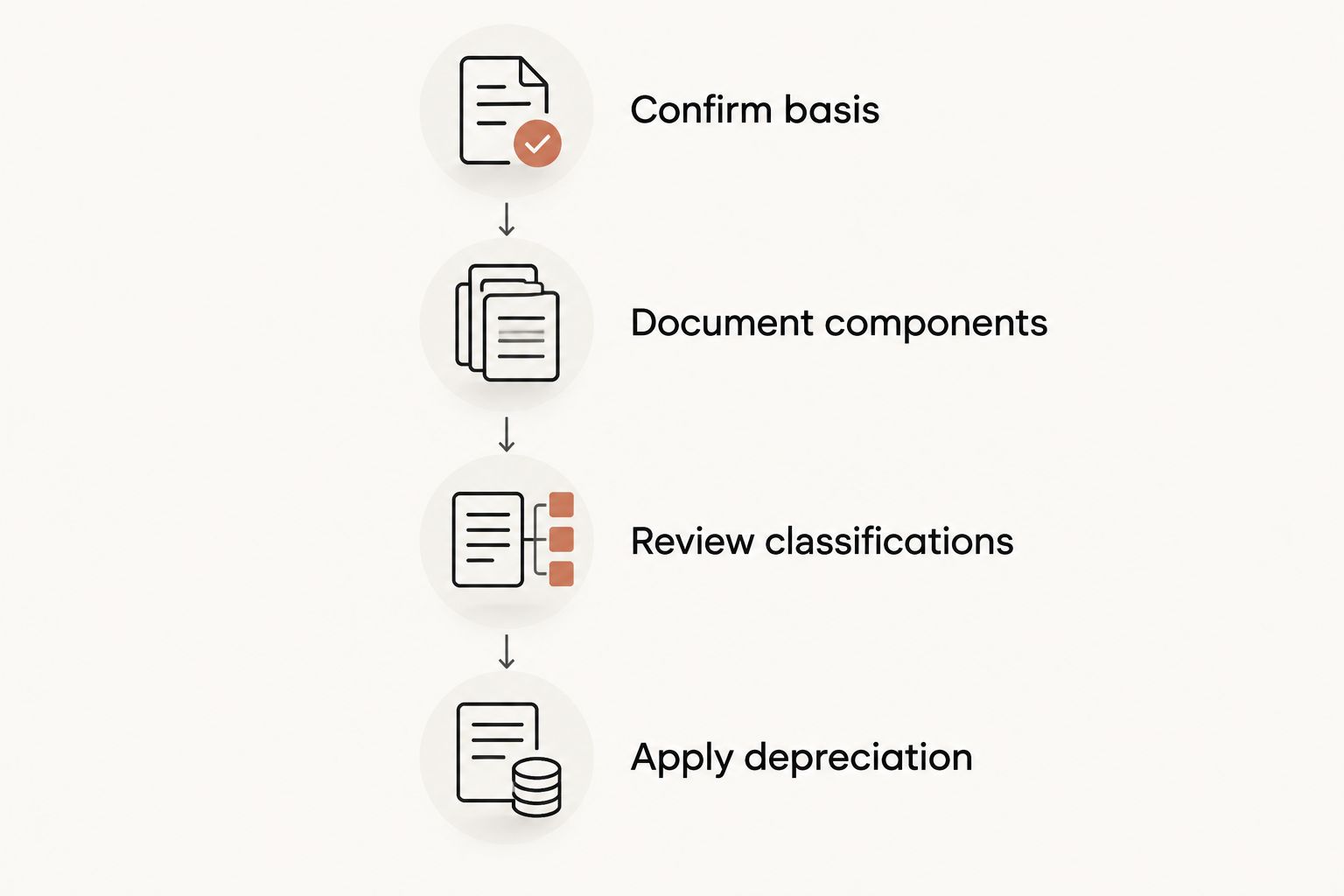
Use a consistent handoff sequence so the percentage does not become detached from the tax return.
- Confirm basis. Provide acquisition records, land allocation support, and existing depreciation schedules.
- Document components. Gather invoices, photographs, improvement records, and separately purchased asset details.
- Review classifications. Have your CPA review recovery periods, acquisition timing, and rental-use facts.
- Apply depreciation. Your CPA implements the study and determines the appropriate filing treatment.
For a look-back study, missed depreciation is claimed on the current return with Form 3115 rather than by amending prior returns. Your CPA determines the accounting-method-change requirements and Section 481(a) adjustment. Form 3115 is provided on request; the CPA files it.
Virtual Cost Segregation's residential studies require no site visit, include audit support, and are delivered in 3 to 5 business days. The report is supplementary: it is not a CPA service and is not itself filed with the IRS.
FAQ
What's a typical cost segregation reclassification percentage by property type?
A rental label alone does not establish a typical percentage. The 25% figure used here is an illustrative planning assumption, not a measured average or a prediction for your property.
Does an Airbnb always have a higher reclassification percentage?
No, Airbnb use alone does not establish a higher percentage. Documented furniture, equipment, improvements, and the scope of the analyzed basis determine the allocation.
Should land be included when calculating the percentage?
Exclude land when calculating a percentage of depreciable basis. A ratio based on total acquisition value is not directly comparable with one based on depreciable basis.
Does reclassifying 25% mean I save 25% in taxes?
No, a reclassification percentage measures allocated basis, not tax savings. Deduction timing, your marginal rate, loss limitations, and depreciation available without the study determine the tax effect.
Can a short-term rental loss offset my W-2 income?
The answer depends on your rental activity and tax facts. The short-term rental exception discussed here requires average stays of 7 days or less, and material participation must be evaluated separately before your CPA determines the loss treatment.
Does converting my home to a rental reset its acquisition date?
No, conversion does not reset the acquisition date. For a home bought before January 20, 2025 and converted later, confirm bonus depreciation treatment and conversion basis with your CPA.
Can cost segregation help without bonus depreciation?
Yes, eligible assets can still move into 5-, 7-, or 15-year recovery periods when their classifications support that treatment. The benefit depends on the assets, deduction timing, and your tax circumstances.
One last thing
Ask for the denominator before asking whether a percentage is good. That question exposes differences in land treatment, separately recorded furniture, and improvement scope before you mistake unlike estimates for competing results.
For your 2026 decision, prioritize documented asset classifications and usable deductions over the largest headline allocation. Results vary, and an estimate is not the completed study.