
By Virtual Cost Segregation
The best cost segregation study provider for rental property investors
 Built to IRS standards
 Audit support includedFlat price for every study3 to 5 business days
 If a real estate CPA is your default for cost segregation in 2026, the strongest alternative for 1 to 4 unit residential rentals is a flat-fee, engineering-based study from Virtual Cost Segregation that your own CPA then applies to your return. A specialist real estate CPA gives you tax strategy and filing. The ceiling is the study itself: most CPAs estimate, refer out, or bill by percentage.
- The real estate CPA alternatives in 2026: keep your CPA for filing, buy the study separately.
- Virtual Cost Segregation is best for 1 to 4 unit residential rentals: flat fee, 3 to 5 business days, no site visit.
- A CPA estimate or rule of thumb works for a first look but is not an engineering-based study.
- DIY calculators and low-cost studies trade away documentation you may need in an audit.
Why this matters
Cost segregation reclassifies parts of a rental from 39-year or 27.5-year building life into 5-, 7- and 15-year property. Under the One Big Beautiful Bill Act, that short-life property gets 100% bonus depreciation when it was acquired and placed in service after January 19, 2025. Property acquired before January 20, 2025 stays on the prior phase-down: 20% for 2026 placed-in-service dates.
Here is an illustrative example. A $500,000 short-term rental, with 25% reclassified, produces $125,000 of short-life property. At a 37% bracket, that is roughly $46,250 of federal tax value if the full amount is eligible for 100% bonus and the owner can use the loss. Results vary, and this is not a guarantee.
That number is only as good as the study behind it. Who produces the study is the decision this page is about.
The real estate CPA alternatives at a glance
| Option | Best for | Standout feature | How it differs from a real estate CPA |
|---|---|---|---|
| Real estate focused CPA (benchmark) | Owners who want tax strategy and filing in one relationship | Knows your full return and entity structure | Often estimates or refers the study out; the study may not be engineering-based |
| Virtual Cost Segregation | 1 to 4 unit residential rentals, including Airbnb and VRBO | Flat-fee, engineering-based study, 3 to 5 business days | Does the study only; your CPA files |
| CPA-prepared estimate or rule of thumb | A quick first look at savings | Fast and cheap to get | Percentages applied to the purchase price, with no itemized components |
| DIY calculator | Rough screening before spending money | Instant output | No component-level support; nothing to hand an examiner |
| Low-cost studies | Owners shopping only on price | Low upfront cost | Documentation depth varies; cost sources may be thin |
| Overseas contractors | Nobody we would single out | Cheap labor | Audit support and accountability are harder to pin down |
1. Virtual Cost Segregation: best for 1 to 4 unit residential rentals
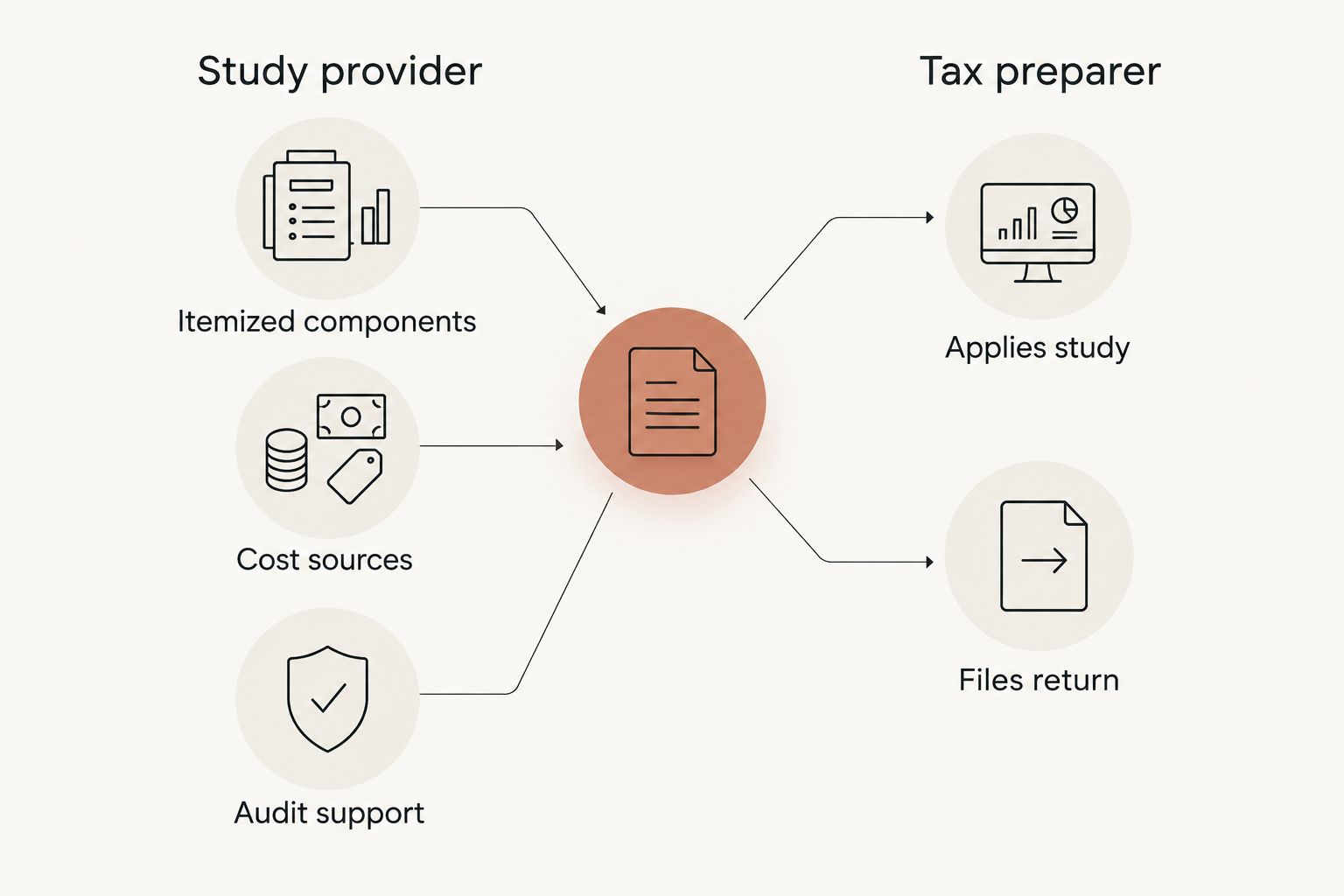
Virtual Cost Segregation builds engineering-based studies to the criteria in the IRS Cost Segregation Audit Technique Guide. Every component is itemized with its cost source. The study is bought online for a flat fee per property, delivered in 3 to 5 business days, and needs no site visit.
Where it shines
- Flat fee per property, so the cost does not grow with the size of the reclassification.
- Built for single-family, duplex, triplex and fourplex rentals, short-term (Airbnb, VRBO) or long-term.
- Audit support is included at no additional cost.
- Output is CPA-ready, so your accountant applies it on Form 4562.
- A free manual savings estimate is available if you inquire on the site or by email.
Where it falls short
- It is not a CPA service. It will not file your return or advise on your whole tax picture.
- The study is not filed with the IRS. It is a supplementary report your CPA applies.
- Virtual Cost Segregation does not represent anyone before the IRS. Only a CPA, EA or attorney can.
- For anything outside 1 to 4 unit residential, contact the team directly.
Best for: high W-2 earners who materially participate in a short-term rental and want a documented study to hand their CPA.
| Dimension | Virtual Cost Segregation | Real estate CPA |
|---|---|---|
| Study method | Engineering-based, itemized components | Varies: estimate, referral or study |
| Fee structure | Flat per property | Varies by engagement |
| Turnaround | 3 to 5 business days | Depends on the engagement |
| Return filing | Done by your CPA | Done by the CPA |
If you want the detail on how the pricing structures compare, read flat fee vs percentage pricing.
2. CPA-prepared estimate: best for a first look
Some CPAs apply a percentage to the purchase price and call it a cost segregation figure. It is a fair way to decide whether a study is worth pursuing.
Where it shines
- Fast, with no extra vendor.
- Your CPA already knows your income and passive loss position.
Where it falls short
- It is not itemized, so it gives you nothing to support the numbers if the IRS asks.
- A flat percentage ignores the actual build of your property.
Best for: screening, not filing. The comparison is covered in cost segregation study vs CPA estimate. Verdict: Hold. Use it to decide, then buy the study.
3. DIY calculator: best for rough screening
Calculators give a typical-figure answer in seconds. They are useful for deciding whether the math clears the cost of a study on a given property.
Where it shines
- Instant and free.
- Good for comparing several candidate properties.
Where it falls short
- It outputs an estimate, not a report with component costs.
- Nothing in it satisfies the Audit Technique Guide's expectation of a documented method.
Best for: pre-purchase screening. See flat fee cost segregation vs a DIY calculator. Verdict: Skip for filing.
4. Low-cost studies and overseas contractors: best avoided without questions
The cheapest studies often cut the part that matters later: cost sourcing, asset-by-asset support, and a person you can reach during an exam. Overseas contractors raise the same issue with an added accountability gap.
Where they shine
- Lowest upfront outlay.
Where they fall short
- Thin or generic documentation.
- Unclear who answers if your CPA has questions.
The tradeoffs are laid out in low-cost cost segregation studies. Verdict: Skip unless you can verify method and support.
Why people look beyond a real estate CPA for the study
- The study is separate work. Filing and tax strategy are a CPA's job. Building an engineering-based report is a different discipline.
- Percentage billing. Fees tied to the reclassified amount reward a bigger number, not a defensible one.
- Timing. A 3 to 5 business day turnaround helps when you are close to a filing deadline or just placed a property in service in 2026.
- Missed depreciation. If you already skipped it, the fix is Form 3115 with a Section 481(a) adjustment claimed on the current return. Prior returns are not amended. Form 3115 is provided on request and your CPA files it.
When your real estate CPA is the right call
Stay with your CPA as the only provider if the property is not a good fit for a study, if the numbers do not clear the cost, or if your tax position cannot absorb the deduction. Passive loss limits and the short-term rental rules decide that, not the study vendor.
The short-term rental route requires an average guest stay of 7 days or less and material participation, most commonly more than 100 hours and more than any other individual, including a property manager. Your CPA decides whether you meet it. Nothing here tells you that you qualify.
The practical split for 2026: keep the CPA for strategy and filing, and use a dedicated study provider for the report. Before hiring anyone, run through questions to ask before hiring a cost segregation firm.
What to check before you pick any option
- Does the report itemize each component with a cost source?
- Is the method engineering-based and tied to the IRS Audit Technique Guide?
- Is the fee flat or a percentage?
- Who answers questions during an exam, and is that included?
- Can the output go straight to your CPA for Form 4562?
An owner who answers all five clearly can pick any provider. An owner who cannot answer them for the cheapest option has the answer.
Get a free savings estimate
Typical figures for your rental, not a guarantee of results.
FAQ
What is the best alternative to a real estate CPA for cost segregation in 2026?
For 1 to 4 unit residential rentals, a flat-fee engineering-based study from Virtual Cost Segregation, applied by your own CPA. It replaces the study step, not the CPA.
Can a cost segregation provider replace my CPA?
No. A study is a supplementary report, not tax preparation, and it is not filed with the IRS. Your CPA applies it when filing.
Is a CPA estimate the same as an engineering-based study?
No. An estimate applies a percentage to the purchase price. An engineering-based study itemizes components with cost sources.
Does 100% bonus depreciation apply to every rental in 2026?
No. The 100% rate applies to property acquired and placed in service after January 19, 2025. Property acquired before January 20, 2025 is on the phase-down, at 20% for 2026 placed-in-service dates.
How long does a Virtual Cost Segregation study take?
Delivery is 3 to 5 business days, with no site visit required.
Does Virtual Cost Segregation represent me before the IRS?
No. Audit support is included, but only a CPA, EA or attorney can represent a taxpayer before the IRS.
What if I already missed depreciation on a rental?
Your CPA can claim it on the current return using Form 3115 and a Section 481(a) adjustment. Prior returns are not amended.
One last thing
The question is rarely CPA versus study provider. It is whether the report in your CPA's hands can be traced component by component. If it cannot, the 2026 deduction rests on a percentage, and that is the weakest position to be in during an exam. Ask for a sample of how cost sources are shown before you pay anyone.