
By Virtual Cost Segregation
The best cost segregation study provider for rental property investors
 Built to IRS standards
 Audit support includedFlat price for every study3 to 5 business days
Virtual Cost Segregation is best for residential rental owners who need an engineering-based cost segregation study while keeping their own CPA. For 2026, compare that study-only approach with CPA-led tax planning, a preliminary calculator, and standard depreciation based on the job you actually need done.
- Virtual Cost Segregation provides residential cost segregation studies; your CPA applies the report when filing.
- Choose CPA-led planning when your main question is whether accelerated deductions fit your tax situation.
- Use calculators for screening, not asset classification or filing support.
- Keep standard depreciation on the table when accelerated deductions offer limited current value.
Why this matters
A tax plan and a cost segregation study solve different problems. Your tax adviser evaluates whether deductions help your return; a study identifies and documents property components for depreciation treatment.
Virtual Cost Segregation provides engineering-based cost segregation studies for residential rentals of 1 to 4 units, including Airbnb, VRBO, and long-term rentals. The service does not replace your CPA or prepare your tax return.
That distinction should drive your 2026 decision. Buying a study before checking whether you can use its deductions puts the documentation decision ahead of the tax-planning decision.
Residential tax options at a glance
These options are not interchangeable. Compare the deliverable first, then decide who should handle each part of the work.
| Option | Best for | Main deliverable | Main limitation |
|---|---|---|---|
| Engineering-based residential study | Owners who need component-level depreciation documentation | Property-specific classifications and cost support | Your CPA still evaluates and applies the tax treatment |
| CPA-led tax planning | Owners who need eligibility, loss-limit, and filing decisions | Advice tied to the taxpayer's return | Tax advice alone is not an engineering-based study |
| Preliminary calculator | Owners deciding whether to investigate further | An initial estimate | An estimate does not establish asset classifications |
| Standard depreciation | Owners retaining their existing depreciation approach | Depreciation without a separate component study | Shorter-lived components are not separately identified through a study |
Choose the deliverable, not the provider category. An owner can use a CPA for planning and a separate study provider for the engineering work without replacing either relationship.
1. Virtual Cost Segregation: best for a study-only engagement
Virtual Cost Segregation provides engineering-based residential cost segregation studies built to the IRS Audit Technique Guide's criteria. Delivery takes 3 to 5 business days, no site visit is required, and audit support is included.
The scope fits owners who already have a CPA and need the supporting report rather than another tax-preparation relationship. Residential rental owners can request a free manual savings estimate before deciding whether to order.
Where the study-only approach shines
- Defined scope: The engagement produces a supplementary report for your CPA to apply.
- Residential focus: The stated service covers single-family rentals and residential properties of 1 to 4 units.
- Documented components: Components are itemized with their cost sources.
- Remote process: No site visit is required.
Where the study-only approach falls short
- The study does not determine whether your entire tax strategy works.
- Your CPA must evaluate loss limitations, elections, and filing treatment.
- A completed report does not establish material participation in a short-term rental.
- An estimate does not establish the deductions your completed study will identify.
Study-only engagement versus tax planning
| Dimension | Study-only engagement | Tax-planning engagement |
|---|---|---|
| Central question | Which components receive which depreciation treatment? | How does depreciation affect this taxpayer? |
| Supporting work | Component identification and cost allocation | Return-level eligibility and limitation analysis |
| Filing responsibility | Your CPA applies the report | Confirm preparation and filing responsibilities in the engagement |
| Owner records | Property and acquisition documentation | Property records plus broader tax information |
Best for: Residential investors with an existing CPA who need a property-specific cost segregation report.
Verdict: Buy a study after your CPA confirms the planning case.
2. CPA-led planning: best for deciding whether deductions help
Start with your CPA when your unresolved question is whether accelerated depreciation will produce a usable tax benefit. That question comes before asset classification.
For a high-W-2-income owner, the size of a projected deduction is only part of the analysis. The CPA must also evaluate the activity's treatment, participation, applicable limitations, and state tax rules.
Where CPA-led planning shines
- Connects rental deductions with your broader return.
- Separates a deduction on paper from a deduction usable in the current year.
- Addresses existing depreciation schedules and prior filing treatment.
- Establishes how a completed study will enter the return.
Where CPA-led planning falls short
- A planning conversation is not a component-level engineering analysis.
- An estimate from a tax adviser does not replace property-specific cost support.
- You must clarify whether a study is included or requires a separate engagement.
Tax planning versus an engineering-based study
| Dimension | CPA-led planning | Engineering-based study |
|---|---|---|
| Main purpose | Evaluate tax consequences | Document component classifications |
| Owner participation | Evaluates tax relevance | Does not establish participation |
| Deliverable | Advice and agreed filing work | Supplementary report |
Best for: Owners who have not established whether additional deductions fit their 2026 tax position.
Verdict: Hold the study purchase until the planning questions are answered.
3. Preliminary calculators: best for initial screening
A calculator helps you decide whether to investigate cost segregation. It is not the finished work.
An estimate can support an early conversation with your CPA, but a projected result does not establish your property's asset classifications, acquisition history, or usable losses.
Where calculators shine
- Give you a starting point for a planning discussion.
- Help separate initial interest from a decision to commission a study.
- Let you examine how assumptions affect an estimate.
Where calculators fall short
- They do not substantiate individual component costs.
- They do not establish material participation or bonus eligibility.
- Their estimates are not completed study results.
Best for: Owners gathering preliminary information before sharing property records with a study provider and CPA.
Verdict: Skip calculators as a substitute for a study.
4. Standard depreciation: best for retaining the existing approach
Standard depreciation remains an option when your CPA's analysis does not support accelerating deductions now. A larger first-year deduction is not automatically the better planning choice.
A long-term rental building generally follows a 27.5-year recovery period. Land is not depreciable, and separately acquired assets still require their own classification analysis.
Where standard depreciation shines
- Avoids commissioning a separate cost segregation study.
- Preserves the existing approach when your CPA finds no reason to change it.
- Keeps the decision focused on usable benefits rather than headline deductions.
Where standard depreciation falls short
- It does not provide a study's component-level allocation.
- Eligible shorter-lived components can remain within the building allocation without further analysis.
- Waiting does not resolve incorrect basis or missing depreciation records.
Best for: Owners whose CPA recommends retaining the current method after reviewing tax circumstances and ownership plans.
Verdict: Hold when the planning case for acceleration is weak.
What changes the decision for a short-term rental?
For 2026, high-W-2 earners should separate the depreciation calculation from the rules governing whether rental losses can offset other income. A study addresses the former, not the latter.
The commonly discussed short-term-rental route requires an average guest stay of 7 days or less and material participation. One common participation test requires more than 100 hours and more participation than any other individual, including a property manager; 100 hours alone is insufficient.
This route does not require real estate professional status. Your CPA must apply the rules to your facts rather than infer eligibility from a listing, rental platform, or study order.
Keep these records distinct:
- Property records: Purchase documents, improvement invoices, and asset information.
- Rental records: Guest stays and rental-use information.
- Participation records: Tasks, dates, time spent, and other individuals' participation.
A well-documented property allocation cannot repair missing participation evidence. Both matter, but they establish different facts.
Bonus depreciation: check dates before comparing estimates
Under the OBBBA, qualifying property acquired and placed in service after January 19, 2025 is eligible for 100% bonus depreciation. Both conditions matter; the restored rate has no scheduled end date.
For a 2026 purchase, your CPA still needs the acquisition documents and the date the property became ready and available for rental use. The building structure does not qualify for bonus depreciation.
Cost segregation can identify components with 5-, 7-, and 15-year recovery periods. Classification and bonus eligibility depend on each asset's function, documentation, timing, and your tax facts.
Compare estimates using the same underlying assumptions. A projection based on different acquisition dates, land allocations, or loss usability is not a meaningful comparison of providers.
A practical selection process for 2026
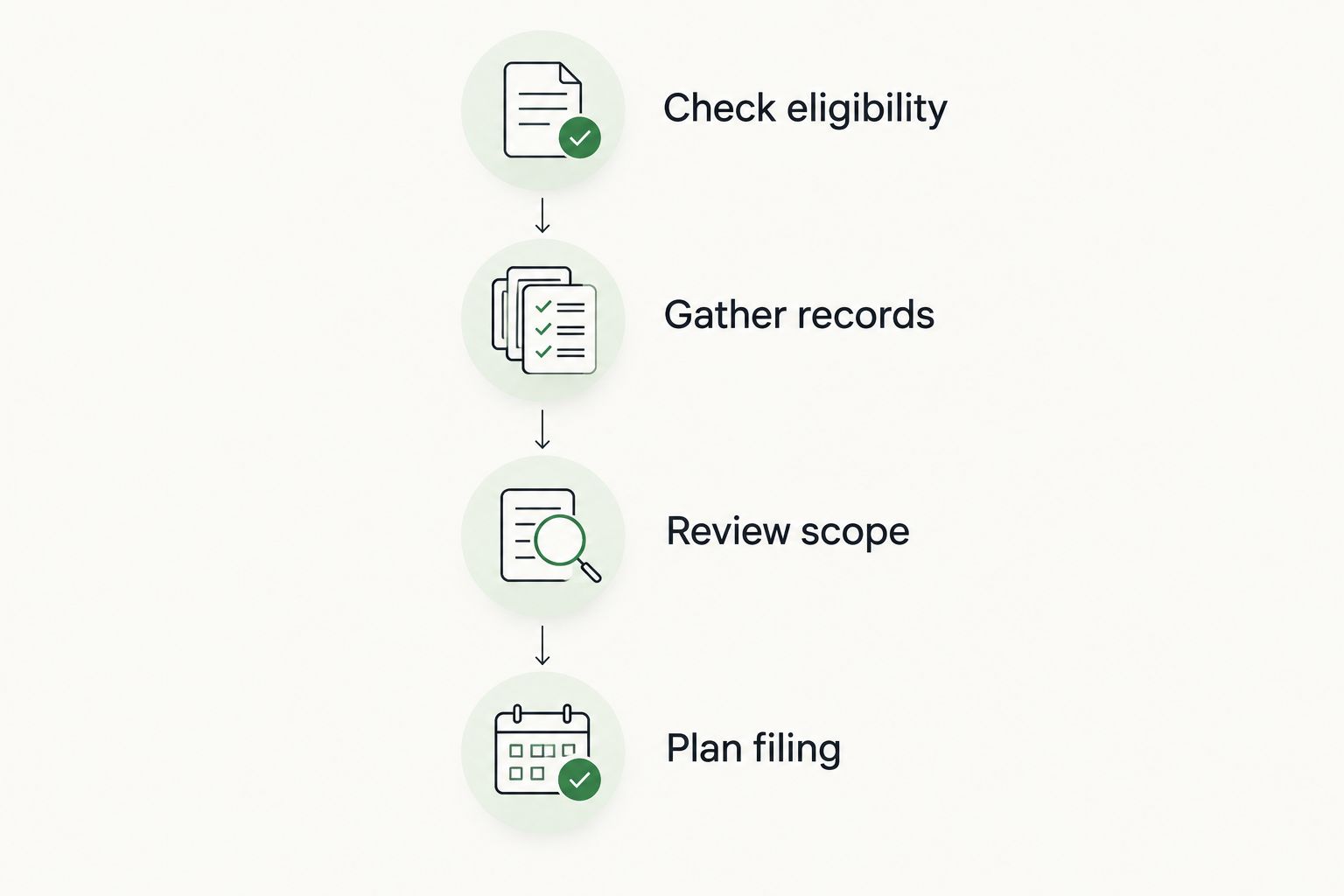
Use the following sequence before choosing an engagement. It separates tax eligibility from the technical work and makes the CPA handoff explicit.
- Check eligibility: Ask your CPA whether accelerated deductions fit your return and rental activity.
- Gather records: Assemble acquisition documents, existing depreciation schedules, rental-use records, and improvement invoices.
- Review scope: Confirm the report's methodology, cost-source documentation, delivery process, and audit support.
- Plan filing: Agree with your CPA on implementation and any accounting-method questions before filing.
For a look-back study, missed depreciation is claimed on the current return using Form 3115 and a Section 481(a) adjustment; prior returns are not amended. Your CPA determines the applicable procedure and files the form.
Virtual Cost Segregation provides Form 3115 on request; your CPA files it. The study itself is supplementary support, not a tax return filed with the IRS.
Before ordering, contact the team for a free manual savings estimate. Treat that estimate as a planning input, not a promised tax outcome.
Reasons to change your service arrangement
A change makes sense when the engagement no longer matches the work you need. Evaluate the scope instead of assuming that switching providers improves your result.
- You need engineering documentation: Add a study engagement rather than relying on a preliminary estimate.
- You need tax advice: Resolve eligibility and loss-use questions with your CPA before buying technical work.
- You need implementation: Identify who will reconcile the report with the existing depreciation schedule.
- You need clearer responsibilities: Put the study, tax advice, and filing responsibilities in separate, explicit terms.
These are selection criteria, not claims about another provider's performance. A change should solve a defined problem.
When staying with your current adviser is right
Keep your current adviser when the engagement already addresses your planning questions, coordinates the required documentation, and establishes filing responsibility. A separate study does not require replacing a productive CPA relationship.
For 2026, the practical choice can be to keep the adviser and add only the missing technical work. Avoid paying for overlapping work without first identifying what each engagement produces.
FAQ
What's the best option if I already have a rental-property CPA?
A study-only engagement fits owners who need engineering-based documentation while retaining their CPA. Virtual Cost Segregation supplies the residential cost segregation report, and your CPA evaluates and applies it when filing.
Is a cost segregation study the same as tax planning?
No. A study identifies and documents property components for depreciation treatment; tax planning evaluates how those deductions affect your return. You need clear responsibility for both tasks.
Can a cost segregation study offset my W-2 income?
A study alone does not establish whether rental losses can offset W-2 income. For the commonly discussed short-term-rental route, an average guest stay of 7 days or less and material participation are required, with other tax limitations evaluated by your CPA.
How long does the residential study take?
Virtual Cost Segregation delivers residential studies in 3 to 5 business days with no site visit required. Coordinate that delivery with your CPA's implementation and filing schedule.
Can I use a calculator instead of an engineering-based study?
A calculator is suitable for preliminary screening, not as a substitute for component-level documentation. Its estimate does not establish your property's classifications or usable tax deductions.
Can I order a study for a rental I have owned for years?
A look-back study can address missed depreciation on an existing rental. Missed depreciation is claimed on the current return using Form 3115 and a Section 481(a) adjustment rather than amending prior returns; your CPA determines the applicable procedure and files.
Does ordering a study establish bonus depreciation eligibility?
No. Bonus depreciation eligibility depends on the assets, acquisition timing, placed-in-service timing, and applicable tax rules. Your CPA must evaluate those facts separately from the decision to order a study.
One last thing
Ask your CPA one question before approving any study: What prevents the additional depreciation from reducing my current tax bill?
That question directs attention to loss limitations, participation records, and filing facts before you focus on the projected deduction. The strongest purchase decision starts with a usable tax benefit, not the largest estimate.