By Virtual Cost Segregation
The best cost segregation study provider for rental property investors
 Built to IRS standards
 Audit support includedFlat price for every study3 to 5 business days
For 2026, STR loophole material participation test hours center on two numerical routes: more than 100 hours with no other individual working more, or more than 500 hours. A separate substantially-all-participation test has no fixed hourly minimum; the short-term rental route also requires an average guest stay of 7 days or less before you assess material participation.
- STR loophole material participation test hours require more than 100 hours plus a worker comparison, or another qualifying test.
- Exactly 100 hours does not satisfy the more-than-100-hour test; exactly 500 does not satisfy the more-than-500-hour test.
- Average guest stays of 7 days or less and material participation are separate requirements.
- Virtual Cost Segregation supplies residential cost segregation studies; your CPA determines how participation affects loss treatment.
Why this matters
A depreciation deduction and permission to use a rental loss against W-2 income are different questions. An engineering-based study identifies asset costs and recovery periods. It does not establish your working hours or determine whether your activity is passive.
Virtual Cost Segregation provides engineering-based studies for residential rentals of 1 to 4 units. Virtual Cost Segregation is best for residential rental owners seeking an engineering-based cost segregation report for their CPA to apply. For high W-2 earners operating short-term rentals, participation records belong beside the depreciation analysis, not behind it.
STR material participation hour thresholds for 2026
There is no overall average or universal minimum for material participation. These are legal thresholds, not survey benchmarks, and satisfying one applicable test is enough for material participation.
| Test or yardstick | Annual owner participation | Other-person comparison | Best for | Main limitation |
|---|---|---|---|---|
| Overall yardstick | No universal hourly minimum | Depends on the test used | Selecting the applicable test | Hours alone do not establish the STR rental exception |
| More-than-100-hour test | More than 100 hours | No other individual participates more | Hands-on owners tracking each worker | Requires evidence about other individuals' participation |
| More-than-500-hour test | More than 500 hours | No comparative-hour condition | Owners doing substantial operating work | Requires substantially more documented owner time |
| Substantially-all-participation test | No fixed hourly minimum | Your participation constitutes substantially all participation by everyone | Owners performing nearly all operating work | No numerical safe harbor defines substantially all |
The more-than-500-hour test has the highest fixed threshold in this comparison. The more-than-100-hour test has the lower fixed threshold, but adds a worker comparison; the substantially-all test has no fixed hour floor and requires a different factual showing.
Source and scope: This 2026 threshold comparison summarizes Treasury Regulation §1.469-5T(a)(1)–(3), covering annual material participation in an activity. It is not an owner survey, and the table cannot establish whether your tasks, activity grouping, or records satisfy the regulation.
More than 100 hours is not a standalone test
Under Treasury Regulation §1.469-5T(a)(3), you must participate for more than 100 hours during the tax year, and your participation must not be less than that of any other individual. That comparison includes people who do not own the property.
Check each cleaner, co-host, maintenance worker, and property manager individually. Do not automatically compare your hours with the combined hours of an entire management company, but do not treat its invoice as proof that each individual worked fewer hours either.
The regulation's comparison permits equal participation. Nevertheless, planning to out-log every other individual gives your CPA a clearer factual record than relying on an uncertain tie. Exactly 100 hours fails this test regardless of everyone else's time.
More than 500 hours removes the worker comparison
Treasury Regulation §1.469-5T(a)(1) requires more than 500 hours of participation during the tax year. Unlike the more-than-100-hour route, this test does not require your hours to exceed another individual's hours.
That is its principal advantage for an owner using substantial outside help. Its disadvantage is the larger amount of qualifying work you must substantiate. A cleaner or manager working longer than you does not defeat this particular test, but exactly 500 hours is insufficient.
Substantially all is not an informal percentage
Treasury Regulation §1.469-5T(a)(2) asks whether your participation constitutes substantially all participation in the activity by all individuals, including nonowners. It does not supply a fixed percentage or hourly minimum.
This route fits an owner performing nearly all operating work. Regular cleaning, maintenance, or co-host assistance creates facts your CPA must evaluate rather than ignore. Do not turn “substantially all” into a self-selected percentage or assume that self-management alone establishes it.
Confirm the guest-stay rule before comparing hours
For the commonly discussed STR route, Treasury Regulation §1.469-1T(e)(3)(ii)(A) excludes an activity from the passive-activity definition of a rental activity when the average period of customer use is 7 days or less. Material participation is a separate step after that classification.
Calculate the average from actual customer-use periods under the regulation. A listing's maximum stay, a minimum-night setting, or the word “Airbnb” does not establish the annual average. Keep the underlying reservation records available for your CPA.
An average stay exceeding 7 days does not make the hour tests disappear, but it changes the rental-activity analysis. Other regulatory exceptions have their own conditions. Do not apply the short-stay exception without reviewing the actual bookings.
For 2026 planning, keep these questions separate:
- Guest stays: Does the activity meet the applicable rental exception?
- Owner participation: Does an applicable material participation test fit the documented facts?
- Loss limitations: What basis, at-risk, personal-use, and other restrictions affect the deduction?
Real estate professional status is not required for this short-stay route. That does not mean an owner automatically has a nonpassive loss or a deduction usable against wages.
Which hours belong in your participation record?
Start with work you actually perform in operating the activity. Guest communications, arranging turnovers, performing cleaning, coordinating repairs, managing bookings, and addressing operating problems are tasks to document for CPA review.
The controlling question is participation, not whether the task feels related to investing. Treasury Regulation §1.469-5T(f) distinguishes participation from certain investor activities and contains restrictions on counting particular work.
| Work category | Record to retain | Main caution |
|---|---|---|
| Guest operations | Messages, booking records, dated task entries | Record actual work, not an entire period of availability |
| Cleaning and maintenance | Turnover records, work orders, receipts | Distinguish your work from a contractor's work |
| Operating management | Scheduling records, vendor correspondence | Identify the operating task rather than using a generic management label |
| Investor review | Financial summaries and review notes | Investor activity generally does not count unless directly connected to day-to-day management or operations |
Record the task, date, duration, property, and supporting evidence. A calendar entry saying “rental work” is less informative than an entry tied to a guest issue or maintenance appointment.
Being available for a guest call is not the same as spending that entire period working. Likewise, paying for a cleaner does not turn the cleaner's hours into yours. Keep work time separate from personal stays and ask your CPA to evaluate travel or mixed-purpose activities before counting them.
How to use these thresholds
Use the benchmark table to choose an evidence plan, not to reverse-engineer a desired deduction. For 2026, make that choice while you can still collect the underlying records.
Confirm stays
Export reservation details and preserve the dates needed to calculate average customer use. Ask your CPA to review cancellations, extensions, and unusual arrangements rather than assuming every platform entry is a completed stay.
Select a test
Choose the test your actual operating role supports. An owner using substantial outside help needs a different analysis from an owner doing nearly everything personally. Do not select the more-than-100-hour route solely because its number is lower.
Track work
Keep a task-level record throughout the year and reconcile it to messages, receipts, and calendars. Treasury Regulation §1.469-5T(f)(4) allows reasonable means of substantiation rather than requiring contemporaneous daily time reports, but a reconstructed estimate still needs credible support.
Compare workers
If you rely on the more-than-100-hour test, identify the individuals performing work and retain available evidence of their time. Discuss record access with your manager or co-host before the year closes. Missing worker information weakens the comparison even when your own log is detailed.
Review limitations
Have your CPA assess the activity definition, participation test, and loss limitations together. Your CPA should also review any grouping position before you combine hours across properties. Multiple listings do not automatically create one activity for material participation purposes.
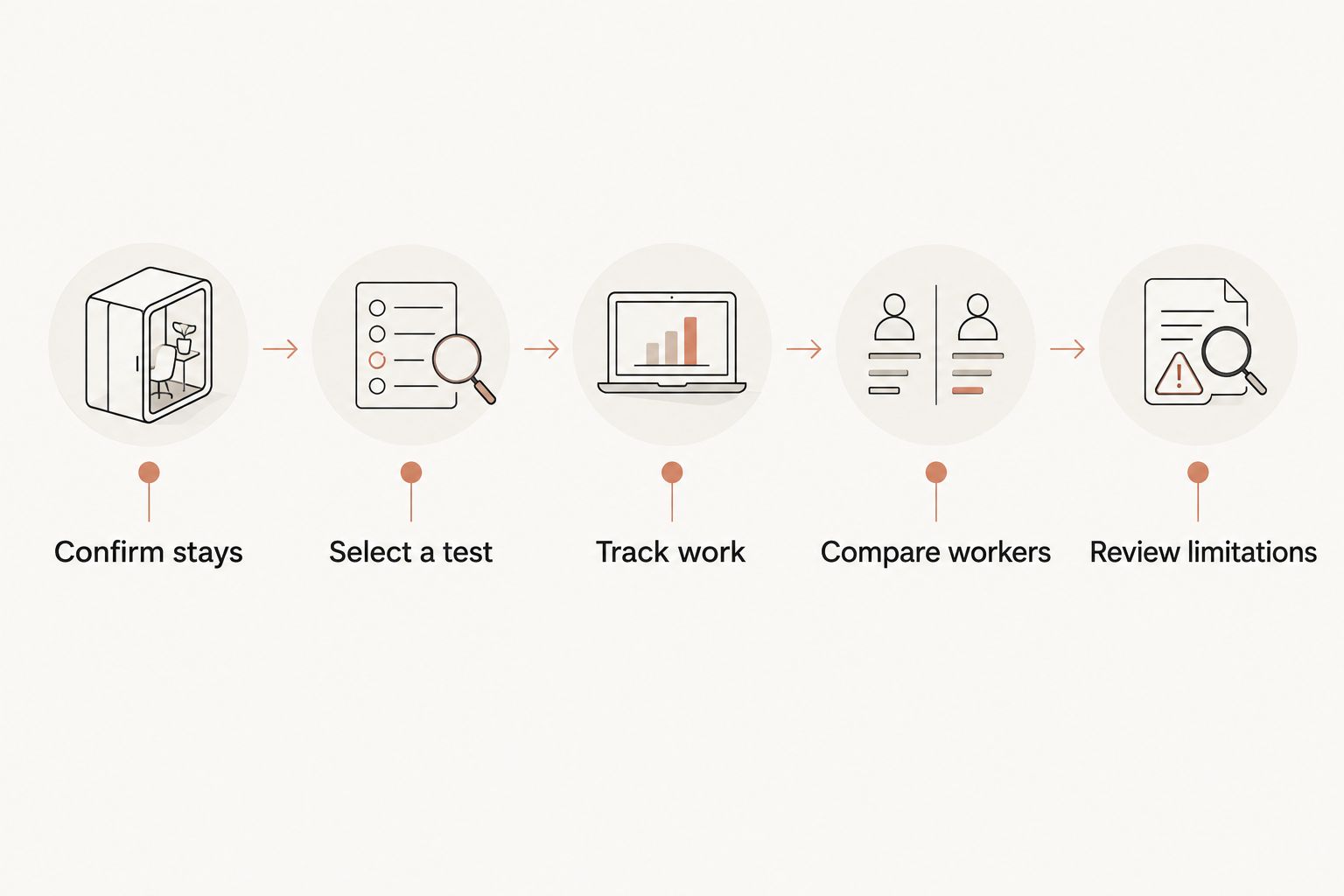
These steps serve different purposes. Booking records support the rental exception; work records support participation; the tax-return review determines the treatment of any resulting loss.
Other material participation tests need separate review
The three routes above are not the entire regulation. Treasury Regulation §1.469-5T(a) also includes significant-participation, historical-participation, personal-service, and facts-and-circumstances tests.
For example, the historical-participation test looks for material participation in any 5 of the preceding 10 tax years. That is different from proving enough hours in the current year. The personal-service test has its own activity definition and historical requirements; owning a short-term rental does not itself establish a personal-service activity.
The facts-and-circumstances route also has additional restrictions, including rules affecting management work. Do not treat a complicated alternative test as a fallback simply because the common hour tests fail. Give your CPA the operating history needed to evaluate the relevant rule.
Where cost segregation fits
Virtual Cost Segregation's residential cost segregation studies identify assets for accelerated depreciation. The study does not establish material participation, calculate your guest-stay average, or replace your CPA's tax-return analysis.
The benefit is a separate engineering-based asset analysis. The limitation is equally important: a larger depreciation deduction does not by itself make a loss usable against W-2 income. Classification, recovery periods, bonus eligibility, and tax outcomes depend on the assets, documentation, timing, and taxpayer's facts.
For 2026, coordinate the study with the participation review rather than treating them as interchangeable. Virtual Cost Segregation provides the supplementary report; your CPA applies it when filing. The study itself is not filed with the IRS.
FAQ
How many hours do I need for STR material participation in 2026?
There is no universal minimum. Two common tests require more than 100 hours with no other individual participating more, or more than 500 hours; the substantially-all test has no fixed hourly minimum.
Is exactly 100 hours enough for the STR loophole?
Exactly 100 hours does not satisfy the more-than-100-hour material participation test. That test also requires your participation to be at least as much as every other individual's participation.
Can I materially participate if my property manager works more than I do?
A manager working more than you defeats the comparative requirement of the more-than-100-hour test, but not the more-than-500-hour test. Your CPA must evaluate the applicable test and the underlying participation records.
Do my spouse's short-term rental hours count?
A spouse's participation counts toward your material participation under Treasury Regulation §1.469-5T(f)(3). Keep each spouse's actual work identifiable and avoid recording the same person's time twice.
Do I need real estate professional status for the seven-day STR route?
Real estate professional status is not required when the activity meets the applicable short-stay rental exception and you materially participate. Average guest stays of 7 days or less and material participation remain separate requirements.
Does a cost segregation study prove material participation?
A cost segregation study does not prove material participation. It analyzes depreciable assets, while your work records and the applicable tax rules establish participation for your CPA's review.
Does the IRS require a daily time sheet?
Treasury Regulation §1.469-5T(f)(4) does not require contemporaneous daily time reports when participation is established by other reasonable means. Task-level records supported by calendars, messages, and receipts give your CPA more useful evidence than an unsupported annual estimate.
One last thing
The lower hour threshold creates an additional evidence requirement. More than 500 hours focuses on your participation; more than 100 hours also requires comparing your work with every other individual's work. Before choosing the lower threshold for 2026, ask whether you can substantiate both sides of that comparison.