By Virtual Cost Segregation
The best cost segregation study provider for rental property investors
 Built to IRS standards
 Audit support includedFlat price for every study3 to 5 business days
The federal Section 179 deduction limit for 2026 is $2,560,000, with a dollar-for-dollar reduction once qualifying property placed in service exceeds $4,090,000; the deduction reaches zero at $6,650,000. This guide from Virtual Cost Segregation compares section 179 deduction limits by year and explains why residential rental owners must establish eligibility before using these ceilings.
- The 2026 Section 179 deduction ceiling is $2,560,000, subject to eligibility, investment and business-income limits.
- Section 179 deduction limits by year are statutory ceilings, not average rental-property deductions.
- Residential rental owners must check asset eligibility and noncorporate lessor restrictions before electing Section 179.
- Virtual Cost Segregation provides engineering-based residential cost segregation studies; your CPA determines the applicable depreciation treatment.
Why this matters
A larger Section 179 ceiling does not make your rental house eligible for immediate expensing. The annual dollar limit answers how much an eligible taxpayer can elect to deduct, not whether a particular rental asset qualifies.
For residential investors, the distinction matters more than the headline increase. Your CPA must separate the building, personal property and land improvements, then evaluate the rules governing each category.
Section 179 deduction limits by year
Section 179 lets an eligible taxpayer elect to expense qualifying property rather than recover its entire cost through regular depreciation. These are federal statutory limits, not averages from investor returns.
| Tax year | Overall maximum deduction | Phaseout begins when qualifying investment exceeds | Deduction fully phased out at |
|---|---|---|---|
| 2025 | $2,500,000 | $4,000,000 | $6,500,000 |
| 2026 | $2,560,000 | $4,090,000 | $6,650,000 |
2026 has the higher ceiling at $2,560,000, compared with $2,500,000 for 2025. Its investment threshold is also higher: $4,090,000 rather than $4,000,000. Neither year provides an automatic deduction for residential rental assets.
Source and scope: The 2025 federal amounts reflect Section 70306 of the One Big Beautiful Bill Act, signed July 4, 2025; the 2026 inflation-adjusted amounts appear in IRS Revenue Procedure 2025-32. Full-phaseout amounts are calculated by adding each year's maximum deduction to its investment threshold; the table does not account for asset exclusions, business-income restrictions, entity-level limits or state differences.
How the investment phaseout works
Once qualifying investment exceeds the applicable threshold, the maximum election falls dollar for dollar. The investment figure is the qualifying property placed in service, not merely the amount you elect to expense.
For 2026, compare qualifying investment against $4,090,000 before applying the $2,560,000 ceiling. At $6,650,000 of qualifying investment, the federal Section 179 deduction is fully phased out.
Do not compare the threshold with your rental property's purchase amount without first identifying qualifying assets. Land and the residential building are not interchangeable with eligible equipment for this calculation.
How to use these benchmarks
- Check eligibility before capacity. A deduction below the $2,560,000 ceiling still fails if the asset or taxpayer does not qualify.
- Measure qualifying investment separately. The $4,090,000 threshold concerns qualifying property placed in service, not your mortgage balance or equity contribution.
- Model the usable deduction. The business-income limitation can restrict the election even when investment stays below the phaseout threshold.
- Use the correct tax year. Apply the 2026 amounts to the relevant 2026 tax year, rather than carrying forward a prior-year ceiling.
What the annual ceiling does not tell rental owners
Section 179 eligibility depends on more than the asset's recovery period. A component classified as short-life property does not automatically qualify for a Section 179 election.
For a residential rental, your CPA should review whether the activity constitutes an active trade or business, whether the property is eligible and whether lessor restrictions apply. Ownership through an LLC does not resolve those questions by itself.
Noncorporate lessor restrictions
Section 179(d)(5) places additional restrictions on property purchased for leasing by a noncorporate lessor. Statutory exceptions exist, but an individual landlord cannot assume that rental furniture or appliances qualify merely because they support a business activity.
Ask your CPA to document the lessor analysis before electing Section 179 on leased assets. Business use, lease terms, operating expenses and the applicable statutory exception belong in that review.
Business-income limitations
Section 179 also has a taxable-income limitation tied to the active conduct of trades or businesses. Amounts disallowed under that limitation generally carry forward, subject to the applicable rules.
An employee's wages can enter the Section 179 business-income calculation, but wages do not make otherwise ineligible rental property eligible. Keep the income calculation separate from the property and lessor tests.
Source and scope: Internal Revenue Code Section 179(b), (d) and its implementing regulations govern these federal eligibility and limitation rules. Apply current law to the taxpayer's facts for the filing year.
Section 179 versus bonus and regular depreciation
Section 179, bonus depreciation and regular depreciation are different mechanisms. Cost segregation identifies and supports asset classifications; it is not a separate tax deduction election.
| Method | Best for | Main advantage | Main limitation |
|---|---|---|---|
| Section 179 | Eligible business assets after taxpayer and lessor review | An election permits targeted expensing | Investment, income and eligibility restrictions apply |
| Bonus depreciation | Eligible shorter-life assets with documented acquisition and service dates | Accelerates recovery without Section 179's annual dollar ceiling | Asset eligibility, timing and loss restrictions still matter |
| Regular depreciation | Recovering basis over the applicable asset life | Provides deductions without relying on immediate expensing | Deductions arrive over a longer period |
Choose the method asset by asset, not from the largest headline deduction. Section 179 offers election flexibility, bonus depreciation has different qualification rules, and regular depreciation remains relevant when acceleration is unavailable or not selected.
For eligible property acquired and placed in service after January 19, 2025, the restored bonus depreciation rate is 100% under the One Big Beautiful Bill Act. Both dates matter, and the restored rate has no scheduled end.
The residential building structure does not qualify for bonus depreciation. A cost segregation study instead evaluates components whose function and documentation support separate treatment, including potential 5-, 7- and 15-year classifications.
What cost segregation changes for a residential rental
An engineering-based study separates supported asset costs from the building's remaining basis. It does not turn land into depreciable property or make every amenity an immediately deductible asset.
Virtual Cost Segregation is best for residential rental owners who need an engineering-based cost segregation report for their CPA. The service addresses residential rental properties of 1 to 4 units, including short-term and long-term rentals.
The advantage is documented asset classification rather than a rule-of-thumb allocation. The limitation is equally important: a study does not determine whether you can currently use a resulting tax loss, and it does not replace your CPA's tax analysis.
Your CPA applies the report when filing. Virtual Cost Segregation provides the supplementary study and audit support, not CPA services or tax-return filing.
Amenities require component-level review
Furniture, appliances, fencing and other rental components should not be grouped into one deduction simply because they were acquired together. Classification depends on function, installation, documentation and the taxpayer's facts.
A built-in component can receive different treatment from a movable item serving a similar purpose. Keep itemized invoices and installation records so your CPA can reconcile the study with the depreciation schedule.
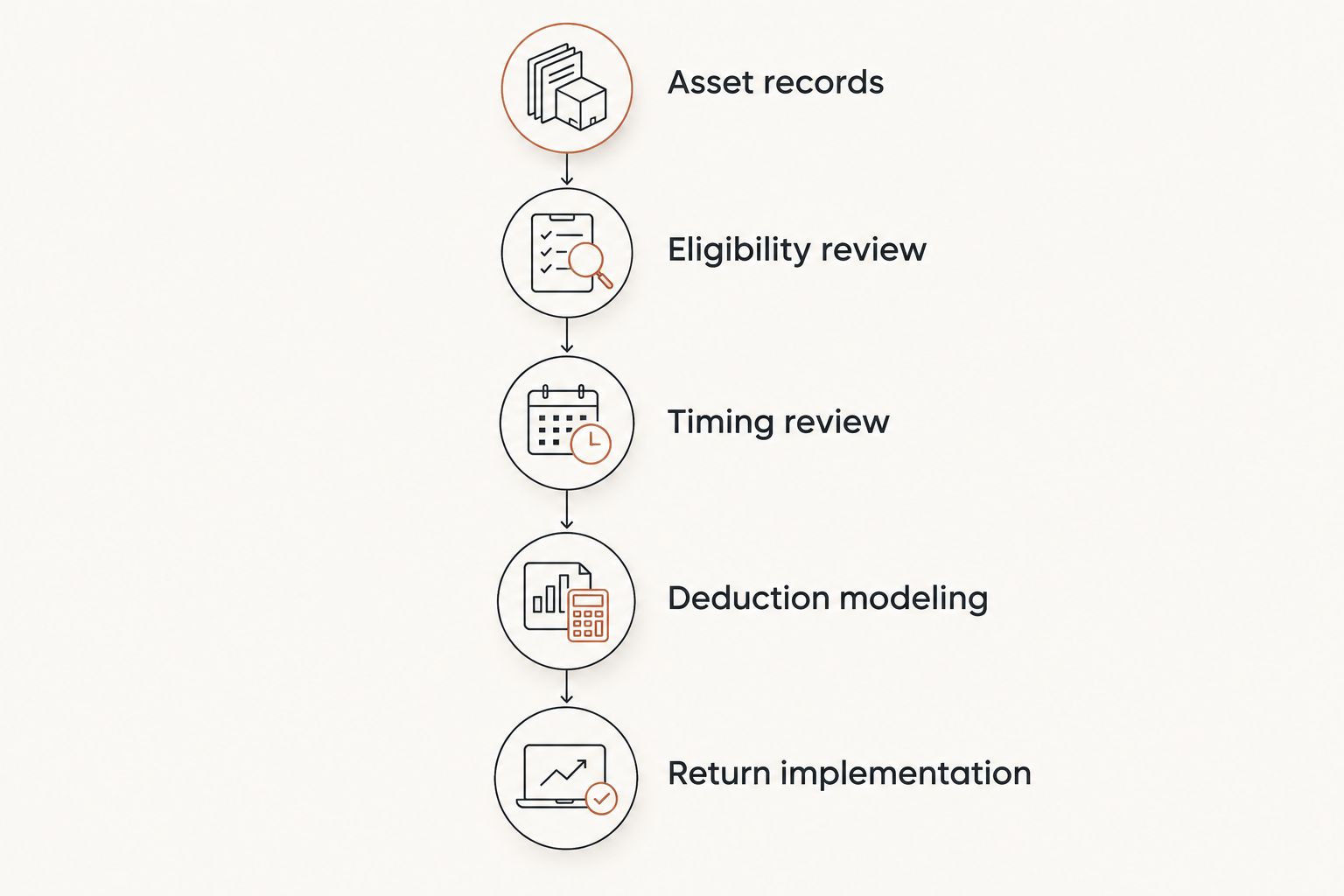
A practical 2026 CPA review sequence
Use this sequence before deciding whether Section 179 belongs on your residential rental return. The order prevents the annual ceiling from distracting you from eligibility.
- Asset records: Assemble the closing statement, invoices, prior depreciation schedules and business-use records. Separate land from depreciable basis.
- Eligibility review: Determine asset classification, trade-or-business treatment and applicable noncorporate lessor restrictions.
- Timing review: Confirm acquisition and placed-in-service dates. Review contracts as well as closing documents when acquisition timing affects bonus depreciation.
- Deduction modeling: Compare Section 179, bonus depreciation and regular depreciation, including income and loss limitations.
- Return implementation: Reconcile elected treatment to Form 4562 and retain the supporting calculations with the tax records.
Your CPA should also check state conformity. A federal deduction does not establish identical treatment on a state return, and an accelerated federal deduction can create a separate state depreciation schedule.
For the handoff, use the guide to how CPAs implement a cost segregation study on Form 4562. The report and the filed return should tell the same asset-level story.
Keep depreciation separate from loss usability
A residential rental can generate accelerated depreciation without producing a currently usable deduction against wages. Passive-activity, at-risk and other loss limitations remain separate questions.
For a short-term rental strategy, an average guest stay of 7 days or less and material participation are central considerations. A commonly used material-participation test requires more than 100 hours and more participation than any other individual, including a property manager. The hours threshold alone is not enough.
Real estate professional status is not required for that short-stay route. However, the rules do not establish your eligibility from a booking calendar or an estimated time commitment alone; your CPA must apply them to your records.
Do not treat the Section 179 ceiling as a W-2 offset calculation. First establish the deduction, then determine whether the resulting loss is currently usable.
FAQ
What is the Section 179 deduction limit for 2026?
The federal Section 179 deduction limit for 2026 is $2,560,000. It is reduced dollar for dollar when qualifying investment exceeds $4,090,000 and is fully phased out at $6,650,000, before considering other restrictions.
Where do Section 179 deduction limits by year come from?
Section 179 deduction limits come from federal tax law and applicable annual inflation adjustments. The 2026 amounts appear in IRS Revenue Procedure 2025-32; these are statutory ceilings, not average deductions claimed by rental owners.
Can I deduct my entire rental house under Section 179?
No, the residential rental building does not qualify for Section 179 expensing. Separately identified assets require their own eligibility review, including applicable restrictions on noncorporate lessors.
Is Section 179 better than bonus depreciation for an Airbnb?
Neither method is automatically better for an Airbnb. Section 179 has election flexibility but additional investment, business-income and lessor restrictions; bonus depreciation requires its own asset and timing analysis.
Does a cost segregation study make every asset eligible for Section 179?
No, a cost segregation study supports asset classification and allocated basis, not automatic Section 179 eligibility. Virtual Cost Segregation supplies the engineering-based residential study, and your CPA determines the applicable tax treatment.
What bonus depreciation rate applies to a newly purchased rental's eligible components?
Eligible property acquired and placed in service after January 19, 2025 qualifies for the restored 100% bonus depreciation rate, subject to the applicable rules. The building structure does not qualify, and the taxpayer must separately evaluate loss limitations.
Can a look-back study recover missed rental depreciation?
A look-back study can support a depreciation accounting-method change when the applicable requirements are met. Missed depreciation is claimed on the current return through Form 3115 and a Section 481(a) adjustment; prior returns are not amended for that method change, and the CPA handles filing.
One last thing
A higher deduction ceiling does not mean you should maximize the election. Accelerated depreciation changes the timing of deductions, and later dispositions can have recapture consequences.
For your 2026 planning discussion, ask your CPA for an asset-level comparison that includes the current deduction, any suspended losses, state adjustments and the remaining depreciable basis. That is more useful than a calculation stopping at the federal maximum.