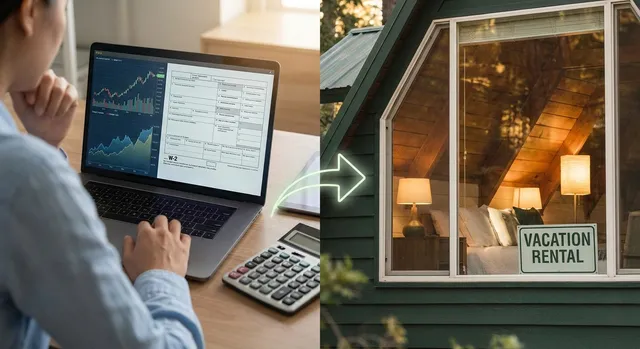
High-income W-2 earners looking to reduce taxable income with real estate tax benefits can use short-term rentals (like Airbnb or VRBO) combined with bonus depreciation, but there are specific IRS rules and participation tests you must meet to use it effectively. This guide breaks down how bonus depreciation works under current law, the difference between passive and non-passive rental income, the STR qualification tests, and a worked example showing the numbers on a $500,000 property.
Bonus Depreciation Basics
What bonus depreciation does
Bonus depreciation allows property owners to deduct a large portion of qualifying property costs in the year the property is placed in service. After recent tax law changes (OBBBA), 100% bonus depreciation was restored for qualifying property acquired and placed in service after January 19, 2025. This unlocks a major accelerated depreciation opportunity for STR investors.[1]
Without bonus depreciation, residential rental property is depreciated over 27.5 years — roughly $3,636 per year on a $100,000 basis. Bonus depreciation lets you front-load that deduction into year one for qualifying components, generating a much larger tax benefit when you need it most.
2026 bonus depreciation schedule
The One Big Beautiful Bill Act (OBBBA), signed in July 2025, restored 100% bonus depreciation retroactively for qualifying property acquired and placed in service after January 19, 2025. Here is how the percentage breaks down by placed-in-service year:
| Placed in Service | Bonus Rate | Notes |
|---|---|---|
| 2018-2022 | 100% | Original TCJA rate |
| 2023 | 80% | Pre-OBBBA phase-down |
| 2024 | 60% | Pre-OBBBA phase-down |
| 2025 (before Jan 19) | 40% | Pre-OBBBA phase-down |
| 2025 (after Jan 19) | 100% | OBBBA restoration |
| 2026 | 100% | OBBBA restoration continues |
| 2027 and later | 100% | OBBBA rate is permanent; no scheduled phase-down |
For STR investors placing property in service in 2026, the full 100% rate applies to qualifying components identified in a cost segregation study.
How cost segregation unlocks bonus depreciation
To maximize bonus depreciation:
- Perform a cost segregation study to reclassify components (like furniture, appliances, flooring) into shorter-life asset classes (5, 7, or 15 years). Hint: we can help with that!
- These reclassified assets can then be fully written off in year one, generating substantial depreciation tax benefits.
- Without a cost segregation study, you’re limited to 27.5-year straight-line depreciation on the structure — a fraction of the potential year-one deduction.
A typical cost segregation study reclassifies 20-45% of a residential rental property’s cost basis into 5, 7, and 15-year asset classes — all eligible for 100% bonus depreciation in year one under current law.
Passive vs. Active Income
The passive activity default
By default, rental properties are passive activities under IRS rules, meaning that losses (including depreciation) cannot offset W-2 wages. They can only offset passive income from your rentals.[2]
Even if your investment is passive, cost segregation and bonus depreciation can be helpful in offsetting most or all of your rental income within the first few years, since untapped bonus depreciation can roll over into the next year.
When rental losses can offset W-2 income
There are two primary ways rental losses — under current law bonus depreciation — can be used to offset W-2 income:
- Non-passive STR treatment: If your short-term rental qualifies as a non-passive business (see STR Tax Rules below), losses offset W-2 wages directly with no dollar cap.
- Real Estate Professional Status (REPS): If you or your spouse spend 750+ hours/year in real property trades and businesses and meet the >50% material participation test, all rental losses — including bonus depreciation — can offset W-2 income regardless of whether the rental is short-term or long-term.[2]
If you don’t qualify for either path, the Active Participation Exception lets you deduct up to $25,000 of rental losses against ordinary income, provided your Modified Adjusted Gross Income (MAGI) is below $100,000. The deduction phases out between $100,000 and $150,000 MAGI.[2]
STR Tax Rules
The 7-day average stay test
Airbnb and other short-term rentals can be treated as non-passive if ALL of the following criteria are met:
- Short-Term Rental Rule: Average guest stay is 7 days or less, or significant services are provided (such as daily cleaning, meals, or concierge).[3]
- Material Participation: You materially participate in the STR business (meets one of the IRS tests, such as spending >500 hours/year or meeting other participation tests).[3]
The 7-day rule is calculated by dividing total guest nights by total bookings for the tax year. Fifty-two reservations totaling 286 nights gives you a 5.5-day average. You pass.
Common pitfalls that disqualify STR status:
- Weekly minimums kill your average. Saturday-to-Saturday vacation rentals will almost certainly land above 7 days.
- One long stay won’t disqualify you. A single 14-night booking doesn’t break your average if the rest are short.
- Personal use days don’t count. Only actual rental nights factor into the calculation.
You re-qualify every year. A year where your average drifts above 7 days means passive treatment for that year’s losses.
Material participation tests
Treasury Regulation 1.469-5T lists seven tests; satisfying one qualifies you. For STR owners, two matter in practice:
- Option 1: 500+ hours in the activity for the year, roughly 10 hours a week. Realistic for owners managing multiple properties.
- Option 2: 100+ hours, more than anyone else. A lower bar, but you need to log more hours than any single cleaner, handyman, or manager.
- Either way, document as you go. The IRS scrutinizes STR participation claims; a calendar reconstruction at tax time won’t survive an audit.
Guest communication, booking management, supply runs, maintenance coordination, listing optimization, check-in troubleshooting — it all counts.
STR vs. long-term rental tax treatment
| Feature | Short-Term Rental (non-passive) | Long-Term Rental (passive) |
|---|---|---|
| Losses offset W-2 income? | Yes, directly | No (passive loss rules) |
| Losses offset rental income? | Yes | Yes |
| 7-day average stay required? | Yes | No |
| Material participation required? | Yes | No (but needed for $25K exception) |
| $25,000 active participation cap | Not needed (uncapped) | Available if MAGI < $150K |
| Cost segregation benefit | Full bonus depreciation offsets W-2 | Bonus depreciation offsets rental income only |
| REPS required? | No | Yes (to offset W-2) |
Step-by-Step Calculation
Worked example: $500,000 STR property
Imagine you purchased a $500,000 short-term rental property in early 2026, placed it in service, and self-manage it on Airbnb. You meet the 7-day average stay test and materially participate (500+ hours/year).
A cost segregation study reclassifies 30% of the property ($150,000) into 5, 7, and 15-year asset classes — appliances, furniture, flooring, landscaping, and specialized electrical.
Here is how the year-one deduction breaks down:
| Component | Cost Basis | Asset Class | Year-One Deduction (100% Bonus) |
|---|---|---|---|
| Furniture and appliances | $45,000 | 5-year | $45,000 |
| Flooring and window treatments | $30,000 | 5-year | $30,000 |
| Landscaping | $25,000 | 15-year | $25,000 |
| Specialized electrical and plumbing | $20,000 | 5-year | $20,000 |
| Decor and fixtures | $30,000 | 5-year | $30,000 |
| Total reclassified | $150,000 | $150,000 |
Combined with standard 27.5-year depreciation on the remaining $350,000 structure (~$12,727/year), total year-one depreciation hits roughly $162,727.
At a 37% marginal rate, that is about $60,200 in federal tax savings from a single study — against a $2,200 flat-fee cost segregation report. The deduction offsets both your STR rental income and your W-2 wages, because the activity qualifies as non-passive.
What happens without cost segregation
Without a cost segregation study, you’re limited to straight-line depreciation on the $500,000 basis over 27.5 years — roughly $18,182 per year. At 37%, that is about $6,700 in annual tax savings. You’d forgo the $150,000 year-one bonus depreciation deduction entirely.
The difference: $60,200 vs. $6,700 in year one. That is the value a cost segregation study unlocks — and why it is one of the highest-ROI tax planning moves available to STR investors.
Next steps
If this strategy interests you, try our cost segregation calculator to estimate your potential tax savings, or explore our cost segregation services to get started. Our $2,200 flat-fee study delivers a complete audit-defensible report in 3-5 business days — no site visit required.
Final Note: IRS rules are complex and subject to change. Always consult a qualified CPA or tax advisor before implementing strategies to offset W-2 income with bonus depreciation in your Airbnb or STR business. This article provides typical averages and estimates only and is not a guarantee of study results.
References
[1] The STR Tax Loophole 2025: How to Offset W-2 Income With Airbnb Losses - The Offer Sheet [2] How Bonus Depreciation Works for Rental Property - LegalClarity [3] TurboTax Community: Short-term rental losses against W2 income [4] How to Maximize Tax Savings - Short-Term Rental Tax Loophole - Attacct Accounting Advisors