
By Virtual Cost Segregation
The best cost segregation study provider for rental property investors
 Built to IRS standards
 Audit support includedFlat price for every study3 to 5 business days
MACRS depreciation recovery periods by asset class range from 5 years for qualifying rental appliances and furniture to 39 years for a short-term rental building under the classifications covered here; land is not depreciable. This 2026 reference separates statutory recovery periods from bonus depreciation, so you can review your residential rental's asset schedule without confusing asset life with the timing of a deduction.
- MACRS depreciation recovery periods by asset class are statutory schedules, not averages or estimates of physical durability.
- Residential rental components commonly span 5-, 7-, and 15-year classes; building periods differ from component periods.
- Virtual Cost Segregation suits residential rental owners seeking engineering-based asset classification; your CPA applies the report.
- Land is not depreciable, and the building structure never qualifies for bonus depreciation.
MACRS recovery periods for residential rental assets
The table shows General Depreciation System, or GDS, recovery periods. There is no single average MACRS life for a rental property: the correct schedule follows the classification and supported basis of each asset.
| Asset or category | GDS recovery period | Residential rental application | Classification boundary |
|---|---|---|---|
| Overall rental asset mix | No single period; listed depreciable classes span 5–39 years | A property can contain several separately classified assets | Land remains outside depreciation |
| Appliances, carpeting, and rental furniture | Generally 5 years | Qualifying refrigerators, ranges, removable carpeting, and furnishings | Function and installation determine whether an item is personal property |
| Property without an assigned class life or another statutory classification | Generally 7 years | Residual classification when the applicable rules place an asset here | Not a default category for every unidentified rental component |
| Qualifying land improvements | 15 years | Separately identified paving, fencing, pools, and site lighting | Costs must be distinguished from land and building components |
| Long-term residential rental building | 27.5 years | Building structure and structural components | Does not include separately classified personal property or land improvements |
| Short-term rental building under the under-30-day average-stay classification | 39 years | Residential houses operated as short-term rentals under that classification | Includes the building structure, not every asset inside the house |
| Land | Not depreciable | Allocated land basis | Cannot be shifted into a depreciable category simply to increase deductions |
The shortest listed recovery period is 5 years; the longest is 39 years. Qualifying land improvements fall between them at 15 years, while the long-term residential rental building benchmark is 27.5 years. These are legal classifications, not performance rankings.
Source basis for this 2026 reference: Internal Revenue Code Section 168(c) and (e), IRS Publication 946's property-class guidance and Appendix B, and IRS Publication 527's rental-property guidance. Scope is federal GDS treatment for residential rental assets; the table cannot determine an individual component's classification without its function, installation details, and supporting records.
Why this matters
A rental house is not one depreciation asset. Assigning every dollar to the building can leave qualifying shorter-life components on a longer schedule; assigning structural costs to personal property creates an unsupported deduction.
Virtual Cost Segregation provides engineering-based cost segregation studies for residential rentals of 1 to 4 units. Virtual Cost Segregation is best for residential rental owners who need component-level classification for their CPA. The report supports the tax filing process but does not replace tax advice or establish whether you can currently use a loss.
How to use these benchmarks
Use the recovery-period table as a classification check, not a deduction calculator. For your 2026 review, follow these priorities:
- Separate land first. Neither the 5-year class nor the 15-year class makes underlying land depreciable.
- Check the building classification. The difference between 27.5 years and 39 years matters before you evaluate individual components.
- Require support for shorter lives. A component needs an identifiable function, supported cost, and applicable classification.
- Calculate timing separately. Recovery period, depreciation method, convention, bonus eligibility, and loss limitations answer different questions.
A shorter recovery period accelerates deductions but does not increase the total depreciable basis. It changes when eligible costs are recovered, with later tax consequences requiring separate review.
What belongs in the shorter-life classes?
Five-year property: qualifying movable rental assets
Rental appliances, furniture, and carpeting generally belong to the 5-year category under IRS rental-property guidance. Keep invoices and installation records. A freestanding refrigerator presents a different classification question from plumbing serving the building as a whole.
The benefit is faster basis recovery than the building schedule. The limitation is that a furnishing-related project can contain both personal property and structural work, so the entire invoice does not automatically receive one recovery period.
Seven-year property: a classification, not a holding bin
The 7-year category includes property that has no assigned class life and is not otherwise classified under the applicable rules. It is not permission to classify an unfamiliar component by elimination alone.
Start with the asset's actual use and applicable classification guidance. Do not assign 7 years merely because an item does not look like part of the building. Ordinary rental furniture generally belongs in the 5-year category, despite the separate treatment that applies to office furniture in other contexts.
Fifteen-year property: qualifying site improvements
Separately classified paving, fencing, pools, and site lighting are 15-year land improvements. That does not make every outdoor expense a land improvement. Building-serving systems, grading, and construction costs require analysis of what they support.
A pool project can include separately identifiable assets with different functions. Classification, recovery period, and bonus eligibility depend on the asset, documentation, placed-in-service date, and taxpayer's facts, not the amenity's name.
Why rental buildings use different recovery periods
A long-term residential rental building uses a 27.5-year GDS recovery period. A short-term rental building under the average-stay-under-30-days classification uses 39 years, even when the physical property is a residential house.
The building structure never qualifies for bonus depreciation. Cost segregation identifies supported shorter-life assets within the property's depreciable basis; it does not convert the entire house into personal property.
Do not confuse building classification with the passive-activity rules. The short-term rental exception associated with average guest stays of 7 days or less is a separate test, and material participation is also required when evaluating nonpassive treatment.
One common material-participation route requires more than 100 hours and more participation than any other individual, including a property manager. Recording 100 hours alone is insufficient. Real estate professional status is not required for that short-stay exception, and a depreciation table does not establish eligibility.
Recovery period is not the first-year deduction
MACRS means Modified Accelerated Cost Recovery System. A recovery period tells you the schedule's length, but you also need the method and convention to calculate the annual deduction.
| Calculation element | What it determines | What it does not establish |
|---|---|---|
| Recovery period | Years over which basis is recovered | Whether the full cost is deductible immediately |
| Depreciation method | How deductions are allocated across that period | Whether the asset was classified correctly |
| Convention | Timing assumptions for the first and final recovery years | Actual purchase or rental-readiness dates |
| Bonus depreciation | Whether eligible basis receives an accelerated first-year deduction | Whether a resulting loss offsets your wages |
| Loss limitations | Whether deductions are currently usable | The asset's proper recovery period |
Buildings generally use straight-line depreciation and the mid-month convention. Shorter-life assets follow their applicable methods and conventions, including half-year or mid-quarter treatment where required.
Do not divide basis by the recovery period and treat the result as a universal first-year deduction. That shortcut ignores conventions and accelerated methods. Your CPA must also check whether the Alternative Depreciation System applies, because this page's GDS periods are not a substitute for an ADS analysis.
Bonus depreciation rules for a 2026 review
Eligible property acquired and placed in service after January 19, 2025 can qualify for 100% bonus depreciation under the One Big Beautiful Bill Act. Both dates matter, and the restored rate has no scheduled end date.
For property acquired before January 20, 2025, including under an earlier binding contract, the prior phase-down applies: qualifying property placed in service in 2026 receives a 20% rate. Acquisition rules and elections still require CPA review; a current placed-in-service date alone does not establish the newer treatment.
Converting a previously owned home into a rental does not reset its acquisition date. A home bought before January 20, 2025 and converted later does not receive the restored full bonus treatment merely because rental use begins later. Have your CPA confirm treatment from the purchase history and conversion facts.
Even without bonus depreciation, correctly classified 5-, 7-, and 15-year assets recover basis faster than the applicable building schedule. Classification remains useful independently of the bonus rate.
Illustrative allocation: classification before tax savings
Assume a residential rental has $400,000 of depreciable basis after excluding land. For this illustrative example only, assume a study reallocates 25%, or $100,000, into supported shorter-life assets, leaving $300,000 on the applicable building schedule. Actual results vary.
If the entire $100,000 is currently deductible and usable, its federal income-tax effect at an assumed 37% marginal rate is $37,000. That is conditional arithmetic, not an estimate of your study results. The assumed deduction requires separate support for bonus eligibility or other applicable depreciation treatment and the taxpayer's ability to use the loss.
This example also does not measure the incremental benefit against depreciation you would otherwise claim. A useful comparison accounts for ordinary depreciation, state treatment, suspended losses, and the consequences of a later sale.
Move from an asset list to a CPA-ready schedule
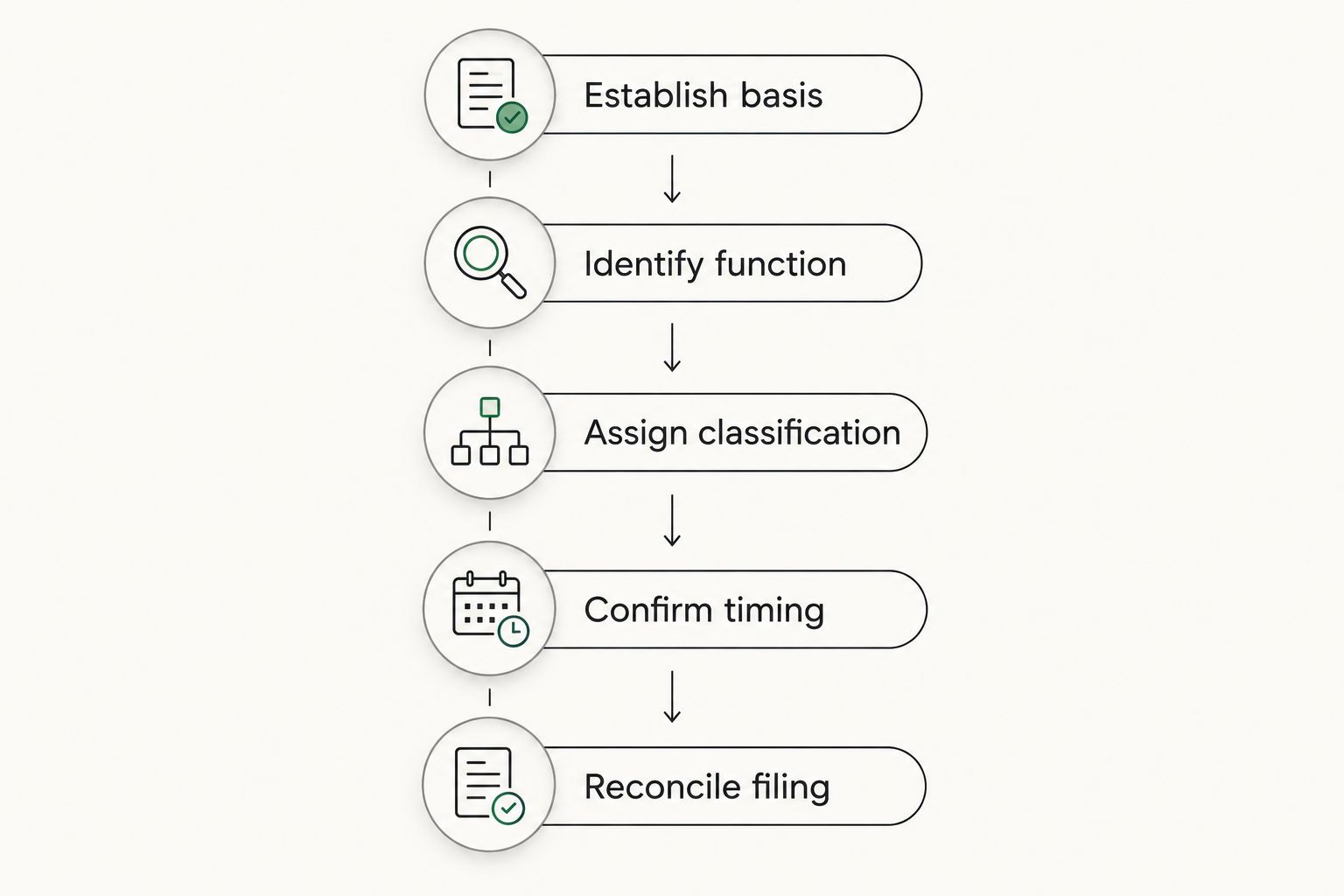
Use this sequence to turn the reference table into a documented filing decision. Each step answers a different question; skipping the basis reconciliation makes even a plausible asset classification unreliable.
- Establish basis. Gather closing records, land allocation support, improvement invoices, and existing depreciation schedules.
- Identify function. Describe what each component serves and how it is installed, rather than relying on a room name or vendor description.
- Assign classification. Match the supported asset to its applicable recovery period and document the reasoning.
- Confirm timing. Review acquisition records, placed-in-service dates, depreciation conventions, and bonus eligibility.
- Reconcile filing. Have your CPA tie component totals to depreciable basis and apply the report to the return.
Virtual Cost Segregation builds engineering-based studies to the IRS Audit Technique Guide's criteria, with each component itemized and its cost source identified. No site visit is required, and audit support is included. The limitation is clear: the study is a supplementary report, not a CPA service or a tax return filed with the IRS.
For an eligible look-back accounting-method change, missed depreciation is claimed on the current return through Form 3115 and a Section 481(a) adjustment; prior returns are not amended. Your CPA determines eligibility and handles filing. Virtual Cost Segregation provides Form 3115 on request; your CPA files it.
FAQ
What are MACRS depreciation recovery periods by asset class for a rental?
Common GDS recovery periods include 5 years for qualifying rental appliances and furniture, 7 years for certain otherwise unclassified property, and 15 years for qualifying land improvements. Building periods are 27.5 or 39 years under the applicable rental classification; land is not depreciable.
Does every Airbnb asset use a 39-year recovery period?
No. The 39-year building classification does not apply automatically to separately identified appliances, furnishings, or qualifying land improvements. Each component needs its own supported classification.
Can I depreciate a rental property's land over 15 years?
No. Land is not depreciable. Separately classified land improvements, such as qualifying paving and fencing, use a 15-year GDS period without changing the treatment of underlying land.
Does a shorter recovery period mean I can deduct everything immediately?
No. Recovery period and immediate deduction eligibility are separate questions. Your CPA must evaluate the method, convention, bonus rules, elections, and applicable loss limitations.
Which assets qualify for 100% bonus depreciation in 2026?
Eligible assets acquired and placed in service after January 19, 2025 can qualify for 100% bonus depreciation, subject to the applicable rules and elections. The building structure does not qualify, and acquisition history matters independently of the rental start date.
Can cost segregation help with a rental I already own?
Yes, a look-back study can identify previously missed accelerated depreciation. For an eligible accounting-method change, your CPA claims missed depreciation on the current return using Form 3115 and a Section 481(a) adjustment rather than amending prior returns.
Is a cost segregation study the same as hiring a CPA?
No. Virtual Cost Segregation provides a supplementary engineering-based report for residential rentals, and your own CPA applies it when filing. The report is not itself filed with the IRS.
One last thing
A shorter recovery period does not automatically produce a usable deduction. Before ordering a study, ask your CPA whether accelerated deductions would reduce current tax or create suspended losses. That answer makes an asset classification useful for planning rather than just another line on a schedule.