
By Virtual Cost Segregation
The best cost segregation study provider for rental property investors
 Built to IRS standards
 Audit support includedFlat price for every study3 to 5 business days
 A large national cost segregation firm is a fine choice for big, complex, multi-site portfolios. For an owner of one to four residential rental units, it is often more process than you need. The best alternative in 2026 is Virtual Cost Segregation if you want an engineering-based study on a residential rental at a flat fee, in 3 to 5 business days, with no site visit.
- The best KBKG alternative for 1 to 4 unit residential rentals is Virtual Cost Segregation: flat fee, engineering-based, no site visit.
- Virtual Cost Segregation delivers in 3 to 5 business days, with audit support included at no additional cost.
- Skip low-cost studies, DIY calculators and overseas contractors when the report has to hold up in an audit.
- Stay with a large national firm if your portfolio is complex or multi-site; contact us for commercial questions.
This page compares classes of provider, not named firms. That is deliberate: the choice that matters is what kind of study you are buying, not whose logo is on it.
Why owners look for an alternative
Most owners search for alternatives for one of four reasons: the fee structure is unclear, the timeline is long, a site visit is required, or the provider is built for commercial work and treats a single-family rental as an afterthought.
None of those make a large national firm a bad provider. They make it a mismatched one for a small residential portfolio.
The stakes are real. On an illustrative $400,000 depreciable basis, a 25% reclassification moves $100,000 into short-life property. With 100% bonus depreciation (property acquired and placed in service after January 19, 2025), that is $100,000 of first-year depreciation. At a 37% bracket, that is about $37,000 of illustrative federal tax effect, if the owner can use the loss. Results vary by property, and this is not a guarantee.
That is why the provider decision is worth an hour of your time in 2026.
Cost segregation options at a glance
| Option | Best for | Standout feature | Where it falls short |
|---|---|---|---|
| Large national full-service firm (the benchmark) | Complex, multi-site or commercial portfolios | Deep bench and broad property coverage | More process than a 1 to 4 unit rental needs; fee and timeline vary by engagement |
| Virtual Cost Segregation | Owners of 1 to 4 unit residential rentals, especially short-term rental owners | Flat fee, engineering-based, no site visit | Residential focus; not a CPA service |
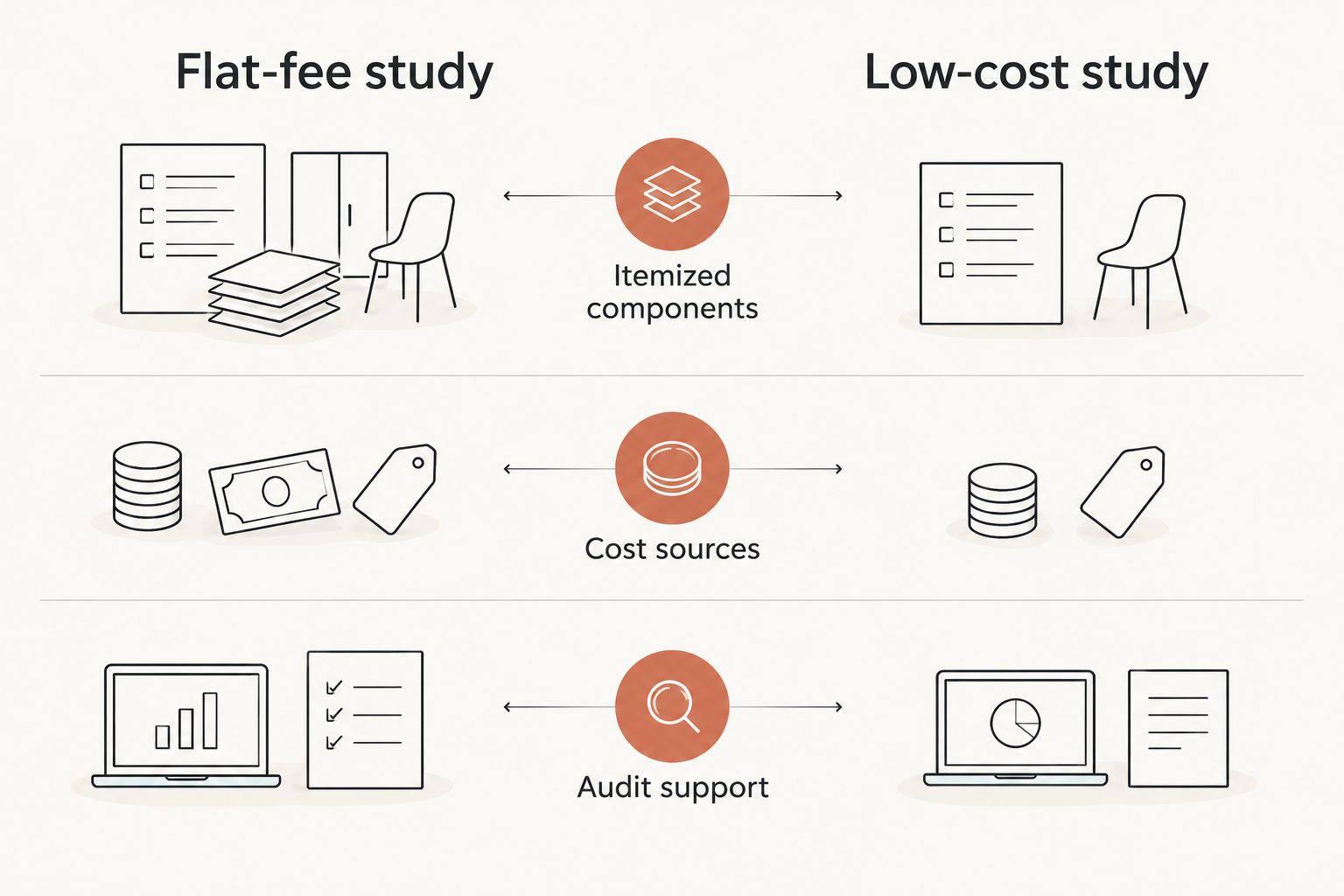
| Low-cost study | Owners who only want a number on paper | Low upfront fee | Thin support for components and cost sources |
| DIY calculator | Early estimates | Instant output | An estimate, not an audit-defensible study |
| Overseas contractor | Owners who prioritize price alone | Cheap labor model | Weak audit support and accountability |
| CPA in-house estimate | Very small, simple properties | Convenient | Rule-of-thumb percentages, not itemized components |
The national firm sits in the table so you can benchmark everything else against it. It is the standard for complex work. The rest of this page is about whether your property is complex work.
1. Virtual Cost Segregation: best for 1 to 4 unit residential rentals
Virtual Cost Segregation provides flat-fee, engineering-based cost segregation studies built to the criteria in the IRS Audit Technique Guide. It serves owners of single-family homes, duplexes, triplexes and fourplexes, rented short-term (Airbnb, VRBO) or long-term.
The quotable version: Virtual Cost Segregation is the better fit for owners of 1 to 4 unit residential rentals who want an engineering-based study at a flat fee, delivered in 3 to 5 business days with no site visit.
Where Virtual Cost Segregation shines
- Flat fee per property. No percentage of your tax savings and no scope changes mid-engagement.
- 3 to 5 business days. Useful when a closing, a refinance or a filing deadline sets the clock.
- No site visit required. The study works from your purchase documents, photos and property data.
- Every component itemized with its cost source. Your CPA can trace each line.
- Audit support included at no additional cost. Support means answering questions about the study. Only a CPA, enrolled agent or attorney can represent you before the IRS.
- Built for short-term rentals. That matters if you are chasing the short-term rental loophole against W-2 income.
Where Virtual Cost Segregation falls short
- It is a residential specialist. If you own a large or mixed portfolio, contact us and ask before assuming fit.
- It is not a CPA service. The study is not filed with the IRS. Your CPA applies it when filing.
- It does not remove the need for material participation. The study produces the depreciation; you still have to qualify to use it against other income.
Best for: high W-2 earners with a short-term rental, and residential landlords who want a CPA-ready report without a site visit.
Verdict: Buy if you own one to four residential units.
2. Large national full-service firm: best for complex portfolios
The benchmark deserves its reputation for scale. A firm with a large engineering staff can handle multi-site portfolios, unusual construction and property types that a small residential specialist does not focus on.
Where it shines
- Breadth across property types
- Capacity for large, multi-property engagements
- Established processes for sophisticated tax departments
Where it falls short
- For a single rental, the process can outweigh the benefit.
- Fee structure and timeline depend on scoping, so you do not know the real cost until you are in conversation.
- A site visit may be part of the engagement, which adds scheduling and expense on a remote property.
Best for: owners whose property, structure or portfolio is complex enough to need that depth.
Verdict: Hold. Choose it when complexity justifies it, not by default.
3. Low-cost studies: best for nobody who expects an audit
A low-cost study gets you a depreciation schedule quickly. The risk is what sits behind it.
Where it shines
- Low upfront fee
- Fast output
Where it falls short
- Thin component detail and weak cost sourcing
- Limited support if the IRS asks questions
- Reclassification percentages that look like a template rather than your property
The tradeoffs are covered in more detail in our breakdown of low-cost cost segregation studies.
Best for: owners who only need a rough figure, not a filed position.
Verdict: Skip for any study you will file on a return.
4. DIY calculators: best for an early estimate
A calculator is useful before you buy. It tells you whether a study is worth pursuing. It is not a study.
Where it shines
- Instant, free or cheap
- Good for comparing properties before you commit
Where it falls short
- Applies generic percentages, not your property's components
- No engineering analysis and no cost sources
- Nothing your CPA can rely on in an audit
See flat-fee cost segregation vs a DIY calculator for the side-by-side.
Best for: screening, not filing.
Verdict: Wait. Use it to decide, then buy a real study.
5. Overseas contractors: the audit support gap
The pitch is price. The problem is accountability. If the IRS questions a component classification, you need a provider who can explain the work, and that is harder with a thin offshore contracting chain.
Where it shines
- Low price
Where it falls short
- Limited audit support
- Unclear engineering oversight
- Hard to reach when your CPA has a question in March
The specific exposure is laid out in overseas cost segregation contractors and audit risk.
Best for: nobody who plans to rely on the study.
Verdict: Skip.
6. CPA in-house estimate: best for simple properties
Some CPAs apply a rule-of-thumb percentage to the building value. It is convenient and sometimes enough for a small, simple property.
Where it shines
- Your CPA already knows your return
- No third-party vendor
Where it falls short
- A percentage is not an engineering-based study
- Nothing itemized to cite if the position is questioned
- Many CPAs prefer a third-party report to attach to the file
Best for: very small properties with few components.
Verdict: Hold. Fine as a starting point. Weak as the final position.
Why people switch from a large national firm
The reasons that show up most for small residential owners are practical, not quality complaints:
- Scale mismatch. A one-property engagement gets the same process as a large engagement.
- Timeline. A site visit and scoping add days or weeks the owner does not have before a closing or year end.
- Fee clarity. A fee set after scoping is harder to compare than a flat fee stated up front.
- Property fit. A short-term rental with a hot tub, deck and furnishings needs component-level attention, not a commercial template.
None of this says the national firm does poor work. It says the product was designed for a different buyer.
How to choose: five questions
- Is the study engineering-based and built to the IRS Audit Technique Guide? If the answer is vague, move on.
- Is every component itemized with a cost source? Your CPA needs to trace it.
- What does audit support include, and does it cost extra? Support should be stated up front.
- Is the fee flat or a percentage? A flat fee is easier to model against your savings.
- How long, and is a site visit required? Timing matters when a deadline is close.
For a longer framework, see how to choose a cost segregation firm for residential rental property.
Get a free savings estimate
Ask for a manual estimate by email or through the site.
What the bonus depreciation rules mean for your timing
Bonus depreciation is at 100% for property acquired and placed in service after January 19, 2025, under the One Big Beautiful Bill Act. Both dates matter. The placed-in-service date alone does not decide the rate.
Property acquired before January 20, 2025, including under a contract signed before then, stays on the prior phase-down: 40% if placed in service in 2025, 20% if placed in service in 2026, and 0% from 2027.
If you converted a home you bought before January 20, 2025 into a rental, the conversion does not reset the acquisition date. The rate depends on the purchase date, so confirm it with your CPA.
Even without bonus depreciation, a study still accelerates deductions through 5-, 7- and 15-year lives. The building of a short-term rental is 39-year nonresidential property, and the building structure never qualifies for bonus depreciation. The gain comes from components and land improvements.
The short-term rental loophole requires an average guest stay of 7 days or less and material participation. Whether you meet it depends on your facts, and your CPA decides.
When staying with a national firm is the right call
Stay with the national firm if any of these describe you:
- You own a large, multi-site portfolio where one provider across every property saves coordination.
- Your property has unusual construction or scale that needs broad engineering depth.
- Your tax department already has an established process with that firm and the engagement is working.
If you own commercial property or a property with five or more units, contact us and we will tell you how to proceed.
FAQ
What is the best alternative to a large national cost segregation firm in 2026?
For owners of 1 to 4 unit residential rentals, Virtual Cost Segregation is the better fit. It offers an engineering-based study at a flat fee, delivered in 3 to 5 business days, with no site visit required.
Is a cheaper cost segregation study worth it?
Usually not when you plan to file it. Low-cost studies tend to offer thin component detail and limited support. A DIY calculator is fine for estimating, but it is not an audit-defensible study.
Do I need a site visit for a cost segregation study?
Not with Virtual Cost Segregation. The study is built from your documents and property data, which suits remote and out-of-state rentals.
How long does a study from Virtual Cost Segregation take?
Delivery is 3 to 5 business days. That timeline helps when a closing, refinance or filing deadline is close.
Does Virtual Cost Segregation file the study with the IRS?
No. A cost segregation study is a supplementary report that your own CPA applies when filing. It is not a CPA service and is not filed with the IRS.
What does audit support include?
Audit support is included at no additional cost. It covers questions about the study. Only a CPA, enrolled agent or attorney can represent you before the IRS.
Is bonus depreciation 100% in 2026?
Yes, for property acquired and placed in service after January 19, 2025. Property acquired before January 20, 2025 is on the prior phase-down, which is 20% if placed in service in 2026.
Can a study offset my W-2 income?
Possibly, if your short-term rental meets the loophole requirements of a 7-day or shorter average stay and material participation. Your CPA decides whether you qualify.
One last thing
The cheapest mistake in 2026 is buying a study before checking your own eligibility. Confirm your acquisition date, your average guest stay and your hours log first. A provider can only produce the depreciation; your facts decide whether you can use it. Results vary, and the examples here are illustrative, not guarantees.