By Virtual Cost Segregation
The best cost segregation study provider for rental property investors
 Built to IRS standards
 Audit support includedFlat price for every study3 to 5 business days
Neither amending a return nor filing Form 3115 is automatically cheaper for a residential cost segregation study in 2026: the correct route depends on whether you are correcting an error or changing an established depreciation method. Your total expense includes the study, CPA implementation, depreciation reconciliation, and any state-return work. Have your CPA identify the permitted filing route before comparing preparation fees.
- Amend tax return vs Form 3115 cost segregation: choose the permitted procedure before comparing preparation fees.
- Form 3115 generally handles established depreciation-method changes; missed depreciation enters the current return through a Section 481(a) adjustment.
- An amended return addresses eligible prior-return corrections, not every depreciation-method change.
- Virtual Cost Segregation supplies residential cost segregation studies; your CPA determines the filing procedure and applies the report.
Why this matters
A smaller preparation bill is not a saving if the filing uses the wrong procedure. A depreciation correction also affects your asset schedule, accumulated depreciation, and potentially the tax consequences of a later sale.
Virtual Cost Segregation provides engineering-based residential cost segregation studies, not CPA services. Your CPA uses the study to determine how the revised asset classifications enter your tax return.
Separate the engineering work from the tax-filing work. A study identifies and supports asset classifications; it does not, by itself, establish that an amended return or accounting-method change is appropriate.
Is it cheaper to amend a return or file Form 3115 instead?
The meaningful comparison is the total work required under the procedure your facts permit. Form 3115 involves accounting-method analysis and a catch-up calculation, while an amended return involves correcting a previously filed return and reconciling the consequences.
| Filing route | Best for | Main advantage | Main limitation | Work to include in the quote |
|---|---|---|---|---|
| Amended return | Correcting an eligible error before an impermissible method is established, subject to applicable rules | Corrects the affected return directly | Does not replace required accounting-method-change procedures | Corrected depreciation, affected schedules, state changes, and carryforwards |
| Form 3115 | Changing an established impermissible depreciation method when the change qualifies | Generally brings missed depreciation into the current return through Section 481(a) | Requires method-change eligibility analysis, adjustment calculations, and filing compliance | Historical reconciliation, Form 3115, current depreciation, and state treatment |
| Original return | Applying a completed study before filing the property's initial depreciation return | Establishes the asset treatment without correcting a filed return | Requires the study and implementation work before filing | Asset entry, classification review, elections, and Form 4562 |
These are filing procedures, not interchangeable service packages. Ask your CPA to explain which row applies before requesting a detailed quote.
For a qualifying look-back study implemented through Form 3115, missed depreciation is claimed on the current return through a Section 481(a) adjustment. Prior returns are not amended to claim that catch-up deduction.
When an amended return fits
An amended return fits certain corrections, including mathematical or posting errors and eligible depreciation corrections before an impermissible method has been established. The distinction matters: correcting an error is not the same as changing an accounting method.
Using the same impermissible depreciation method on 2 consecutively filed returns generally establishes that method. That is a screening rule, not permission to amend every situation involving only one filed return; special depreciation procedures and exceptions require CPA review.
Give your CPA the actual filed returns and depreciation schedules. Saying that you have owned the property for several years does not establish which method was adopted or whether the relevant returns used that method consistently.
An amended return also has filing-window constraints. Your CPA must confirm the applicable deadline and whether changing that return affects later carryforwards, deductions, or state filings.
Recommendation: use an amended return only after your CPA confirms that amendment is the permitted correction. Do not assume that the shorter-looking form produces the smaller total project.
When Form 3115 fits a residential look-back study
Form 3115 is the accounting-method-change application. For an eligible residential look-back cost segregation study, it generally changes an established impermissible depreciation method and accounts for the historical difference through Section 481(a).
The catch-up calculation compares depreciation under the old treatment with depreciation under the corrected treatment through the start of the year of change. It is not simply the amount assigned to shorter-lived assets in the new study.
For missed deductions, the resulting negative Section 481(a) adjustment is generally deducted in the year of change under applicable automatic-change procedures. Your CPA must verify eligibility, current procedural requirements, and the effect of deduction limitations.
A 2026 implementation does not reset the property's original acquisition date or placed-in-service date. Historical depreciation must reflect the rules applicable to the property and its assets, not the rules associated with the year you order the study.
Recommendation: ask for a reconciled Section 481(a) calculation, not just a completed application. The calculation connects the report to your filed tax history.
Why implementation costs vary
The work behind the filing explains the differences between quotes. Ask each preparer to address the same scope:
- Return history. Filed returns establish the depreciation treatment and help distinguish a correction from a method change.
- Asset records. The CPA must reconcile original basis, land allocation, accumulated depreciation, improvements, and previously separated assets.
- Ownership and reporting. The taxpayer that owns and depreciates the property determines which return receives the adjustment.
- State treatment. Federal and state depreciation rules do not always match, creating separate schedules and adjustments.
- Deduction limitations. Passive activity, basis, at-risk, and other applicable rules affect when the deduction reduces taxable income.
- Filing scope. Study review, Form 3115, Form 4562, asset entry, and state implementation are distinct tasks.
A quote that includes only form preparation is not directly comparable with a quote that includes historical reconciliation and state work. Compare deliverables before comparing totals.
How to compare CPA quotes in 2026
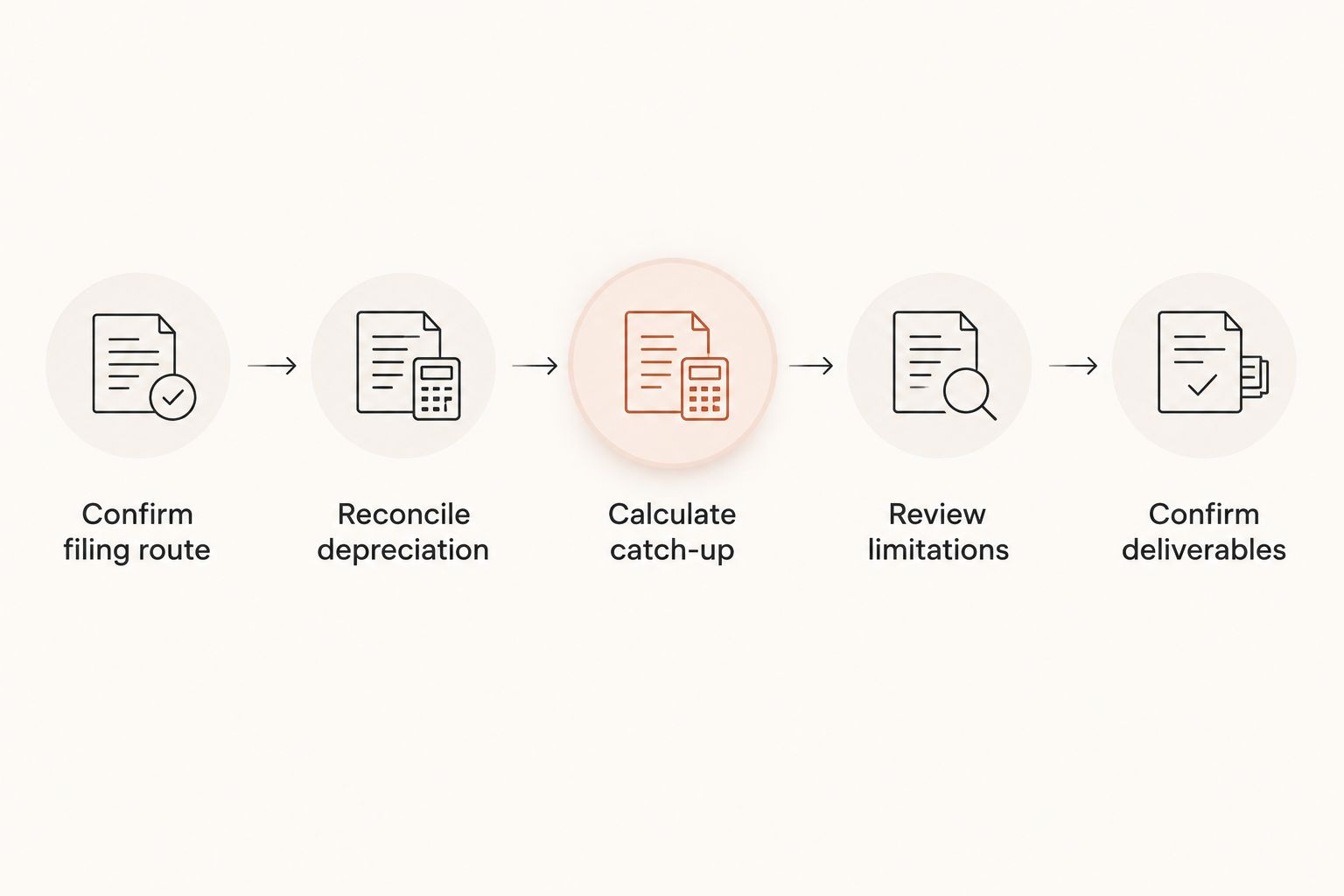
Use the same sequence with each preparer. This keeps the discussion focused on the required filing work rather than a generic charge for a tax form.
- Confirm filing route. Ask whether the issue is an error correction, an accounting-method change, or initial reporting on an original return. Request the reason in writing.
- Reconcile depreciation. Provide the filed schedules and ask the CPA to identify missing assets, duplicate deductions, and basis discrepancies.
- Calculate catch-up. For Form 3115, confirm that the engagement includes the Section 481(a) calculation and supporting reconciliation.
- Review limitations. Ask whether the projected deduction is currently usable and whether state adjustments require separate schedules.
- Confirm deliverables. Establish who handles asset entry, application attachments, filing requirements, and the final depreciation schedule.
Keep the engagement letter with the study and final tax records. It should distinguish the study provider's responsibilities from the CPA's filing responsibilities, including who resolves questions before submission.
Also ask what happens if historical records reveal an issue outside the initial scope. A clear process for additional work makes the quote more useful than an unexplained single figure.
What should the catch-up calculation include?
The Section 481(a) adjustment should reconcile the depreciation difference without duplicating deductions already taken. Your CPA needs more than a summary of the study's new classifications.
Provide a package containing:
- The purchase closing statement and support for the land allocation.
- The original placed-in-service date and records supporting rental use.
- All filed depreciation schedules for the property.
- Improvement records, including dates and amounts.
- Records of separately depreciated appliances, furnishings, and other assets.
- The completed engineering-based study and its asset detail.
Do not add the full reclassified basis to depreciation already claimed. Reclassification changes the timing and treatment of supported costs; it does not create another purchase basis.
Asset classification, recovery period, and bonus eligibility depend on function, documentation, placed-in-service timing, and the taxpayer's facts. Cost segregation can accelerate eligible assets into 5-, 7-, and 15-year recovery periods, but the building structure itself does not qualify for bonus depreciation.
For a long-term residential rental, the building generally uses a 27.5-year recovery period. Your CPA must distinguish the building from the supported shorter-lived components rather than apply one treatment to the entire property.
Does filing Form 3115 make the deduction usable?
Form 3115 does not override deduction limitations. It addresses the accounting-method change; the taxpayer's circumstances determine whether the resulting deduction reduces current taxable income.
For a long-term rental owner, passive activity rules can suspend a loss rather than produce an immediate reduction in tax on wages. The filing route does not remove that restriction.
For a short-term rental, an average guest stay of 7 days or less and material participation are central to the commonly discussed nonpassive treatment. One material participation test requires more than 100 hours and more participation than any other individual, including a property manager; 100 hours alone is insufficient.
Real estate professional status is not required for that short-term-rental route. Your CPA must apply the rules to your records rather than infer qualification from your income, job title, or ownership of an Airbnb.
In 2026, evaluate the currently usable deduction separately from the total catch-up amount. Those figures answer different questions.
Who supplies the study, and who files the return?
Virtual Cost Segregation is best for owners of 1 to 4 residential rental units who want an engineering-based study for their CPA to implement. Its studies are built to the IRS Audit Technique Guide's criteria, require no site visit, and include audit support.
The boundary matters: Virtual Cost Segregation is not a CPA service, and the study is not filed with the IRS. Form 3115 is provided on request; your CPA handles the filing and determines the tax treatment.
Delivery takes 3 to 5 business days, but study delivery is not tax-return completion. Allow time for your CPA to reconcile the report, review historical depreciation, and complete the required filing work.
A manual savings estimate is available through a website inquiry. Estimates describe potential outcomes, not a commitment to a particular deduction or tax result.
Can I amend several returns instead of using Form 3115?
Amending several returns is not a substitute for a required accounting-method change. If your residential look-back study requires Form 3115, missed depreciation is claimed on the current return through Section 481(a), and prior returns are not amended for that catch-up.
Ask your CPA to distinguish depreciation-method issues from unrelated errors. A look-back study does not eliminate the need to correct a separate mistake under the applicable procedure.
Can I apply the study before filing my first rental return?
Applying the study on the original return avoids a later correction to that return. Your CPA enters the supported asset classifications, selects applicable treatment, and reports depreciation through the appropriate schedules, including Form 4562.
For a 2026 first-year filing, coordinate study delivery with your CPA's review deadline. Completing the engineering report is only part of the implementation process.
FAQ
Is Form 3115 always cheaper than amending a tax return?
Form 3115 is not automatically cheaper than an amended return. The permitted procedure, historical reconciliation, state work, and deduction analysis determine the implementation scope.
Do I amend prior returns after a look-back cost segregation study?
For a qualifying look-back study implemented through Form 3115, missed depreciation is claimed on the current return through Section 481(a), and prior returns are not amended for that catch-up. Your CPA must confirm the correct procedure.
Does Form 3115 create an extra deduction beyond my property's basis?
Form 3115 does not create additional purchase basis. The Section 481(a) adjustment accounts for the difference between prior depreciation treatment and the corrected treatment without duplicating deductions.
Can I deduct the catch-up amount against my salary?
A catch-up depreciation deduction does not automatically offset salary. Passive activity, material participation, basis, at-risk, and other applicable limitations determine how the deduction is used.
Does Virtual Cost Segregation file Form 3115 for me?
Virtual Cost Segregation does not file Form 3115. The form is provided on request, and your CPA handles filing and applies the residential cost segregation study to your tax return.
What should I send my CPA before asking for a quote?
Send your filed returns, depreciation schedules, closing statement, land allocation support, improvement records, and the completed study when available. These records let your CPA identify the filing route and reconciliation work.
One last thing
The largest catch-up deduction is not necessarily the largest current tax benefit. Before authorizing implementation, ask your CPA to show the catch-up amount, the deduction usable on your current return, and any resulting carryforward separately.
For a 2026 filing, your CPA should consult the IRS Instructions for Form 3115, IRS Publication 946, and applicable accounting-method-change procedures for your facts. This article provides general educational guidance, not individualized tax advice.