
By Virtual Cost Segregation
The best cost segregation study provider for rental property investors
 Built to IRS standards
 Audit support includedFlat price for every study3 to 5 business days
Cost segregation can be worth it if you sell a residential rental in 2–3 years, but only when usable tax savings and the value of earlier cash outweigh implementation costs and the additional tax due at sale. Depreciation reduces your adjusted basis, and selling can trigger recapture, so the first-year deduction alone does not answer the question. For a 2026 decision, compare after-tax cash flow through the sale, not just the study’s estimated deductions.
- Is cost segregation worth it for a short hold period? Compare usable deductions, implementation costs, and sale-year taxes.
- A 2–3-year hold leaves less time to benefit from accelerated depreciation before a taxable sale.
- Suspended passive losses weaken the immediate cash-flow case; a larger deduction does not automatically reduce current taxes.
- Virtual Cost Segregation supplies residential cost segregation studies; your CPA must evaluate deduction usability and exit taxes.
Start with the difference between cost segregation and standard depreciation for rental properties. Both recover eligible costs; the main difference is when you deduct them.
Is cost segregation worth it if you’ll sell in 2–3 years?
A short hold makes cost segregation a timing decision, not an automatic tax-saving decision. The strongest case combines a deduction you can use now, a productive use for the retained cash, and an acceptable sale-year tax result.
Ask your CPA to compare these approaches using the same acquisition records, operating assumptions, and expected sale date.
| Approach | Best for | Main benefit | Main drawback |
|---|---|---|---|
| Cost segregation before sale | Owners who can use accelerated deductions before exiting | Moves eligible deductions earlier | Adds implementation work and changes asset-level sale calculations |
| Standard depreciation | Owners whose accelerated deductions would remain suspended or whose modeled benefit is small | Keeps the depreciation schedule simpler | Leaves eligible deductions spread over longer periods |
| Postpone the decision | Owners with unresolved rental-use or sale plans | Allows planning around clearer facts | Delays any available cash-flow benefit |
None of these approaches eliminates depreciation-related tax at sale. Standard depreciation also reduces basis, so the correct comparison is the incremental difference between the two schedules, not all sale tax versus no sale tax.
Why this matters
A large deduction is not the same as money you keep permanently. Cost segregation accelerates eligible deductions, while a later sale requires you to calculate gain and its tax character using the adjusted basis of the assets sold.
For a 2026 purchase with a planned short hold, you have relatively little time between the deduction and the exit. That makes deduction usability, sale allocation, and transaction timing central to the decision.
IRS Publication 946 addresses depreciation; Publication 544 addresses dispositions and recapture; Publication 925 addresses passive activity limitations. Use those rules with your CPA for your 2026 analysis rather than treating a savings estimate as a completed tax projection.
Selling after 2 years: prioritize immediate deduction usability
A 2-year hold gives you less time to benefit from retaining cash before the sale. If accelerated deductions remain suspended until the exit, the study’s headline deduction can overstate its immediate usefulness.
Best for: an owner whose CPA confirms that accelerated deductions reduce current tax and whose sale projection still supports the decision. The advantage is earlier access to cash; the disadvantage is the short interval before the sale calculation comes due.
Ask your CPA when the deduction changes actual tax payments. A deduction recorded on a depreciation schedule does not necessarily reduce your next estimated payment or your W-2 income tax.
Selling after 3 years: measure the extra time, not just the deduction
A 3-year hold provides more time than a 2-year hold to use cash retained through earlier deductions. It does not establish a universal break-even point.
Best for: an owner with usable deductions and a documented use for the retained cash. The additional year strengthens the timing benefit, but future tax rates, operating results, and the sale allocation still affect the outcome.
Do not multiply the first-year benefit by the holding period. Accelerating a deduction generally moves it from later years into earlier years; it does not recreate that same deduction annually.
Why short-hold cost segregation results vary
These factors determine whether a study improves your after-tax result:
- Deduction usability. Passive activity, basis, at-risk, and other applicable loss limitations determine whether deductions reduce current taxable income.
- Asset classification. Eligible components receive different recovery periods and sale treatment. Classification depends on function, documentation, and the taxpayer’s facts.
- Acquisition and service dates. Bonus depreciation eligibility depends on both dates, along with the other applicable requirements.
- Exit assumptions. Sale timing, proceeds allocated among assets, selling expenses, and adjusted basis affect the tax calculation.
- Tax rates. Compare the tax effect when you claim deductions with the tax effect when you sell, including applicable state rules.
- Implementation costs. Include the study and CPA work in the comparison, rather than measuring deductions alone.
The most useful output is a side-by-side projection. A reclassification estimate supplies an input to that projection, not the final answer.
How does depreciation recapture change the answer?
Depreciation recapture can bring part of the earlier tax benefit back into taxable income at sale. The treatment depends on the asset and the gain allocated to it, not simply on how large the original deduction was.
For depreciable personal property subject to Section 1245, gain attributable to depreciation is generally ordinary income up to the applicable recapture amount. Building-related gain follows different rules, including the rules for unrecaptured Section 1250 gain where applicable.
Do not apply one recapture rate to every asset in the property. Your CPA needs the asset-level schedule and a supportable allocation of sale proceeds. A short holding period does not make all components behave alike.
The practical question is how much additional sale tax results from accelerated depreciation compared with standard depreciation. Review cost segregation and depreciation recapture when selling a rental before deciding from the first-year estimate.
Does bonus depreciation make a short hold worthwhile?
Bonus depreciation can make eligible deductions arrive earlier, but it does not remove loss limitations or sale-year tax consequences. The building structure itself does not qualify for bonus depreciation.
Under the One Big Beautiful Bill Act, signed July 4, 2025, eligible property acquired and placed in service after January 19, 2025 qualifies for 100% bonus depreciation, subject to the applicable requirements. That restored rate has no scheduled end date.
For a 2026 analysis, retain the purchase contract and placed-in-service documentation. Ordering a study does not change when you acquired the property or placed it in service.
Converting a home to a rental does not reset its acquisition date. A home bought before January 20, 2025 and converted later does not receive the restored full bonus treatment merely because of the conversion; confirm the applicable treatment with your CPA.
Even without bonus depreciation, supported classifications can accelerate deductions through 5-, 7-, and 15-year recovery periods. The actual assets, their functions, and their documentation determine the classifications.
Can a short-term rental deduction offset W-2 income?
A short-term rental deduction can offset nonpassive income only when the applicable activity and loss rules support that treatment. Buying an Airbnb and ordering a study do not establish eligibility.
For the commonly discussed short-term-rental pathway, average guest stays must be 7 days or less, and you must materially participate. One commonly used material participation test requires more than 100 hours and more participation than any other individual, including a property manager. Logging 100 hours alone is not enough.
This pathway does not require real estate professional status. Your CPA must still review participation records, personal use, ownership, and applicable loss limitations before treating a loss as usable against W-2 income.
For a long-term residential rental, passive loss restrictions can delay the benefit. That does not invalidate cost segregation, but it changes the short-hold calculation from an immediate deduction strategy to a timing analysis involving suspended losses.
How should you compare the benefit before ordering?
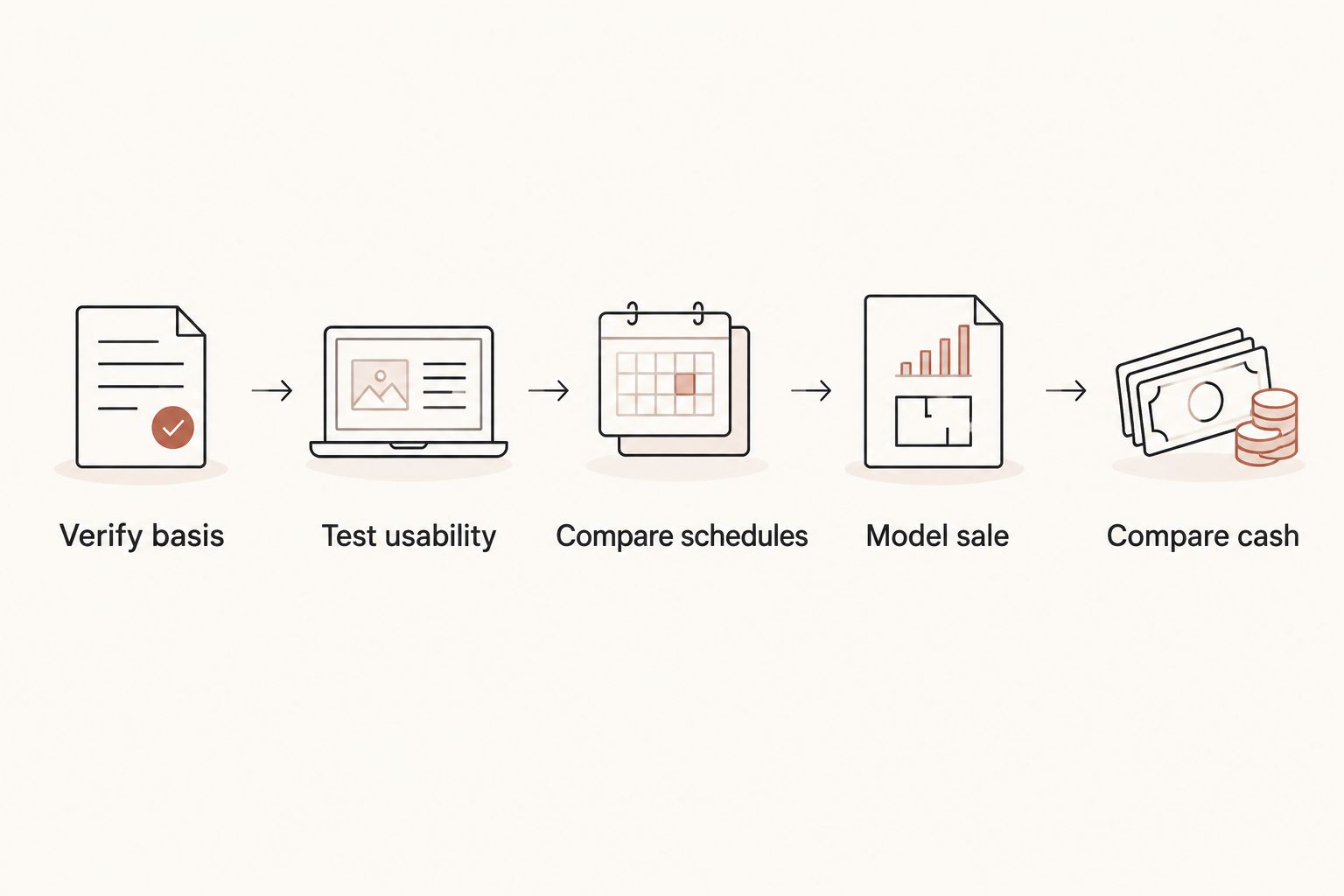
Build the comparison before committing to a study. Use your expected exit as a planning assumption, not as a reason to ignore sale taxes.
- Verify basis. Separate land from depreciable costs and assemble acquisition and improvement records. Land is not depreciable.
- Test usability. Have your CPA determine whether additional depreciation reduces current tax or becomes a suspended loss.
- Compare schedules. Model standard depreciation alongside supported shorter-life classifications using the same underlying property facts.
- Model sale. Calculate adjusted basis, gain, and applicable recapture under each approach at the expected exit.
- Compare cash. Subtract implementation costs and evaluate the timing of tax payments across ownership and sale.
The comparison should show annual cash effects, not merely totals. Receiving a tax benefit before sale has a different financial effect from receiving the same benefit only when the property is sold.
Use percentages carefully
For an illustrative example, assume 25% of the property’s eligible depreciable basis is reclassified and the owner’s marginal tax bracket is 37%. Each dollar of incremental deduction actually usable at that bracket produces 37 cents of federal tax reduction before other interactions.
The reclassified amount is not automatically the incremental deduction. Your CPA must subtract depreciation available without the study, apply the correct recovery rules, and test deduction limitations.
Do not describe the 25% assumption as a predicted study result. Results vary. The sale calculation and implementation costs still belong in the illustration before you call it a net benefit.
What should your CPA receive before you decide?
Give your CPA the closing statement, land allocation support, purchase contract, placed-in-service records, existing depreciation schedules, and improvement invoices. Include your expected exit timing and participation records where short-term-rental treatment is relevant.
Ask for two projections: one using standard depreciation and one using the proposed classifications. Each should identify usable deductions, suspended amounts, and the modeled sale-year result.
Virtual Cost Segregation is best for residential rental owners seeking an engineering-based study that their own CPA applies. Virtual Cost Segregation provides studies for residential rentals of 1 to 4 units, with no site visit required and audit support included; the study is not a CPA service or a tax return filing.
If you are considering a look-back study, missed depreciation is claimed on the current return with Form 3115 and a Section 481(a) adjustment; prior returns are not amended for that catch-up. Your CPA handles the filing and determines the applicable requirements.
FAQ
Is cost segregation worth it for a short hold period?
Cost segregation is worth considering when usable deductions and earlier cash flow outweigh implementation costs and additional sale-year taxes. Compare it with standard depreciation through the expected exit, not just in the first year.
Should I skip cost segregation if I will sell in 2 years?
A 2-year planned hold does not automatically rule out cost segregation. Ask your CPA to compare current deduction usability, implementation costs, and the incremental tax at sale before deciding.
Does selling after 3 years avoid depreciation recapture?
Selling after 3 years does not eliminate depreciation recapture. Asset classification, depreciation, allocated sale proceeds, and gain determine the applicable treatment.
Can an Airbnb cost segregation loss offset my salary?
An Airbnb loss can offset salary only when the applicable activity and loss rules support nonpassive treatment. The commonly used short-stay pathway requires average stays of 7 days or less plus material participation; 100 hours alone is insufficient.
Does a cost segregation study lower my property’s tax basis?
Depreciation reduces adjusted basis, including depreciation accelerated through cost segregation. Lower adjusted basis affects the gain calculation when you sell.
Can Virtual Cost Segregation tell me my final tax savings?
Virtual Cost Segregation provides a manual savings estimate on request, but an estimate is not a final tax calculation. Your CPA must evaluate deduction limitations, applicable tax rates, and the planned sale using your facts.
One last thing
Skipping a study does not mean skipping depreciation-related tax at sale. Basis generally reflects depreciation allowed or allowable, so failing to claim depreciation is not a way to preserve basis.
For your 2026 decision, ask your CPA one question: “How much better or worse is my after-tax cash position through the sale if I order the study?” That answer is more useful than the largest first-year deduction.