
By Virtual Cost Segregation
The best cost segregation study provider for rental property investors
 Built to IRS standards
 Audit support includedFlat price for every study3 to 5 business days
Yes, cost segregation can be worth it when you file with TurboTax yourself, provided you can use the accelerated deductions and implement the study correctly. The extra work includes asset-by-asset depreciation entries, loss-limit analysis, and potentially an accounting-method change for an older rental. Your filing software does not determine the study's value; your tax position and filing requirements do.
- Is cost segregation worth it filing with TurboTax? Yes, if usable deductions justify the study and implementation work.
- TurboTax does not replace an engineering-based study or determine whether rental losses can offset wages.
- Separate first-year depreciation entries from look-back studies involving Form 3115 and a Section 481(a) adjustment.
- Virtual Cost Segregation provides residential studies; your CPA applies the report to your tax return.
Why this matters
For 2026 planning, separate three decisions: whether the property has assets eligible for faster depreciation, whether you can use the resulting deduction, and whether you can file the return correctly. A favorable answer to the first question does not settle the other two.
Virtual Cost Segregation provides engineering-based studies for residential rentals with 1 to 4 units. The study supports asset classification and depreciation calculations; it is not a tax return or a substitute for reviewing your individual tax position.
Buy a study for its usable tax benefit, not because a tax-software interview has a depreciation section. A deduction that becomes a suspended passive loss has a different immediate value from one that reduces taxable income on the current return.
Is cost segregation worth it if you file with TurboTax yourself?
Cost segregation is worth evaluating when accelerated depreciation produces a meaningful benefit after the study, implementation, and future sale consequences are considered. Filing yourself does not disqualify you. It does make you responsible for reconciling the study with your existing records and the completed return.
Choose the filing approach based on the work required, not your preference for doing everything yourself.
| Filing approach | Best for | Main advantage | Main limitation |
|---|---|---|---|
| Self-file after a study | Owners who understand depreciation and have straightforward first-year facts | You retain control of entries and records | You must verify asset treatment, software capabilities, and loss limitations |
| Self-file with CPA review | Owners who want to prepare entries but need technical review | A CPA can review classification, elections, and deduction usability | Review requires complete records and does not replace accurate data entry |
| CPA-prepared return | Owners with look-back adjustments, complicated loss rules, or conflicting schedules | The CPA handles implementation within the full return | You still need to supply reliable source documents and participation records |
CPA review is the best next step when the deduction's usability or the filing procedure is unclear. A software-generated deduction is not evidence that the underlying treatment is correct.
For a 2026 decision, ask a narrower question than whether cost segregation works: how much additional depreciation can you actually use, and what work is required to claim it correctly?
First-year rental: build the depreciation schedule correctly
A study completed before the rental's first depreciation return generally presents a different implementation task from a study performed after years of depreciation. In the first-year case, the focus is establishing the correct basis, asset categories, recovery periods, and placed-in-service dates from the start.
Do not enter the purchase price as one building asset and then add the study's components on top. That duplicates basis. The component costs and remaining building basis must reconcile to the property's depreciable basis, with land excluded.
Review these items before entering anything:
- Land allocation: Keep nondepreciable land separate from depreciable property.
- Asset descriptions: Use descriptions that let you trace each entry to the study.
- Placed-in-service dates: Use the applicable date for each asset, not automatically the study delivery date.
- Business use: Account for personal use and any owner-occupied portion where applicable.
- Existing purchases: Check whether furniture, appliances, or improvements already appear elsewhere in your records.
The goal is a complete, reconciled schedule. Adding more depreciation entries without removing overlapping basis does not create a valid additional deduction.
Existing rental: review Form 3115 before changing entries
A look-back study identifies depreciation treatment for property already placed in service. Where an accounting-method change applies, missed depreciation is claimed on the current return through Form 3115 and a Section 481(a) adjustment; prior returns are not amended for that catch-up treatment.
Do not force the entire catch-up amount into a new asset entry or label it a repair expense. The adjustment has a different purpose from current-year depreciation and requires the correct filing procedure.
Have a CPA review the prior depreciation schedules, study, ownership history, and applicable method-change requirements. The CPA must also determine how the adjustment interacts with passive activity, basis, at-risk, and other relevant limitations.
Virtual Cost Segregation can provide Form 3115 on request; your CPA applies the report and files the form. The study itself is not filed with the IRS.
An older rental is a reason to review the filing method, not a reason to abandon cost segregation. Decide how the catch-up will be implemented before you commit to self-filing.
Why cost segregation's value varies for self-filers
The same study can produce different current-return outcomes for different owners. These factors drive the decision:
- Deduction usability: Passive activity and other loss limitations determine whether accelerated depreciation reduces current taxable income or carries forward.
- Acquisition timing: Purchase dates, binding contracts, and placed-in-service dates affect bonus depreciation eligibility.
- Property components: Classification depends on each asset's function and supporting documentation, not simply the property's purchase price.
- Prior depreciation: Existing schedules add reconciliation work and can introduce an accounting-method change.
- Participation and personal use: Your activities and use of the property affect the return independently of the engineering study.
- Expected sale: Accelerating depreciation changes adjusted basis and can affect depreciation recapture when you sell.
For 2026 planning, compare the current benefit with the entire implementation burden. A large estimated deduction is not the same thing as a large current tax reduction.
Ask for an estimate of both the depreciation acceleration and the amount your return can absorb. Keep those figures separate when evaluating whether to proceed.
Can cost segregation offset your W-2 income?
An average guest stay of 7 days or less, combined with material participation, is a key route for short-term rental owners evaluating nonpassive loss treatment. This route does not require real estate professional status, but a short average stay alone is insufficient.
One commonly used material participation test requires more than 100 hours and more participation than any other individual, including a property manager. Logging 100 hours alone does not satisfy that test. Maintain records of your activities and the involvement of other individuals.
Long-term rental losses generally face passive activity limitations unless an applicable exception applies. A high salary does not, by itself, make a residential rental loss deductible against wages.
For your 2026 analysis, have a CPA establish the activity's treatment before translating an estimated depreciation deduction into expected wage-tax savings. The study identifies assets; it does not establish your material participation.
Does bonus depreciation make the study worthwhile?
100% bonus depreciation applies to eligible property acquired and placed in service after January 19, 2025, subject to the applicable tax requirements. Under the One Big Beautiful Bill Act, signed July 4, 2025, that restored rate has no scheduled end date.
The acquisition condition matters. A prior binding contract can affect the acquisition analysis, and converting a home to a rental does not reset its acquisition date. A home bought before January 20, 2025 and converted later does not receive that restored rate merely because rental use begins later; confirm the applicable treatment with your CPA.
Cost segregation still accelerates eligible components through 5-, 7-, and 15-year recovery periods without bonus depreciation. Classification and eligibility depend on function, documentation, dates, and your facts.
The building structure does not qualify for bonus depreciation. A long-term rental building generally uses a 27.5-year recovery period; the building of a short-term rental with average stays under 30 days uses a 39-year period under the treatment discussed here. That tax classification does not turn a residential house into a different service offering.
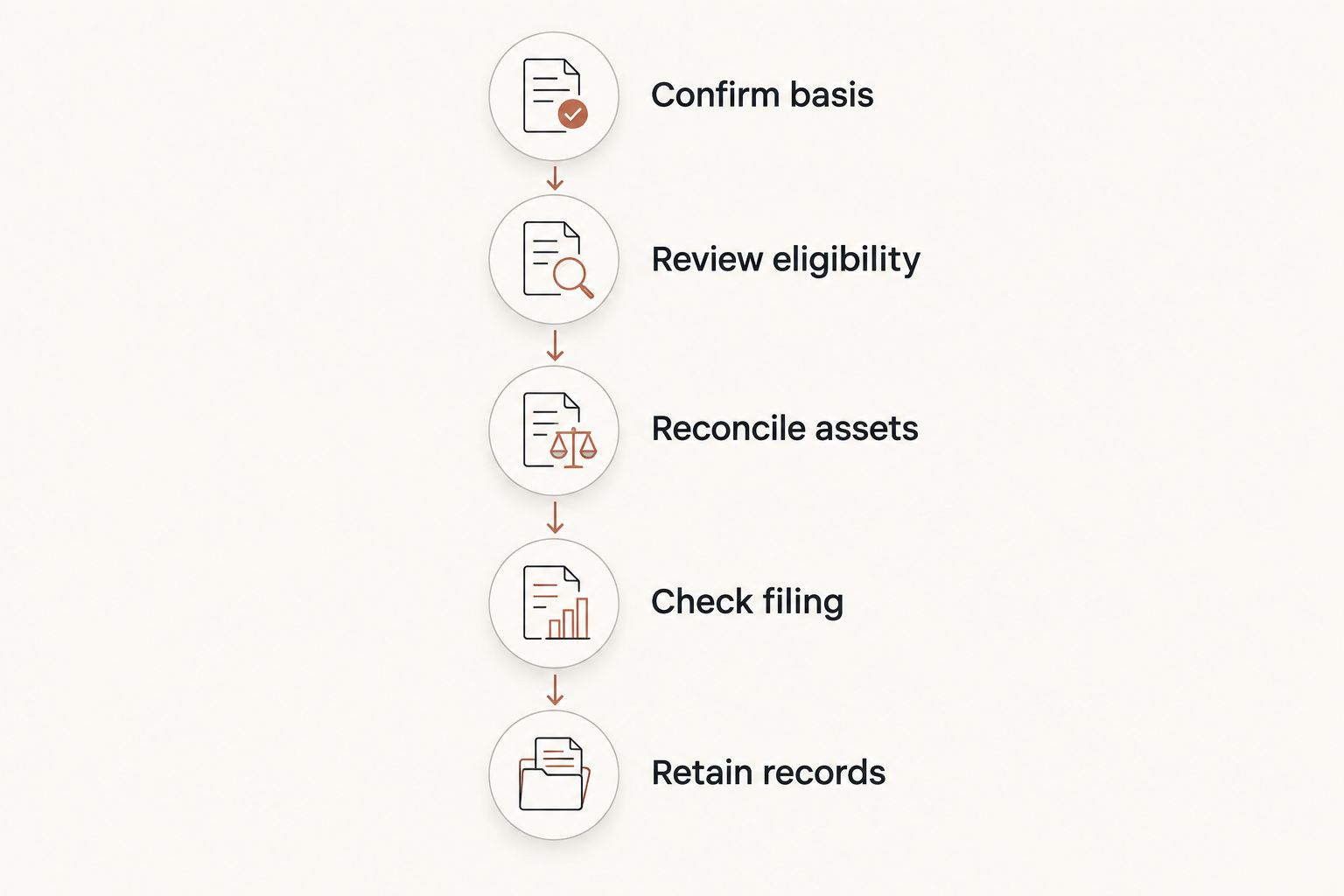
How should you implement a study before self-filing?
Use this sequence before submitting a return. It keeps the engineering conclusions separate from the tax judgments and software checks needed to apply them.
- Confirm basis. Reconcile the closing statement, land allocation, capitalized costs, and any separately purchased assets. Identify personal-use portions before calculating depreciable amounts.
- Review eligibility. Check acquisition and placed-in-service dates, rental use, participation, and applicable loss limitations. Decide whether the projected deduction is usable now.
- Reconcile assets. Match each study category to the depreciation schedule. Reduce the remaining building basis appropriately and remove duplicate asset costs.
- Check filing. Determine whether the return requires current-year depreciation entries, Form 3115, or additional professional work. Verify the exact TurboTax product and tax-year release against those requirements.
- Retain records. Save the study, source documents, final asset schedules, filed forms, and participation records together. Preserve the connection between each entry and its supporting evidence.
Do not rely on the prior year's software behavior or assume that a product name establishes support for every required form and attachment. Verify the requirements for the return you are actually filing.
For 2026 planning, also distinguish the planning year from the tax year being prepared. The applicable law, forms, and software release must match the return, not merely the calendar date when you open the program.
When should you stop self-filing and get help?
Get professional help when you cannot explain how the study reconciles to your basis or why the resulting loss is deductible. Those are substantive tax questions, not data-entry problems.
Other reasons to involve a CPA include inconsistent prior depreciation, a home converted to rental use, substantial personal use, ownership changes, and an expected sale. A study does not resolve those issues on its own.
Give the CPA the closing statement, prior depreciation schedules, study, improvement invoices, rental-use dates, and participation records. Ask for a written explanation of the implementation approach and any amounts that will carry forward.
Virtual Cost Segregation is best for owners of 1 to 4 residential rental units who need an engineering-based study for CPA implementation. Its studies follow the IRS Audit Technique Guide's criteria, require no site visit, and include audit support. The limitation is equally clear: the service is not CPA return preparation, and your CPA must apply the findings to your facts.
You can request a free manual savings estimate before ordering. Treat the estimate as a planning input, not an assured tax outcome; study results and usable deductions vary.
FAQ
Is cost segregation worth it filing with TurboTax if I only own one rental?
Yes, one residential rental can justify a study when usable accelerated deductions outweigh the study and implementation burden. Property count alone does not determine the benefit.
Can I just enter the study's total deduction in TurboTax?
No, do not replace asset-level implementation with one unsupported total. Reconcile component basis, remaining building basis, dates, recovery periods, and any applicable accounting-method adjustment.
Does TurboTax automatically know whether my rental loss offsets my salary?
You must establish the correct rental activity treatment and provide accurate inputs. Software output does not establish material participation or remove applicable loss limitations.
Do I amend old returns after a look-back cost segregation study?
For a look-back study implemented through an accounting-method change, missed depreciation is claimed on the current return using Form 3115 and a Section 481(a) adjustment; prior returns are not amended. Have your CPA determine the applicable filing procedure.
Do I need real estate professional status for the short-term rental strategy?
No, the short-term rental route based on average guest stays of 7 days or less does not require real estate professional status. Material participation and other applicable tax requirements still matter.
Can I use a calculator instead of an engineering-based study?
A calculator estimates potential benefits; it does not supply property-specific asset classifications and supporting engineering documentation. Use estimates to evaluate whether a study deserves further review.
Does Virtual Cost Segregation file my return?
No, Virtual Cost Segregation provides a supplementary engineering-based report, not CPA tax-return preparation. Your CPA applies the study when filing and handles any required Form 3115 filing.
One last thing
The biggest decision is not where you enter the deduction. It is whether you can use it. Before ordering a study, ask your CPA to distinguish additional depreciation, current usable deductions, and suspended losses.
Then ask how the result changes if you sell. Cost segregation accelerates deductions rather than creating additional purchase basis, so the current-return benefit belongs in a longer ownership calculation.
Keep the final depreciation schedule outside your filing software as well as inside it. You need an understandable asset history when you change software, replace components, commission a later study, or sell the property.