By Virtual Cost Segregation
The best cost segregation study provider for rental property investors
 Built to IRS standards
 Audit support includedFlat price for every study3 to 5 business days
Cost segregation before converting rental to primary residence is worth considering when accelerated deductions are usable and their timing benefit exceeds the study, tax-preparation, and future tax costs. Moving in ends depreciation for the personal-use portion, does not release suspended passive losses by itself, and does not erase depreciation-related tax exposure when you sell.
- Cost segregation before converting rental to primary residence needs a usable-loss calculation, not just a depreciation estimate.
- Moving into a rental ends depreciation for its personal-use portion; it does not automatically release suspended passive losses.
- Virtual Cost Segregation provides residential studies; your CPA determines deduction eligibility, filing treatment, and conversion consequences.
- Compare accelerated depreciation with standard depreciation, then model the eventual sale before ordering a study.
Is cost segregation worth it before converting to a primary home?
Proceed only after your CPA compares the deduction you can actually use with the consequences of personal conversion and a later sale. A large depreciation deduction on paper is not the same as a current tax reduction.
The main choices are accelerating eligible rental depreciation, keeping the existing schedule, or postponing the decision until the conversion facts are settled. Each has a different trade-off.
| Approach | Best for | Main advantage | Main drawback |
|---|---|---|---|
| Cost segregation before conversion | Owners with usable deductions and documented rental service | Brings eligible depreciation forward | Adds implementation work and changes asset-level basis |
| Standard depreciation | Owners whose projected acceleration benefit is limited | Keeps the existing schedule simpler | Leaves eligible deductions spread over longer periods |
| CPA review before ordering | Owners with uncertain move-in dates or suspended losses | Tests whether acceleration delivers a current benefit | Delays the study decision while records are reviewed |
For your 2026 decision, use a rental-period tax projection and a future-sale projection. Neither calculation works without your existing depreciation schedule.
Virtual Cost Segregation is best for residential rental owners seeking an engineering-based cost segregation study, not tax-return preparation. The study supports asset classification; it does not establish whether your household can deduct the resulting loss.
Why this matters
A planned move-in changes the question from how much depreciation you can accelerate to how much benefit you can retain. Your remaining rental period, loss limitations, and eventual sale all matter.
For a 2026 review, have your CPA apply IRS Publication 527 to rental depreciation, Publication 925 to passive losses, and Publication 523 to the eventual home sale. These rules address different parts of the decision; satisfying one does not satisfy the others.
Treat the conversion date as a tax-planning deadline, not a reason to rush into a study. Completing a report before moving in does not override depreciation eligibility or filing requirements.
What changes when the rental becomes your home?
Depreciation stops when you withdraw an asset from income-producing use and convert it to personal use. The final rental-year deduction follows the applicable depreciation method and convention, not simply the number of months you remember renting it.
Keep evidence of when rental availability ended and personal use began. A tenant's departure, a listing removal, and your move-in date do not necessarily describe the same event.
Personal conversion is not a sale
Moving into a rental is generally not a taxable sale. The conversion alone therefore does not automatically produce the same depreciation-related gain that a later taxable disposition can produce.
That does not make every accelerated deduction consequence-free. Your CPA should check any Section 179 deductions separately because a reduction in business use can trigger its own recapture rules.
Basis survives the move
Depreciation allowed or allowable during the rental period reduces adjusted basis. Moving in does not restore that basis, even if you did not claim every deduction correctly.
Keep the asset schedule after conversion. You will need it when calculating a later sale, disposing of particular assets, or returning the property to rental use.
Why the value of cost segregation varies
The same study can produce different tax outcomes for owners with otherwise similar houses. These factors determine whether accelerating deductions before a 2026 move-in helps:
- Loss usability: Passive-activity, basis, at-risk, and other applicable limitations determine whether a deduction reduces current taxable income.
- Remaining rental use: Depreciation ends for the portion withdrawn from rental service; personal occupancy does not extend the deduction period.
- Acquisition and service dates: Bonus eligibility depends on the relevant acquisition and placed-in-service facts, not the report's completion date.
- Existing depreciation: Prior deductions and accounting methods affect the additional depreciation available and the filing process.
- Asset classification: The building, personal property, and land improvements do not share one recovery period or disposition treatment.
- Future sale: Adjusted basis, depreciation-related gain, and home-sale exclusion limits affect the eventual after-tax result.
A useful projection identifies which factor limits your benefit. It should not stop at the study's estimated reclassification amount.
Can you actually use the rental loss before moving in?
A deduction that remains suspended does not create the same immediate benefit as a deduction used on your current return. Ask your CPA to show the usable amount separately from the total depreciation amount.
For a long-term rental, passive-activity rules often restrict losses against wages. A high salary alone does not turn a rental loss into a wage offset.
For a short-term rental, an average guest stay of 7 days or less can take the activity outside the rental-activity definition for passive-loss purposes. You must also materially participate for nonpassive treatment under the relevant rules; the stay length alone is insufficient.
One common material-participation test requires more than 100 hours and more participation than any other individual, including a property manager. Logging 100 hours alone does not satisfy that test, and this route does not require real estate professional status.
Personal-use rules remain a separate concern. If you rent the house and occupy it during the same tax year, your CPA must evaluate the vacation-home rules rather than assuming every rental-period loss remains deductible.
Which depreciation rules matter before conversion?
Cost segregation separates eligible components from the building's longer recovery period. Depending on function and documentation, components can receive 5-, 7-, or 15-year recovery periods; the entire amenity or renovation cost does not automatically qualify.
The building of a long-term residential rental generally uses a 27.5-year recovery period. Short-term lodging can require a 39-year building classification, including the short-stay setup described above; have your CPA confirm the property's classification rather than relying on its residential appearance.
The building structure does not qualify for bonus depreciation. Neither does land, which is not depreciable.
Under the One Big Beautiful Bill Act, signed July 4, 2025, eligible property acquired and placed in service after January 19, 2025 can qualify for 100% bonus depreciation. Both conditions matter, along with the other eligibility requirements.
A study completed in 2026 does not change the property's acquisition date. For property acquired before January 20, 2025, including under a binding contract signed before then, your CPA must apply the applicable acquisition rules rather than assume the restored treatment applies.
If the house was previously your home, became a rental, and is now becoming your home again, document that complete history. An earlier conversion to rental use did not reset its acquisition date.
What if you missed depreciation in earlier rental years?
A look-back study addresses depreciation from an earlier rental period. It does not create deductions for the period after the property becomes your personal home.
For an eligible accounting-method correction, missed depreciation is claimed on the current return through Form 3115 and a Section 481(a) adjustment; prior returns are not amended. Your CPA must confirm eligibility, timing, and the treatment of assets withdrawn from rental service.
Raise the conversion before the filing decision. Ordering a report does not establish that an accounting-method change remains available for every asset or tax year.
Virtual Cost Segregation provides the supplementary study; your CPA applies the report and files the return. The study itself is not filed with the IRS as a standalone tax return.
How should you evaluate the decision before moving in?
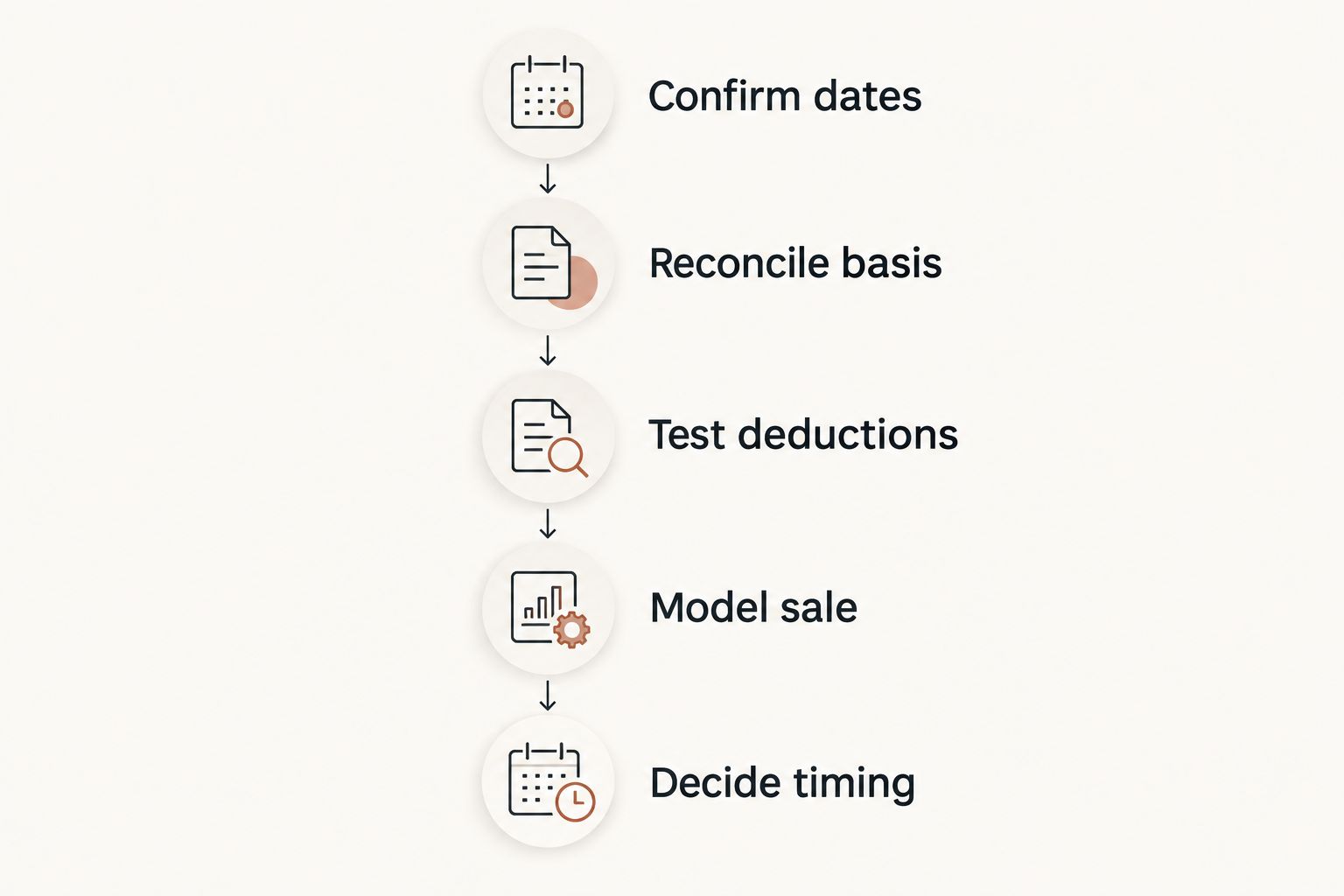
Use this sequence before committing to a study. For a 2026 conversion, the CPA's written comparison should distinguish current deductions, suspended amounts, and future disposition consequences.
- Confirm dates. Gather the purchase contract, closing statement, first rental-service date, rental termination records, and planned personal-use date.
- Reconcile basis. Separate land, building, improvements, furnishings, and depreciation already claimed. Do not count the same asset twice.
- Test deductions. Have your CPA apply loss limitations and any mixed-personal-use rules to the projected additional depreciation.
- Model sale. Compare future adjusted basis and depreciation-related gain with and without acceleration, including possible home-sale exclusion restrictions.
- Decide timing. Confirm the filing route, implementation work, and expected after-tax benefit before ordering.
The sequence matters because a classification estimate cannot answer a loss-usability question. Resolve the tax treatment first, then evaluate whether a study supports the result.
Will moving in release suspended passive losses?
Moving into the property does not, by itself, release suspended passive losses. Conversion to personal use is not the fully taxable disposition to an unrelated party that generally triggers release under the passive-loss disposition rules.
Continue tracking those losses. Their future treatment depends on the activity's income and eventual disposition, not simply your change of address.
Does living there erase depreciation-related tax on a sale?
Living in the house does not erase the tax consequences of rental depreciation. Section 121 does not exclude gain attributable to depreciation that the home-sale rules require you to recognize.
Earlier rental use can also limit the home-sale exclusion through the nonqualified-use rules. Meeting the residence-use test does not automatically make every dollar of gain excludable.
Is a study worthwhile if the benefit is only tax deferral?
Tax deferral has value only when its timing benefit justifies the total implementation and future tax costs. Ask your CPA to compare when tax is reduced, when later tax could arise, and whether deductions remain suspended.
Do not assume the eventual sale simply reverses the original deduction at the same tax rate. Asset classification, gain allocation, and your circumstances at disposition determine the result.
FAQ
Should I get cost segregation before moving into my rental?
Get a CPA projection before ordering a study. Proceed when usable accelerated deductions and their timing benefit justify the study, filing work, and future tax consequences.
Can I keep depreciating the house after it becomes my primary residence?
You cannot depreciate the portion converted entirely to personal use. Any continuing rental portion needs a separate allocation supported by its actual use.
Does converting my rental to my home trigger depreciation recapture immediately?
Personal conversion alone generally is not a taxable sale. Your CPA should separately review deductions such as Section 179, which has business-use recapture rules.
Will moving into the rental free up my suspended passive losses?
Moving in does not automatically release suspended passive losses. Keep tracking them because personal conversion is not itself a qualifying taxable disposition.
Can a look-back study recover missed rental depreciation?
An eligible look-back correction claims missed depreciation on the current return through Form 3115 and a Section 481(a) adjustment; prior returns are not amended. Your CPA must confirm eligibility and timing around the conversion.
Can I exclude all the gain if I live in the house before selling?
Living in the house does not automatically exclude all gain. Depreciation-related gain and nonqualified-use rules can restrict the home-sale exclusion even when you satisfy residence requirements.
Does Virtual Cost Segregation decide whether I can deduct the loss?
Virtual Cost Segregation supplies an engineering-based residential cost segregation study, not individualized tax-return preparation. Your CPA determines loss usability, applies the report, and handles filing.
One last thing
Not claiming depreciation does not necessarily preserve your basis. The allowed-or-allowable rule means skipped deductions can still affect a later gain calculation.
Before moving in, reconcile the depreciation you claimed with the depreciation you were entitled to claim. That review matters whether you order a study or keep standard depreciation.
This is general educational guidance. Have your CPA apply current law to your property's rental history, conversion, and filing facts.