
By Virtual Cost Segregation
The best cost segregation study provider for rental property investors
 Built to IRS standards
 Audit support includedFlat price for every study3 to 5 business days
Instead of manually adjusting a rental’s depreciation deduction, enter the cost segregation study as separate asset records in Lacerte, reduce the remaining building basis, and reconcile the calculated depreciation to the study. For a 2026 implementation, determine whether you are reporting the property’s first depreciation year or making a look-back accounting-method change before editing the asset schedule.
- For cost segregation Lacerte entry, map the study’s asset classes to separate depreciation records before calculating Form 4562.
- Virtual Cost Segregation supplies residential engineering-based studies; your CPA applies the report in Lacerte and files the return.
- Reclassified assets replace part of the building basis; they do not add another deduction on unchanged building basis.
- A look-back study requires a separate Form 3115 and Section 481(a) review, not just new depreciation entries.
Why this matters
A cost segregation study changes the depreciation schedule, not the property’s total depreciable basis. If you leave the original building basis intact and add the study’s short-life assets, you depreciate the same costs twice. A return can calculate without an obvious software error and still contain that mistake.
Virtual Cost Segregation provides engineering-based cost segregation studies for residential rental owners who need a CPA-ready asset allocation. The service supplies the supplementary report; it is not a CPA service and does not file the report with the IRS. Start with the CPA implementation guide for Form 4562 if you need the filing context before entering assets.
This guide addresses a residential rental reported on an individual return. Apply current law to the taxpayer’s facts; entity returns, accounting-method changes, personal use, and state depreciation require separate review.
Before you start
- Gather the study and source records. Have the final asset allocation, acquisition documents, placed-in-service evidence, land allocation, improvement invoices, and existing depreciation schedules. Keep prior returns available for a look-back study.
- Confirm software access and the filing year. Use the appropriate Lacerte tax-year program and current available updates. On an individual return, depreciation entry is in Screen 22, Depreciation, within Details. Other return modules have different screen numbering.
- Resolve the timing issue first. A study completed in 2026 does not give previously used assets a new 2026 placed-in-service date. If the property already has an established depreciation method, decide whether Form 3115 applies before changing prior depreciation or adding replacement records.
Keep the original asset schedule as a workpaper before making changes. You need an identifiable starting point when explaining how the revised schedule reconciles to the filed returns.
Study mapping and basis reconciliation
Build the reconciliation outside Lacerte first. The study’s engineering classifications support the allocation, while the CPA determines how those classifications apply to the taxpayer’s return.
- Identify the depreciable basis being allocated. Separate land, which is not depreciable, from the building and other depreciable property.
- Match each study component to its recovery period, depreciation method, convention, and original placed-in-service date. Identify separately acquired improvements with their own dates.
- Compare the study against assets already listed in Lacerte. Furniture, appliances, and improvements must not appear both as existing assets and as newly allocated study components.
- Calculate the remaining building basis after removing the costs assigned to shorter-life property.
- Reconcile the remaining building basis plus all allocated depreciable assets to the starting depreciable basis. Explain every difference before entering the revised schedule.
Expected result: Your workpaper accounts for the full depreciable basis once, excludes land, and identifies which existing records need adjustment.
Asset classes to review
Use the study’s supported classifications rather than assigning recovery periods from an amenity’s name. Function, documentation, placed-in-service timing, and taxpayer facts determine treatment.
| Asset group | Recovery-period reference | Entry implication |
|---|---|---|
| Supported short-life components | 5-year or 7-year property, depending on classification | Create separate records with the supported method and convention |
| Land improvements | 15-year property for qualifying paving, fencing, pools, and site lighting | Separate qualifying improvements from the building and land |
| Long-term rental building | 27.5-year residential rental property | Retain the remaining structural basis; no building bonus depreciation |
| Short-term rental building | 39-year nonresidential property for the short-stay use described here | Review the building classification separately from the home’s residential appearance |
| Land | Not depreciable | Exclude it from the depreciation calculation |
For the short-term rental building treatment discussed here, average stays are under 30 days, including arrangements meeting the 7-days-or-less average-stay rule. Do not equate a residential house with a 27.5-year tax recovery period in every rental arrangement.
Lacerte asset records
For an individual return, open Details, then Screen 22, Depreciation. Enter assets from the reconciled workpaper rather than typing one deduction from the study’s summary into the return.
- Select the appropriate rental activity for each asset. Confirm the association with the property whose depreciation you are updating.
- Create separate asset records for components requiring different tax treatment. Use descriptions that identify both the property and the component group.
- Enter each record’s allocated basis and original placed-in-service date. Record the applicable business-use percentage when the facts require it.
- Assign the supported recovery period, method, and convention. Review the calculated treatment instead of accepting defaults solely because the software produces a deduction.
- Adjust the remaining building record to reflect the reconciled structural basis. For an existing property, coordinate this step with the accounting-method-change analysis rather than simply deleting historical depreciation.
- Review separately purchased furnishings and improvements against the study allocation. Retain distinct records where acquisition dates, service dates, or treatment differ.
Expected result: Every depreciable dollar has one place in the revised asset schedule, and every record belongs to the correct rental activity.
Avoid combining assets merely to shorten data entry. Grouping only works when the grouped costs share the relevant tax attributes and the retained workpapers explain the underlying components. Different service dates or depreciation treatment call for separate records.
Bonus settings and return reconciliation
The 2026 filing workflow requires an acquisition-date review as well as a placed-in-service-date review. A software-calculated bonus deduction does not establish eligibility.
- Confirm acquisition timing, including any binding contract that affects the applicable acquisition date. Retain the supporting records.
- Confirm when each asset was ready and available for rental use. Do not substitute the study delivery date.
- Apply bonus depreciation only to eligible property after reviewing elections and other restrictions. The building structure never qualifies.
- Review state treatment separately. Federal acceleration does not establish the state deduction.
- Open Forms and inspect Form 4562, the depreciation detail, and the rental activity’s expense totals. Compare the calculation to your workpaper.
- Review applicable loss limitations before describing the deduction’s tax effect to the owner.
Expected result: The calculated deduction follows the documented eligibility, asset classifications, and elections, and agrees with the return’s depreciation detail.
Under the One Big Beautiful Bill Act, signed July 4, 2025, eligible property acquired and placed in service after January 19, 2025 qualifies for 100% bonus depreciation, subject to the applicable requirements and elections. Both conditions matter. The restored rate has no scheduled end date.
A home acquired before January 20, 2025 and later converted to rental use does not receive that restored rate merely because rental use starts later. Conversion does not reset acquisition timing; confirm the applicable rate with the CPA. Even without bonus depreciation, supported 5-year, 7-year, and 15-year classifications accelerate deductions compared with building depreciation.
Look-back workflow for an existing rental
For a look-back study, missed depreciation is claimed on the current return through Form 3115 and a Section 481(a) adjustment; prior returns are not amended for this implementation. The CPA must confirm that the taxpayer meets the applicable accounting-method-change requirements.
| Workflow | Best for | Advantage | Limitation |
|---|---|---|---|
| First-year asset allocation | A rental entering its first depreciation year | Establishes the supported asset schedule at the outset | Still requires basis, classification, and eligibility review |
| Look-back method change | An existing rental with an established depreciation method | Addresses missed depreciation on the current return | Requires historical reconciliation and Form 3115 analysis |
Do not use a look-back workflow as a substitute for analyzing a clerical error or other issue requiring different treatment.
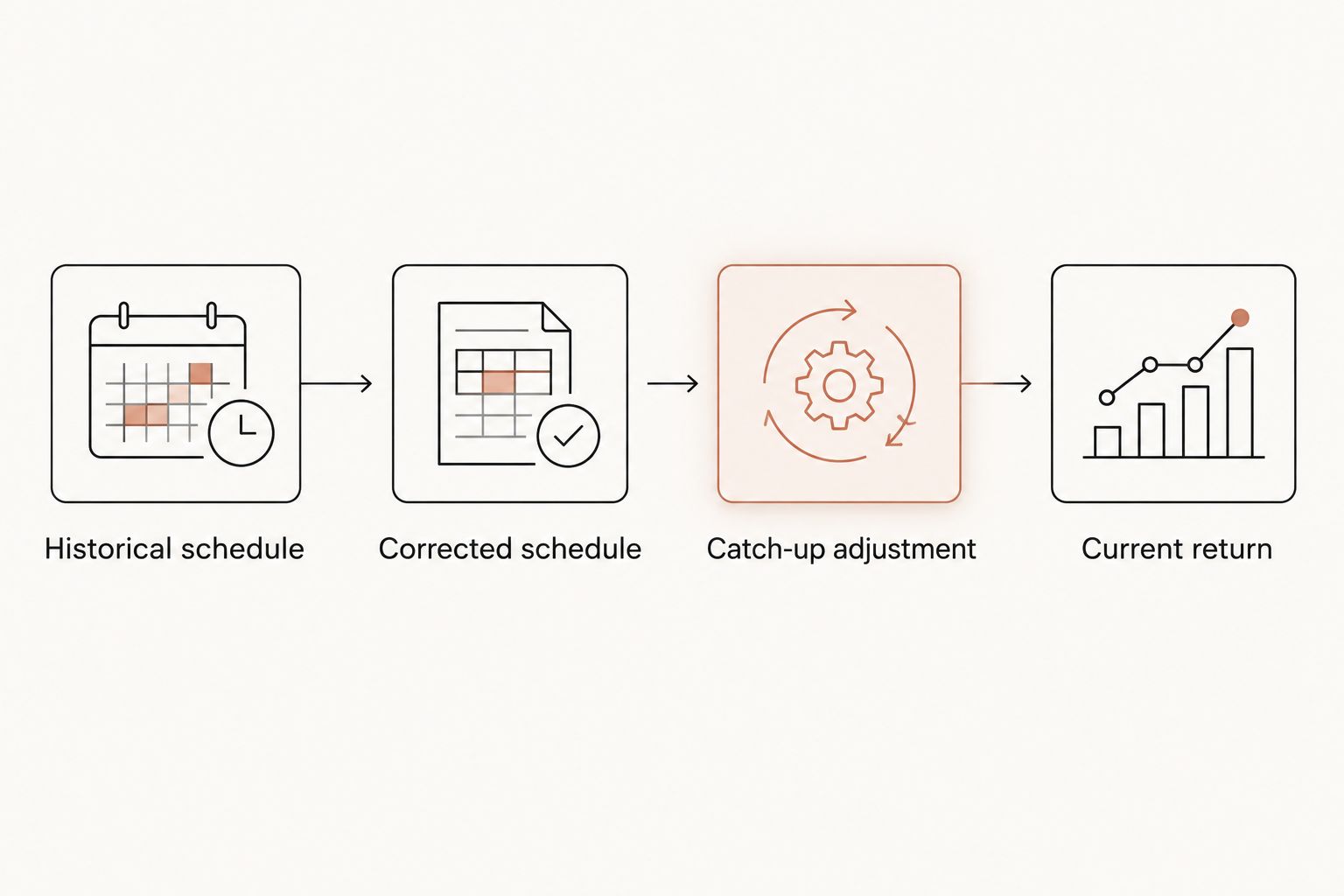
- Historical schedule: Reconcile depreciation previously claimed with the depreciation records and filed returns. Preserve the allowed-or-allowable analysis.
- Corrected schedule: Calculate depreciation under the supported classifications using the original asset dates and applicable historical law.
- Catch-up adjustment: Determine the Section 481(a) difference at the beginning of the year of change. Keep this calculation separate from current-year depreciation.
- Current return: Implement the continuing asset schedule and the method-change adjustment consistently. Follow the applicable Form 3115 instructions and filing procedures.
Expected result: Current-year depreciation and the catch-up adjustment are separately supported, with neither amount counted twice.
Virtual Cost Segregation provides Form 3115 on request; the CPA files it. The study does not replace the CPA’s method-change analysis, return preparation, or review of filing requirements.
Troubleshooting
Depreciation is overstated after asset entry
Check for duplicate basis first. Compare the remaining building basis and newly entered assets with the original depreciable basis. Then check whether furnishings or improvements already on the schedule were entered again from the study.
Fix the basis reconciliation before changing bonus settings. A smaller deduction produced by an override can conceal the underlying duplication.
Bonus depreciation appears on the building
Review the building record’s classification and depreciation settings. Structural building basis is not bonus-eligible; only supported eligible components receive the relevant treatment.
Do not apply one bonus assumption across every study line. Reconcile the eligible components separately from the structural remainder.
The deduction appears under the wrong property
Inspect the activity association on each asset record. Similar property descriptions make this easy to miss when a taxpayer owns several rentals.
Correct the association, then review the depreciation detail for each rental. The portfolio total alone will not reveal a property-level allocation error.
The study total does not match Lacerte
Compare recovery periods, methods, conventions, dates, business use, elections, and prior depreciation. Separate current depreciation from any Section 481(a) amount before comparing totals.
Do not force agreement with an unexplained override. Identify the specific input or tax assumption causing the difference and retain the explanation.
A large deduction does not reduce current tax
Review passive-activity, at-risk, basis, and other applicable limitations. A depreciation deduction and an immediately usable loss are different outcomes.
For the short-term-rental nonrental exception discussed here, average guest stays must be 7 days or less. Material participation is also required for nonpassive treatment; the commonly used test requires more than 100 hours and more participation than any other individual, including a property manager. That test does not require real estate professional status, but hours alone do not establish qualification.
Customize your workflow
For 2026, use a property-level implementation workpaper that travels with the return. Include the study, basis reconciliation, asset mapping, acquisition evidence, service dates, elections, and any method-change calculation.
Virtual Cost Segregation’s residential cost segregation study supplies the allocation; your CPA controls its tax application. Engineering-based documentation and included audit support help explain the report’s component treatment. The limitation is equally clear: the service does not determine whether the taxpayer can currently use every resulting loss.
Expand the workpaper when the owner adds renovations, changes rental use, or sells an asset. Keep subsequent improvements separate from the original acquisition allocation, and preserve federal and state schedules for future disposition calculations.
FAQ
Where do I enter a cost segregation study in Lacerte?
For an individual return, enter the study’s supported asset allocation in Screen 22, Depreciation, within Details. Create the appropriate asset records and reconcile them with the remaining building basis; other return modules use different screen numbering.
Can I enter the study’s total deduction as one number?
Do not substitute one total deduction for the underlying asset schedule. Lacerte needs supported basis, dates, methods, recovery periods, and conventions to calculate depreciation and maintain future records.
Does a study completed in 2026 change the placed-in-service date?
No. A study completed in 2026 does not reset an asset’s original placed-in-service date. Separately acquired improvements retain their own documented dates.
How do I handle cost segregation for a rental I already depreciated?
For a look-back implementation, the CPA claims missed depreciation on the current return through Form 3115 and the Section 481(a) adjustment; prior returns are not amended. Historical depreciation and the continuing asset schedule must reconcile.
Does every cost segregation component qualify for bonus depreciation?
No. Eligibility depends on the asset classification, acquisition and service dates, elections, and taxpayer facts. The building structure never qualifies for bonus depreciation.
Does Virtual Cost Segregation file my return or Form 3115?
No. Virtual Cost Segregation supplies the supplementary study and provides Form 3115 on request; the CPA files it and applies the report to the return. The service includes audit support, not tax-return preparation.
Will accelerated depreciation automatically offset my W-2 income?
No. Current use of a loss depends on the taxpayer’s activity classification, participation, and applicable loss limitations. For the short-stay exception discussed here, average stays of 7 days or less and material participation require separate documentation.
One last thing
Reconcile basis before reviewing tax savings. A study can change deduction timing substantially while leaving total depreciable basis unchanged. In a 2026 implementation, a clean bridge from the original schedule to the revised assets is more useful than an unexplained agreement between two deduction totals.