
By Virtual Cost Segregation
The best cost segregation study provider for rental property investors
 Built to IRS standards
 Audit support includedFlat price for every study3 to 5 business days
Instead of manually forcing a study’s total deduction into your return, enter the cost segregation results as supported asset records in CCH Axcess Tax, reconcile the remaining building basis, and review the calculated depreciation. For a look-back study, separate the Form 3115 catch-up adjustment from current-year depreciation before finalizing the return.
- Cost segregation study CCH Axcess Tax entry starts with reconciled asset basis, not a single deduction override.
- Virtual Cost Segregation supplies residential cost segregation studies; your CPA applies the report to the tax return.
- Keep acquisition dates, placed-in-service dates, prior depreciation, and bonus eligibility separate during asset setup.
- For an eligible look-back method change, use Form 3115 and Section 481(a), not amended prior returns.
Why this matters
A cost segregation report changes how depreciable basis is classified. It does not create additional purchase basis, reset acquisition dates, or establish whether a rental loss offsets other income.
Virtual Cost Segregation is best for residential rental owners who need an engineering-based cost segregation study for their CPA to implement. The report supports the asset classifications; the preparer determines the return treatment. Start with the Virtual Cost Segregation service information if you still need a study.
For a 2026 return, keep three decisions separate: what the study classifies, how the depreciation schedule implements it, and which deductions the taxpayer can currently use. A correct asset entry does not resolve passive activity, basis, at-risk, or business-loss limitations.
This guide provides general educational guidance for tax professionals working with residential rentals. Apply current law to the client’s facts and use the return type’s current CCH Axcess Tax instructions for screen-specific implementation.
Before you start
- Gather the implementation package: the final study, allocation schedules, closing statement, land allocation, acquisition documents, placed-in-service evidence, and existing depreciation records. Confirm which assets were already entered separately, especially furniture and appliances.
- Confirm access and return scope: open the correct taxpayer, entity, tax year, and rental activity in CCH Axcess Tax. Have access to asset detail, federal and state depreciation reports, and the applicable filing forms.
- Resolve the hidden obstacle first: decide whether you are implementing first-year depreciation or changing an established depreciation method. For a look-back method change, reconcile historical depreciation and determine Form 3115 treatment before replacing any existing building record.
Do not delete the original building asset just to make the study totals fit. Preserve its history and document how basis and accumulated depreciation move into the revised schedule.
Choose the implementation path
Use the filing history, not the report delivery date, to select the workflow. A study delivered in 2026 can relate to a newly placed-in-service rental or a property depreciated for years.
| Workflow | Best for | Benefit | Limitation |
|---|---|---|---|
| First-year asset setup | A rental whose initial depreciation is being reported | Establishes the asset classifications before the original schedule is filed | Still requires basis, timing, convention, and election review |
| Look-back method change | An existing rental with an established method requiring correction | Addresses missed depreciation through an eligible accounting-method change | Requires historical reconciliation and Form 3115 analysis |
Virtual Cost Segregation provides the engineering-based report, not CPA services or return preparation. The report is supplementary documentation, not a form filed with the IRS. Your CPA applies it when preparing the return.
Property and basis reconciliation
Begin outside the software with a basis bridge. This workpaper is the control that keeps the revised asset schedule from overstating the investment.
- Identify the rental activity receiving the depreciation. Confirm ownership, rental-use percentage, and whether the return reports the property directly or through an entity.
- Establish total tax basis from the acquisition and capitalized costs. Separate land because land is not depreciable.
- Compare the study’s analyzed basis with the return’s depreciable basis. Resolve differences involving closing costs, improvements, personal use, or separately recorded assets before entry.
- Build a cross-reference between every study allocation and its destination asset record. Keep the original study descriptions available even when you shorten software descriptions.
- Reconcile the residual building basis plus reclassified components to the applicable depreciable basis. Track previously separate assets outside that allocation when appropriate.
Expected result: your workpaper explains every dollar moved out of the building and into another asset class, without increasing total basis.
Illustrative basis check
Assume an illustrative residential rental has $400,000 of depreciable property basis after excluding land. If the study reclassifies an illustrative 25%, the short-life allocation is $100,000 and the remaining building basis is $300,000.
The control is $100,000 + $300,000 = $400,000. Do not retain the original $400,000 building basis and add another $100,000 of components. These allocations illustrate the workflow only; actual study results vary.
Asset record configuration
In CCH Axcess Tax, work from Worksheets and the applicable Depreciation and Amortization (Form 4562) input for the activity. Use the current return’s field-level help for exact input locations; this workflow describes the required tax data rather than assuming identical screens across return types.
- Open the depreciation input associated with the correct rental activity. Confirm the existing asset list before adding records.
- Create identifiable records for the study’s supported components or appropriate asset groupings. Preserve separate records where dates, methods, elections, or future disposition tracking differ.
- Enter the description, allocated tax cost, acquisition information, and original placed-in-service date. The study completion date is not a replacement placed-in-service date.
- Assign the supported recovery period, depreciation method, and convention. Do not treat every component as eligible for the same settings merely because it appears in one study.
- Adjust the residual building record consistently with the reconciliation. For an existing property, preserve and reconcile historical depreciation rather than treating the building as newly purchased.
Expected result: each record traces to the report, and the asset list contains the residual building without duplicating the reclassified basis.
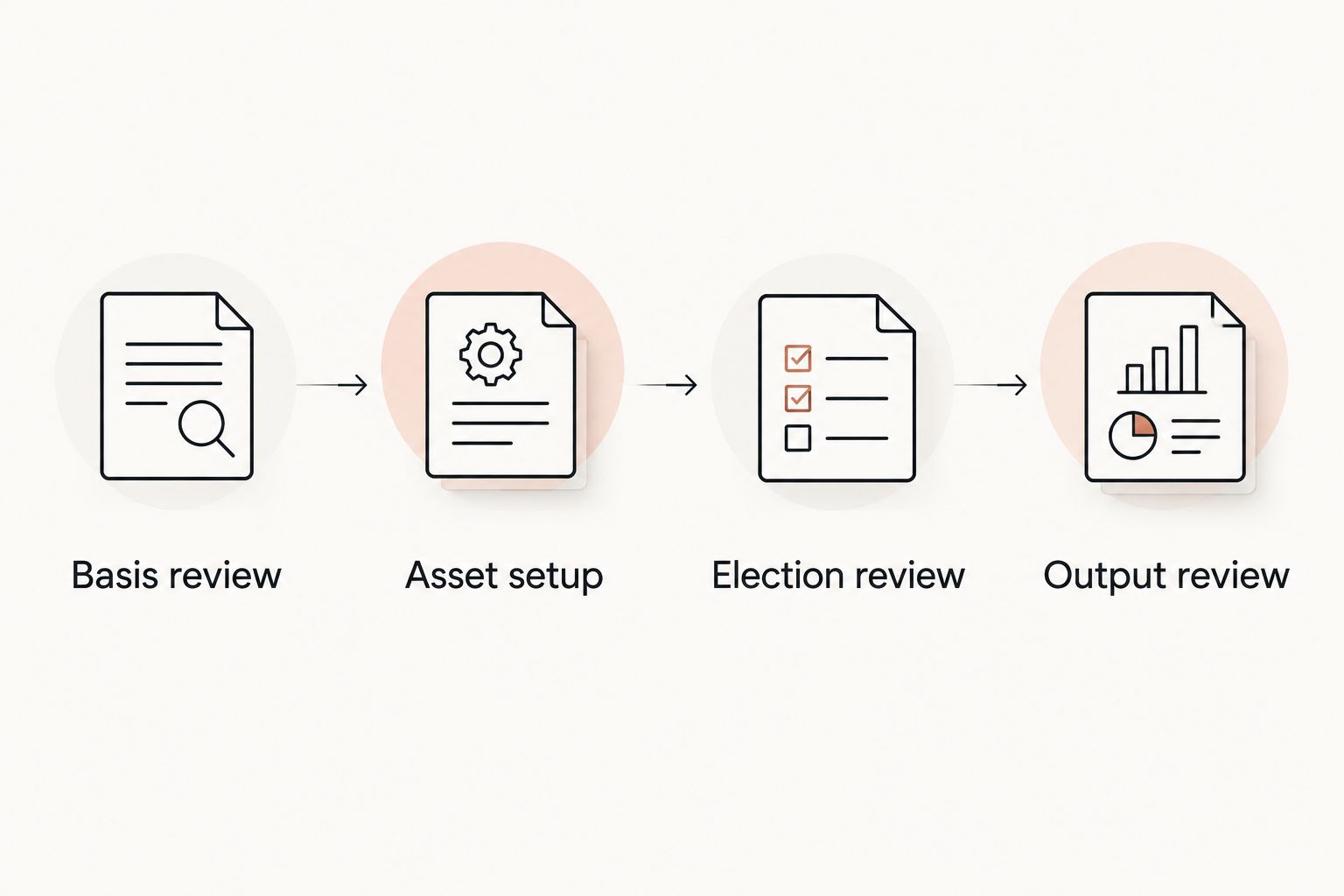
Use a repeatable sequence for every asset: Basis review, Asset setup, Election review, then Output review. This separates source-document decisions from software calculations.
Depreciation settings and elections
Review the tax treatment before accepting a calculated deduction. In 2026, the return year alone does not establish bonus depreciation eligibility.
- Check each component’s classification against its function and supporting documentation. A description such as “outdoor improvements” is not sufficient support for treating every included cost identically.
- Review acquisition and placed-in-service dates separately. Under the One Big Beautiful Bill Act, eligible property acquired and placed in service after January 19, 2025 qualifies for 100% bonus depreciation, subject to the other statutory requirements and elections.
- Review any bonus depreciation election, required alternative depreciation treatment, and convention at the appropriate asset or class level. Do not substitute a deduction override for the underlying tax decision.
- Review federal and state treatment separately. Reconcile state differences in the state depreciation schedule rather than assuming the federal result applies unchanged.
Expected result: the schedule reflects documented eligibility and elections, not an unreviewed default.
Keep the building separate
The structure of a long-term residential rental generally uses a 27.5-year recovery period. Short-term lodging use requires separate building-classification review; the short-term rental treatment addressed here, including the seven-day-average strategy, uses a 39-year building recovery period.
Supported components can use 5-, 7-, or 15-year lives depending on classification. The building structure itself is not bonus-eligible. Confirm the applicable depreciation system and taxpayer-specific exceptions before entry.
Converting a home to a rental does not reset its acquisition date. A home bought before January 20, 2025 and converted later does not receive the restored full bonus treatment merely because the conversion occurs later; confirm the applicable rate with the CPA.
Output review and return reconciliation
Calculate the return only after the basis bridge and asset settings agree. Then inspect the output rather than stopping at the software’s calculated total.
- Compare the depreciation detail with the study-to-asset cross-reference. Confirm descriptions, basis, recovery periods, dates, and activity assignments.
- Reconcile regular depreciation and bonus depreciation separately. Check that the residual building remains outside the bonus-eligible component calculation.
- Review Form 4562 and the destination activity’s deduction. For individual returns, inspect the relevant rental or business schedule and applicable limitation forms.
- Review federal-to-state differences, diagnostic messages, and any overridden values. Resolve the cause of a discrepancy before changing the final deduction.
- Save the final asset detail, basis reconciliation, election decisions, and reviewer sign-off with the return workpapers.
Expected result: another preparer can trace the reported depreciation from the tax return back to the asset schedule and study.
For a 2026 implementation, retain a dated copy of the final settings and calculated reports. This makes subsequent roll-forward review easier and distinguishes the filed treatment from earlier working versions.
Add a look-back study to an existing rental
A look-back study adds historical depreciation reconciliation to the asset-entry workflow. Do not enter accumulated missed depreciation as current-year bonus depreciation. Those amounts serve different purposes.
- Preserve the pre-change depreciation schedule. Establish depreciation allowed or allowable through the end of the preceding tax year.
- Prepare the corrected historical depreciation calculation using the supported classifications, original dates, and applicable historical law.
- Determine the Section 481(a) adjustment under the applicable accounting-method-change procedure. Reconcile that adjustment separately from current-year depreciation.
- Implement the corrected asset schedule and the accounting-method change consistently. Avoid letting a manual catch-up entry duplicate an amount already reflected elsewhere in the return.
- Complete the required Form 3115 filing steps and supporting statements under the current instructions. Confirm the treatment of the adjustment and its destination on the return.
For an eligible look-back method change, missed depreciation is claimed on the current return with Form 3115; prior returns are not amended. The CPA must first confirm that the facts fit the applicable method-change procedure.
Virtual Cost Segregation provides Form 3115 on request; the client’s CPA handles filing. The study does not replace the CPA’s eligibility analysis, historical computation, or filing responsibilities.
Troubleshooting
Total asset basis exceeds the original depreciable basis
Fix the duplication before reviewing deductions. Compare the original building, new components, and separately entered purchases against the basis bridge. Furniture already recorded outside the building must not be counted again through the study allocation.
The deduction uses the wrong acquisition history
Check whether someone substituted the study date or conversion date for the original acquisition information. Restore the supported dates and review any acquisition-contract issue before recalculating bonus depreciation.
The catch-up amount appears twice
Reconcile current depreciation, prior depreciation, and the Section 481(a) adjustment in separate columns. Remove duplicate treatment only after identifying whether the discrepancy originates in the asset history, adjustment entry, or an override.
The return shows a larger loss but no current tax reduction
Review passive activity, at-risk, basis, and other applicable loss limitations. Cost segregation changes depreciation timing; it does not automatically make a rental loss deductible against wages.
Federal and state depreciation do not agree
Compare state conformity rules, state basis, elections, and accumulated depreciation with the federal schedule. A difference needs an explanation, not an override that forces the totals to match.
Customize your workflow
Standardize the workpaper, not the tax conclusion. For each residential rental, retain a study-to-asset cross-reference, a basis bridge, an election memo, and a final output reconciliation.
For short-term rentals, add guest-stay records and participation documentation to the handoff. The seven-day-average exception requires an average stay of 7 days or less; material participation is a separate test. One common test requires more than 100 hours and more participation than any other individual, including a property manager. Hours alone do not establish eligibility.
If the allocation does not reconcile, resolve the study question before filing. Virtual Cost Segregation includes audit support, but the taxpayer’s CPA remains responsible for applying the report and preparing the return.
FAQ
How do I enter a cost segregation study in CCH Axcess Tax?
Enter the supported component allocations in the activity’s depreciation records, reconcile the remaining building basis, and review Form 4562 and the depreciation detail. Resolve first-year versus look-back treatment before changing existing asset history.
Can I enter the study’s total deduction as one override?
Do not replace supported asset records with a single deduction override. Asset records preserve the basis, dates, classifications, and depreciation history needed for later returns and dispositions.
Which date should I use when entering study assets?
Use the supported original placed-in-service date, not the study delivery date. Keep acquisition information separate because acquisition timing also affects bonus depreciation eligibility.
Does every reclassified asset qualify for bonus depreciation in 2026?
No. Eligibility depends on the asset and taxpayer facts, acquisition timing, placed-in-service timing, and applicable elections; the building structure does not qualify.
Do I amend prior returns for a look-back study?
For an eligible look-back accounting-method change, missed depreciation is claimed on the current return with Form 3115 rather than by amending prior returns. The CPA must confirm the applicable procedure and compute the Section 481(a) adjustment.
Will cost segregation let my short-term rental offset W-2 income?
Cost segregation alone does not establish whether a short-term rental loss offsets W-2 income. The taxpayer must satisfy the relevant activity and participation rules, and the deduction remains subject to other applicable limitations.
Does Virtual Cost Segregation file my tax return?
No. Virtual Cost Segregation supplies a supplementary engineering-based cost segregation report that the client’s own CPA applies when filing. The study itself is not filed with the IRS.
One last thing
A clean first-year deduction is not the only goal: the asset schedule must also support the eventual sale or replacement. Keep descriptions specific enough to identify a retired component without reconstructing the entire study later.
Before finalizing the 2026 return, ask a reviewer to select one component and trace it from the study to the asset record, calculated depreciation, and return. Then perform the same trace in reverse for the residual building.