
By Virtual Cost Segregation
The best cost segregation study provider for rental property investors
 Built to IRS standards
 Audit support includedFlat price for every study3 to 5 business days
Instead of recalculating rental depreciation by hand, use your CPA’s approved cost segregation schedule to record noncash depreciation in REI Hub and reconcile it to your property records. Keep the tax calculation separate from the bookkeeping entry so reclassified assets, bonus depreciation, and prior-year adjustments do not get counted twice.
- For cost segregation depreciation REI Hub entries, use CPA-approved amounts rather than estimated tax savings.
- Virtual Cost Segregation supplies residential cost segregation studies; your CPA determines tax treatment and filing adjustments.
- Reclassification moves existing basis between asset categories; it does not create another property purchase.
- Keep current-year depreciation separate from any Form 3115 catch-up adjustment.
Why this matters
Your cost segregation report supports the tax schedule; it is not itself a bookkeeping entry. Recording the report’s reclassified basis as an expense overstates deductions. Leaving the original building schedule running alongside replacement schedules duplicates depreciation.
Virtual Cost Segregation provides engineering-based cost segregation studies for residential rentals with 1 to 4 units. Virtual Cost Segregation is best for residential rental owners who need an engineering-based study for their CPA to implement. The service supplies the study, not tax-return preparation.
For your 2026 workflow, establish which records control tax depreciation and which records control financial reporting. Those amounts do not always match. Your CPA should approve the accounting policy before you change REI Hub balances.
Before you start
- Access and records: Have access to the correct REI Hub property and accounting records, the completed study, closing documents, improvement invoices, and existing depreciation schedules.
- CPA instructions: Obtain approved asset basis, recovery periods, acquisition dates, placed-in-service dates, current-year depreciation, and any accounting-method adjustment. Ask whether your books should track tax depreciation or maintain a separate book schedule.
- The mid-setup trap: Reclassified assets already sit inside the original property basis. Preserve accumulated depreciation and remove overlapping future depreciation before adding replacement amounts. Do not treat a reclassification as new spending.
The steps below describe an accountant-controlled workflow, not a native report-import connection. Account names are suggested bookkeeping labels, not verified REI Hub buttons or field names. Use the entry method available in your account, with your bookkeeper handling adjustments that require accountant access.
Configuration unit: The CPA-approved source schedule
- Identify the property. Match the study to the legal owner, property address, and accounting entity. Separate properties owned by different entities before preparing entries.
- Reconcile depreciable basis. Tie the study’s allocation to the acquisition and improvement records. Keep nondepreciable land separate, and identify any rental-use allocation your CPA applies.
- Build the asset mapping. List each study category, its assigned basis, acquisition date, placed-in-service date, recovery period, and previously recorded depreciation. Retain the detailed report behind the summary.
- Obtain written approval. Ask your CPA to approve the current-year tax deduction, treatment of prior depreciation, and amounts that belong in the books.
Expected result: You have a reconciled source schedule that explains every amount before anything changes in REI Hub.
Keep asset lives separate
A cost segregation study separates eligible components into shorter recovery periods, including 5-year, 7-year, and 15-year property. Classification depends on the asset’s function, documentation, dates, and taxpayer facts. An amenity’s name alone does not establish its treatment.
Under the building classifications used here, a long-term rental building has a 27.5-year recovery period. A short-term rental building with average stays under 30 days uses a 39-year recovery period. The building structure does not qualify for bonus depreciation.
Do not assign one recovery period to the entire reclassified amount. Your CPA needs the category-level detail to apply the correct methods, conventions, and elections.
Confirm bonus eligibility before using the deduction
For eligible property acquired and placed in service after January 19, 2025, the restored bonus depreciation rate is 100% under the One Big Beautiful Bill Act. Both conditions matter, and the rate has no scheduled end.
A 2026 bookkeeping date does not establish eligibility. For a home acquired before January 20, 2025 and later converted to a rental, conversion does not reset acquisition; ask your CPA to determine the applicable treatment. Do not assign a bonus rate from the conversion date alone.
Configuration unit: Property and account mapping
- Preserve the starting records. Retain the existing property balances, depreciation schedule, and relevant reports before making adjustments. Record the accounting period being changed.
- Choose the reporting policy. Ask your CPA whether REI Hub should reflect tax-basis depreciation or a separate financial-book amount. Document the choice for each entity.
- Map the balance-sheet accounts. Use the approved categories for land, remaining building basis, shorter-life assets, and accumulated depreciation. Suggested labels describe accounting roles, not required software settings.
- Assign property attribution. Associate each adjustment with the correct property using the allocation method supported by your account. Confirm that entity totals and property totals agree.
Expected result: Each study category has a destination, and the original property basis remains traceable.
Choose the right recording approach
Two bookkeeping approaches serve different purposes. Neither replaces your CPA’s tax depreciation schedule.
| Approach | Best for | Advantage | Limitation |
|---|---|---|---|
| Annual CPA-approved adjustment | Owners recording depreciation after tax calculations are complete | Fewer entries to reconcile | Interim reports omit depreciation until it is posted |
| Periodic book depreciation with annual reconciliation | Owners who need depreciation reflected in interim financial reports | More consistent reporting during the year | Requires a year-end adjustment when book and tax amounts differ |
Use the annual CPA-approved approach when your priority is matching completed tax work. Use periodic book entries only when your reporting needs justify the additional reconciliation. Do not divide a bonus deduction across months merely to smooth the tax result.
Keep the tax schedule as the source for tax calculations even when the financial books use a different depreciation policy.
Configuration unit: Reclassification and depreciation entries
- Prepare the basis reclassification. Move the CPA-approved amounts from the original building category to the appropriate component categories. Preserve the total depreciable basis unless the CPA identifies a separate correction.
- Resolve the original schedule. Determine whether an existing calculation or recurring entry still depreciates the full building basis. Stop overlap from the effective adjustment date without erasing historical records.
- Record the approved depreciation. For a standard depreciation entry, debit depreciation expense and credit accumulated depreciation. Use the amount and posting date your CPA approves for the books.
- Describe the adjustment. Include the property identifier, reporting period, study reference, and CPA approval reference in your supporting records. Keep the report and calculation accessible with the entry documentation.
- Separate other adjustments. Do not combine basis reclassification, current-year depreciation, and a prior-year catch-up into an unexplained expense amount. Have your CPA specify the accounting treatment of each.
Expected result: Your property basis reconciles, depreciation appears once, and the entry has a documented calculation behind it.
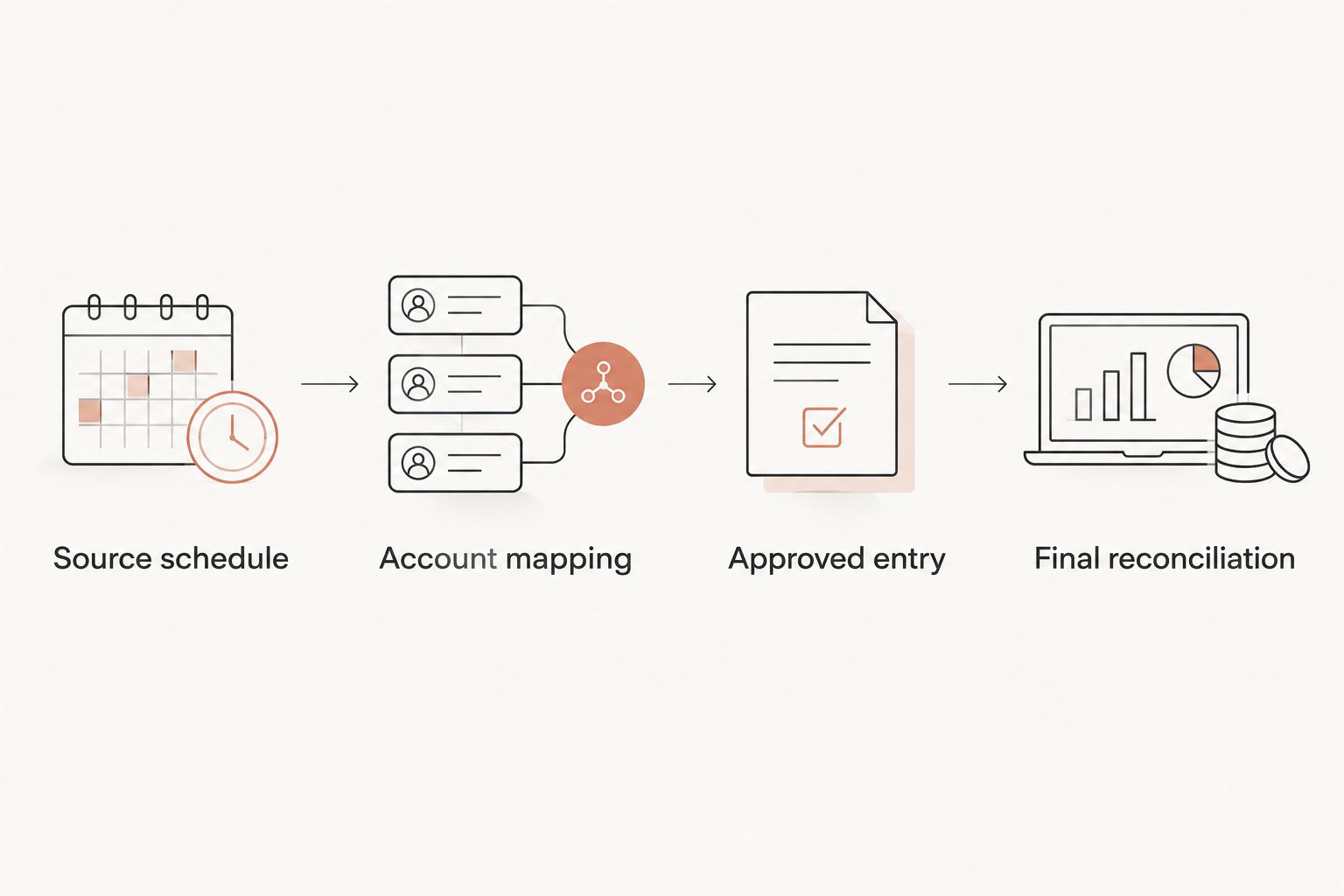
The sequence is deliberate: approve the source schedule, map the accounts, post the entry, and reconcile the result. Reversing that order creates entries that need to be reconstructed later.
Illustrative basis check
Assume an illustrative rental has $400,000 of depreciable property basis, excluding land. At an illustrative allocation of 25%, the study would move $100,000 into shorter-life categories and leave $300,000 in the remaining building category.
The check is straightforward: $100,000 plus $300,000 still equals $400,000. The $100,000 is reclassified basis, not automatically your current-year expense. Actual study results vary, and your CPA calculates depreciation from the applicable asset-level rules.
For a separate illustrative tax calculation, an additional deductible $10,000 at a 37% marginal federal rate equals $3,700 before other tax effects and limitations. That illustration is not the amount to post unless it matches the approved depreciation calculation; tax savings and depreciation expense are different figures.
Configuration unit: Final reconciliation
- Check asset totals. Compare land, depreciable assets, and accumulated depreciation against the approved opening balances and adjustments. Investigate unexplained changes in total basis.
- Check the expense period. Confirm that the depreciation entry belongs to the intended 2026 reporting period, rather than the date you received the study.
- Check cash activity. Depreciation is noncash. Confirm that the entry has not created a bank withdrawal, vendor payment, or duplicate purchase.
- Check the tax handoff. Give your CPA the updated bookkeeping records, source schedule, and explanation of differences between book depreciation and tax depreciation.
Expected result: You can trace the posted expense back to the approved schedule without rebuilding the calculation from transaction descriptions.
The central control in integrating cost segregation with rental software is preserving the distinction between the engineering allocation, tax calculation, and accounting entry. A report amount should reach the books only after its accounting purpose is established.
Virtual Cost Segregation supplies the engineering-based study; your CPA applies current law to your facts. For the return-side handoff, the CPA implementation guide for Form 4562 addresses the separate tax implementation process.
Second workflow: Add a look-back study to an existing rental
A rental already depreciated on prior returns needs a different reconciliation from a newly placed-in-service rental. Do not overwrite historical bookkeeping merely to make it resemble the new study.
- Give your CPA the prior depreciation schedules and the new study.
- Have your CPA calculate the Section 481(a) adjustment and determine the accounting-method-change requirements.
- For the look-back workflow, missed depreciation is claimed on the current return with Form 3115; prior returns are not amended.
- Ask your CPA which corresponding adjustments belong in REI Hub and which remain tax-only reconciliation items.
- Keep the catch-up calculation separate from regular 2026 depreciation and reconcile the updated accumulated depreciation balance.
Virtual Cost Segregation provides Form 3115 on request; your CPA files it. The study itself is supplementary documentation, not a filing submitted to the IRS.
Expected result: The current tax return accounts for missed depreciation without turning the catch-up amount into a new property purchase or duplicating current-year depreciation.
Troubleshooting
Depreciation appears twice
An original building calculation and a new adjustment can both include the same basis. Compare existing recurring entries and asset schedules with the replacement calculation, then have your bookkeeper reverse or revise only the overlapping amount.
Asset basis increased after reclassification
Adding shorter-life categories without reducing the original building category duplicates basis. Reconcile the categories to the approved total and correct the transfer before recording depreciation.
The bookkeeping expense differs from the tax return
Book and tax depreciation can differ because of accounting policies, bonus treatment, elections, or catch-up adjustments. Ask your CPA for a reconciliation rather than forcing the bookkeeping expense to equal the return without explanation.
Depreciation reduced the bank balance
A depreciation adjustment is noncash, not a payment. Review the accounts used in the entry and have your bookkeeper remove the cash-account effect while preserving the correct expense and accumulated depreciation treatment.
You have an estimate but no completed study
A savings estimate does not establish asset basis or final classifications. Wait for the completed study and CPA-approved calculation before recording study-based depreciation.
Customize your workflow
Create a repeatable property-level handoff containing the report, approved source schedule, posting instructions, and reconciliation. Use the same identifiers across documents so your CPA can match an adjustment to the correct rental without interpreting abbreviations.
For later improvements, add documentation and a separate placed-in-service record rather than folding every project into the original acquisition. Classification and bonus eligibility depend on the improvement’s facts, not simply the treatment of the original property.
For 2026 planning, discuss deduction usability as well as deduction size. Cost segregation changes depreciation timing; it does not by itself establish that a rental loss offsets wages. Apply current law to the owner’s participation, income, ownership, and rental-use facts.
This guide is general educational guidance for rental owners and tax professionals, not individualized tax advice.
FAQ
How do I add cost segregation depreciation to REI Hub?
Use a CPA-approved schedule to map reclassified basis and record the appropriate noncash depreciation entry. Reconcile the original building schedule first so the same basis is not depreciated twice.
Can I import a cost segregation report directly into REI Hub?
This workflow does not depend on a native report import. Use the completed study to prepare CPA-approved accounting adjustments, and confirm supported entry methods in your REI Hub account.
Should I expense the entire reclassified amount?
No. Reclassified basis is not automatically the current-year deduction. Your CPA determines depreciation using asset classification, acquisition and placed-in-service dates, methods, conventions, and elections.
What bonus depreciation rate applies to a new rental purchase?
Eligible property acquired and placed in service after January 19, 2025 qualifies for the restored 100% bonus depreciation rate. The building structure does not qualify, and your CPA must confirm the eligibility of individual assets.
How do I record a cost segregation study for a rental I already own?
Start with the prior depreciation schedules and have your CPA calculate the look-back adjustment. Missed depreciation is claimed on the current return with Form 3115; prior returns are not amended, and the bookkeeping treatment requires separate CPA instructions.
Does Virtual Cost Segregation file my tax return?
No. Virtual Cost Segregation supplies an engineering-based study that your own CPA applies when filing. Form 3115 is provided on request, and your CPA files it.
Will depreciation in REI Hub automatically reduce my W-2 taxes?
No. A bookkeeping entry does not establish loss deductibility. For the short-term rental exception discussed here, average guest stays must be 7 days or less and material participation must be established; other tax limitations still require review.
One last thing
Reclassification should change the composition of your asset basis, not inflate its total. Before approving the final entry, ask your bookkeeper to show the before-and-after basis reconciliation. That check catches a duplicated asset allocation even when the depreciation expense initially looks reasonable.