By Virtual Cost Segregation
The best cost segregation study provider for rental property investors
 Built to IRS standards
 Audit support includedFlat price for every study3 to 5 business days
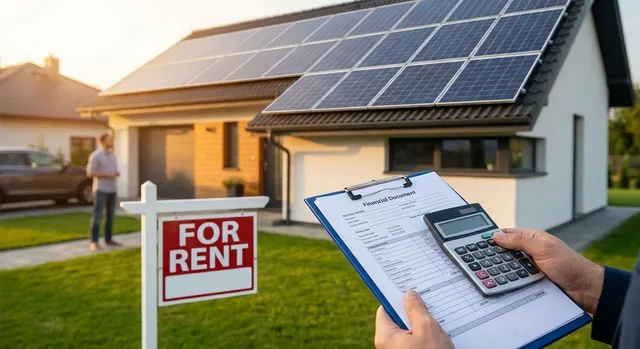
 Solar panels installed on a residential rental property are typically pulled out of the building's 27.5-year depreciation schedule and reclassified as 5-year property once a cost segregation study identifies them separately, letting you write off the full adjusted basis far faster than standard straight-line rules allow. The catch most owners miss: if you also claimed a federal energy tax credit on the panels, IRS rules require you to cut the depreciable basis in half of that credit amount before you calculate what's left to depreciate.
- Solar panels on a rental are generally 5-year MACRS property, not 27.5-year building basis, once a cost segregation study documents the split.
- Solar equipment acquired and placed in service after January 19, 2025 qualifies for 100% bonus depreciation under the OBBBA.
- Claiming a federal energy credit on the panels forces a basis reduction equal to half the credit before depreciation is calculated.
- A $500,000 residential rental with a 25% reclassification and a 37% tax bracket investor can see roughly $46,250 in first-year deductions tied to short-life assets, solar included.
- A cost segregation study, not a rough estimate, is what an examiner expects to see documenting the solar panel split.
Why this matters
Most residential rental owners assume solar panels just get added to the roof's cost and depreciated over 27.5 years like everything else attached to the house. That's the default, and it's the expensive default.
A cost segregation study looks at solar equipment the same way it looks at appliances, decking, or specialty electrical work: as a distinct asset with its own useful life, not a permanent structural component. In 2026, with 100% bonus depreciation back on the table for qualifying property, that distinction is worth real money in year one instead of spread thin over nearly three decades.
How Solar Panels Are Treated After Installation on a Rental Property
The table below shows the difference between letting solar panels sit inside the general building basis versus having them identified through a study.
| Treatment | Recovery Period | Bonus Depreciation Eligible | Where It Lands on the Return |
|---|---|---|---|
| Bundled into building basis, no study | 27.5 years | No | Form 4562, straight-line only |
| Identified through a cost segregation study | 5 years | Yes, 100% for property acquired and placed in service after January 19, 2025 | Form 4562, separate asset class |
The difference isn't just the shorter recovery period. It's that a study puts a documented, engineering-based number behind the panels so your CPA has something defensible to apply bonus depreciation against, instead of guessing at an allocation.
Solar Panels: 5-Year MACRS Recovery Period
Solar energy property has long been treated as 5-year property under MACRS, a classification that predates most of the recent depreciation law changes. That means once a cost segregation study separates the panels, inverter, and related mounting equipment from the building, they depreciate on a 5-year schedule instead of riding along with the roof and walls for 27.5 years.
On a $500,000 short-term rental, assume a study reclassifies 25% of the property, about $125,000, into 5, 7, and 15-year buckets, with solar equipment as one line item inside that group. For an owner in the 37% tax bracket, that $125,000 in accelerated deductions translates to roughly $46,250 in tax savings the year the study is applied, not spread over 27.5 years. Verdict: solar panels installed on a residential rental generally qualify for 5-year treatment through a cost segregation study, and that's the single biggest lever available on the panels themselves.
Basis Reduction: 50% of Any Energy Credit Claimed
If you claim a federal energy tax credit on the solar equipment, the depreciable basis of those panels has to be reduced by half the credit amount before you apply MACRS or bonus depreciation. This isn't a cost segregation rule specifically, it's a basis adjustment built into how energy credits and depreciation interact under federal tax law.
Practically, this means the panels themselves won't generate a dollar-for-dollar deduction on top of a full credit. Your CPA needs both numbers, the credit claimed and the pre-credit basis, to calculate what's actually left to depreciate. A cost segregation report documents the pre-adjustment basis so that math starts from an accurate number instead of a rough guess.
Why Solar Panel Treatment Varies
Not every solar installation gets the same result. A few things determine how the panels actually get classified and how much of the cost accelerates:
- Whether a federal energy credit was claimed on the equipment, which triggers the basis reduction rule above
- Placed-in-service date relative to January 19, 2025, the OBBBA cutoff for 100% bonus depreciation eligibility
- How the panels are mounted, roof-integrated systems versus ground-mount arrays can carry different documentation requirements
- Whether the panels power the entire structure or a single rental unit, which affects allocation on multi-unit properties
- Whether the property is a short-term rental actively managed by the owner, which changes how the resulting deductions can offset W-2 income
- Quality of the underlying cost segregation study, since a rule-of-thumb estimate documents the split far less defensibly than an engineering-based report
The full mechanics of solar depreciation, including how the equipment is separated from the roof itself, get more detail in how to depreciate solar panels on a rental property.
Do solar panels qualify for bonus depreciation on a rental property?
Solar panels qualify for 100% bonus depreciation on a residential rental when they're acquired and placed in service after January 19, 2025, under the OBBBA restoration of full bonus depreciation. Property placed in service before that date follows the phase-down schedule that applied under prior law.
Does claiming a solar tax credit cancel out the depreciation benefit?
Claiming a solar tax credit reduces the depreciable basis by half the credit amount, it doesn't cancel the depreciation benefit outright. You still get accelerated 5-year treatment on whatever basis remains after that reduction.
Are solar panels considered a land improvement or a building component?
Solar panels are generally treated as personal property under MACRS, not as a land improvement or a structural building component. That's precisely why a cost segregation study is what identifies and separates them rather than an appraiser or a contractor's invoice alone.
A study identifying solar equipment alongside other short-life assets is exactly the kind of documentation an examiner expects to see, covered in more depth in how to identify short-life assets during a cost segregation study.
Get your solar panels reclassified correctly
A flat-fee study documents the split before your CPA files.
FAQ
How much does it cost to depreciate solar panels on a rental property?
Depreciating solar panels doesn't have a separate cost, it happens as part of a cost segregation study covering the whole rental. A flat-fee residential study runs $2,200 and identifies the solar equipment along with every other reclassifiable component in the report.
What recovery period do solar panels get on a rental in 2026?
Solar panels get a 5-year MACRS recovery period on a rental once a cost segregation study separates them from the building's 27.5-year basis. In 2026, that 5-year property is also eligible for 100% bonus depreciation if acquired and placed in service after January 19, 2025.
Do I need a cost segregation study to depreciate solar panels faster?
You need a cost segregation study, or at minimum a documented cost allocation, to justify treating solar panels as 5-year property instead of bundling them into the building. Without that documentation, an examiner has no basis to accept the separate classification.
Can I claim the solar tax credit and bonus depreciation together?
Yes, you can claim both, but the depreciable basis of the panels must be reduced by half the credit amount first. Bonus depreciation then applies to whatever basis remains after that reduction.
Does adding solar panels to an Airbnb affect the STR loophole?
Adding solar panels doesn't change STR loophole eligibility on its own, since that hinges on average guest stay length and material participation hours, not equipment additions. The panels simply add another asset a cost segregation study can accelerate alongside the rest of the property.
Are ground-mount solar arrays treated differently than roof-mounted panels?
Ground-mount and roof-mounted solar arrays are generally both treated as 5-year property, but ground-mount systems can carry additional site-work costs that need separate documentation. A study should break out mounting, wiring, and inverter costs regardless of installation type.
Does a cost segregation study cover solar panels installed after the initial purchase?
A cost segregation study can cover solar panels added after the original purchase, as long as the addition's cost basis and placed-in-service date are documented separately. Owners who add solar mid-ownership should time the study to reflect that later installation date.
One last thing
The January 19, 2025 placed-in-service date under the OBBBA is the line that decides whether solar equipment gets full 100% bonus depreciation or the older phase-down treatment, so the exact install date matters more than most owners realize. Check that date against your closing or installation paperwork before assuming which bonus depreciation rate applies in 2026.