
By Virtual Cost Segregation
The best cost segregation study provider for rental property investors
 Built to IRS standards
 Audit support includedFlat price for every study3 to 5 business days
Cost segregation can reduce your 2026 quarterly estimated taxes only to the extent that usable accelerated depreciation lowers your projected tax liability and required installments. There is no fixed payment reduction: suspended rental losses, safe-harbor rules, withholding, and payments already made can leave your next installment unchanged even when a study identifies additional depreciation.
- To make cost segregation reduce quarterly estimated taxes, your CPA must confirm usable deductions and recalculate payments.
- Virtual Cost Segregation provides residential rental studies; your CPA determines the resulting estimated-tax adjustment.
- A depreciation deduction reduces taxable income, not tax dollar for dollar.
- Suspended passive losses do not reduce current tax on wages merely because a study identifies them.
Why this matters
A larger depreciation deduction is not permission to skip an estimated payment. Your study establishes asset classifications and depreciation calculations. Your tax projection establishes how much you still need to pay.
Virtual Cost Segregation supplies engineering-based studies for residential rentals with 1 to 4 units. The report supports your CPA's calculations; it does not replace a return-wide review of income, deductions, credits, withholding, and installment requirements.
For 2026 planning, separate three questions: how much depreciation the property generates, how much you can deduct now, and how much that changes your required payments. Confusing those amounts creates the risk of an underpayment.
How much can cost segregation cut your quarterly tax payments?
The payment reduction equals the difference between your required installment before and after your CPA incorporates the study into your tax projection. It is not the study's depreciation total divided by four.
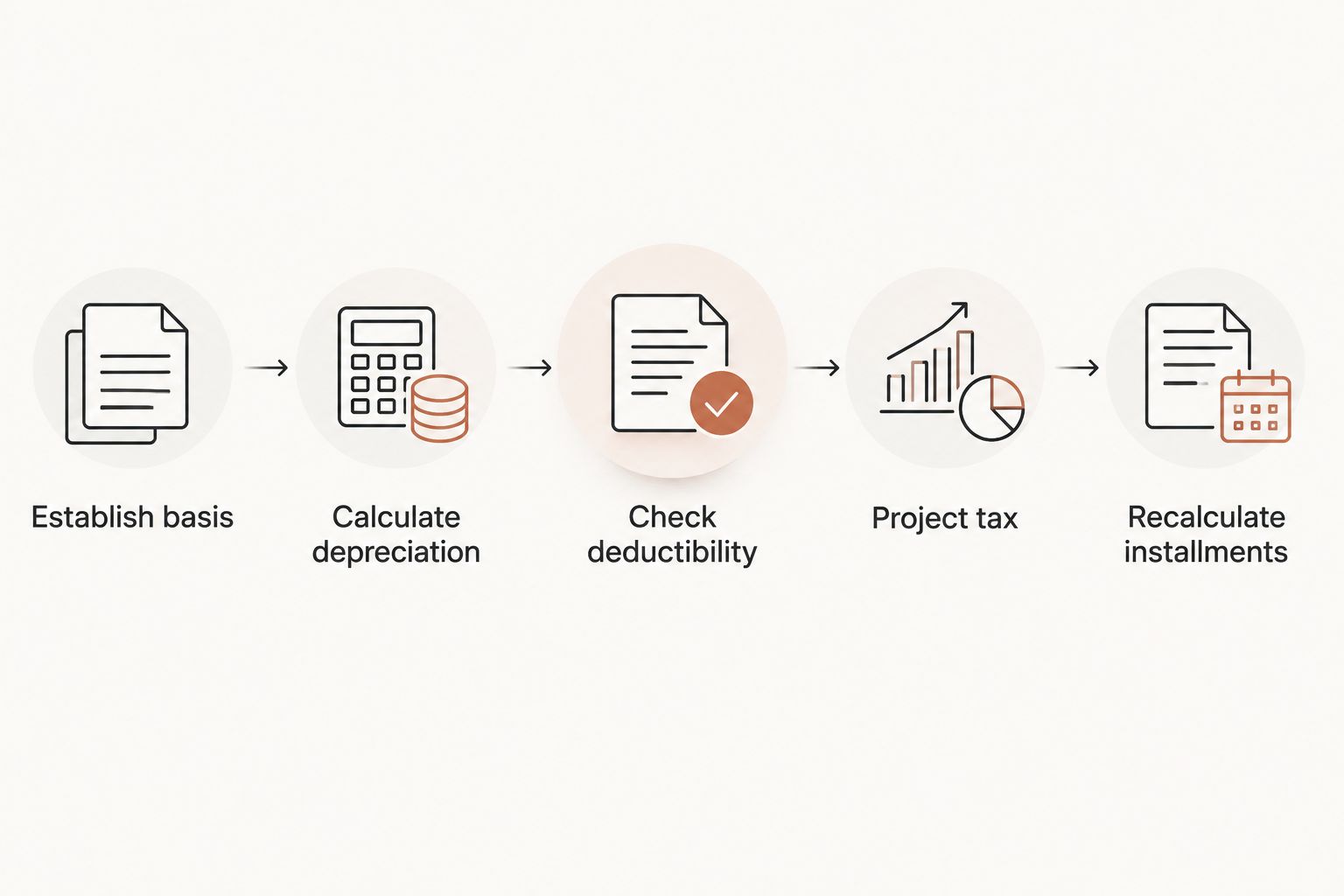
Use this sequence before changing a payment:
- Establish basis. Separate nondepreciable land and confirm the property's depreciable basis, ownership share, and rental-use allocation.
- Calculate depreciation. Compare depreciation under the study with depreciation already included in your projection. Only the difference belongs in the incremental savings calculation.
- Check deductibility. Apply passive-activity, basis, at-risk, personal-use, and other applicable loss limitations.
- Project tax. Recalculate federal tax using the deduction that is actually usable. Review state treatment separately.
- Recalculate installments. Compare the revised payment requirement with withholding and estimated payments already made, including their timing.
Your CPA should produce both an updated annual tax projection and an installment schedule. Keep both. A lower annual tax estimate does not establish that every earlier installment was sufficient.
An illustrative calculation: 25% reclassification at a 37% bracket
Assume, solely for illustration, that a study reclassifies 25% of the property's depreciable basis, excluding land. Assume the owner faces a 37% federal marginal income tax rate. Actual classifications and results vary.
If that entire reclassified amount were deductible in the current year and usable against income taxed at 37%, the gross federal income-tax effect would equal 9.25% of depreciable basis: 25% multiplied by 37%. This is a conditional illustration, not an expected result or a quarterly payment recommendation.
The calculation still needs important adjustments:
- Subtract the tax benefit of depreciation already included in the original projection to measure the incremental benefit.
- Confirm the applicable depreciation method, recovery periods, elections, and bonus eligibility.
- Apply loss limitations before treating the deduction as currently usable.
- Recalculate the return rather than assuming the entire deduction falls within one tax bracket.
Do not divide the illustrated 9.25% by four and reduce each payment accordingly. Your actual installment adjustment depends on the full tax calculation and payment history. Depreciation also changes future deductions and can affect tax when you sell.
Which rental situations support a current payment reduction?
The distinction is whether accelerated depreciation reduces tax you otherwise owe now. A study can identify valid deductions without producing a current reduction in tax on wages.
| Rental situation | Best for | Potential current benefit | Main limitation |
|---|---|---|---|
| Short-term rental with nonpassive treatment | Owners who document qualifying participation | Usable losses can offset nonpassive income, subject to other limits | Average stays and participation must satisfy applicable rules |
| Long-term residential rental with passive income | Landlords with income against which passive deductions are usable | Accelerated deductions can reduce taxable passive income | Excess losses can remain suspended |
| Rental with losses that remain suspended | Owners planning future use of passive losses | Deductions remain relevant to later tax calculations | No immediate wage-tax reduction from the suspended amount |
For the commonly discussed short-term rental exception, average guest stays must be 7 days or less, and the owner must materially participate for nonpassive treatment. One material-participation test requires more than 100 hours and more participation than any other individual, including a property manager. More than 100 hours alone is insufficient.
This route does not require real estate professional status. Your CPA must still evaluate your records and other applicable limitations; owning an Airbnb or VRBO rental does not establish eligibility.
Which bonus depreciation rules matter in 2026?
Eligible short-life property acquired and placed in service after January 19, 2025 can qualify for 100% bonus depreciation under the One Big Beautiful Bill Act. Both timing conditions matter, alongside the other eligibility requirements. The restored rate has no scheduled end date.
Do not apply that treatment to the entire rental purchase. Land is not depreciable, and the building structure does not qualify for bonus depreciation. Classification depends on each asset's function, documentation, placed-in-service date, and the taxpayer's facts.
Cost segregation can still accelerate deductions through 5-, 7-, and 15-year recovery periods without bonus depreciation. That changes the timing of deductions, although the resulting current-year tax effect differs from immediate expensing.
A home acquired before January 20, 2025 does not receive a new acquisition date when converted to rental use. Such a conversion does not qualify for the restored full bonus treatment merely because rental use begins later; confirm the applicable treatment with your CPA.
Why your quarterly payment reduction varies
These factors determine whether the study changes your next payment, a later installment, or only a future tax return:
- Currently usable losses. Passive-activity and other limitations can defer deductions even when the depreciation calculation is correct.
- Incremental depreciation. Your starting projection already contains depreciation. The additional deduction, not the report's entire depreciation amount, drives the change.
- Asset eligibility and timing. Acquisition dates, placed-in-service dates, asset functions, and elections affect the current deduction.
- Income and marginal rates. Wages, rental results, business income, and investment income affect the deduction's tax value.
- Payment history. Withholding and estimated payments already made affect the remaining amount due and potential underpayment exposure.
- Federal and state differences. A federal depreciation deduction does not establish identical state treatment. Calculate each jurisdiction separately.
For 2026, update the projection again when your income changes materially. A study does not freeze the rest of your tax return.
Should you use a safe harbor or your revised tax projection?
A safe harbor addresses estimated-tax underpayment penalties. It does not determine your final tax bill. Your CPA should compare the applicable safe-harbor amount with the payment requirement based on your revised current-year tax.
Under the IRS Form 1040-ES framework for individual estimated taxes, the general comparison is 90% of current-year tax versus 100% of prior-year tax. The prior-year percentage generally increases to 110% when prior-year adjusted gross income exceeds $150,000, with a different threshold for married filing separately. Special rules and exceptions apply, including requirements concerning the prior-year return.
| Payment approach | Best for | Advantage | Limitation |
|---|---|---|---|
| Prior-year safe harbor | Owners prioritizing a predictable payment target | Uses a prior-year benchmark | Can require payments above the revised current-year requirement |
| Current-year projection | Owners whose usable deductions materially lower projected tax | Reflects the updated tax calculation | Requires accurate income and deduction estimates |
| Annualized income installment method | Owners with uneven income or deductions | Accounts for income timing under the applicable calculation | Requires period-specific records and additional calculations |
The scope here is federal individual estimated tax for 2026. Use the current IRS Form 1040-ES instructions and Form 2210 instructions when applying these methods to your facts.
Can you reduce a payment after earlier installments were paid?
Earlier payments count toward your remaining obligation, but their timing still matters. Ask your CPA to reconcile each payment and withholding amount against the applicable installment requirements before reducing the next payment.
Do not assume a year-end study automatically removes an earlier underpayment. Where income or deductions are uneven, your CPA should evaluate the annualized income installment method rather than simply spreading the annual change evenly.
Also distinguish cash flow from final savings. Paying less now preserves cash; the final return determines the actual tax liability.
Can a study on an older rental change current estimates?
A look-back study can identify depreciation missed in earlier years. When the correction is an accounting-method change, missed depreciation is claimed on the current return using Form 3115 and a Section 481(a) adjustment; prior returns are not amended for that method change.
Your CPA determines the appropriate procedure, calculates the adjustment, and applies the relevant limitations. A catch-up deduction that remains suspended does not automatically reduce current tax on wages.
Include the anticipated adjustment in your 2026 projection only after your CPA confirms its amount, deductibility, and filing treatment. The study date alone does not establish those conclusions.
What should you give your CPA before changing payments?
Send a complete package rather than a savings estimate alone. Your CPA needs evidence supporting both the property's depreciation and your ability to use it.
- Property records: closing statement, land allocation, acquisition documents, and placed-in-service records.
- Depreciation records: existing schedules, the engineering-based study, and improvement invoices.
- Activity records: booking history, personal-use records, and participation logs where relevant.
- Tax records: prior return, current income projection, withholding, estimated payments, and payment dates.
Virtual Cost Segregation is best for owners of 1- to 4-unit residential rentals seeking an engineering-based study for CPA implementation. Its studies follow IRS Audit Technique Guide criteria, require no site visit, and include audit support. The limitation is clear: a study is not a CPA service and does not determine your estimated payments.
Virtual Cost Segregation provides a free manual savings estimate on inquiry, but estimates are not promises of tax benefits. Your own CPA applies the report when filing and determines the payment adjustment.
FAQ
Can cost segregation reduce my quarterly estimated taxes in 2026?
Cost segregation can reduce 2026 quarterly estimated taxes when usable accelerated depreciation lowers your required payments. Your CPA must recalculate the tax projection, installment requirements, withholding, and payments already made.
Can I divide my cost segregation tax savings by four?
Do not divide projected tax savings by four without checking installment requirements. Payment timing, earlier payments, withholding, and the applicable calculation determine the remaining amount due.
Will a short-term rental loss reduce taxes on my W-2 income?
A short-term rental loss can offset W-2 income when it receives nonpassive treatment and survives other applicable limitations. The commonly discussed route requires average guest stays of 7 days or less and material participation; your CPA must assess your facts.
Does a suspended passive loss lower my current wage taxes?
A suspended passive loss does not currently offset wages merely because a cost segregation study created it. The deduction remains subject to the rules governing when passive losses become usable.
Does meeting a safe harbor mean I owe no more tax?
Meeting an applicable estimated-tax safe harbor does not eliminate the remaining tax due with your return. It addresses underpayment penalties when its payment and timing requirements are satisfied.
Can a look-back study help with my current tax return?
A look-back study can support a current-return catch-up deduction through Form 3115 and a Section 481(a) adjustment when an accounting-method change applies. Prior returns are not amended for that method change, and your CPA determines the usable deduction.
Does Virtual Cost Segregation calculate or file my quarterly taxes?
Virtual Cost Segregation provides the residential cost segregation study, not CPA services. Your CPA applies the report and calculates your estimated-tax payments.
One last thing
Ask for the incremental tax reduction, not the depreciation total. A report can show substantial accelerated depreciation while your current payment changes little because depreciation was already projected or losses remain suspended.
Before changing your next payment, get a written schedule showing the revised annual tax, applicable payment method, amounts already paid, and remaining installments. That schedule connects the study to a payment decision.