
By Virtual Cost Segregation
The best cost segregation study provider for rental property investors
 Built to IRS standards
 Audit support includedFlat price for every study3 to 5 business days
There is no fixed tax refund timeline after a cost segregation amendment; the filing method, IRS processing, and your ability to use the deduction determine when you receive money. For an eligible look-back study, missed depreciation is claimed on the current return with Form 3115 rather than by amending prior returns, so confirm the filing route before planning around a payment date in 2026.
- How long to get tax refund after cost segregation amendment depends first on whether an amendment is appropriate.
- Form 3115 generally brings eligible missed depreciation onto the current return without amending prior returns.
- Virtual Cost Segregation delivers residential cost segregation studies in 3 to 5 business days, separate from IRS processing.
- Accelerated depreciation reduces current tax only when applicable loss limitations permit the deduction.
How long until you get a refund after amending for cost seg?
There is no separate IRS processing schedule for a cost segregation deduction. An actual amended individual return follows the amended-return process; a current return using a depreciation accounting-method change follows the current-return process. Ordering or receiving a study starts neither process.
The first question is therefore not how fast an amendment will clear. It is whether your CPA should amend at all. A residential cost segregation study from Virtual Cost Segregation supplies the component classifications and supporting calculations; your CPA determines how those results enter your return.
| Filing route | Best for | Main advantage | Main limitation |
|---|---|---|---|
| Current original return | Reporting depreciation for a return not yet filed | Incorporates the study before filing | Requires completed calculations and supporting records |
| Form 3115 with the current return | Eligible look-back depreciation accounting-method changes | Claims missed depreciation through a Section 481(a) adjustment without amending prior returns | Requires accounting-method analysis and filing compliance |
| Amended individual return | Corrections your CPA determines require amendment | Corrects the affected filed return | Has a separate processing track and is not a substitute for a required method change |
These routes are not interchangeable. Choose the legally appropriate filing route, not the route that sounds fastest.
Why this matters
A large depreciation deduction and a cash payment are different outcomes. The deduction changes your tax calculation; a tax refund depends on whether payments and credits exceed the resulting liability after all applicable adjustments.
For 2026 planning, keep three milestones separate: study delivery, tax-return filing, and IRS processing. A provider controls its report delivery, your CPA controls return preparation, and the IRS controls processing. Combining those milestones into a single promised payment date creates a cash-flow assumption you cannot rely on.
Study delivery: 3 to 5 business days
Virtual Cost Segregation delivers engineering-based residential cost segregation studies in 3 to 5 business days, with no site visit required. That is the study delivery window, not an IRS processing estimate or a date when tax savings reach your bank account.
The service serves owners of residential rental property with 1 to 4 units, including short-term and long-term rentals. Studies are built to the IRS Audit Technique Guide's criteria, and audit support is included.
The practical benefit is a defined report handoff. The limitation is equally important: a study is not a CPA service, and the report itself is not filed with the IRS. Your CPA applies its findings to your tax filing.
Before scheduling a return around report delivery, confirm that your CPA has room to review the study. Fast delivery does not remove the need to reconcile asset basis, earlier depreciation, elections, and loss limitations.
Form 3115: missed depreciation on the current return
For an eligible look-back cost segregation study, missed depreciation is claimed on the current return with Form 3115; prior returns are not amended. The Section 481(a) adjustment reconciles depreciation under the old method with depreciation under the corrected method.
That distinction changes the timing question. You are generally waiting for the current return to be prepared, filed, and processed, rather than waiting for a separate amendment for each earlier rental year.
Your CPA must determine whether an accounting-method change applies and whether the relevant procedural requirements are satisfied. Do not assume that every depreciation correction belongs on Form 3115, or that every previously filed return should be amended.
For a 2026 filing decision, give your CPA the complete depreciation history. A study identifies asset treatment, but the catch-up calculation also depends on deductions already claimed, applicable elections, and the property's tax history.
An actual amendment: a separate IRS processing track
If your CPA determines that an amended individual return is necessary, the relevant filing is generally Form 1040-X. Its processing timeline is separate from the study's completion date and from any original return already filed.
Ask your CPA to identify the correction, the affected tax year, and why amendment is appropriate. A clear explanation prevents you from treating an accounting-method change as an amended-return claim.
Once the amendment is submitted, retain the filing confirmation and use the IRS Where's My Amended Return? service to check status when eligible. Follow its current instructions rather than measuring the wait from the day you ordered the engineering report.
Do not submit another amendment merely because the first payment has not arrived. Have your CPA review the filing status and any IRS correspondence before taking another filing action.
Why the time until a tax refund varies
The deduction amount alone does not establish the payment date. These factors determine which work must happen before the IRS can process the relevant return:
- Filing route: An original return, Form 3115 implementation, and an actual amendment require different preparation and processing steps.
- Document readiness: Missing acquisition records, improvement invoices, or depreciation schedules prevent a complete reconciliation.
- Deduction usability: Passive activity, basis, at-risk, and other applicable loss limitations affect the current tax result.
- Return completeness: Unresolved figures and inconsistent schedules require correction before filing or a response afterward.
- IRS processing and correspondence: Filing acceptance, processing, and any requests for information are distinct milestones.
- Payment application: An overpayment applied to another tax period or an outstanding obligation does not produce the same cash payment as an amount issued to you.
These factors explain why two rental owners with similar studies can have different payment outcomes. The engineering report is one input into a broader tax return.
What should you do before starting the filing clock?
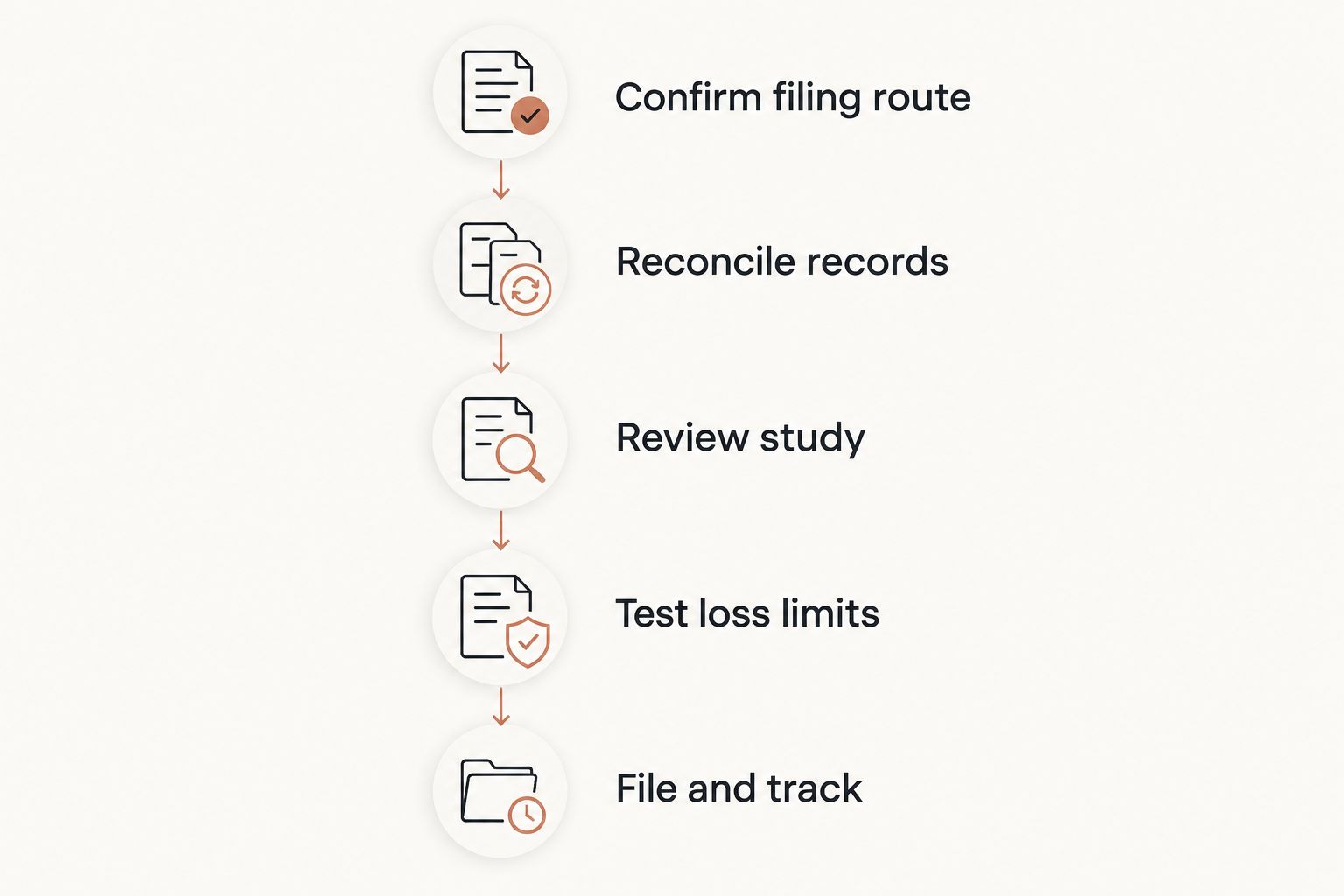
Use this sequence before treating an estimated tax benefit as available cash. Each step answers a different question, and the order keeps filing work from starting with incomplete assumptions.
- Confirm filing route. Ask your CPA whether the study belongs on an unfiled original return, an eligible Form 3115 method change, or another correction procedure.
- Reconcile records. Provide the closing statement, acquisition and rental-use dates, improvement records, earlier returns, and depreciation schedules.
- Review study. Have your CPA reconcile the report's classifications and basis totals with your records and prior deductions.
- Test loss limits. Determine how much of the resulting deduction is usable on the relevant return.
- File and track. Retain submission records, then monitor the applicable IRS status service and correspondence.
The sequence ends with filing, not study delivery. That is the milestone that puts the return into the applicable IRS process.
A bigger deduction does not necessarily mean immediate cash
Cost segregation separates qualifying components into shorter recovery periods, including 5-, 7-, and 15-year property where appropriate. Classification depends on each asset's function, documentation, placed-in-service date, and the taxpayer's facts. The building structure does not qualify for bonus depreciation.
The immediate cash result then depends on the rest of your return. A long-term rental loss subject to passive activity limits does not become a current W-2 offset merely because an engineering study identifies additional depreciation.
For short-term rental planning in 2026, an average guest stay of 7 days or less and material participation are central to the commonly discussed STR strategy. One material participation test requires more than 100 hours and more participation than any other individual, including a property manager. Logging 100 hours alone is insufficient.
Real estate professional status is not required for that short-stay exception, but the exception does not automatically establish material participation or remove other loss limits. Your CPA must apply the rules to your records before estimating a current tax benefit.
Separate the study expense from the payment forecast
The timing of cost segregation study costs and the timing of a tax payment belong in separate parts of your cash-flow plan: paying for analysis does not establish that a deduction is currently usable or that the IRS will issue money by a particular date.
Ask your CPA to distinguish among a usable current deduction, a suspended loss, reduced tax still owed, and an overpayment payable to you. Those outcomes have different effects on the cash available for your next property expense.
Keep cash available for property obligations independently of an expected tax payment. A planning estimate is not an IRS payment notice, and a completed study does not establish a deposit date.
For a 2026 decision, review bonus depreciation eligibility separately from report timing. Completing a study now does not reset the property's acquisition date or placed-in-service date.
Can a look-back study help without amending old returns?
Form 3115 generally provides the current-return route for eligible missed depreciation. The CPA calculates the Section 481(a) adjustment rather than amending prior returns for that look-back method change.
The benefit is a consolidated correction. The trade-off is that the filing still requires complete historical records and compliance with the applicable accounting-method procedures.
Can you get tax savings before the IRS sends money?
Reduced tax due can provide a cash-flow benefit without a tax refund. If your return shows less tax still payable, the benefit is a smaller payment rather than a later deposit.
Changes to withholding or estimated payments require a separate calculation. Ask your CPA to review safe-harbor requirements before reducing payments based on projected depreciation.
Who is this service best for?
Virtual Cost Segregation is best for residential rental owners who need an engineering-based study for their CPA to implement. High W-2 earners operating short-term rentals should resolve participation and deduction-usability questions before treating accelerated depreciation as a wage-income offset.
The service supplies the study, not tax-return preparation. That division is useful when you already have a CPA, but it also means you need to coordinate the handoff and filing schedule yourself.
FAQ
How long to get tax refund after cost segregation amendment?
There is no fixed cost-segregation-specific tax refund timeline. First confirm whether your CPA should file an amendment or claim eligible missed depreciation on the current return with Form 3115; then track the applicable IRS process.
Does a look-back cost segregation study mean I amend every prior return?
No. For an eligible look-back accounting-method change, missed depreciation is claimed on the current return with Form 3115 and a Section 481(a) adjustment; prior returns are not amended.
Does receiving my study start the IRS processing clock?
No. Study delivery does not submit a tax return or begin IRS processing. Virtual Cost Segregation delivers residential cost segregation studies in 3 to 5 business days, separately from your CPA's filing work.
Can cost segregation produce a deduction but no immediate tax refund?
Yes. Loss limitations, your remaining tax liability, and the treatment of any overpayment determine whether additional depreciation results in a current cash payment.
Can a short-term rental deduction offset my W-2 income?
A short-term rental deduction can offset W-2 income when the applicable activity rules, material participation requirements, and other tax limitations permit it. An average stay of 7 days or less does not establish eligibility by itself.
Who files Form 3115 after the study is complete?
Your CPA handles the applicable tax filing. The study provider supplies the supporting report; the engineering study itself is not filed with the IRS.
What should I do if my amended return is still processing?
Check the applicable IRS status service and have your CPA review any correspondence or instructions. Do not submit a duplicate filing merely because an expected payment has not arrived.
One last thing
The most useful question is: Which return receives the deduction, and how much is usable on that return? That answer tells you whether to expect a current-return benefit, an amended-return process, reduced tax due, or a deduction carried forward.
Before ordering around a filing deadline, get those answers from your CPA. They matter more to your cash-flow plan than the study completion date alone.