
By Virtual Cost Segregation
The best cost segregation study provider for rental property investors
 Built to IRS standards
 Audit support includedFlat price for every study3 to 5 business days
You can do cost segregation in the purchase year or years after buying a rental; there is no universal deadline measured from closing. The filing method changes once you have established a depreciation method, and a later study does not reset your property's acquisition date, placed-in-service date, or bonus depreciation eligibility.
- How long after buying a rental can you do cost segregation? Years later, with the correct filing method.
- A look-back study generally uses Form 3115 and a Section 481(a) adjustment rather than amended prior returns.
- The study date does not reset acquisition dates, depreciation eligibility, or the rental's original placed-in-service date.
- Virtual Cost Segregation serves residential rental owners; your CPA determines how the report affects your return.
How long do you have to cost segregate after buying a rental?
You do not lose access to cost segregation simply because you missed the purchase year. The practical question is which return and filing procedure should reflect the corrected depreciation.
For a 2026 review, separate your situation into these categories before ordering a study:
| Timing option | Best for | Main advantage | Main limitation |
|---|---|---|---|
| Before the first rental return | Owners establishing the initial depreciation schedule | Your CPA starts with the study's supported classifications | Basis and placed-in-service records must be ready |
| After an established depreciation method | Owners reviewing rentals held for years | A look-back study can identify missed depreciation | Your CPA must evaluate Form 3115 eligibility and procedures |
| Near a planned sale | Owners comparing remaining deductions with disposition consequences | The review connects depreciation with the exit plan | Recapture and limited remaining ownership can change the benefit |
Virtual Cost Segregation provides engineering-based studies for residential rentals with 1 to 4 units. A study supplies the asset analysis; it does not decide whether you can currently use the resulting tax deductions.
Why this matters
Missing the first return is not the same as missing every opportunity. A later study can correct the timing of depreciation without pretending the property was purchased again.
The distinction matters when you review an older rental in 2026. The study identifies supported asset classifications, while your CPA evaluates prior depreciation, filing procedures, loss limitations, and the tax consequences of a future sale.
Choose the filing route before choosing the filing date. A completed engineering report alone does not put a deduction on your return.
Before your first rental return: establish the schedule correctly
If you have not filed the property's first rental return, coordinate the study with your CPA before that return is prepared. This lets the initial depreciation schedule reflect the supported allocation among land, the building, and qualifying shorter-lived assets.
Closing is not automatically the depreciation start date. IRS Publication 527 describes rental property as placed in service when it is ready and available for rent, even if the first tenant has not moved in.
A house undergoing work that prevents rental use requires a different timeline from a ready-to-rent house awaiting a tenant. Keep evidence of readiness rather than relying only on the closing statement.
For a rental entering service in 2026, gather the settlement statement, acquisition contract, renovation invoices, photographs, and rental-readiness records. Ask your CPA which items belong in acquisition basis, which are separate improvements, and which require another treatment.
The advantage of early coordination is a cleaner starting schedule, not a special deduction available only immediately after closing. The limitation is that incomplete costs or unfinished work can leave the analysis premature.
After prior returns: use a look-back study
A look-back study analyzes the rental using its historical basis and original placed-in-service facts. It does not value the house at today's market price or restart depreciation from the report date.
For an eligible accounting-method change, missed depreciation is claimed on the current return with Form 3115 through a Section 481(a) adjustment; prior returns are not amended. Your CPA reconciles depreciation already taken with the depreciation that should have been taken under the corrected method.
That reconciliation prevents double counting. You do not claim the entire reclassified basis again if part of that basis has already been depreciated.
Form 3115 is not automatically the right procedure after every filing error. An isolated first-return issue and an established accounting method require different analysis, so your CPA must confirm the applicable correction procedure and current filing requirements.
A look-back study changes the depreciation calculation, not the property's history. Its advantage is access to a catch-up mechanism; its limitation is the additional accounting-method work and the possibility that loss rules restrict current use.
Why the right timing varies
There is no single purchase-to-study interval that works for every residential landlord. These factors determine whether ordering now supports your tax plan:
- Return history: An unfiled first return and an established depreciation method call for different implementation decisions.
- Acquisition evidence: Purchase agreements and binding-contract facts affect bonus eligibility. The closing date alone does not settle every acquisition question.
- Rental readiness: Depreciation follows the supported placed-in-service date, not the study's completion date.
- Prior depreciation: Your CPA needs the existing asset schedule to calculate any catch-up adjustment without duplication.
- Deduction usability: Passive activity, basis, at-risk, and other loss limitations affect when a deduction reduces taxable income.
- Expected sale: Depreciation recapture and your remaining holding period belong in the same analysis as accelerated deductions.
For a 2026 decision, ask your CPA to compare the study's expected deduction timing with your actual ability to use losses. A large depreciation figure is not the same as an immediate reduction in tax payable.
Does ordering in 2026 change the bonus depreciation rate?
Ordering a study in 2026 does not give older property a new acquisition date. Bonus depreciation follows the qualifying asset's acquisition and placed-in-service facts, together with applicable elections and other requirements.
Under the One Big Beautiful Bill Act, signed July 4, 2025, eligible property acquired and placed in service after January 19, 2025 qualifies for 100% bonus depreciation. The restored rate has no scheduled phase-down or end date.
Property acquired before January 20, 2025, including property under a contract signed before then, remains subject to the prior phase-down rules. For such property placed in service in 2026, the applicable bonus rate is 20%, subject to eligibility and applicable elections.
A personal home bought before January 20, 2025 and converted to a rental later does not receive the restored full bonus treatment merely because of the conversion. Its rate depends on the purchase facts and should be confirmed with a CPA.
The building structure never qualifies for bonus depreciation. Supported asset classifications can still accelerate deductions through 5-, 7-, and 15-year recovery periods when bonus depreciation is unavailable.
Can a later study help offset your W-2 income?
A later study does not automatically make rental losses deductible against wages. Cost segregation determines depreciation timing; the activity rules determine how the resulting loss is treated.
For the commonly discussed short-term rental exception, average guest stays must be 7 days or less, and material participation must also be established. A commonly used participation test requires more than 100 hours and more participation than any other individual, including a property manager.
More than 100 hours alone is not enough under that test. Real estate professional status is not required for this short-term rental route, but your actual operating facts and records still control.
Long-term residential landlords also use cost segregation. Their deductions remain subject to the applicable rental activity and loss rules, so a study can produce accelerated depreciation without an immediate wage offset.
A 2026 catch-up deduction needs a current-year usability review. Do not assume that participation records from an earlier year resolve the treatment of a later adjustment.
What should you send your CPA before ordering?
Start with a shared file, not a requested deduction amount. Your CPA and study provider need consistent historical facts to avoid rebuilding the analysis later.
- Acquisition records: Include the purchase agreement, settlement statement, ownership details, and support for the land allocation.
- Service records: Document when the property became ready and available for rent, including renovations that delayed readiness.
- Depreciation history: Supply prior returns and complete asset schedules, including separately recorded furniture, appliances, and improvements.
- Cost records: Organize invoices, improvement dates, photographs, and documents identifying what was purchased or installed.
- CPA review: Confirm the filing route, any accounting-method change, loss limitations, and the intended return before implementation.
Keep acquisition records and later improvement records separate. A replacement appliance or later renovation can have its own basis and service date rather than inheriting every fact of the original purchase.
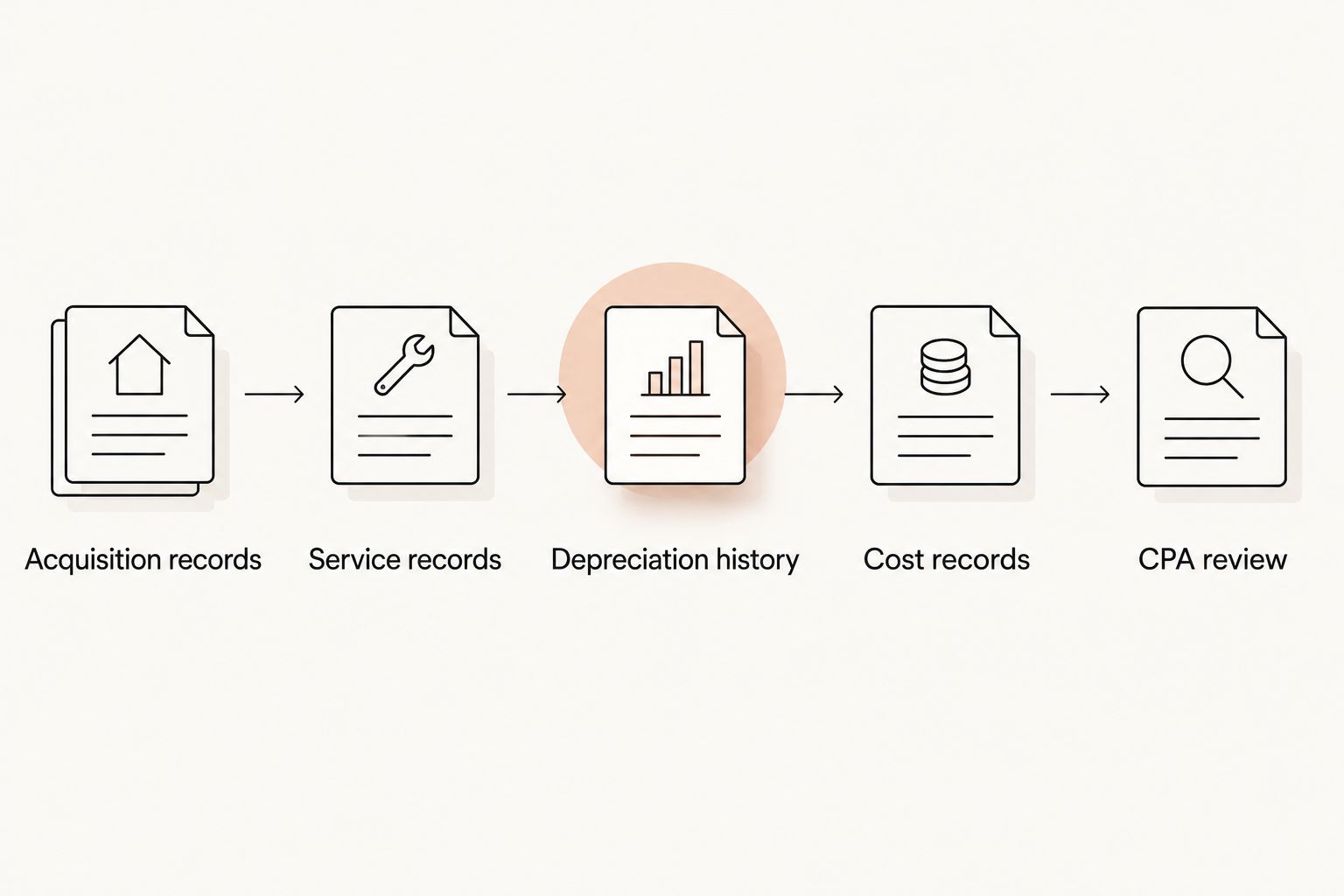
The client-to-CPA handoff checklist explains how to organize the report and supporting documents for implementation. Give your CPA time to resolve missing records before the return deadline becomes the deciding factor.
Where does the study provider's role end?
Virtual Cost Segregation is best for residential rental owners seeking an engineering-based study for their own CPA to apply. The service covers residential rentals with 1 to 4 units, including short-term and long-term rentals.
Virtual Cost Segregation delivers studies in 3 to 5 business days, with no site visit required, and includes audit support. That report turnaround is not a promise that your CPA can complete a return or accounting-method change within the same period.
The report is supplementary documentation, not a CPA service, and the study itself is not filed with the IRS. Your CPA applies the report when preparing the return and handles the relevant filing decisions.
The benefit is a documented engineering analysis built to the IRS Audit Technique Guide's criteria. The limitation is equally important: the study does not establish material participation, remove loss limitations, or determine your final tax result.
FAQ
Can I do cost segregation years after buying my rental?
Yes, cost segregation can be performed years after purchase. Your CPA should review the property's depreciation history, remaining basis, ownership status, and the appropriate filing procedure before implementation.
Do I have to finish the study before December 31?
No universal rule requires the report to be completed by December 31. Your CPA must coordinate the study with the relevant return deadline, extensions, and applicable filing procedures; the report date does not replace the placed-in-service date.
Do I amend old returns for a look-back cost segregation study?
For an eligible look-back accounting-method change, missed depreciation is claimed on the current return using Form 3115 and a Section 481(a) adjustment; prior returns are not amended. Your CPA confirms eligibility and the current filing requirements.
Does a study ordered in 2026 use 2026 bonus depreciation rules for every asset?
No, ordering a study in 2026 does not reset an asset's acquisition or placed-in-service date. Your CPA applies the rules relevant to each asset's historical facts and applicable elections.
Can I use cost segregation if my rental losses are passive?
Yes, passive rental owners can use cost segregation, but passive activity loss limitations can restrict current deductions. Accelerated depreciation and immediate tax savings are separate questions.
How long does Virtual Cost Segregation take to complete a study?
Virtual Cost Segregation delivers studies in 3 to 5 business days with no site visit required. Your CPA's review, return preparation, and any accounting-method filing require separate coordination.
Can I depreciate the land after a later study?
No, land is not depreciable. A later study must preserve a supported land allocation rather than moving land value into depreciable assets.
One last thing
The deadline you are worried about is often a filing deadline, not a deadline to commission the study. A property held for years deserves a review, but that review should begin with its historical depreciation schedule rather than a new estimate of market value.
Before ordering, ask your CPA one specific question: which return will reflect this study, and what filing procedure will put it there? That answer connects the engineering work to an actionable tax plan.
This article provides general educational guidance. Apply current law to your property's facts with your own tax adviser; estimates and illustrative calculations are not predictions of your tax outcome.