By Virtual Cost Segregation
The best cost segregation study provider for rental property investors
 Built to IRS standards
 Audit support includedFlat price for every study3 to 5 business days
 Furnished rental appliances are typically classified as 5-year personal property under MACRS, not as part of the 27.5-year residential building, when they are freestanding, easily removable, and not integrated into the structure. The hidden catch: built-in appliances that are wired or plumbed directly into cabinetry, walls, or the building's utility systems can be treated as structural components instead, which pushes them back into the 27.5-year bucket and cuts the first-year deduction significantly.
- Freestanding rental appliances (fridges, ranges, washers) usually classify as 5-year personal property in a cost segregation study.
- Built-in appliances wired or plumbed into the structure often get pulled into 27.5-year real property instead.
- Furnished rental appliances cost segregation classification depends on attachment method, function, and documentation, not just the appliance type.
- A typical residential cost segregation study reclassifies 20-45% of a property's cost basis into shorter recovery periods.
- 100% bonus depreciation applies to qualifying assets acquired and placed in service after January 19, 2025 under the OBBBA.
Why This Matters for Furnished Rentals
Appliances are one of the most common line items in a furnished short-term rental or long-term residential rental, and they're also one of the easiest categories for an examiner to question. If your CPA lumps every appliance into the building's 27.5-year schedule by default, you're leaving accelerated deductions on the table every year you own the property.
Getting the tax deductions to review when furnishing an Airbnb right matters just as much for classification as it does for expense tracking. A refrigerator purchased for $1,800 and correctly classified as 5-year property depreciates roughly five times faster than the same refrigerator lumped into the building's basis. Multiply that across a fully furnished short-term rental with a kitchen suite, laundry set, and multiple bedroom furniture packages, and the classification decision compounds fast.
The distinction also matters for 2026 tax planning. Under the One Big Beautiful Bill Act (OBBBA), bonus depreciation returned to 100% for qualifying property acquired and placed in service after January 19, 2025, which means correctly classified 5-year appliances placed in service in 2026 can be written off in full in year one, not spread across five years.
How Are Furnished Rental Appliances Classified in a Cost Segregation Study?
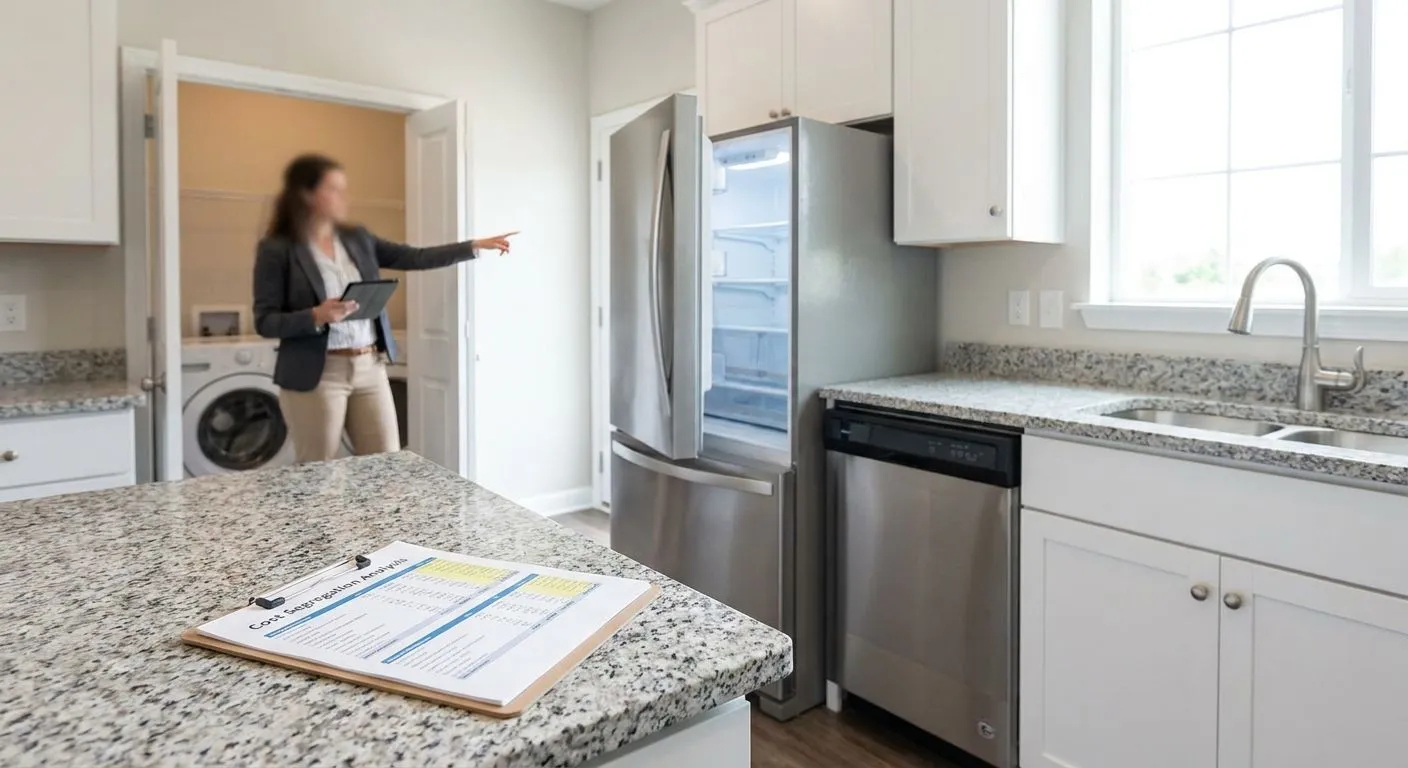
An engineering-based cost segregation study looks at how each asset is attached, how it functions, and whether removing it would damage the building. That functional test, not the appliance's price tag, drives the classification.
| Appliance Type | Typical Classification | Recovery Period | Bonus Depreciation Eligible (2026) | |---|---|---| | Freestanding refrigerator, range, or oven | Personal property | 5 years | Yes, if acquired and placed in service after Jan 19, 2025 | | Stackable or freestanding washer/dryer | Personal property | 5 years | Yes | | Built-in dishwasher (plumbed and hardwired) | Depends on installation, often real property | 27.5 years | Case-by-case | | Integrated microwave or wall oven set into cabinetry | Often treated as a structural component | 27.5 years | Case-by-case | | Furniture, décor, and small kitchen appliances | Personal property | 5 years | Yes |
Classification, recovery period, and bonus eligibility depend on the specific asset's function, how it was installed, its placed-in-service date, and the taxpayer's own facts. No blanket rule guarantees a specific appliance qualifies for a specific recovery period.
Freestanding Appliances: 5-Year Recovery Period
A freestanding refrigerator, range, or portable dishwasher that plugs into a standard outlet and can be pulled out without tools generally lands in 5-year personal property. These units support the tenant's use of the unit as a furnished rental rather than the building's structural function, which is the test IRS examiners apply.
Built-In Appliances: Classification Depends on Installation
Appliances hardwired into the electrical panel, plumbed directly into supply lines, or built into custom cabinetry face a tougher classification call. Some engineers will still isolate the appliance component from the surrounding millwork, but the analysis takes more documentation and judgment than a freestanding unit.
Furniture and Décor: 5-Year Personal Property
Beds, sofas, dining sets, and decorative items furnishing a short-term rental almost always classify as 5-year personal property because they're never attached to the structure. These items typically make up a meaningful share of the total furnishing budget on a fully outfitted Airbnb or VRBO unit.
Why Appliance Classification Varies
- Attachment method: bolted, plumbed, or hardwired assets face more scrutiny than plug-in units.
- Function test: does the item serve the tenant's use of the space, or does it serve the building itself?
- Removability: can the appliance come out without damaging drywall, cabinetry, or flooring?
- Documentation: purchase invoices, installation photos, and contractor notes support the classification if the IRS ever asks.
- Placed-in-service date: appliances acquired and placed in service after January 19, 2025 qualify for 100% bonus depreciation under OBBBA; earlier acquisitions may fall under lower phase-out percentages.
- Engineer's judgment: two similar-looking appliances can classify differently depending on how they're wired into the unit.
Run a quick example. On a $500,000 furnished short-term rental, an engineering-based study might reclassify 25% of the cost basis, or $125,000, into 5-year and 15-year property. For an owner in the 37% tax bracket, that $125,000 in accelerated first-year deductions is worth roughly $46,250 in tax value, as an illustrative example only and not a guaranteed outcome. Appliances and furniture are one of several categories, alongside flooring, cabinetry, and site improvements, that make up that reclassified share.
Identifying short-life assets during a cost segregation study is exactly where this kind of line-item analysis happens, and it's the step where appliances get separated from the building's real property basis.
Get your reclassified percentage estimated
See how furnished appliances and furnishings factor into your study.
Do Built-In Appliances Qualify for the Same 5-Year Treatment as Freestanding Units?
Built-in appliances do not automatically get the same 5-year treatment as freestanding units. Whether a hardwired oven or plumbed dishwasher qualifies for 5-year classification depends on how it's installed, whether it can be separated from the surrounding cabinetry, and the specific facts of the property, so each unit gets evaluated individually rather than assumed.
Does Furnishing a Short-Term Rental Increase the Reclassified Percentage?
Furnishing a short-term rental can increase the reclassified percentage because furniture, décor, and freestanding appliances typically classify as 5-year property alongside other short-life assets. A furnished unit generally shows a higher share of personal property than an unfurnished long-term rental, though the exact percentage still depends on the property's construction and finishes.
What Documentation Supports Appliance Classification if the IRS Audits the Return?
Purchase invoices, delivery records, and installation photos support appliance classification if the IRS audits the return. A well-documented, engineering-based study also explains the functional test applied to each asset, which is the kind of record examiners look for under the IRS Cost Segregation Audit Technique Guide.
Virtual Cost Segregation prepares its residential studies with that documentation built in, so the appliance and furnishing line items in your report already carry the reasoning an examiner or your CPA would need to see. A study on a fully furnished Airbnb or VRBO looks different from one on an unfurnished long-term rental, and the report should reflect that distinction rather than treating every property the same.
FAQ
What is the typical recovery period for furnished rental appliances?
Freestanding rental appliances typically depreciate over 5 years under MACRS, while built-in appliances wired or plumbed into the structure may follow the building's 27.5-year schedule instead. The correct classification depends on installation and function, not the appliance type alone.
Does furnished rental appliances cost segregation classification affect bonus depreciation?
Yes, appliances classified as 5-year personal property and acquired and placed in service after January 19, 2025 qualify for 100% bonus depreciation under the OBBBA. Appliances classified as structural components do not get this treatment.
Are kitchen appliances in an Airbnb treated differently than in a long-term rental?
The classification test is the same for both, based on attachment and function, but a furnished short-term rental usually contains more freestanding appliances and furniture than a typical long-term rental. That can push the overall reclassified percentage higher on a furnished unit.
Can a washer and dryer be classified as 5-year property?
A freestanding or stackable washer and dryer that plugs into a standard outlet generally classifies as 5-year personal property. A unit built into a laundry closet with hardwired connections may require closer review.
How much of a rental property's cost basis typically gets reclassified?
A residential cost segregation study typically reclassifies 20-45% of a property's cost basis into 5-year, 15-year, or land improvement categories. The exact percentage depends on the property's finishes, furnishings, and construction.
Do I need a site visit to classify appliances correctly?
No, appliance classification can be handled through photos, invoices, and floor plans without an on-site visit, which is how a no-site-visit cost segregation study is typically prepared. Accuracy depends on the quality of documentation provided, not a physical inspection.
What happens if an appliance is misclassified on a tax return?
A misclassified appliance can trigger an IRS inquiry during an audit, since the examiner will apply the same functional test the study should have used. Correcting it later usually requires a Form 3115 accounting method change filed by your CPA.
One Last Thing
The appliance line item is rarely the biggest dollar amount in a furnished rental cost segregation study, but it's often the first thing an examiner checks because the classification rule is easy to state and easy to misapply. Get the freestanding-versus-built-in distinction right on paper before your CPA files, and the rest of the reclassified percentage tends to hold up without a second look.