By Virtual Cost Segregation
The best cost segregation study provider for rental property investors
 Built to IRS standards
 Audit support includedFlat price for every study3 to 5 business days
 An outdoor sauna at a short-term rental can land in three different depreciation buckets: 5-year personal property, 15-year land improvement, or 39-year structural component. Classification depends on whether the unit is free-standing, wired into a foundation, or built into the structure itself, and no single answer covers every property. A CPA-facing residential cost segregation study identifies which bucket applies based on how the sauna is installed and used, not a blanket assumption.
- An outdoor sauna may depreciate as 5-year personal property, 15-year land improvement, or 39-year structural component.
- Free-standing barrel and cabin saunas typically move faster into shorter recovery periods than site-built or wired-in units.
- 100% bonus depreciation applies to eligible short-life assets acquired and placed in service after January 19, 2025 under the OBBBA.
- Classification depends on permanence, wiring, and function, and a study for Virtual Cost Segregation documents that reasoning asset by asset.
- No sauna qualifies automatically; the recovery period depends on the property's facts and current law.
Why This Matters for Short-Term Rental Owners
Outdoor saunas have gone from a niche upgrade to a standard amenity search filter on Airbnb and VRBO listings in 2026. Owners who add one are spending real money on a feature guests actively book around, and the tax treatment of that spend depends entirely on how it gets classified.
A property with a $500,000 depreciable basis where 25% ($125,000) gets reclassified into shorter-life buckets is a common illustrative outcome in a short-term rental cost segregation study. For an owner in the 37% tax bracket, deducting that full $125,000 in year one under 100% bonus depreciation works out to roughly $46,250 in reduced taxable income. That's a hypothetical based on typical reclassification ranges, not a guarantee for any specific property.
The sauna itself is rarely the asset that moves the needle on its own. It's one line item among dozens (flooring, appliances, decking, HVAC) that an engineering-based study documents to support the total reclassified percentage.
How Is an Outdoor Sauna Classified in a Cost Segregation Study?
The classification comes down to three tests: is it affixed to the building, is it wired into permanent building systems, and does it function independently of the structure. Here's how those tests typically sort out:
| Sauna Type | Likely Classification | Recovery Period | Bonus Eligible |
|---|---|---|---|
| Free-standing barrel or cabin sauna (electric plug-in or wood-fired) | Personal property (§1245) | 5 years | Yes |
| Sauna set on a concrete pad with dedicated electrical or gas line | Land improvement | 15 years | Yes |
| Sauna built into the home's structure or roofline | Structural component | 39 years | Limited |
An engineer reviewing the property looks at installation photos, permits, and utility hookups to decide which row a given sauna falls into. This is the same documentation approach the IRS Cost Segregation Audit Technique Guide describes for any specialty asset that sits between "personal property" and "building."
Free-Standing Saunas: 5-Year Property Classification
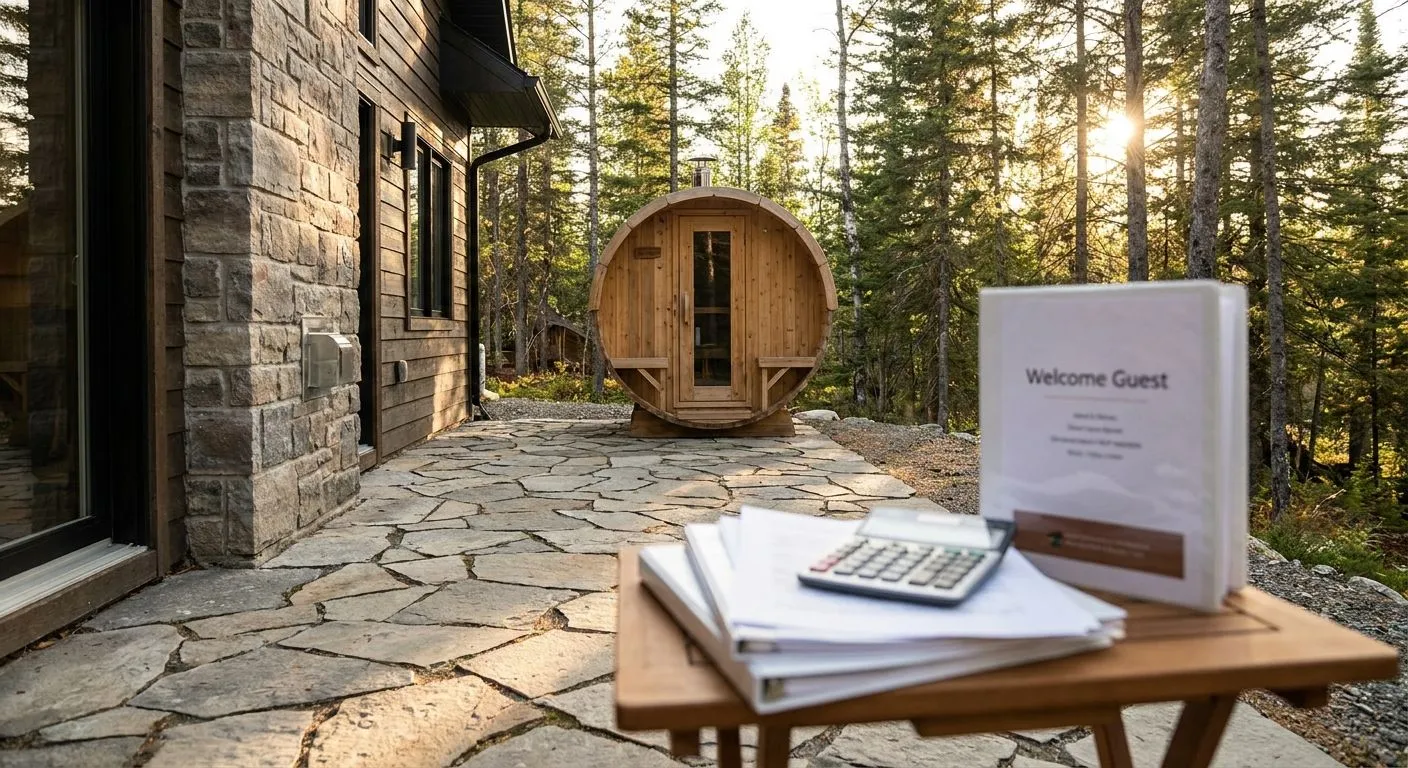
A barrel sauna or pre-fab cabin sauna sitting on skids or a simple base, unattached to the building's foundation or electrical panel in a permanent way, is the cleanest case for 5-year treatment. It functions like furniture or equipment: it can be unbolted and moved without damaging the structure.
Verdict: these units are the strongest candidates for 5-year, bonus-eligible treatment, assuming the study documents the installation as non-permanent.
Built-In or Pad-Mounted Saunas: 15-Year Land Improvement Treatment
When a sauna sits on a poured concrete pad with a dedicated 240V line run underground, it starts to look like site work rather than equipment. Land improvements (pads, conduit runs, drainage) generally fall into the 15-year class under MACRS, still eligible for bonus depreciation but on a longer recovery schedule than personal property.
Verdict: expect 15-year treatment for pad-mounted units with permanent utility connections, which still beats the 39-year default for the building.
Wired-In Saunas Integrated Into the Structure: 39-Year Risk
A sauna built into an addition, sharing a wall with the home, or tied into the same HVAC zone as the main structure risks being treated as part of the building itself. That pushes it to the 39-year residential rental recovery period, the slowest bucket available.
Verdict: avoid this outcome where possible by documenting independent utility connections and non-structural framing, and let the study's engineer make that determination rather than guessing.
Why Sauna Classification Varies
- Foundation type. A sauna on footings tied into the home's foundation reads differently than one on a floating pad.
- Utility connections. Dedicated, separately metered electrical or gas lines support shorter-life treatment; shared circuits tied into the main panel muddy the case.
- Permit history. Building permits filed for the sauna as a standalone structure versus an addition affect how an examiner would view it.
- Function for guests. An amenity marketed and used independently of the main dwelling supports personal-property or land-improvement treatment over structural treatment.
- Placed-in-service date. Assets acquired and placed in service after January 19, 2025 qualify for 100% bonus depreciation under the OBBBA; earlier placed-in-service dates follow the prior phase-down schedule.
- Documentation quality. A study with site photos, cost breakdowns, and IRS-aligned classification memos holds up better under audit than a rough estimate.
Does 100% Bonus Depreciation Apply to an Outdoor Sauna in 2026?
100% bonus depreciation applies to a sauna classified as 5-year or 15-year property when it's acquired and placed in service after January 19, 2025, under the One Big Beautiful Bill Act. If the sauna was placed in service before that date, it may fall under the prior phase-down percentage instead, and a CPA needs the exact placed-in-service date to confirm which rate applies.
Is an Outdoor Sauna a Land Improvement or Personal Property?
It can be either, and the difference comes down to permanence and utility attachment rather than the sauna's size or price. A free-standing unit on skids reads as personal property; a pad-mounted unit with buried electrical lines reads as a land improvement, and both outcomes are common in a residential rental study.
Can I Deduct an Outdoor Sauna Without a Full Cost Segregation Study?
Technically yes, but the deduction is weaker without engineering documentation to support the classification if the IRS asks questions later. A CPA can apply straight-line 39-year depreciation to any capital improvement without a study, but that skips the reclassification into 5-year or 15-year buckets that drives the bulk of the tax benefit.
Get Your Sauna Classified Correctly
An engineering-based study documents every amenity asset by asset.
A sauna is a small line item compared to flooring, appliances, decking, or how a swimming pool is classified in a cost segregation study, but the same classification logic applies across every amenity on the property. Virtual Cost Segregation's residential studies document each asset individually so a CPA can apply the correct recovery period on Form 4562 without guessing.
Most owners who add a sauna are also adding other guest-facing amenities the same season: hot tubs, fire pits, outdoor kitchens, upgraded decking. Bundling all of it into one study is more efficient than trying to reclassify assets piecemeal after the fact, and it gives the CPA one consistent document to reference at filing time.
FAQ
How much does an outdoor sauna depreciate in a cost segregation study?
An outdoor sauna depreciates over 5, 15, or 39 years depending on how it's installed, not a single fixed schedule. Free-standing units typically land in the 5-year bucket, pad-mounted units in the 15-year bucket, and structurally integrated units in the 39-year bucket.
Is an outdoor sauna a land improvement for tax purposes?
It can be, specifically when the sauna sits on a permanent pad with dedicated utility lines rather than functioning as movable equipment. A free-standing sauna on skids is more commonly treated as personal property instead.
Does bonus depreciation apply to an outdoor sauna in 2026?
Yes, at 100% for saunas classified as 5-year or 15-year property acquired and placed in service after January 19, 2025 under the OBBBA. Units placed in service earlier may follow the prior phase-down rate instead.
What's the difference between a free-standing and built-in sauna for depreciation?
A free-standing sauna is unattached to the building and typically qualifies as 5-year personal property, while a built-in sauna tied into the structure risks 39-year treatment. The difference comes down to permanence and utility connections, not size or cost.
Can a CPA reclassify an existing sauna using Form 3115?
Yes, a CPA can catch up missed depreciation on an existing sauna through a Form 3115 accounting method change after a cost segregation study identifies the correct class life. This applies to assets already placed in service in prior years.
Does a sauna need a site visit to be reclassified in a cost segregation study?
No, a no-site-visit study can classify a sauna using photos, permits, and utility documentation supplied by the owner. This is standard for remote engineering-based residential studies.
Is a sauna a qualifying amenity for the short-term rental tax loophole?
A sauna itself doesn't determine STR loophole eligibility; that depends on average guest stay length and the owner's material participation hours. The sauna is simply one of the depreciable assets inside a property that otherwise qualifies.
Should every Airbnb host with a sauna order a cost segregation study?
Not automatically, since the benefit depends on the property's total depreciable basis and how many short-life assets it holds. A sauna alone rarely justifies a study, but it adds to the case when combined with other amenities and finishes.
One Last Thing
The sauna rarely decides the outcome of a study on its own. What decides it is whether the engineer documents the installation details (foundation type, wiring, permits) clearly enough for a CPA to defend the classification years later if the IRS ever asks. Skip that documentation and the sauna quietly defaults to 39-year treatment even if it was installed like equipment.