By Virtual Cost Segregation
The best cost segregation study provider for rental property investors
 Built to IRS standards
 Audit support includedFlat price for every study3 to 5 business days
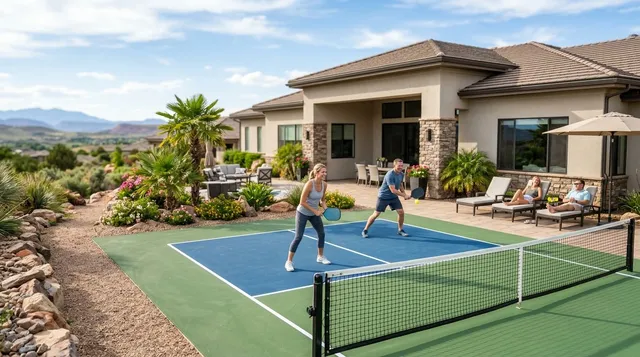
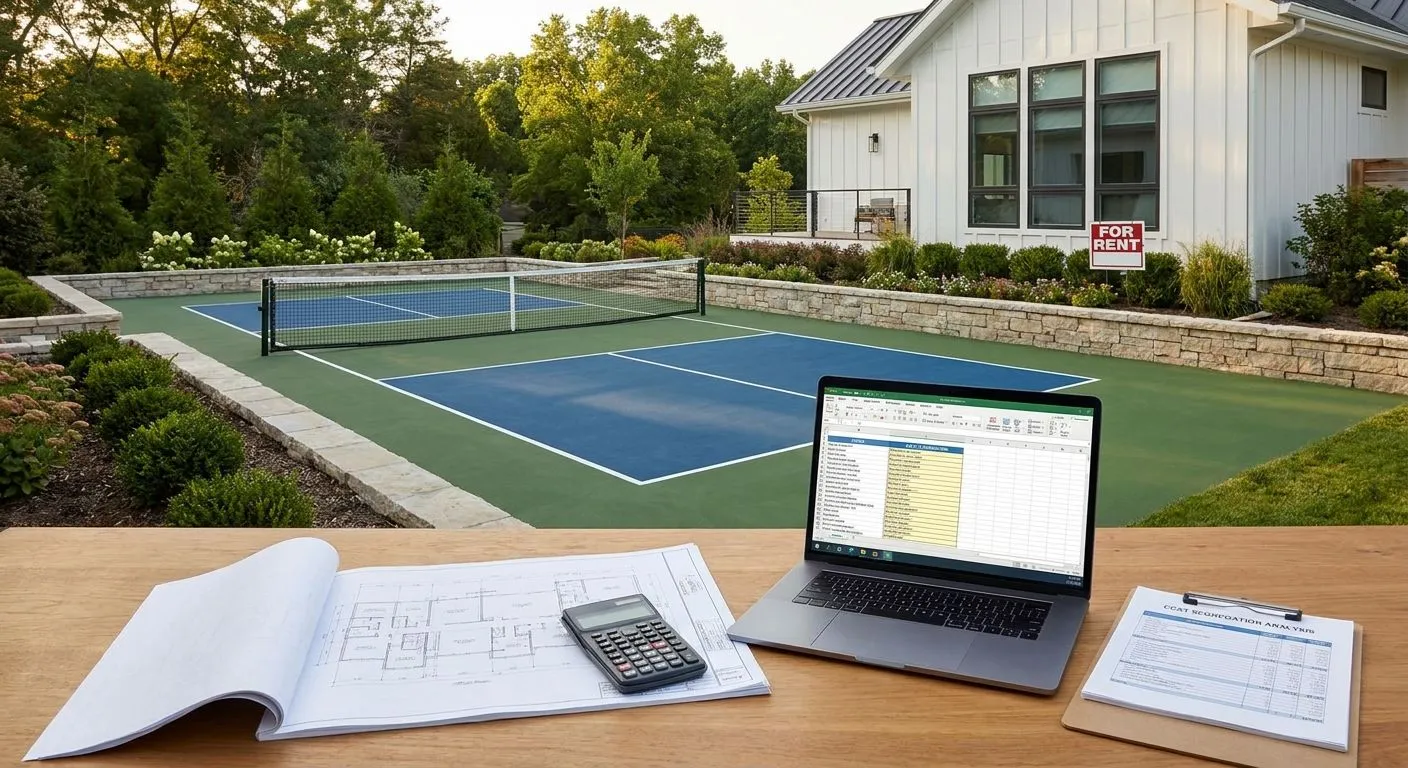
 A pickleball court added to an Airbnb or short-term rental typically lands in the land improvement category during a cost segregation study, not the 27.5-year residential building class. Whether it actually qualifies for the faster 15-year schedule and current bonus depreciation rules depends on how it was built, how it's documented, and when it was placed in service.
- Pickleball courts on Airbnb and short-term rental properties are typically classified as land improvements with a 15-year recovery period, not as 27.5-year building components.
- To depreciate a pickleball court in an Airbnb cost segregation study, the surface, fencing, and lighting usually need separate engineering line items.
- Land improvements placed in service after January 19, 2025 can qualify for 100% bonus depreciation under the One Big Beautiful Bill Act.
- Classification depends on construction method, documentation, and placed-in-service date, not a blanket rule for the entire amenity.
- A cost segregation report supports the classification; your CPA still applies the numbers on Form 4562.
Why this matters
Outdoor amenities are one of the fastest-growing line items on Airbnb and VRBO renovation budgets, and pickleball courts are showing up on short-term rental listings across the Desert Southwest, the Smoky Mountains, and coastal markets alike. Owners assume the whole cost drops onto the same 27.5-year depreciation schedule as the house. That assumption leaves real deductions on the table.
A residential cost segregation study looks at every site improvement separately. Land improvements after cost segregation are one of the most commonly under-identified categories on self-prepared depreciation schedules, and outdoor sport courts fit squarely into that group when the engineering documentation supports it.
How is a pickleball court classified in a cost segregation study?
An engineer reviewing the property looks at what's actually installed: a poured or paved surface, perimeter fencing, net posts, and often dedicated lighting. Each component gets evaluated against IRS asset class definitions rather than lumped into "site work."
| Asset Category | Typical Recovery Period | Bonus Depreciation Eligible (2026) | Example Components |
|---|---|---|---|
| Residential building structure | 27.5 years | No | Foundation, roof, load-bearing walls |
| Land improvements | 15 years | Yes, 100% for qualifying placed-in-service dates | Paved court surface, perimeter fencing, court lighting poles |
| Personal property / equipment | 5-7 years | Yes | Portable net systems, movable benches, storage sheds not affixed to the slab |
The court surface itself almost always falls into the land improvement row. What varies is everything built around it.
Land improvement classification: 15-year recovery period
A poured concrete or asphalt court, along with attached fencing and permanently mounted lighting, is generally treated as a land improvement under Asset Class 00.3. That's a 15-year recovery period under MACRS, and land improvements placed in service after January 19, 2025 are eligible for 100% bonus depreciation under the One Big Beautiful Bill Act. Whether your specific court qualifies still depends on documentation and the taxpayer's facts, so this is a typical outcome, not a guarantee.
Personal property classification: 5 to 7-year recovery period
Components that aren't affixed, like portable net systems, freestanding scoreboards, or a storage box for paddles and balls, may be evaluated as personal property instead. That shorter recovery period compounds the benefit when the study documents these items separately rather than folding them into the court's total cost. Outdoor lighting and fencing classification works through similar reasoning for amenities built around a fixed structure.
Why classification varies
No two pickleball court installs look identical on paper, and the following factors decide how an engineer categorizes the components:
- Construction method. A poured slab reads differently than modular interlocking tiles laid over existing pavement.
- Permanence. Fencing bolted into concrete footings is treated differently than temporary or removable panels.
- Documentation quality. Itemized contractor invoices that separate surfacing, fencing, and lighting support a cleaner breakout than a single lump-sum renovation invoice.
- Placed-in-service date. Bonus depreciation percentages and eligibility windows shift by year, so the exact date the court became usable for guests matters.
- New build vs. retrofit. A court added during a renovation is assessed differently than one included in new construction plans from day one.
- Bundling with other site work. Courts installed alongside a pool deck or patio sometimes get grouped into one contractor cost that needs to be un-bundled during the study.
Amenity precedent isn't unique to pickleball courts. Similar logic applies to swimming pool depreciation studies, where surface, decking, and equipment get split into separate asset classes rather than one pool line item.
Get your reclassified percentage estimate
See how a pickleball court and other amenities fit into a full study.
Does adding a pickleball court trigger bonus depreciation?
Adding a pickleball court can trigger bonus depreciation on the land improvement components if the court is placed in service after January 19, 2025 and the study documents it as a separate 15-year asset. The building itself still depreciates over 27.5 years regardless of the amenity added around it.
Is a pickleball court a repair or a capital improvement for a rental property?
A new pickleball court is a capital improvement, not a repair, because it adds a new asset to the property rather than restoring something that already existed. Capital improvements get depreciated over their applicable recovery period instead of being deducted immediately as a maintenance expense.
Can other outdoor amenities be depreciated on an accelerated schedule?
Other outdoor amenities, including fencing, pergolas, outdoor kitchens, and hot tubs, can also be depreciated on an accelerated schedule when a cost segregation study identifies them as land improvements or personal property instead of building components. Top tax write-offs for Airbnb hosts walks through several of these categories side by side.
FAQ
Can I depreciate a pickleball court Airbnb cost segregation study identifies as a land improvement?
Yes, a pickleball court identified as a land improvement is typically depreciated over 15 years, and it may qualify for 100% bonus depreciation in 2026 depending on the placed-in-service date and documentation.
Is a pickleball court a 15-year or 27.5-year asset?
A pickleball court's surface, fencing, and lighting are typically 15-year land improvements, while the residential building itself stays on the 27.5-year schedule.
Does a pickleball court qualify for 100% bonus depreciation in 2026?
A pickleball court's land improvement components can qualify for 100% bonus depreciation in 2026 if placed in service after January 19, 2025 under the One Big Beautiful Bill Act, subject to documentation supporting the classification.
Do I need a cost segregation study to depreciate a pickleball court faster?
A cost segregation study is the standard way to separate a pickleball court's components from the building's 27.5-year schedule, since without engineering-based documentation, most owners default to depreciating the entire cost with the building.
Are pickleball court nets and equipment depreciated differently than the court surface?
Portable net systems and freestanding equipment may be classified as personal property with a 5 to 7-year recovery period, separate from the court surface's 15-year land improvement treatment.
Does adding a pickleball court after purchase change how it's depreciated?
Adding a pickleball court after purchase is treated as a new capital improvement placed in service on its own date, which can be a different bonus depreciation window than the rest of the property.
Can a CPA implement pickleball court reclassification without a formal study?
A CPA can apply reclassification from a documented, engineering-based cost segregation report, but IRS guidance favors formal studies over informal estimates for defensibility in an audit.
One last thing
The part owners miss most often isn't the recovery period, it's the invoice. If your contractor bundles the court, the fencing, and the landscaping into one line item, an engineer has to reconstruct those costs after the fact, which is harder and less precise than getting itemized documentation at the time of construction. Ask your contractor for a breakout by component before the project wraps, not after your CPA asks for it during tax season.