
By Virtual Cost Segregation
The best cost segregation study provider for rental property investors
 Built to IRS standards
 Audit support includedFlat price for every study3 to 5 business days
 Virtual Cost Segregation is best for residential rental owners who want an engineering-based cost segregation study while keeping their own CPA. For your 2026 decision, compare a residential study specialist, a broader tax-service engagement, standard depreciation through your CPA, and a calculator used only for preliminary planning.
- Virtual Cost Segregation offers engineering-based cost segregation for residential rentals with 1 to 4 units.
- A study supplies asset-level depreciation documentation; your CPA applies it to your tax return.
- Standard depreciation remains an option when accelerating deductions does not fit your tax position.
- DIY calculators estimate potential benefits but do not replace a property-specific study.
Why this matters
You are buying documentation for a tax position, not just a larger deduction estimate. The right choice separates asset classification from the question of whether you can use the resulting deductions.
Virtual Cost Segregation provides residential cost segregation studies built to the IRS Audit Technique Guide's criteria. Its service covers rentals with 1 to 4 units, including short-term rentals and long-term residential rentals, with delivery in 3 to 5 business days and no site visit required.
That scope answers the study question. Your CPA still needs to answer the tax question: which deductions apply, when they apply, and whether activity-loss limits restrict their use.
For 2026, start with those two questions before comparing providers. A faster report does not remove the need for a correct acquisition date, supportable depreciable basis, and accurate rental-use records.
Cost segregation alternatives at a glance
These are different ways to handle your depreciation decision, not interchangeable services. Compare the deliverable first.
| Option | Best for | Main deliverable | Principal limitation |
|---|---|---|---|
| Residential engineering-based study | Owners seeking property-specific asset classification | Component allocations and supporting methodology | Your CPA must implement the findings |
| Broader tax-service engagement | Owners seeking tax planning and filing coordination | Work defined by the engagement agreement | Confirm whether an engineering-based study is included |
| Standard depreciation through your CPA | Owners not pursuing accelerated component deductions | A depreciation schedule under applicable tax rules | Does not itself identify every eligible short-life component |
| DIY calculator | Owners screening whether to investigate further | An estimated planning figure | Does not establish property-specific classifications |
Compare the work product, not the projected deduction. A calculator, a depreciation schedule, and an engineering-based report answer different questions.
Before selecting any option, ask who establishes asset costs, who determines recovery periods, and who applies the findings on your return. Your engagement should make those responsibilities clear.
1. Virtual Cost Segregation: best for residential study buyers
Virtual Cost Segregation provides engineering-based cost segregation studies for residential rentals with 1 to 4 units. You buy the study online, receive the report in 3 to 5 business days, and give it to your own CPA for implementation.
The service fits an owner who already has a tax preparer and needs the property analysis rather than a replacement accounting relationship. Audit support is included, and no site visit is required.
Where the residential study service shines
- Defined residential scope: Single-family rentals, duplexes, triplexes, fourplexes, and residential short-term rentals.
- Engineering-based documentation: The study is built to the IRS Audit Technique Guide's criteria.
- Remote process: No site visit is required.
- Defined delivery window: Studies are delivered in 3 to 5 business days.
- Planning before purchase: A free manual savings estimate is available through a website or email inquiry.
Where the residential study service falls short
- It is not a CPA service and does not replace tax-return preparation.
- A study cannot establish material participation or remove passive-activity restrictions.
- An estimate does not establish the final reclassification result or tax benefit.
- Your CPA must review the report against your ownership, basis, dates, and filing history.
Residential study versus broader tax engagement
| Dimension | Residential study service | Broader tax engagement |
|---|---|---|
| Primary purchase | Engineering-based study | Services specified in the engagement |
| Tax-return filing | Your own CPA applies the report | Confirm filing responsibilities |
| Property scope | Residential rentals with 1 to 4 units | Confirm the provider's scope |
| Implementation | Separate CPA handoff | Confirm whether implementation is included |
Best for: Residential owners who need a documented study and already have a CPA.
Verdict: Buy when your CPA confirms that accelerated depreciation fits your facts and you need the supporting property analysis.
2. A broader tax-service engagement: best for coordinated tax work
A broader engagement is the category to evaluate when your main need extends beyond the study. Start by identifying the work you actually need: return preparation, entity questions, depreciation implementation, or ongoing tax planning.
Do not assume one agreement includes all of it. Ask for a written scope that distinguishes the engineering work from the accounting work.
Where a broader engagement shines
- You can request coordination between the study and tax-return implementation.
- You can define responsibilities for related tax questions in the engagement.
- You can evaluate the study alongside your wider filing needs.
Where a broader engagement falls short
- The engagement label does not establish the study methodology.
- You still need to confirm who supplies asset-level classifications and cost support.
- Additional services are useful only when they address an actual need.
| Decision point | Broader engagement | Standalone residential study |
|---|---|---|
| Scope | Defined by your agreement | Property study |
| Filing work | Confirm inclusion | Handled by your CPA |
| Documentation | Request study specifications | Engineering-based report |
Best for: Owners seeking several tax services under a clearly defined engagement.
Verdict: Hold until the agreement identifies the study deliverable, tax responsibilities, and implementation process.
3. Standard depreciation: best when acceleration is not the priority
Standard depreciation is a valid choice, not a failed tax strategy. Your CPA establishes the applicable basis, recovery period, and depreciation treatment without commissioning a component-level cost segregation study.
For a long-term residential rental, the building generally has a 27.5-year recovery period. Under the short-term-rental treatment addressed here, including the 7-day-average scenario, the building uses a 39-year recovery period; the house remains residential real estate even though its building depreciation classification differs.
Where standard depreciation shines
- You avoid ordering a study before confirming its usefulness.
- Your CPA can assess depreciation alongside your existing return.
- You retain a path that does not depend on a reclassification estimate.
Where standard depreciation falls short
- It does not itself identify all components eligible for shorter recovery periods.
- Treating eligible components as part of the building delays their deductions.
- A building-level schedule alone does not supply engineering-based allocation support.
Best for: Owners whose CPA determines that accelerating deductions is not currently the priority.
Verdict: Hold when the tax benefit, timing, or documentation needs do not justify a study yet.
4. DIY calculators: best for an initial screen
A calculator helps you decide which questions to ask next. It is not the document your CPA uses to support property-specific component classifications.
The distinction is simple: an estimate applies assumptions; a study analyzes the property. Treat a calculator's output as a planning input, not a filing instruction.
Where calculators shine
- They provide a starting point for discussing potential benefits.
- They help you identify assumptions that need checking.
Where calculators fall short
- They do not establish the property's actual reclassified percentage.
- They do not establish your ability to use a rental loss.
- They do not replace cost sources, classification analysis, or a study report.
Best for: Owners deciding whether to request a manual estimate or discuss a study with their CPA.
Verdict: Skip as a replacement for an engineering-based study; use only for preliminary planning.
Why residential owners choose a different service model
Change the service model when the work you need changes. Do not change it merely because another estimate shows a larger deduction.
Useful reasons to reassess your arrangement include:
- You already have a CPA: You need property analysis rather than another tax-preparation engagement.
- Your property is a residential rental: You want a study scope that matches the asset you own.
- You need a remote process: No-site-visit delivery fits your circumstances.
- You need implementation clarity: The preparer needs classifications, cost support, and acquisition records rather than a headline savings figure.
- You are comparing different deliverables: A calculator estimate is not equivalent to an engineering-based report.
For your 2026 review, request the same scope from every provider category. Ask how costs are supported, how assets are classified, what audit support includes, and what your CPA receives.
Confirm the tax fit before ordering
Cost segregation separates eligible components into shorter recovery periods, including 5-, 7-, and 15-year property where the facts support those classifications. The building structure does not qualify for bonus depreciation, and land is not depreciable.
Asset treatment depends on function and documentation. Do not assume an entire amenity, renovation, or furnishing package belongs in one recovery period.
Illustrative allocation, not promised savings
Assume, solely for illustration, that a study reclassifies 25% of the relevant depreciable property basis and that the owner faces a 37% marginal federal tax bracket. Those assumptions do not establish this property's allocation or the owner's usable deduction.
The reclassified amount is not automatically the tax savings. Your CPA must determine applicable depreciation, bonus eligibility, loss limitations, state treatment, and the effect of deductions already available without the study.
Short-term rentals and W-2 income
For the short-term-rental pathway discussed here, average guest stays must be 7 days or less, and material participation must also be established. A commonly used participation test requires more than 100 hours and more hours than any other individual, including a property manager.
Logging 100 hours alone is insufficient. Real estate professional status is not required for this pathway, but your CPA must evaluate your facts and applicable loss limitations.
Acquisition dates still matter in 2026
Your CPA needs both the acquisition date and the placed-in-service date to determine bonus depreciation eligibility. Buying a property, making it available for rent, and commissioning a study are separate events.
Converting a home purchased before January 20, 2025 into a rental does not reset its acquisition date. Ask your CPA to confirm the applicable treatment rather than applying new-purchase assumptions to a conversion.
Make the CPA handoff part of the purchase
The report is supplementary tax documentation; it is not filed with the IRS as a standalone study. Your CPA applies the findings when preparing the return.
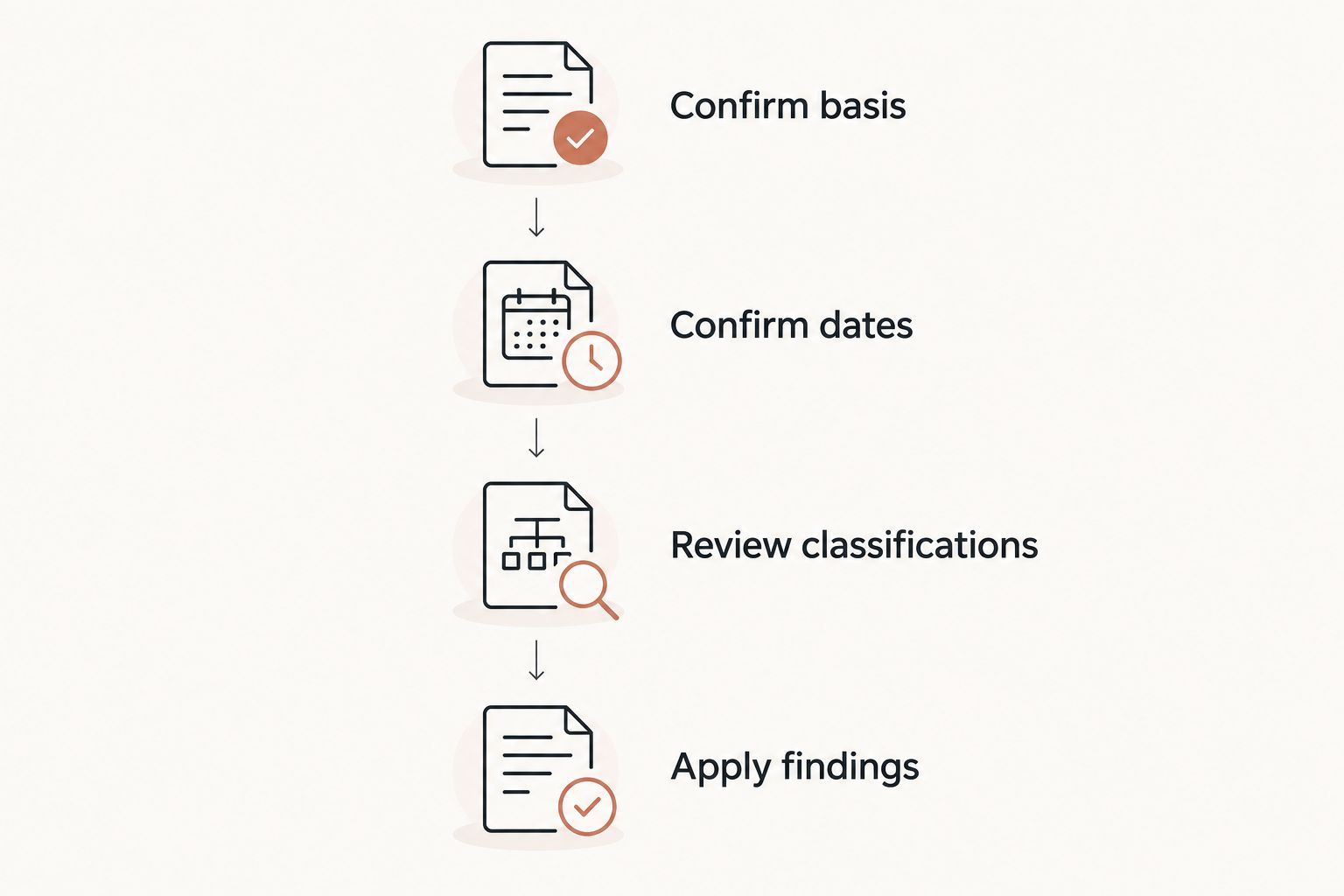
Use this sequence before your 2026 filing:
- Confirm basis: Assemble closing records, land allocation support, and improvement costs.
- Confirm dates: Document acquisition, rental availability, and separately placed-in-service improvements.
- Review classifications: Have your CPA assess recovery periods and applicable depreciation rules.
- Apply findings: Coordinate the study with the depreciation schedule and required tax forms.
For a look-back study, missed depreciation is claimed on the current return with Form 3115 and a Section 481(a) adjustment; prior returns are not amended for that catch-up process. Form 3115 is provided on request, and your CPA handles filing and the applicable method-change requirements.
Review the cost segregation client-to-CPA handoff checklist before transferring the report. Confirm implementation responsibilities before you order, not after delivery.
When staying with your current provider is right
Stay when your current engagement supplies a suitable engineering-based study, clear cost documentation, and coordinated implementation. An existing accounting relationship has practical value when the responsibilities are already clear.
Do not commission a second study merely to chase a higher allocation. First ask your CPA whether the existing work meets your property's documentation needs and whether any identified issue requires correction.
FAQ
What's the best cost segregation alternative for a residential rental owner?
Virtual Cost Segregation is best for residential owners who want an engineering-based study while keeping their own CPA. Its scope includes rentals with 1 to 4 units, and the CPA applies the report to the owner's return.
Is a specialist study better than a broader tax engagement?
A specialist study is the better fit when you need property analysis rather than additional accounting services. A broader engagement fits a different need, so compare the written deliverables and implementation responsibilities.
Can I use a calculator instead of a cost segregation study?
A calculator is not a substitute for a property-specific engineering-based study. Use its estimate to guide questions, not to establish asset classifications or deductions on your return.
How long does a residential study take?
The residential study service described here delivers in 3 to 5 business days. Coordinate the report's arrival with your CPA's review and filing schedule.
Does cost segregation automatically offset my W-2 income?
Cost segregation does not automatically make rental deductions usable against W-2 income. The short-term-rental pathway discussed here requires average stays of 7 days or less and material participation, with other tax limitations evaluated by your CPA.
Can I order a study for a rental I have owned for years?
A look-back study can identify missed depreciation for a previously owned rental. The catch-up is claimed on the current return through Form 3115 and a Section 481(a) adjustment, rather than by amending prior returns for that process.
Do I need a site visit for the residential study?
No site visit is required for the residential study service described here. Your CPA still needs accurate property records to implement the findings.
Does converting my home to a rental change its acquisition date?
Converting a home to rental use does not reset its acquisition date. For a home purchased before January 20, 2025, ask your CPA to determine the applicable depreciation treatment using the original purchase facts and conversion records.
One last thing
Ask your CPA what would prevent you from using the deduction before asking how large it is. A supportable classification and a usable deduction are separate requirements.
That question improves your 2026 decision more than another optimistic estimate. This is general educational guidance; apply current law to your property's facts with your tax professional.