
By Virtual Cost Segregation
The best cost segregation study provider for rental property investors
 Built to IRS standards
 Audit support includedFlat price for every study3 to 5 business days
No. The IRS does not require a licensed engineer to prepare a cost segregation study, and a professional engineer’s stamp is not a federal prerequisite for claiming the resulting depreciation deductions. For a 2026 residential rental study, the important questions are whether the preparer understands construction costing and depreciation law, and whether the report supports its classifications and reconciles its costs.
- Does IRS require a licensed engineer for cost segregation? No; preparer qualifications and documented methodology matter.
- The IRS Audit Technique Guide evaluates study quality, not just professional credentials.
- Virtual Cost Segregation provides engineering-based cost segregation studies for residential rentals with 1 to 4 units.
- Your CPA applies the study; a report does not establish whether you can currently deduct the resulting loss.
Does the IRS require a licensed engineer for cost segregation?
No federal rule requires every cost segregation study to be prepared or stamped by a licensed professional engineer. The IRS Cost Segregation Audit Technique Guide, Publication 5653, discusses preparer expertise, study methods, and the elements of a quality study. It does not establish a professional engineering license as a universal qualification requirement.
For your 2026 provider search, separate the preparer’s credential from the evidence inside the report. Virtual Cost Segregation provides engineering-based studies; that description refers to the study methodology, not an assertion that federal tax law requires an engineering stamp.
The IRS guide’s discussion of quality studies focuses on construction knowledge, cost estimation, asset classification, supporting records, and reconciliation. Its discussion of methods also distinguishes detailed engineering approaches from less-supported allocation methods. These are examination considerations, not a certification program for providers.
| Question | Answer | What you should examine |
|---|---|---|
| Must the preparer hold a professional engineering license? | Not as a universal federal tax requirement | Relevant construction, costing, and tax knowledge |
| Does an engineering license establish the right recovery period? | No | The asset’s function, applicable authority, and supporting facts |
| Does an engineering-based method require an engineering stamp? | Not automatically | How the report identifies, measures, and values components |
| Does the IRS guide approve individual providers? | No | Whether the actual report supports the deductions claimed |
Why this matters
A credential answers a question about the preparer. Your tax deduction depends on the property, the classification, the cost allocation, and your tax circumstances. Treating those as the same question creates a weak buying decision.
A licensed engineer’s construction expertise can be valuable. But a license does not replace depreciation analysis, and a preparer without that license is not automatically disqualified from producing a supported study.
For a residential landlord, the practical test is simple: can your CPA trace a reported amount back to a documented asset, a cost source, and a reason for its tax treatment? If that chain breaks, credentials alone do not repair it.
What does the IRS look for in a quality study?
For a 2026 review, use Publication 5653’s quality-study discussion as an evaluation framework. The guide helps IRS examiners assess studies; it is not itself binding tax law, and following its format does not settle every classification question.
A preparer with relevant expertise
Ask who performs the construction analysis and who reviews the depreciation classifications. Relevant experience includes understanding building systems, estimating component costs, and distinguishing building property from assets eligible for shorter recovery periods.
A résumé is useful evidence of expertise. It is not a substitute for seeing how that expertise appears in the completed work.
A clear methodology
The report should explain how the preparer identified components and assigned costs. Actual invoices, construction records, measurements, photographs, and documented estimating sources serve different purposes, so the report should explain how they were used.
For an acquired rental, a preparer often must allocate an existing purchase basis rather than simply total new construction invoices. That allocation still needs a stated method and a reconciliation.
Asset-level classification support
A component’s name does not settle its treatment. The report should explain the asset’s function and why the selected recovery period applies to that function.
For example, describing an item as electrical work does not establish whether it serves the building generally or particular equipment. The study needs facts that support the distinction.
Costs that reconcile
The allocated components should reconcile to the depreciable basis being analyzed. Land is not depreciable, and separately recorded furnishings or improvements should not be counted again inside the building allocation.
Your CPA should be able to follow the totals without reconstructing the entire study. Unexplained differences deserve questions before filing.
Engineering-based study versus other approaches
Choose a method for its supporting evidence, not its label. The following comparison separates tools that answer different questions; it does not rank providers or imply that a credential determines report quality.
| Approach | Best for | Main benefit | Main limitation |
|---|---|---|---|
| Engineering-based study | Documenting property-specific allocations | Connects components, costing, and classification analysis | Requires reliable property information and tax review |
| Preliminary calculator | Initial planning | Helps frame whether further analysis merits attention | Does not establish property-specific filing amounts |
| Rule-of-thumb allocation | Broad screening only | Produces a quick preliminary allocation | A percentage alone does not substantiate component classifications |
A calculator estimate and a completed study are not interchangeable. A preliminary estimate addresses possible planning value; a filing position requires support for the amounts actually claimed.
Likewise, engineering-based does not mean every input comes from an original invoice. A study can use documented estimates, but it should identify their sources and explain their application to your rental.
Why study quality varies
The absence of a universal licensing requirement makes these differences more important, not less. Evaluate the substance of the work across these factors:
- Preparer expertise: Construction costing and depreciation classification require different knowledge. Ask how both are addressed.
- Source records: Closing documents, invoices, plans, photographs, and prior depreciation schedules affect what the preparer can substantiate.
- Asset function: Similar-looking components can serve different purposes. Classification needs to reflect actual use.
- Cost methodology: Actual costs and estimated costs need a documented basis and a clear reconciliation.
- Taxpayer facts: Acquisition timing, rental use, personal use, and prior depreciation affect implementation even when the construction analysis is sound.
None of these factors establishes a promised tax outcome. They explain why a property-specific analysis is more useful than choosing a provider solely by initials after a name.
How should you evaluate a preparer before ordering?
Use this sequence for your 2026 residential rental review. Ask for explanations of the method and deliverables before treating an estimated deduction as a filing-ready result.
- Check expertise. Ask about experience with residential rental components, construction cost estimation, and depreciation classification. Establish who prepares and reviews the work.
- Check records. Confirm which purchase documents, photographs, improvement invoices, and prior depreciation schedules the preparer needs. Identify missing information early.
- Check methodology. Ask how costs are sourced, how classifications are explained, and how the allocation reconciles to depreciable basis.
- Coordinate filing. Give your CPA the completed report and source documents. Resolve classification, timing, and deduction-limit questions before filing.
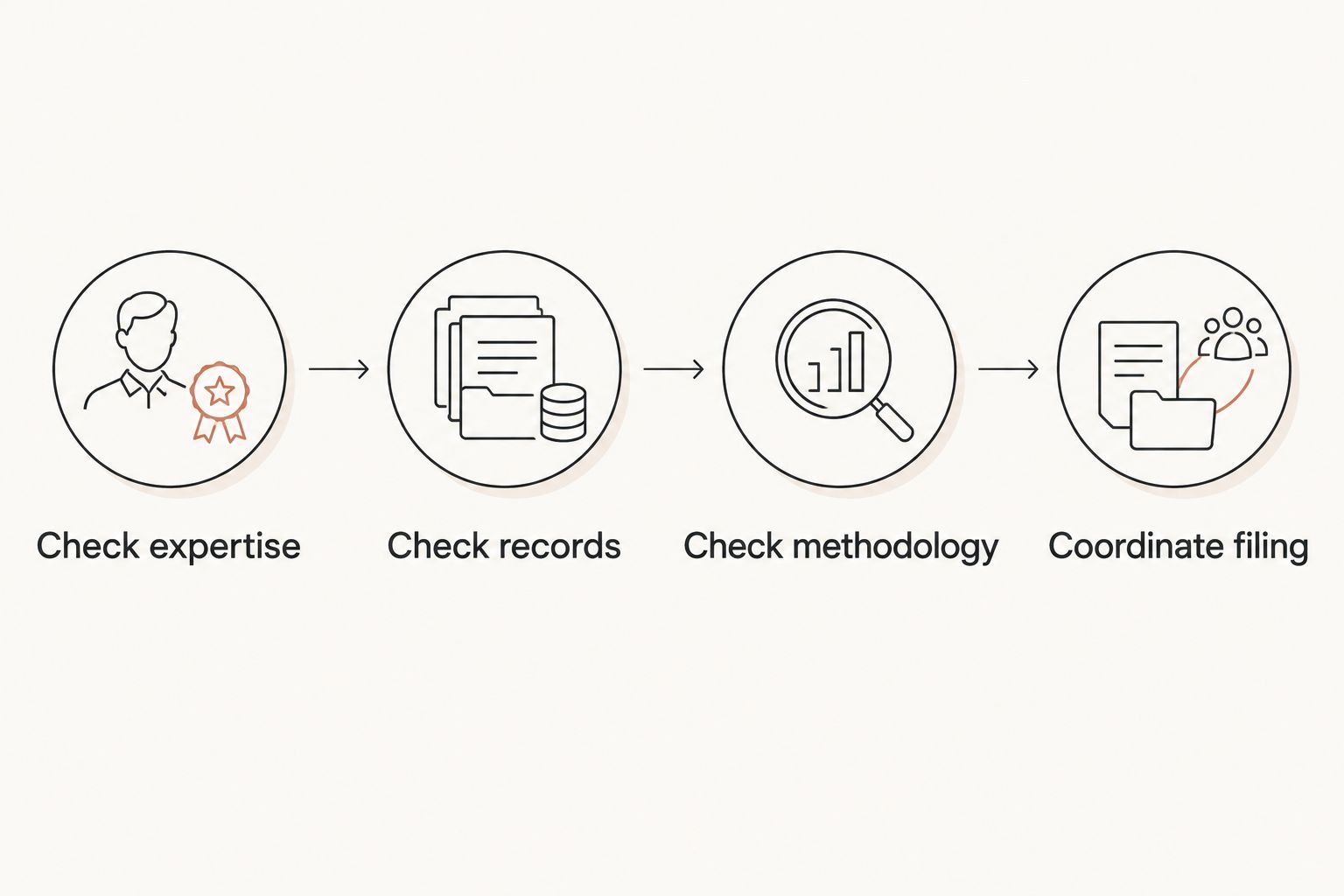
A useful provider conversation ends with specific answers about evidence and responsibilities. It should not end with a claim that a credential eliminates the need for CPA review.
Does engineering-based mean a site visit is required?
No. Engineering-based describes an analytical method, not an automatic requirement for an in-person inspection. A remote study still needs sufficient property-specific information to support its quantities, assumptions, and costs.
Photographs, plans, measurements, and invoices can support that work. When those records leave an important fact unresolved, the preparer needs additional evidence rather than an unsupported assumption.
The same standard applies to an in-person visit. Seeing a component does not, by itself, establish its historical cost or correct tax classification.
Can my CPA apply a study without an engineer’s stamp?
Yes. An engineer’s stamp is not a universal federal prerequisite for your CPA to apply a cost segregation study. Your CPA still needs to evaluate the report’s support and apply current law to your facts.
For a 2026 filing, that review includes basis, acquisition and placed-in-service dates, depreciation methods, conventions, and applicable deduction limitations. Form 4562 is part of reporting depreciation where required; the study itself is a supporting report, not a return filed with the IRS.
A study also does not establish material participation. For the commonly used short-term rental exception, an average guest stay of 7 days or less and material participation require separate analysis. One material participation test requires more than 100 hours and more participation than any other individual, including a property manager; 100 hours alone is insufficient.
What should a residential rental report distinguish?
For a long-term residential rental building, the general recovery period is 27.5 years. Under the short-stay treatment discussed here, a short-term rental building with average stays under 30 days uses a 39-year recovery period, subject to the property’s facts and applicable rules.
Neither building structure qualifies for bonus depreciation. A study instead identifies supported components that receive different treatment, including assets with 5-, 7-, or 15-year recovery periods where applicable.
Asset function and documentation still control. Do not assume that an entire amenity, renovation, or bundled contractor invoice belongs in a shorter-life category merely because part of it does.
Your preparer and CPA should also distinguish original acquisition costs from later improvements. Combining those events without preserving their dates can distort depreciation treatment even when the component descriptions look reasonable.
Where does a residential study service fit?
Virtual Cost Segregation is best for owners of residential rentals with 1 to 4 units who want an engineering-based study for their CPA to apply. The service includes component costing with identified cost sources, requires no site visit, and provides delivery in 3 to 5 business days. Audit support is included: if the IRS questions your study, we respond at no additional cost.
The limitation is equally important: Virtual Cost Segregation is not a CPA service. Your own CPA applies the report when filing, evaluates your deduction limits, and handles the tax return.
For an eligible look-back accounting-method change, missed depreciation is claimed on the current return with Form 3115 and a Section 481(a) adjustment; prior returns are not amended. Your CPA determines eligibility and files the form. The study documents the allocation, not your entitlement to use every resulting deduction immediately.
FAQ
Does IRS require a licensed engineer for cost segregation?
No. The IRS does not impose a universal requirement that a licensed professional engineer prepare or stamp a cost segregation study. The report still needs qualified analysis and support for its costs and classifications.
Is an engineering-based cost segregation study the same as an engineer-stamped report?
No. Engineering-based describes the study methodology; an engineer’s stamp is a professional credential-related feature. Neither label replaces the need for property-specific cost and classification support.
Does the IRS approve cost segregation companies?
No. The IRS Cost Segregation Audit Technique Guide provides examination guidance, not provider approval. Evaluate the actual study and its supporting records.
Can I use a calculator instead of a cost segregation study?
A calculator supports preliminary planning, not property-specific substantiation by itself. Your filing amounts need documented basis, asset identification, costs, and appropriate classifications.
Does a remote cost segregation study require a site visit?
No universal federal rule makes an in-person visit mandatory for every study. A remote analysis still needs sufficient property-specific evidence to support its conclusions.
Will a cost segregation study automatically offset my W-2 income?
No. Whether a rental loss offsets W-2 income depends on your facts and applicable tax limitations. Short-term rental activity requires separate analysis of average stays and material participation.
Does Virtual Cost Segregation file my tax return?
No. Virtual Cost Segregation provides a supplementary cost segregation report, and your CPA applies it when filing. The service includes audit support, not tax-return preparation.
One last thing
For your 2026 provider decision, ask one question beyond whether an engineer is involved: Can my CPA trace each material allocation to its cost source and classification explanation? That question tests the work you are actually buying.
A professional credential is relevant background. A documented chain from property facts to tax treatment is what makes the report useful at filing time.