
By Virtual Cost Segregation
The best cost segregation study provider for rental property investors
 Built to IRS standards
 Audit support includedFlat price for every study3 to 5 business days
No, a cost segregation study does not itself change your property's assessed value or local real estate tax bill; it changes how eligible rental-property costs are classified for income-tax depreciation. The separate issue is local business personal property tax: furniture, equipment, and other assets identified in the study can have reporting requirements under your jurisdiction's rules.
- Does cost segregation affect property tax assessment? Not directly; income-tax depreciation and local assessed value serve different purposes.
- Virtual Cost Segregation provides residential depreciation studies, not property tax reassessments or assessment appeals.
- Rental furniture and equipment require a separate review of local business personal property reporting rules.
- A lower depreciated tax basis does not automatically mean a lower assessed value or property tax bill.
Does cost segregation affect your property tax assessment?
Cost segregation changes depreciation classifications, not the assessor's valuation by itself. For your 2026 rental-property planning, keep the income-tax depreciation schedule separate from the local assessment record.
Virtual Cost Segregation provides engineering-based residential cost segregation studies that your CPA applies when filing. That report is not an instruction to your county or municipal assessor to revise a value.
| Tax record or process | What it addresses | What a cost segregation study does |
|---|---|---|
| Federal depreciation schedule | Recovery of eligible rental-property costs over time | Supports asset classifications and depreciation calculations |
| Local real estate assessment | Taxable value of land and improvements under local law | Does not automatically revise the assessment |
| Business personal property return | Locally reportable furniture, equipment, and other assets | Can supply cost details, but local rules determine reporting |
| Property tax appeal | Whether an assessment follows applicable valuation rules | Does not replace the required valuation evidence |
These records can describe the same house without using the same values. Purchase basis, adjusted tax basis, market value, and assessed value answer different questions.
Why this matters
Confusing depreciation with assessment creates two mistakes: expecting your property tax bill to fall after a study, or assuming accelerated depreciation automatically raises it. Neither follows from completing the study.
The practical concern is consistency. Your CPA needs accurate costs and classifications for the income-tax return, while the local taxing authority needs whatever information its own rules require.
For 2026, budget local property taxes independently from projected income-tax savings. A depreciation deduction is not a property tax credit, and an assessment reduction requires a separate basis under local law.
Federal depreciation: shorter recovery periods, not a new valuation
Cost segregation identifies components that qualify for depreciation separately from the building structure. Depending on an asset's function and documentation, eligible components can have 5-year, 7-year, or 15-year recovery periods.
A long-term rental building generally uses a 27.5-year residential recovery period. Land is not depreciable, and the building structure does not qualify for bonus depreciation.
Those recovery periods describe how costs are deducted for income-tax purposes. They do not tell the local assessor what the house would sell for, establish its taxable value, or set the local tax rate.
Accelerating depreciation reduces adjusted income-tax basis faster; it does not establish that the property lost market value. A house can appreciate while its depreciable assets produce deductions.
The benefit also has limits. Your CPA must evaluate deduction eligibility, loss limitations, state treatment, and the consequences of a later sale rather than treating an accelerated deduction as permanent tax elimination.
Local assessment: a separate valuation process
Local real estate assessments follow state and local rules. The applicable valuation date, assessment method, exemptions, and reassessment procedures determine how your rental is treated.
An assessor's land-and-building allocation can be relevant information when establishing an income-tax allocation, but the two records are not interchangeable. Your CPA still needs a supportable allocation based on the property's facts.
Likewise, a study's component-level cost allocation does not automatically establish local market value. Estimated component costs and a jurisdiction's assessment methodology serve different purposes.
Ask a precise question when contacting the assessor: does the jurisdiction require any submission because of the actual assets, ownership event, or improvement involved? Asking whether “depreciation lowers property taxes” blends separate systems and obscures the answer you need.
Why property tax outcomes vary
There is no nationwide rule that converts a federal depreciation classification directly into a local assessment change. Review these factors for your rental:
- Jurisdiction. State and local law determine assessment procedures, taxable property, exemptions, and filing duties.
- Property category. Real estate and business personal property can have different reporting and valuation rules.
- Ownership events. A purchase or ownership change can have assessment consequences independent of a study.
- Physical improvements. Construction, additions, and newly installed assets require their own local review.
- Rental use. Changes in occupancy or use can affect exemptions or classifications under applicable law.
- Valuation timing. An assessment reflects the jurisdiction's relevant valuation date, not necessarily the date your CPA applies depreciation.
For your 2026 review, identify the event first. A study completed after a renovation does not make the study the cause of every subsequent assessment change.
Could rental furniture create a separate property tax filing?
Yes, rental furniture and equipment can create business personal property reporting obligations where local law taxes those assets. Federal depreciation classifications do not settle whether a local return is required.
An Airbnb's beds, appliances, and other equipment deserve a separate review from the home's real estate assessment. Whether particular items are taxable, exempt, or subject to a filing threshold depends on the jurisdiction.
Avoid assuming that an asset with little remaining federal tax basis has no local taxable value. Local valuation schedules and exemptions can differ from federal depreciation rules.
The reverse distinction matters too: identifying a component separately for federal depreciation does not automatically make it locally taxable personal property. Federal asset classification is not a substitute for local classification.
How should you review both tax records before filing?
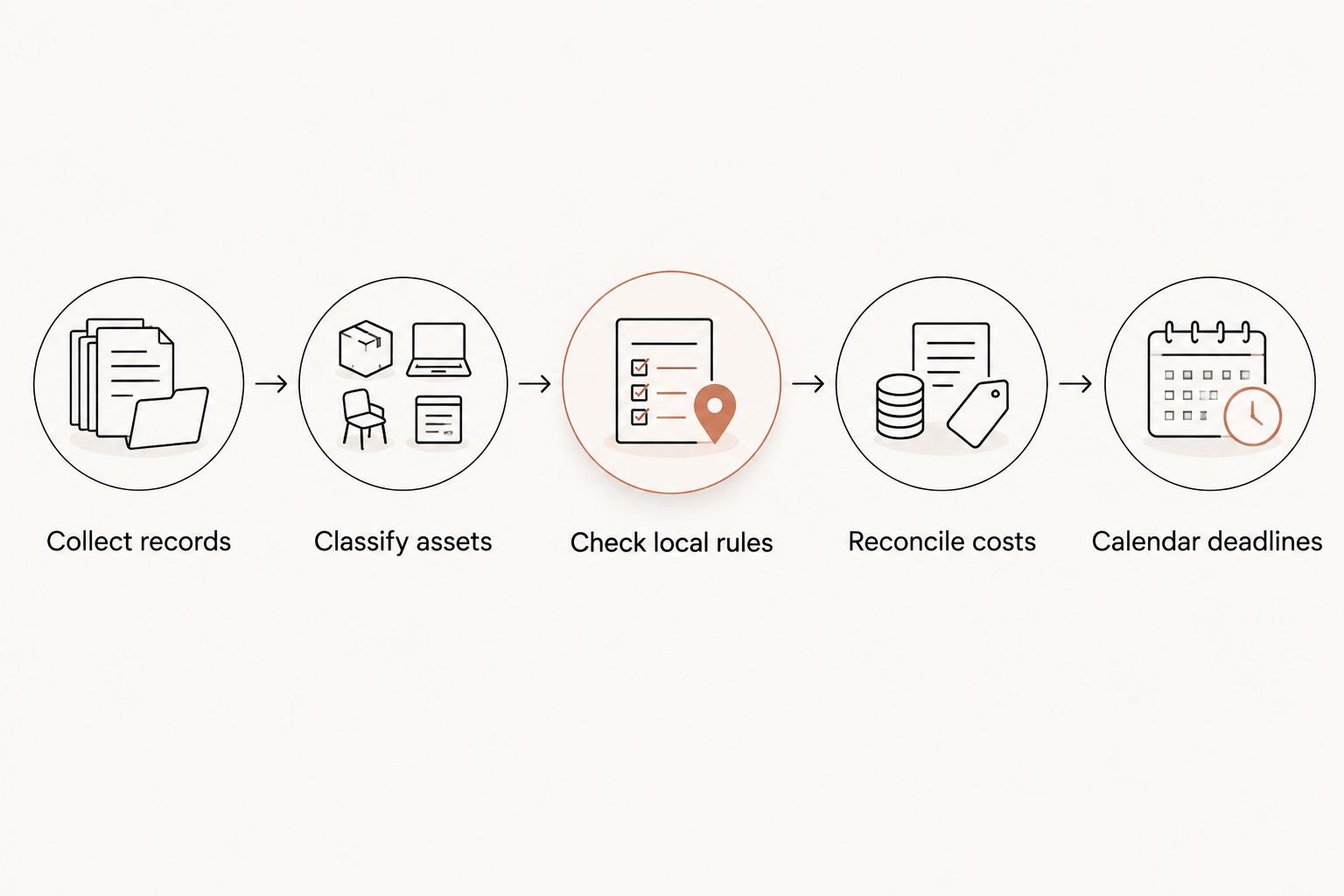
Use separate workstreams for federal depreciation and local property tax compliance. Combine the source documents, not the conclusions.
- Collect records. Gather the closing statement, prior depreciation schedules, assessment notice, asset invoices, and improvement records.
- Classify assets. Have your CPA review the study's classifications, basis allocations, and placed-in-service dates.
- Check local rules. Determine whether furniture, equipment, or improvements require a local filing or updated disclosure.
- Reconcile costs. Explain differences between the study, accounting records, and previously reported asset lists.
- Calendar deadlines. Track income-tax filing dates separately from local reporting and appeal deadlines.
Keep a reconciliation note whenever records differ. It should explain the reason, such as different valuation dates or different definitions of taxable assets, rather than forcing every document to show the same figure.
Your CPA's cost segregation implementation on Form 4562 addresses the income-tax side. Local assessment questions require a separate review of the applicable jurisdiction's procedures.
Can you use cost segregation to appeal an assessment?
A cost segregation study is not, by itself, proof that a real estate assessment is too high. An appeal must address the valuation or assessment issue recognized by local law.
Start with the assessment notice and property record. Verify the parcel, recorded characteristics, applicable exemptions, valuation date, and appeal deadline before deciding what evidence to submit.
If your dispute concerns market value, the relevant evidence must address market value under the jurisdiction's rules. A federal allocation to shorter-lived components does not establish what a buyer would pay for the whole property.
When considering property tax appeal services, distinguish an assessment challenge from depreciation planning: the appeal addresses the local taxable value, while the study supports income-tax cost recovery. Hiring for one task does not complete the other.
Best for a disputed local valuation: an assessment-specific review. Its benefit is addressing the actual assessment issue; its limitation is that a successful appeal does not determine your federal depreciation treatment.
What if you renovate the rental and order a study together?
Separate the construction event from the depreciation analysis. A new addition or improvement can matter to the assessor even when the cost segregation study itself creates no assessment change.
For example, adding a pool involves an actual physical improvement. The federal recovery period depends on the asset's classification and facts, while local reporting and valuation depend on the jurisdiction's treatment of that improvement.
Do not treat the entire amenity project as one automatically deductible asset. Invoices can include different components, and classification depends on function, documentation, placed-in-service timing, and the taxpayer's circumstances.
For a 2026 renovation, retain invoices, permits, completion records, and evidence of rental availability. Those documents help explain what changed physically and when, without confusing construction costs with assessed value.
If an assessment notice arrives after the project, compare its stated basis with the actual work. Do not assume the depreciation report caused the change merely because the dates are close.
What if the study covers a rental you already own?
A look-back study reviews depreciation for an existing rental; it does not automatically reopen the local assessment. Your CPA determines the appropriate accounting-method treatment for the income-tax return.
When a look-back study requires an accounting-method change, missed depreciation is claimed on the current return with Form 3115 and a Section 481(a) adjustment; prior returns are not amended for that catch-up procedure.
That current-return adjustment is not a local property tax reassessment request. Review any previously omitted local asset reporting separately rather than assuming the federal catch-up resolves it.
Bring your CPA both the historical depreciation schedule and local asset returns, if applicable. The goal is to identify inconsistencies and address each under the correct rules.
When does a residential study fit this decision?
Virtual Cost Segregation is best for residential rental owners who want an engineering-based depreciation study for their CPA. The service covers rental properties with 1 to 4 units, including short-term and long-term residential rentals.
The study is built to the IRS Audit Technique Guide's criteria, requires no site visit, and includes audit support. Delivery is 3 to 5 business days.
The boundary matters: the study is not a CPA service and is not filed with the IRS. Your own CPA applies it when preparing the return, and it does not replace a local assessment appeal or jurisdiction-specific property tax advice.
For your 2026 decision, evaluate the expected timing benefit and your ability to use deductions. Estimates are planning figures; actual classifications and tax outcomes depend on the property and your circumstances.
FAQ
Does cost segregation automatically increase my property taxes?
No, completing a cost segregation study does not automatically increase your real estate assessment or tax bill. Purchases, improvements, use changes, and local asset-reporting rules require separate review.
Will a lower depreciated basis reduce my assessed value?
No, a lower adjusted income-tax basis does not automatically reduce assessed value. Federal depreciation and local assessment use different rules and serve different purposes.
Do I send my cost segregation study to the county assessor?
Do not assume the study must be submitted to the assessor simply because your CPA uses it for depreciation. Follow the jurisdiction's actual reporting requirements and any valid information request.
Can Airbnb furniture be subject to property tax?
Yes, Airbnb furniture can be subject to business personal property tax where local law taxes those assets. Check exemptions, reporting duties, and valuation rules separately from federal depreciation.
Is a cost segregation study the same as a property appraisal?
No, a cost segregation study allocates eligible costs for depreciation, while an appraisal develops a value opinion for its stated purpose. A depreciation allocation alone does not establish market value for an assessment appeal.
Can Virtual Cost Segregation change my local assessment?
Virtual Cost Segregation provides engineering-based residential depreciation studies, not local assessment changes. Your CPA applies the study to the income-tax return, while assessment questions follow the jurisdiction's separate procedures.
One last thing
Ask what changed before asking which report caused it. If your assessment rises after a study, compare the assessment date, purchase history, improvements, and rental-use changes first.
The most useful explanation is often in the property record or assessment notice, not the depreciation schedule. Keep both records, but make each answer its own tax question.