
By Virtual Cost Segregation
The best cost segregation study provider for rental property investors
 Built to IRS standards
 Audit support includedFlat price for every study3 to 5 business days
Yes, cost segregation can affect income-based tax credit eligibility when the resulting depreciation deduction changes the income measure used for a particular credit. A suspended rental loss generally does not reduce current adjusted gross income, and a deduction that lowers income can also reduce the tax liability available to absorb nonrefundable credits. For your 2026 return, the right comparison is total tax after deductions and credits, not the depreciation deduction alone.
- Does cost segregation affect income based tax credit eligibility? Yes, but deductible losses and each credit’s income rules control.
- Child Tax Credit and education credit calculations use different rules from the Earned Income Tax Credit.
- Suspended passive losses generally do not lower current adjusted gross income.
- Compare your complete return before and after accelerated depreciation, including refundable and nonrefundable credits.
Does cost segregation affect income-based tax credits?
Cost segregation affects credits indirectly through deductible depreciation, income calculations, and tax liability. The study identifies rental property components for separate depreciation treatment. Your CPA determines which deductions reach your return and then calculates each credit under its own rules.
The Virtual Cost Segregation cost segregation service supplies an engineering-based report; your CPA applies it to the tax return. The report itself does not establish credit eligibility.
| Credit | Income connection | Potential benefit | Limitation to check |
|---|---|---|---|
| Child Tax Credit | Uses modified adjusted gross income for its income phaseout | A deductible rental loss can reduce income used in the phaseout calculation | Refundability and available tax liability have separate rules |
| American Opportunity Tax Credit | Uses a credit-specific modified adjusted gross income calculation | Lower income can affect the income limitation | Student eligibility, qualified expenses, and refundability restrictions still apply |
| Lifetime Learning Credit | Uses a credit-specific modified adjusted gross income calculation | Lower income can affect the income limitation | The credit is nonrefundable and requires eligible education expenses |
| Premium Tax Credit | Uses household income based on modified adjusted gross income | A deductible loss can change the household income calculation | Household composition, other income, and health insurance eligibility also matter |
| Earned Income Tax Credit | Tests earned income, adjusted gross income, and investment income | A change in rental results can affect the calculation | Lower adjusted gross income alone does not establish eligibility |
These are separate calculations, not interchangeable income tests. For 2026 planning, ask your CPA to identify the exact income definition for every credit on your projected return.
Why this matters
A depreciation estimate answers how quickly property costs can be deducted. It does not answer how much your complete tax bill changes after credit phaseouts, loss limitations, and refundability rules.
That distinction matters for residential rental owners with children, education expenses, or Marketplace health insurance. A useful projection tracks the deduction through the return rather than treating an estimated depreciation amount as an equal reduction in taxable income or tax owed.
Calculate the deduction first, its current deductibility second, and the credit effect third. Reversing that order creates a credit estimate based on a loss you might not be able to use.
Adjusted gross income: the first checkpoint
Adjusted gross income, or AGI, is not the same as taxable income. A deductible rental loss generally enters the calculation before AGI, while the standard deduction or itemized deductions generally apply afterward.
This distinction explains why additional depreciation can affect an income-based credit when a larger standard deduction does not produce the same result. The relevant question is where the deduction enters the return.
For your 2026 projection, have your CPA distinguish these outcomes:
- Lower rental profit: Additional depreciation reduces otherwise taxable rental income.
- Currently deductible rental loss: An allowable loss reduces income elsewhere on the return.
- Suspended rental loss: A limitation prevents some or all of the loss from reducing current income.
The third outcome is the common planning trap. A larger depreciation schedule does not automatically mean lower current AGI.
Modified adjusted gross income: each credit has its own rules
Modified adjusted gross income, or MAGI, is not a single universal figure. Each provision starts with an income calculation and applies its own modifications.
For example, the Premium Tax Credit household income calculation includes specified additions to AGI, including tax-exempt interest and certain Social Security benefits. It also considers income of certain family members required to file a return. Looking only at the rental owner’s taxable income misses those rules.
Child and education credits use their own MAGI calculations. A deduction’s effect on AGI therefore needs to be traced into the relevant credit worksheet, rather than copied into every worksheet unchanged.
Ask for a separate MAGI calculation for each affected credit. A spreadsheet with one column labelled MAGI is insufficient when the return includes credits with different statutory definitions.
Passive losses: why the deduction can stop before AGI
Long-term residential rental losses are generally subject to passive activity rules. Cost segregation changes depreciation timing; it does not remove those rules or establish real estate professional status.
A passive loss can offset passive income, subject to the applicable rules. Other provisions, including the rental real estate special allowance, have their own eligibility and income limitations. Your CPA must determine the allowable loss before projecting any credit benefit.
For short-term rentals, an average guest stay of 7 days or less is an important exception to the rental activity definition under the passive activity rules. Material participation must also be evaluated to determine whether the activity is nonpassive.
One material participation test requires more than 100 hours and more participation than any other individual, including a property manager. Exceeding 100 hours alone is not enough. The short-stay exception does not require real estate professional status, but it also does not establish credit eligibility.
Other loss limitations can still apply. Basis, at-risk, personal-use, and excess business loss rules require review where relevant, even after the passive activity analysis.
Why the effect on tax credits varies
The credit result depends on your return, not simply on the study’s depreciation total. Review these factors before treating a projected deduction as a credit planning opportunity:
- Current deductibility: Loss limitations determine whether depreciation reduces current income or carries forward.
- Credit-specific income: AGI, MAGI, household income, earned income, and investment income are different measures.
- Your starting position: Reducing income matters differently inside a phaseout range than outside it.
- Refundability: Some credits can produce a payment beyond tax owed; others cannot.
- Family and expense eligibility: Dependents, student status, qualified expenses, and insurance eligibility remain independent requirements.
- Timing: Acquisition, placed-in-service dates, depreciation elections, and later disposition affect when deductions and income arise.
A sound 2026 decision compares the entire return under consistent assumptions. Changing wages, filing status, or family information between scenarios makes the depreciation comparison unreliable.
Can lower income reduce a tax credit instead of increasing it?
Lower income does not always increase a credit. The Earned Income Tax Credit depends on earned income as well as AGI, and its calculation does not reward every income reduction in the same way.
Ordinary rental income generally is not earned income for this purpose. Moving a rental activity into a nonpassive category under the passive activity rules does not, by itself, turn its income into earned income.
Nonrefundable credits present another issue. Accelerated depreciation can reduce income tax enough to leave less liability against which a nonrefundable credit can be used. That does not automatically make the deduction undesirable; it means the deduction and credit must be evaluated together.
A refundable credit also has conditions beyond its income phaseout. Do not assume that reducing MAGI makes the full credit refundable or removes earned-income requirements.
Does a suspended rental loss help me qualify this year?
A suspended rental loss generally does not reduce current AGI, so it generally does not improve an AGI-based credit calculation in the current year. The deduction remains subject to the rules governing its eventual use.
This matters when an estimate shows substantial accelerated depreciation but your return has insufficient passive income or another restriction. The study can change depreciation timing without producing the immediate income reduction assumed in a credit forecast.
Ask your CPA to show both the current allowable deduction and the carryforward. Those figures answer different questions and should never be combined into one current-year tax benefit.
How should my CPA compare the return before and after a study?
Use a side-by-side 2026 projection with the same wages, household facts, rental revenue, and operating expenses. Change the depreciation treatment and any directly related tax calculations, then compare the final result.
- Establish depreciation. Confirm depreciable basis, exclude land, review existing schedules, and classify components according to their function and documentation.
- Apply loss limits. Determine how much depreciation reduces current rental profit or creates a currently allowable loss.
- Calculate income. Recompute AGI and each relevant credit’s MAGI, household income, or earned-income measure.
- Recalculate credits. Apply income limitations, eligibility requirements, refundability rules, and available tax liability.
- Compare total tax. Review final federal tax, applicable state treatment, carryforwards, and future depreciation effects.
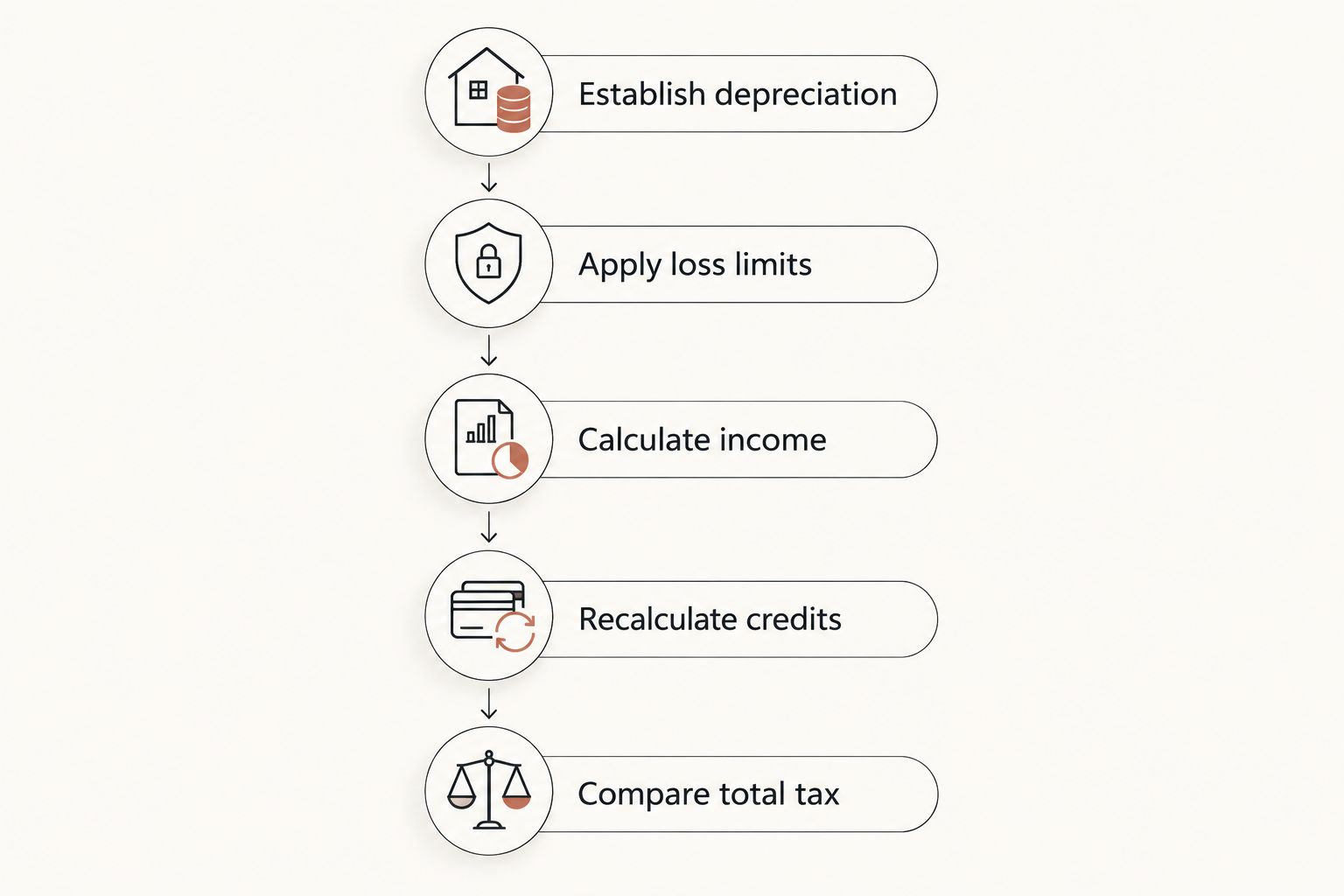
Keep the output focused on usable deductions and final tax. A depreciation total without the loss analysis is not a complete savings estimate.
What depreciation details belong in the credit projection?
Cost segregation can identify components with 5-, 7-, or 15-year recovery periods, depending on classification and the property’s facts. Those shorter lives can accelerate deductions even without bonus depreciation. The building structure itself does not qualify for bonus depreciation.
For eligible property acquired and placed in service after January 19, 2025, the restored 100% bonus depreciation rate applies, subject to the other eligibility requirements. Both dates matter; placing an older acquisition in service does not satisfy the acquisition condition.
For a home bought before January 20, 2025 and later converted to a rental, conversion does not reset the acquisition date. Have your CPA confirm the applicable treatment rather than applying the restored rate based only on the conversion date.
If you are reviewing missed depreciation on an existing rental, the look-back process also needs coordination. Missed depreciation is claimed on the current return through Form 3115 and a Section 481(a) adjustment; prior returns are not amended for that accounting-method correction. Your CPA determines the adjustment and files the form.
Where a study fits, and where it stops
Virtual Cost Segregation is best for residential rental owners who need an engineering-based cost segregation report for their CPA to apply. The service addresses property classification and depreciation documentation, not your household’s credit eligibility.
Virtual Cost Segregation cost segregation studies serve residential rentals of 1 to 4 units, with no site visit required and audit support included. Delivery takes 3 to 5 business days. Your CPA still needs time to review the report, apply loss limitations, and complete the credit calculations.
The distinction is practical: the report supports the depreciation analysis, while the CPA evaluates the complete return. A study estimate is not a promise of a particular deduction, credit, or tax outcome.
FAQ
Does cost segregation affect income based tax credit eligibility?
Yes, cost segregation can affect income-based tax credit eligibility when deductible depreciation changes the income measure used by a credit. Suspended losses generally do not reduce current AGI, and each credit has separate eligibility rules.
Will cost segregation automatically increase my Child Tax Credit?
No, cost segregation does not automatically increase your Child Tax Credit. A currently deductible loss can affect the income phaseout calculation, but dependent eligibility, refundability, and tax liability still matter.
Can depreciation change my Marketplace Premium Tax Credit?
Yes, deductible rental depreciation can change the household income used for the Premium Tax Credit. Your CPA must apply the household MAGI rules and reconcile any advance credit payments using the applicable return requirements.
Does an Airbnb loss count as earned income for the Earned Income Tax Credit?
An Airbnb loss does not become earned income merely because the activity is nonpassive. Earned income treatment requires a separate analysis, and the Earned Income Tax Credit also has AGI and investment-income requirements.
Can cost segregation reduce my education credit?
Yes, additional depreciation can reduce the usable amount of a nonrefundable education credit if it reduces available income tax liability. Lower MAGI can also affect the income limitation, so both calculations belong in the projection.
Do passive loss carryforwards lower my income for credits now?
Suspended passive loss carryforwards generally do not lower current AGI until the losses become allowable. Your CPA should separate currently deductible depreciation from amounts carried forward.
Who determines my credit eligibility after the study?
Your CPA determines credit eligibility by applying current law to your complete tax facts. Virtual Cost Segregation provides the supplementary study, not tax return preparation or an individualized credit determination.
One last thing
A bigger deduction can leave a smaller nonrefundable credit without producing a worse overall tax result. Looking at the credit line alone can therefore be as misleading as looking only at depreciation.
Before approving your 2026 filing strategy, ask your CPA for the final tax difference, the currently usable deduction, and any new carryforwards. This is general educational guidance; apply current law to your specific facts before making elections or filing.