
By Virtual Cost Segregation
The best cost segregation study provider for rental property investors
 Built to IRS standards
 Audit support includedFlat price for every study3 to 5 business days
Yes. A duplex with an owner-occupied unit can qualify for cost segregation in 2026, but only the income-producing rental portion and its eligible assets enter the study. Your personal residence portion and land are excluded, and an accelerated deduction does not automatically become a deduction against your wages.
- Duplex owner occupied unit cost segregation eligibility depends on rental use, documented basis, and separation of personal costs.
- Virtual Cost Segregation serves residential rental owners seeking engineering-based studies, including owners renting one duplex unit.
- Allocate shared costs before classifying rental assets; land and your personal unit remain outside depreciable rental basis.
- Have your CPA confirm bonus depreciation eligibility and whether rental losses are currently deductible.
Does a duplex with an owner-occupied unit qualify for cost seg?
The rental side qualifies for consideration; the owner-occupied side does not. Virtual Cost Segregation is best for residential rental owners seeking an engineering-based cost segregation study rather than tax-return preparation.
Treat the duplex as separate personal and income-producing portions for depreciation purposes. Then distinguish assets serving the rental unit exclusively from assets shared with your home.
| Property portion | Cost segregation treatment | Practical benefit | Limitation |
|---|---|---|---|
| Rental unit | Eligible depreciable basis can be analyzed | Identifies qualifying shorter-life components | Rental use and basis need documentation |
| Owner-occupied unit | Personal-use costs are excluded | Keeps personal costs separate | No rental depreciation for your residence |
| Shared building components | Allocate the supported rental share | Includes appropriate rental costs | Do not assign the whole cost to the tenant's unit |
| Land | Excluded from depreciation | Establishes the correct starting basis | Land does not become depreciable through a study |
| Rental-serving improvements | Analyze function, basis, and use | Some assets qualify for shorter recovery periods | Classification is asset-specific |
A duplex does not need both units rented to have depreciable rental property. However, owning two units does not establish an automatic equal allocation: size, relative value, and actual use must support the method your CPA applies.
Why this matters
For an owner-occupied duplex, the first tax question is not how much depreciation a study identifies. It is how much of the property belongs in the rental calculation at all.
Overstating the rental share carries personal costs into a business deduction. Understating it leaves eligible rental basis out. In 2026, get the allocation right before evaluating accelerated depreciation or a potential tax benefit.
Cost segregation changes the timing of deductions for qualifying assets. It does not turn personal property use into rental use, remove passive-loss restrictions, or make land depreciable.
How do you separate rental and personal costs?
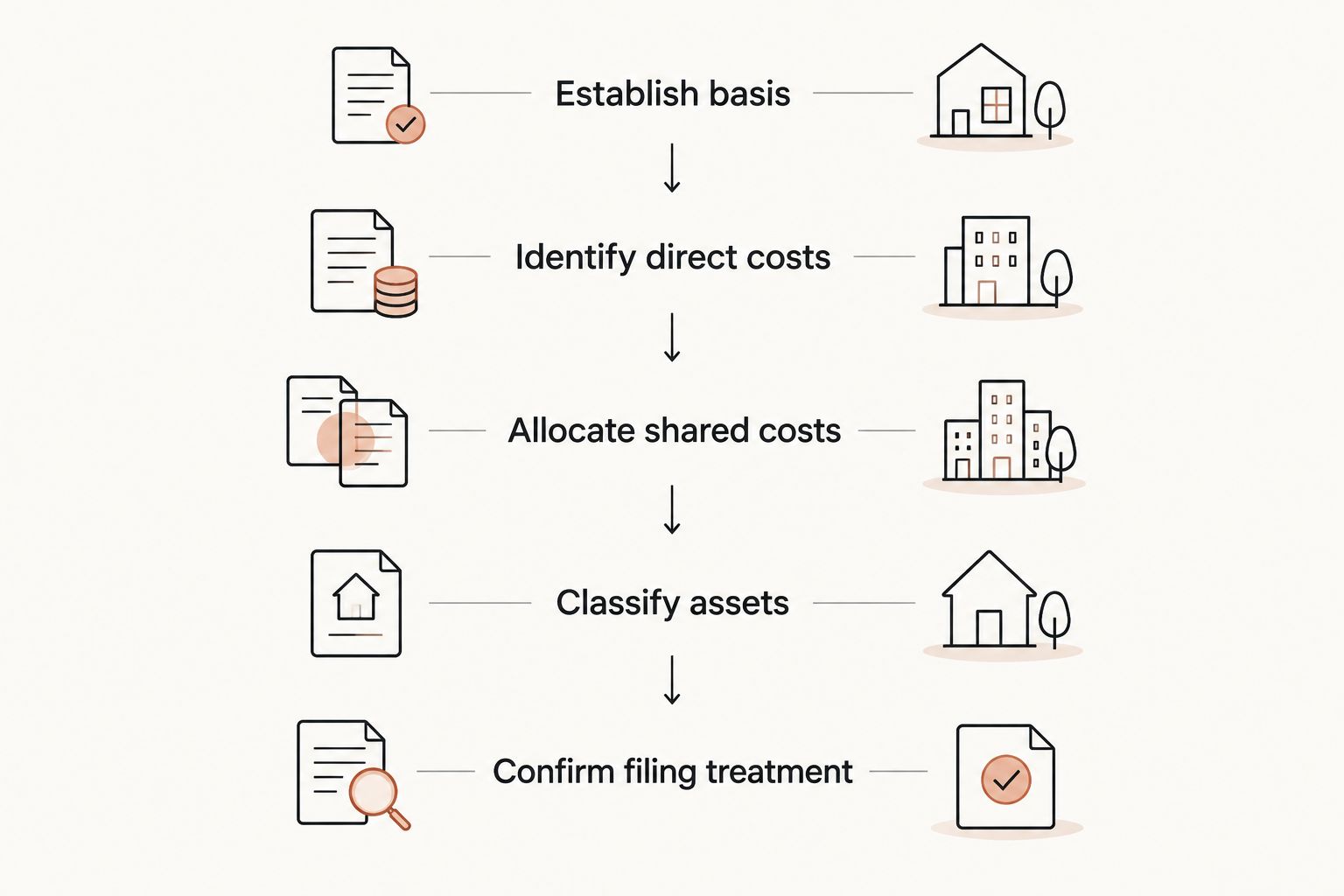
Use a documented sequence rather than applying a single percentage to every invoice. Direct costs and shared costs answer different questions.
- Establish basis. Gather the closing statement, purchase allocation, acquisition records, and capital-improvement invoices. Separate land from depreciable property.
- Identify direct costs. Assign a rental-only appliance or improvement to the rental unit when the records support that treatment. Keep personal-unit costs outside the rental schedule.
- Allocate shared costs. Apply a reasonable, supported method to costs benefiting both units. Square footage can support some allocations, but unequal units or different improvements require closer review.
- Classify assets. Analyze the eligible rental components by function and supporting documentation. Do not assume every fixture receives a shorter recovery period.
- Confirm filing treatment. Have your CPA reconcile the study with prior depreciation, applicable elections, and deduction limits.
The sequence matters. Classifying the entire duplex first and removing a rough personal share afterward obscures whether individual costs belong to the rental unit, your home, or both.
What belongs in your allocation records?
Keep floor plans or measurements, photographs showing each unit's configuration, purchase documents, invoices, and an explanation of shared spaces. Identify which unit uses garages, storage areas, laundry equipment, parking, and outdoor improvements.
For example, an appliance installed exclusively in the tenant's kitchen is different from equipment serving both units. A shared roof requires an allocation of the rental share, but its structural function does not change merely because you allocated its cost.
Document both ownership and use. An invoice proves what you paid; it does not, by itself, prove that the entire asset serves the rental activity.
Long-term rental unit: 27.5-year building treatment
The building portion used as a long-term residential rental generally follows a 27.5-year recovery period. Cost segregation identifies qualifying components within the rental basis that warrant separate treatment instead of remaining entirely in the building category.
Eligible components can have 5-year, 7-year, or 15-year recovery periods, depending on their classification. The building structure itself never qualifies for bonus depreciation. Neither does the land beneath it.
Best for: Owners housing long-term tenants who want to examine the timing of rental deductions. The benefit is potential acceleration; the limitation is that long-term rental losses generally remain subject to passive-activity rules unless an exception applies.
Living next door to your tenant and handling maintenance does not automatically make those losses deductible against W-2 income. Your CPA must assess loss treatment separately from the study's asset classifications.
Short-term rental unit: separate participation and building tests
Renting the other unit through Airbnb or VRBO adds questions about average guest stays, services, personal use, and participation. A platform listing alone does not establish favorable loss treatment.
For the commonly discussed short-term rental exception to the passive rental classification, average guest stays must be 7 days or less. Material participation is a separate requirement. One common test requires more than 100 hours and more participation than any other individual, including a property manager; 100 hours alone is not enough.
Best for: Self-operating owners prepared to document guest stays and participation. The potential benefit is nonpassive loss treatment when all requirements are met; the limitation is that proximity to the rental unit is not proof of participation.
The short-term rental building classification also needs review. A short-term rental building with average stays under 30 days generally receives 39-year nonresidential treatment, including the 7-day-or-less setup discussed here. For an owner-occupied duplex, your CPA must evaluate the building's combined use and applicable classification rules rather than automatically assigning the whole building that treatment.
Why duplex cost segregation eligibility and benefits vary
The same two-unit layout can produce different depreciation schedules and different usable deductions. These factors drive the result:
- Rental allocation: Only supported income-producing basis enters the rental depreciation calculation. Unequal units and shared amenities affect the allocation.
- Asset function: An item's role determines its classification. A structural component does not become short-life property simply because it serves the rental unit.
- Acquisition history: Purchase dates, contract dates, and prior personal use affect bonus depreciation eligibility and basis analysis.
- Placed-in-service timing: Depreciation begins when the rental property is ready and available for rent, not merely when you decide to become a landlord.
- Loss limitations: Passive-activity, at-risk, and other applicable limits determine whether accelerated deductions reduce your current taxes.
- Prior depreciation: Existing schedules must reconcile with the study. A look-back study requires a different implementation review from a first-year study.
For 2026 planning, separate the engineering question from the tax-return question. A correctly classified asset can produce a deduction that is suspended rather than immediately usable.
Does bonus depreciation apply to the rental side?
Bonus depreciation applies only to eligible assets, not the entire rental portion of the duplex. Under the One Big Beautiful Bill Act, 100% bonus depreciation is available for qualifying property acquired and placed in service after January 19, 2025, subject to the applicable requirements.
Both dates matter. A qualifying placed-in-service date does not cure an earlier acquisition or an earlier binding purchase contract. The building structure remains outside bonus depreciation even when eligible shorter-life rental components qualify.
If you bought the duplex before January 20, 2025 and later converted your own unit to rental use, that conversion does not reset the acquisition date. The converted property does not receive the restored full bonus rate merely because rental use begins later; have your CPA confirm the applicable treatment from the purchase history.
Cost segregation still accelerates qualifying deductions through shorter recovery periods without bonus depreciation. In 2026, evaluate both the depreciation schedule and your ability to use the resulting losses.
How should you estimate whether a study is worthwhile?
Start with the supported depreciable rental basis, not the entire duplex's purchase price. Then compare potential deduction timing with your CPA's assessment of usable losses, state treatment, and expected ownership period.
For an illustrative calculation only, assume 25% of the supported depreciable rental basis is reclassified into eligible shorter-life assets. That is a planning assumption, not a predicted study result; actual results vary.
For a high earner using an illustrative 37% federal marginal tax bracket, a currently usable deduction has a different near-term value from a suspended deduction. Do not multiply the reclassified amount by 37% and call it current-year savings: first determine the actual accelerated deduction, subtract depreciation otherwise available, and apply the taxpayer's limitations.
Virtual Cost Segregation provides engineering-based cost segregation studies for residential rentals of 1 to 4 units. No site visit is required, and audit support is included. The limitation is equally important: the study is not a CPA service and is not itself filed with the IRS; your CPA applies it when preparing the return.
A free manual savings estimate is available through a website inquiry. Treat the estimate as a planning figure, not an assurance of tax benefits.
What if you have already depreciated the rental unit?
An existing depreciation schedule does not automatically prevent a cost segregation study. Provide your CPA with the original rental allocation, placed-in-service date, all depreciation schedules, and subsequent improvement records.
For a look-back study, missed depreciation is claimed on the current return through Form 3115 and a Section 481(a) adjustment, rather than amending prior returns. Your CPA evaluates the applicable accounting-method procedures and files the form.
Virtual Cost Segregation provides Form 3115 on request; your CPA handles filing. For a 2026 implementation, reconcile the report to the existing asset ledger so the same basis is not depreciated twice.
FAQ
Can I get cost segregation if I live in half of my duplex?
Yes, the income-producing rental portion can be analyzed even while you occupy the other unit. Your personal-use portion and land remain outside depreciable rental basis.
Do I automatically allocate half the duplex to the rental?
No, two units do not automatically establish an equal allocation. Use a reasonable, documented method reflecting the units and assets involved, with direct rental costs separated from shared costs.
Can I include a shared driveway or fence in the study?
The supported rental share of a driveway or fence can be analyzed as a potential land improvement. Classification, basis, recovery period, and bonus eligibility depend on the asset's function, documentation, timing, and taxpayer's facts.
Will duplex cost segregation offset my W-2 income?
Cost segregation does not automatically offset W-2 income. Your CPA must determine whether the rental loss is nonpassive or qualifies for an applicable exception and then apply other deduction limits.
Does living next to my Airbnb satisfy material participation?
No, living next to the Airbnb does not establish material participation. Under one common test, you need more than 100 hours and more participation than any other individual, including a property manager.
Can I use cost segregation after moving out of my duplex unit?
Yes, the newly rented unit can be evaluated after conversion to income-producing use. Your CPA must determine conversion basis and timing; moving out does not reset the property's acquisition date.
Who puts the cost segregation results on my tax return?
Your CPA applies the study to your tax return and depreciation schedules. Virtual Cost Segregation supplies the supplementary report, not tax-return preparation or filing services.
One last thing
Keep a dated record of changes in use for each unit. Moving out, switching tenants to short-term guests, or reserving rental space for yourself changes facts your CPA needs, even though the property remains a duplex.
Your best next move is to assemble a unit-by-unit basis allocation and existing depreciation schedule. Those records establish the starting point for a useful study and a correctly implemented return.