
By Virtual Cost Segregation
The best cost segregation study provider for rental property investors
 Built to IRS standards
 Audit support includedFlat price for every study3 to 5 business days
No. In a standard taxable sale of a residential rental, the buyer does not inherit the seller’s cost segregation deductions, adjusted basis, or depreciation schedule. The seller can share the study as supporting documentation, but the buyer needs an allocation based on the buyer’s own acquisition cost and rental use. Gifts, inheritances, and ownership restructurings require separate treatment because their basis rules differ.
- Does cost segregation transfer when you sell a property? No, the buyer establishes a separate depreciation basis.
- A seller’s engineering report can document assets, but its dollar allocations do not automatically become the buyer’s allocations.
- Sellers retain responsibility for depreciation recapture; buyers evaluate their own depreciation eligibility.
- Virtual Cost Segregation suits residential rental buyers seeking an engineering-based study for their CPA to implement.
Does cost segregation transfer when you sell a property?
The report can change hands; the seller’s tax deductions do not transfer with it. For a taxable purchase in 2026, the buyer generally establishes cost basis under Internal Revenue Code Section 1012, allocates that basis among the acquired assets, and starts depreciation when those assets are placed in service.
The seller separately calculates the disposition using adjusted basis and applicable recapture rules. Review cost segregation and depreciation recapture when selling a rental before treating accelerated depreciation as permanent tax savings.
| Ownership event | Treatment of the existing study | Main limitation |
|---|---|---|
| Taxable property purchase | Supporting evidence for identifying existing components | Buyer needs an allocation tied to the new acquisition basis |
| Gift of a rental | Historical records can support carryover-basis calculations | Gift basis and depreciation rules require separate review |
| Inherited rental | Asset descriptions can support a new basis allocation | Inherited basis generally follows Section 1014, subject to exceptions |
| Transfer to a disregarded single-member LLC | Existing schedules generally continue when the federal taxpayer remains unchanged | Entity classification and actual ownership changes matter |
| Purchase of a partnership interest | Existing records remain relevant at the partnership level | An interest purchase does not automatically reset property-level basis |
These are different tax events, not interchangeable ways to transfer a study. Have your CPA identify the transaction before deciding whether existing work needs updating or replacing.
Why this matters
A seller’s report answers a historical question: how that seller’s depreciable basis was allocated when the study applied. A buyer needs a different answer: how the buyer’s acquisition basis should be allocated among the assets actually purchased.
Confusing those questions creates mismatched depreciation schedules. The same appliance, fence, or building can remain physically unchanged while its depreciable basis changes after a taxable sale.
For a 2026 closing, separate the seller’s disposition records from the buyer’s depreciation setup. Use the old study as evidence, not as a ready-to-file schedule for a different taxpayer.
What can a buyer reuse from the seller’s study?
The useful material is the underlying asset documentation: descriptions, photographs, measurements, cost sources, and classification reasoning. That information helps establish what existed when the seller’s study was prepared.
Its limitation is age. A component listed in the report might have been removed, replaced, or excluded from the sale. A furnished Airbnb purchase also requires confirmation that the furniture and equipment actually transfer.
Before relying on an existing report, check:
- Asset identity: Match the listed components to what you acquire.
- Property condition: Identify replacements, additions, and removals since the study.
- Transaction scope: Confirm whether furnishings and other separately identifiable assets are included.
- Report rights: Check the provider’s terms before assuming another taxpayer can rely on the report.
- Basis reconciliation: Require the buyer’s allocations to reconcile to the buyer’s capitalized acquisition basis.
An unchanged physical description can remain useful. An unchanged dollar allocation needs separate support because the buyer paid a different amount in a different transaction.
Does the buyer need a new cost segregation study?
The buyer needs buyer-specific support, but that does not always require recreating every engineering observation. A provider can assess whether existing documentation supports updated work or whether a separate study is needed.
The advantage of reviewing the seller’s report is access to component-level records. The drawback is that reviewing an old report does not establish the buyer’s basis, acquisition eligibility, or placed-in-service date.
Standard depreciation remains an alternative. It avoids a separate engineering engagement, but treating all depreciable acquisition costs as building basis can overlook assets that warrant shorter recovery periods.
| Approach | Best for | Benefit | Limitation |
|---|---|---|---|
| Standard depreciation | Owners whose CPA determines separate classification work is unnecessary | Simpler initial asset setup | Does not identify shorter-life assets through an engineering study |
| Buyer-specific engineering study | Buyers seeking documented component allocations | Connects classifications to the buyer’s acquisition basis | Requires source documents and CPA implementation |
| Review of seller documentation | Buyers with a usable existing engineering report | Preserves relevant asset evidence | Does not automatically establish a usable buyer schedule |
Virtual Cost Segregation provides engineering-based cost segregation studies for residential rentals of 1 to 4 units, including short-term and long-term rentals. The studies follow the IRS Audit Technique Guide’s criteria, require no site visit, and include audit support.
Virtual Cost Segregation is best for residential rental buyers who want an engineering-based cost segregation report for their CPA to apply. The service is not a CPA engagement: the report supplements the tax filing, and the client’s CPA determines its application.
You can request a free manual savings estimate from Virtual Cost Segregation. An estimate is a planning tool, not a promised deduction or tax result.
Why the buyer’s depreciation treatment varies
A property address does not determine its entire depreciation treatment. The transaction, assets, and taxpayer’s use all matter.
- Acquisition structure: A taxable asset purchase differs from a gift, inheritance, or entity-interest purchase.
- Acquisition basis: Purchase allocations must account for land, which is not depreciable, and the assets acquired.
- Asset function: Classification depends on what a component does, its documentation, and the applicable tax rules.
- Rental use: A long-term rental building generally uses a 27.5-year recovery period; transient-use rules can change building treatment.
- Timing and eligibility: Acquisition terms, placed-in-service dates, related-party rules, and prior use affect depreciation eligibility.
- Taxpayer limitations: Passive activity, at-risk, and other loss limitations affect when deductions produce a tax benefit.
Cost segregation can identify assets with 5-, 7-, or 15-year recovery periods when their classification supports those lives. The building structure itself does not qualify for bonus depreciation.
For 2026 planning, keep asset classification separate from deduction usability. A properly classified asset does not establish that its owner can immediately deduct the resulting loss against wages.
Does the seller keep responsibility for depreciation recapture?
Yes. The seller’s depreciation history remains part of the seller’s disposition calculation. Giving the buyer a report does not shift that obligation or erase depreciation previously allowed or allowable.
Section 1245 generally governs ordinary-income recapture for qualifying depreciable personal property. Section 1250 and the unrecaptured Section 1250 gain rules address relevant real-property gain; those rules are not interchangeable.
A sale allocation matters because different assets can produce different tax treatment. Give your CPA the engineering report, depreciation ledger, purchase records, improvement records, and proposed sale allocation before finalizing a 2026 sale.
Do not treat a buyer’s new depreciation opportunity as an offset to the seller’s recapture calculation. Each taxpayer reports a separate transaction under the applicable rules.
Can the buyer claim bonus depreciation after the seller already did?
The seller’s prior deduction does not, by itself, prevent an unrelated buyer from qualifying for depreciation on an eligible used asset. The buyer must satisfy the acquisition, prior-use, related-party, and other applicable requirements independently.
Under the OBBBA rules applicable in 2026, eligible property acquired and placed in service after January 19, 2025 can qualify for 100% bonus depreciation. That rule does not apply to land or the building structure, and the seller’s report alone does not establish eligibility.
A purchase from a related party requires particular care. Ask your CPA to review the purchase agreement and ownership relationships rather than assuming every used asset qualifies.
How should a buyer set up depreciation after closing?
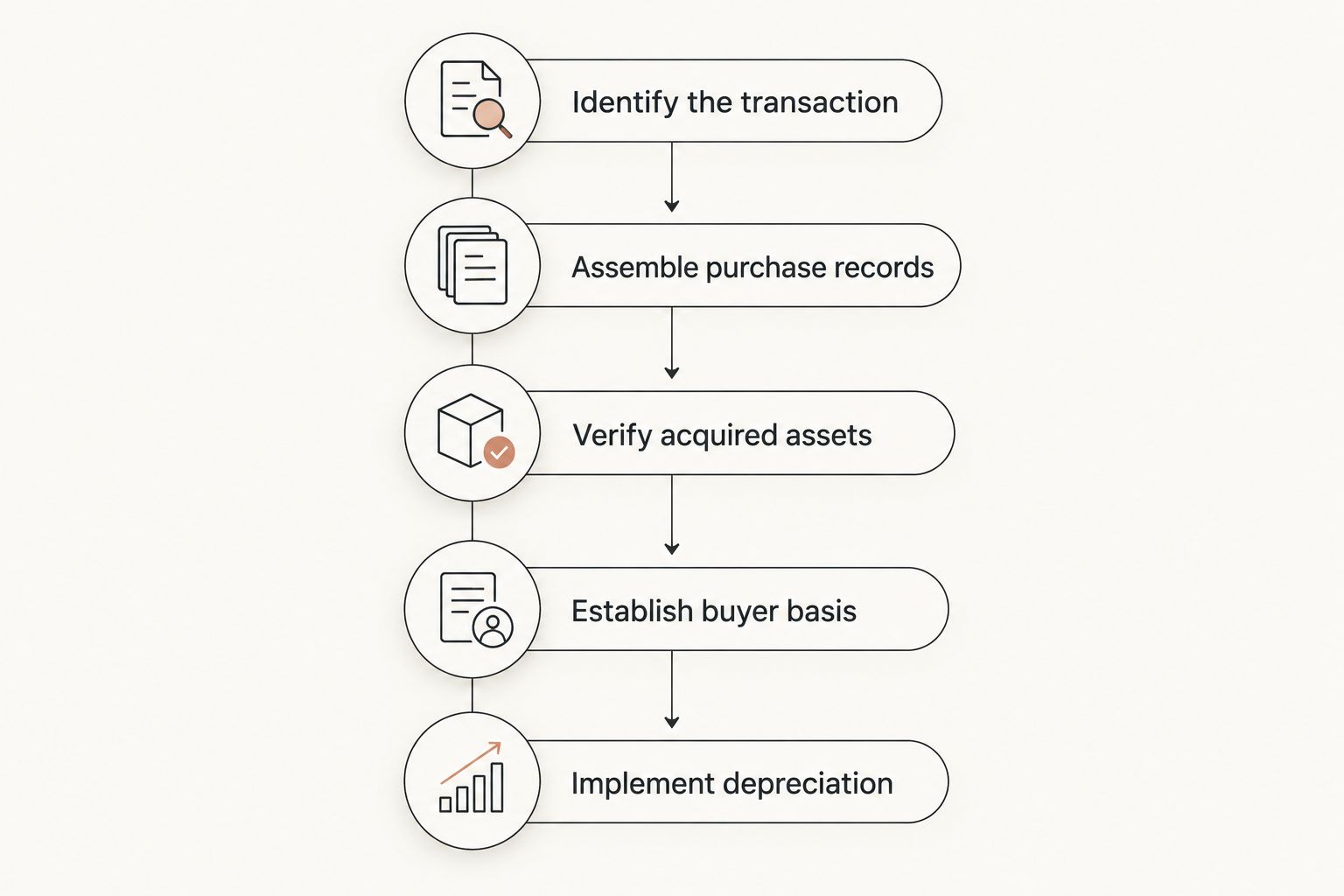
Use this sequence for a residential rental purchase. It keeps the seller’s historical records from being mistaken for your tax basis.
- Identify the transaction. Confirm whether you purchased property directly or acquired an ownership interest in an entity.
- Assemble purchase records. Gather the settlement statement, contract, allocation provisions, furnishings inventory, and capitalizable acquisition costs.
- Verify acquired assets. Compare the property and included equipment against any seller study, noting replacements and missing components.
- Establish buyer basis. Have your CPA reconcile the acquisition basis, land allocation, and component allocations.
- Implement depreciation. Your CPA applies recovery periods, conventions, elections, and eligibility rules using your placed-in-service facts.
Retain the final report and the supporting records with your tax files. Also preserve the reconciliation showing how the study’s asset totals connect to the basis entered into the depreciation software.
If you already owned the rental and later commission a look-back study, that is a different process. When the accounting-method-change procedure applies, missed depreciation is claimed on the current return through Form 3115 and a Section 481(a) adjustment; prior returns are not amended for that catch-up. Your CPA determines eligibility and files the form.
What if I transfer the rental to my own LLC?
A deed transfer does not necessarily create a new federal income-tax owner. Moving a rental into your wholly owned disregarded single-member LLC generally leaves the same taxpayer and depreciation history in place.
That differs from selling the rental to another taxpayer. Adding owners, changing entity classification, or transferring partnership interests requires additional analysis; do not restart depreciation simply because the name on the deed changed.
What if the rental is gifted or inherited?
A gift generally involves carryover-basis rules under Section 1015, while inherited property generally receives basis determined under Section 1014, subject to exceptions. Neither transaction should be processed as an ordinary purchase without review.
Keep the existing study in both cases. Its asset descriptions can support the analysis, but the recipient’s basis and depreciation treatment must follow the applicable transfer rules.
FAQ
Does cost segregation transfer when you sell a property?
No. In a standard taxable property sale, the buyer establishes a separate acquisition basis and depreciation schedule. The seller’s study can provide supporting asset documentation, but the seller’s deductions do not transfer.
Can I give my cost segregation report to the buyer?
You can share a report subject to its contractual terms and any applicable restrictions. Sharing the document does not establish that the buyer can rely on its dollar allocations or use the seller’s depreciation schedule.
Can a buyer depreciate assets the seller already fully depreciated?
A buyer can generally depreciate purchased assets using the buyer’s own eligible basis, even if the seller fully depreciated them. Bonus eligibility requires separate review of acquisition, prior-use, related-party, and other requirements.
Does selling the property erase depreciation recapture?
No. Selling a rental requires the seller to account for depreciation and apply the relevant disposition rules. The buyer’s depreciation treatment does not erase the seller’s recapture exposure.
Do I restart depreciation when I put my rental into my own LLC?
Generally, no, if the LLC is disregarded for federal income-tax purposes and the taxpayer remains unchanged. Different ownership or entity-tax facts require separate analysis.
Do I need a new study if the seller already has one?
You need buyer-specific support for your basis and classifications, not an automatic copy of the seller’s schedule. A provider can review whether existing engineering documentation supports updated work or a separate study is needed.
Does a cost segregation report get filed with the IRS?
The cost segregation report itself is not filed with the IRS. Your CPA uses the report to apply the appropriate depreciation treatment and prepare the required tax forms.
One last thing
Before closing, request the seller’s asset list, not just the report’s summary. A useful transfer file identifies which components still exist and which assets the purchase includes.
That detail connects the physical rental to the buyer’s acquisition records. It also gives both CPAs a clearer starting point without confusing the seller’s historical deductions with the buyer’s future depreciation.
This is general educational guidance. Apply current law to the transaction’s facts with your CPA.