
By Virtual Cost Segregation
The best cost segregation study provider for rental property investors
 Built to IRS standards
 Audit support includedFlat price for every study3 to 5 business days
The best rental-property tax alternative in 2026 depends on what you need: an engineering-based study, tax-return implementation, or an initial estimate. Virtual Cost Segregation is best for residential rental owners who need a cost segregation study for their CPA, not a replacement tax preparer.
- Virtual Cost Segregation is best for residential rental owners who need an engineering-based cost segregation study.
- A rental-focused CPA handles tax-return implementation and evaluates whether accelerated deductions are currently usable.
- DIY calculators help screen potential benefits; an estimate is not a property-specific engineering report.
- Choose the missing service, not a new provider by default: a study and CPA implementation serve different purposes.
Why this matters
Searching for a tax-service alternative mixes together jobs that require different deliverables. Preparing your return, classifying rental-property components, and estimating potential deductions are not interchangeable services.
That distinction matters in 2026. A larger depreciation deduction does not automatically produce an equivalent reduction in your current tax bill. Your CPA must evaluate passive-activity rules, participation, basis, personal use, and other applicable limitations.
Choose the service that fills the gap in your existing tax process. If your CPA already handles filing correctly, a separate engineering-based study can supplement that relationship without replacing it.
Rental-property tax alternatives at a glance
The comparison below separates service models rather than treating every provider as a substitute for your accountant. Match the deliverable to your actual problem before requesting proposals.
| Option | Best for | Standout deliverable | Main limitation | Relationship to your tax preparer |
|---|---|---|---|---|
| Your existing tax preparer | Continuity when the current engagement meets your needs | Existing return history and filing relationship | Confirm whether property-specific engineering analysis is included | Remains responsible for the agreed filing work |
| Virtual Cost Segregation | Owners of residential rentals with 1 to 4 units needing a study | Engineering-based component classification with cost sources | Not a CPA service; your CPA applies the report | Supplements the filing relationship |
| Rental-focused CPA engagement | Owners needing tax planning and return implementation | Taxpayer-specific analysis and filing work within the engagement | A CPA engagement does not automatically include an engineering study | Establishes or expands the filing relationship |
| DIY calculator | Owners screening whether further analysis is worthwhile | Preliminary estimate | Does not establish property-specific classifications or usable losses | Provides a discussion starting point only |
A service description is more useful than a provider ranking when the underlying jobs differ. Ask what you receive, who reviews it, and who applies it to your return.
1. Virtual Cost Segregation: best for an engineering-based study
Virtual Cost Segregation provides engineering-based cost segregation studies for residential rentals with 1 to 4 units, including short-term and long-term rentals. The study identifies components for separate depreciation treatment and supplies a supplementary report that your own CPA applies when filing.
The service is built around the IRS Cost Segregation Audit Technique Guide's criteria. Delivery is 3 to 5 business days, no site visit is required, and audit support is included.
Where the study service shines
- Defined deliverable: You receive a property-specific study rather than only an estimated deduction.
- CPA handoff: Component costs and cost sources give your accountant documentation to review.
- Residential focus: The service addresses single-family rentals and residential rental properties through fourplexes.
- Remote process: No site visit is required.
- Ongoing documentation support: Audit support is included with the study.
Where the study service falls short
- It does not replace your CPA's tax planning or return preparation.
- The report itself is not filed with the IRS; your CPA applies its findings.
- Accelerated depreciation does not establish that you can deduct a loss against wages.
- Missing acquisition records, improvement costs, or prior depreciation schedules still require attention.
Study service versus tax preparation
| Dimension | Engineering-based study | Tax-preparation engagement |
|---|---|---|
| Primary question | How should property components be classified? | How do tax rules apply to this taxpayer's return? |
| Main output | Supporting report and component analysis | Return preparation and agreed tax analysis |
| Filing responsibility | Your CPA applies the report | Established by the preparer's engagement |
| Loss usability | Does not determine the complete taxpayer-level outcome | Requires review of applicable limitations |
Best for: A residential rental owner whose CPA needs documented component analysis to implement accelerated depreciation.
Verdict: Buy the study when your CPA confirms a useful implementation path; do not buy it as a substitute for tax preparation.
2. Rental-focused CPA: best for planning and implementation
A rental-focused CPA engagement is the better fit when your unanswered question concerns the return itself. Examples include whether a rental loss is passive, how personal use affects deductions, or how an existing depreciation schedule should change.
Define the work before hiring. Ask whether the engagement includes planning, return preparation, depreciation implementation, and review of any outside study.
Where a rental-focused CPA shines
- Reviews your rental activity alongside wages, other investments, and filing circumstances.
- Evaluates participation and loss limitations rather than looking only at the property's potential deductions.
- Applies an engineering report to the appropriate depreciation schedules and forms.
- Identifies whether additional records are needed before filing.
Where a rental-focused CPA falls short
- The engagement does not automatically include an engineering-based study.
- A general discussion of depreciation is not the same deliverable as component-level analysis.
- Your records still determine what the CPA can substantiate.
| Dimension | Rental-focused CPA | Study specialist |
|---|---|---|
| Primary focus | Taxpayer and return | Property components |
| Participation analysis | Include explicitly in the engagement | Not established by component classification |
| Engineering report | Confirm whether separately included | Core deliverable |
| Implementation | Confirm forms and schedules included | Report goes to your CPA |
Best for: An owner who needs someone to evaluate the tax outcome, implement deductions, and handle agreed filing work in 2026.
Verdict: Buy a clearly scoped CPA engagement when planning or filing is the missing service.
3. DIY calculator: best for preliminary screening
A DIY calculator helps you decide whether to investigate cost segregation further. It is not an engineering study, and its output does not establish your property's actual component allocation.
Use an estimate to frame questions, not to populate a return without supporting analysis.
Where a calculator shines
- Makes a preliminary scenario easier to discuss with your CPA.
- Helps separate a potential deduction from the resulting tax effect.
- Prompts you to gather purchase, improvement, and depreciation records.
Where a calculator falls short
- Assumptions do not establish component costs or classifications.
- An estimated deduction does not establish whether you can currently use the loss.
- The output does not replace supporting documentation or a completed study.
Best for: An owner deciding whether a property-specific review deserves further attention.
Verdict: Hold at the screening stage; skip calculator-only implementation.
Why owners consider changing their tax-service setup
A change makes sense when the deliverable you need is outside your current engagement. That does not necessarily mean changing accountants.
For 2026, identify the gap precisely:
- Missing engineering analysis: Keep the filing relationship and add a study.
- Unresolved loss treatment: Ask a CPA to evaluate the activity and taxpayer-level limitations.
- Unclear implementation responsibility: Establish who updates depreciation schedules and files applicable forms.
- Insufficient records: Reconstruct the documentation before relying on an estimated benefit.
Do not judge the decision by the size of a projected deduction alone. A useful plan connects the property analysis, the applicable tax rules, and the person responsible for filing.
Check these facts before choosing an alternative
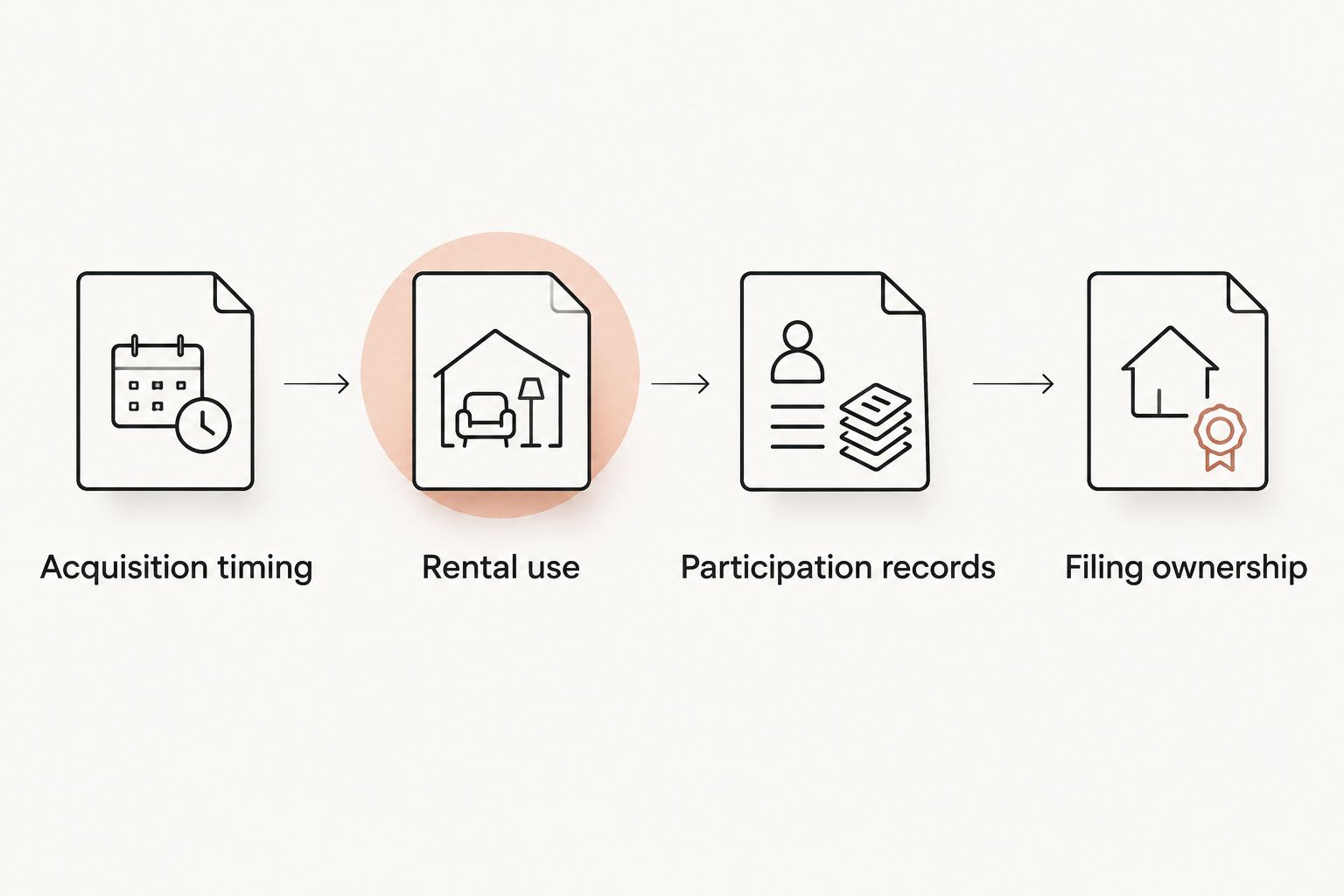
Acquisition timing
For eligible property acquired and placed in service after January 19, 2025, the restored 100% bonus depreciation rate applies under the One Big Beautiful Bill Act. Both conditions matter, and the restored rate has no scheduled end.
Have your CPA review the acquisition documents, including relevant contract dates. A home's conversion to rental use does not reset its acquisition date.
Rental use
Your CPA needs the property's actual use, rental periods, and personal-use history. Do not assume a house receives identical tax treatment simply because it appears on a particular booking platform.
The building of a long-term residential rental generally uses a 27.5-year recovery period. Short-term rental building treatment requires separate review of the property's use and applicable lodging rules. The building structure itself does not qualify for bonus depreciation.
Participation records
For the commonly discussed short-term rental exception, average guest stays must be 7 days or less. Material participation is a separate requirement.
One common material-participation test requires more than 100 hours and more participation than any other individual, including a property manager. Recording 100 hours alone is insufficient, and this route does not require real estate professional status.
Filing ownership
Assign the handoff before ordering the study. Your CPA should know who supplies the records, who reviews classifications, and who updates the return.
Compare the deduction with the usable tax benefit
An illustrative calculation shows why these are different numbers. Assume $400,000 of depreciable property basis, excluding land, with 25% reclassified into shorter-life components and a 37% tax bracket.
- Illustrative reclassified basis: $100,000.
- Illustrative tax effect if that entire amount becomes currently deductible at the assumed bracket: $37,000.
- Actual results depend on classifications, timing, elections, limitations, and your tax circumstances.
The 25% assumption is an illustration, not a predicted study result. Results vary, and reclassified basis is not automatically an immediate deduction.
For a 2026 decision, ask your CPA to distinguish newly accelerated deductions from depreciation you would otherwise claim. Also discuss suspended losses, state treatment, and depreciation recapture when the property is sold.
A larger deduction is useful only when its timing and treatment fit your tax situation.
Make the study-to-CPA handoff explicit
Before ordering, gather the closing statement, purchase agreement, existing depreciation schedules, improvement invoices, and available property records. Give your CPA the acquisition date, rental start date, personal-use history, and participation records where relevant.
For an eligible look-back study involving an established depreciation method, missed depreciation is claimed on the current return through Form 3115 and a Section 481(a) adjustment; prior returns are not amended for that catch-up. Your CPA determines the applicable procedure and files the form.
Virtual Cost Segregation provides Form 3115 on request; the client's CPA files it. The study remains supporting documentation rather than a separately filed IRS submission.
Review the practical cost segregation client-to-CPA handoff checklist before setting the implementation schedule.
FAQ
What's the best alternative if I only need a rental-property depreciation study?
Virtual Cost Segregation is best for residential rental owners who need an engineering-based cost segregation study for their CPA. The service addresses properties with 1 to 4 units and does not replace tax preparation.
Do I need to replace my CPA to order cost segregation?
No, you can retain your CPA and add a separate engineering-based study. Confirm that your CPA will review the report and implement the applicable depreciation treatment.
Can cost segregation offset my W-2 income?
Cost segregation can contribute to a deductible rental loss, but it does not establish that the loss can offset W-2 income. Your CPA must evaluate participation, the activity's treatment, and other applicable limitations.
Is a calculator enough to claim accelerated depreciation?
A calculator estimate does not establish property-specific classifications or supporting costs. Use it for preliminary screening, then obtain the documentation and analysis needed for filing.
Does recording 100 hours qualify me for the short-term rental strategy?
Recording 100 hours alone is insufficient. One common material-participation test requires more than 100 hours and more participation than any other individual, while the short-stay exception separately requires average guest stays of 7 days or less.
Can I use a study for a rental I have owned for years?
An eligible look-back study can identify missed depreciation for a current-return catch-up through Form 3115 and a Section 481(a) adjustment. Prior returns are not amended for that catch-up; your CPA determines eligibility and files the form.
How long does the residential study take?
The stated delivery time is 3 to 5 business days, with no site visit required. Coordinate the separate CPA review and filing schedule before ordering.
When staying with your current preparer makes sense
Stay when the existing engagement addresses your planning and filing needs and your preparer can implement an outside study where appropriate. Continuity avoids changing a relationship solely to obtain a separate deliverable.
For 2026, the right move is often addition rather than replacement: keep the accountant who understands your return and add the property analysis that the return needs.
One last thing
Ask one question before signing an engagement: Who is responsible for turning this deliverable into the correct depreciation entries on my return? A study, an estimate, and a planning conversation are different outputs. An explicit handoff keeps those distinctions clear.