
By Virtual Cost Segregation
The best cost segregation study provider for rental property investors
 Built to IRS standards
 Audit support includedFlat price for every study3 to 5 business days
Federal depreciation recapture rates by asset class in 2026 range from ordinary income rates of up to 37% for Section 1245 property to a maximum 25% rate for unrecaptured Section 1250 gain. There is no meaningful blended average: your asset classification, depreciation history, realized gain, and taxable income determine which treatment applies.
- Depreciation recapture rates by asset class depend on tax classification, not recovery period alone.
- Section 1245 property produces ordinary income recapture, subject to the gain and depreciation limits.
- Unrecaptured Section 1250 gain has a maximum federal rate of 25%, not a flat rate.
- Virtual Cost Segregation suits residential rental owners seeking engineering-based classifications their CPA can use for depreciation and sale planning.
Why this matters
A residential rental sale is not one asset sold at one tax rate. Furniture, qualifying equipment, land improvements, the building, and land can produce different tax results even when the buyer signs one purchase agreement.
Virtual Cost Segregation provides engineering-based residential cost segregation studies that separate qualifying components from the building. The same asset-level records that support accelerated deductions also help your CPA calculate the consequences of selling. A larger deduction today does not eliminate the need to model the exit.
2026 federal rate benchmarks by asset class
Depreciation recapture converts certain sale gains into ordinary income. Unrecaptured Section 1250 gain is different: it is generally long-term gain attributable to real-property depreciation, subject to a special maximum rate.
The table compares federal treatment for individual owners selling rental assets held longer than one year. Rates exclude state tax and any applicable net investment income tax.
| Asset class | Typical recovery period | Sale treatment attributable to depreciation | Federal rate benchmark |
|---|---|---|---|
| Overall residential rental sale | Mixed | Calculate separately for each asset; no blended statutory rate | Ordinary rates up to 37%; eligible unrecaptured Section 1250 gain up to 25% |
| Qualifying furniture and appliances classified as Section 1245 property | Commonly 5 years | Ordinary income recapture, limited by depreciation and recognized gain | Your ordinary income rate, up to 37% |
| Qualifying equipment classified as Section 1245 property | Commonly 5 or 7 years, depending on classification | Same Section 1245 recapture rule | Your ordinary income rate, up to 37% |
| Land improvements classified as Section 1250 property | Commonly 15 years | Ordinary recapture for depreciation exceeding straight-line; remaining eligible depreciation-related gain subject to the unrecaptured Section 1250 rules | Ordinary rates up to 37% on excess depreciation; up to 25% on the eligible remainder |
| Long-term residential rental building | 27.5 years | Generally no ordinary Section 1250 recapture when depreciated straight-line; eligible depreciation-related gain is unrecaptured Section 1250 gain | Maximum 25% on eligible depreciation-related gain |
| Short-term rental building with average stays under 30 days | 39 years under the building classification used here | Same distinction between ordinary recapture and unrecaptured Section 1250 gain | Maximum 25% on eligible depreciation-related gain when depreciated straight-line |
| Land | Not depreciable | No depreciation recapture; taxable appreciation is a separate calculation | No depreciation recapture rate |
Section 1245 assets have the highest headline ceiling here at 37%; qualifying straight-line building depreciation has a lower ceiling of 25%. Land has no depreciation recapture because it is not depreciable, but that does not make appreciation tax-free. Accelerated Section 1250 land improvements require both calculations rather than a blanket 25% assumption.
Methodology: These are statutory federal benchmarks for the 2026 tax year, not averages from property sales, based on Internal Revenue Code Sections 1(h), 1245, 1250, and 168 and the IRS framework in Publication 544. Scope is individual taxpayers and taxable dispositions of residential rental assets held longer than one year; the table does not calculate an owner's effective tax rate, entity-specific adjustments, or state liability.
Section 1245: ordinary income, not a flat recapture tax
Section 1245 generally applies to depreciable personal property, including qualifying rental furniture and appliances. A cost segregation study identifies components whose function and supporting documentation justify that classification; a short recovery period alone is not the legal test.
For a straightforward taxable sale, ordinary recapture generally equals the lesser of depreciation allowed or allowable and the asset's recognized gain. Your ordinary income tax brackets then apply to that amount. The 37% benchmark is a ceiling, not a rate every landlord pays.
If an asset produces no gain, prior depreciation does not automatically create recapture income. Conversely, selling below original cost can still produce taxable gain because depreciation has reduced adjusted basis.
The advantage of Section 1245 classification is earlier recovery of qualifying costs. The trade-off is ordinary-income treatment on qualifying gain when you sell, rather than assuming all sale proceeds receive long-term capital-gain treatment.
Section 1250: distinguish the two depreciation-related buckets
The phrase depreciation recapture often gets used for two different results. That shortcut makes sale estimates unreliable.
- Ordinary Section 1250 recapture: Generally concerns depreciation exceeding straight-line depreciation, subject to the applicable statutory rules.
- Unrecaptured Section 1250 gain: Generally concerns eligible long-term gain attributable to depreciation that was not recaptured as ordinary income. Its federal maximum rate is 25% for individuals.
For a building depreciated using straight-line depreciation, the second bucket is usually the relevant one. A 27.5-year long-term residential rental building and a 39-year short-term rental building can therefore share the same maximum rate on eligible depreciation-related gain despite different recovery periods.
Land improvements need closer review. Qualifying paving, fencing, pools, and site lighting can be 15-year property, but accelerated depreciation can create an ordinary recapture component. Classification depends on the asset's function and documentation; an entire amenity project does not automatically receive one treatment.
A 15-year recovery period does not establish a 25% exit-tax rate. Ask your CPA to reconcile the depreciation method and tax character before calculating sale tax.
How to use these benchmarks
Use the table to identify the tax bucket first. Then calculate the dollars. These four decisions make the benchmarks useful rather than merely descriptive.
Match each asset to its tax character
Best for: owners reviewing a study before filing or selling. Confirm whether each component is Section 1245 property, Section 1250 property, or nondepreciable land. Keep the cost source and classification explanation with the depreciation schedule.
A recovery period tells you when deductions occur. Tax character helps determine what happens when an asset leaves service or is sold. You need both.
Compare deduction timing with the exit treatment
Best for: high earners evaluating accelerated deductions. Compare the deduction's usable tax benefit with projected sale treatment, rather than subtracting 25% from 37% and calling the difference permanent savings.
For qualifying property acquired and placed in service after January 19, 2025, the restored bonus depreciation rate is 100%. That eligibility rule accelerates qualifying deductions; it does not replace the recapture rules or make the building structure eligible for bonus depreciation.
Allocate sale proceeds before applying rates
Best for: residential rental owners preparing a 2026 sale. Ask your CPA to allocate consideration and selling costs among the assets using supportable values. Compare each asset's allocated proceeds with its adjusted basis.
Do not assume the original cost allocation is automatically the correct sale allocation. Depreciation schedules record historical tax basis, while sale allocations require support for the transaction being reported.
Model whether the deduction is usable
Best for: short-term rental owners targeting W-2 offsets. Separate depreciation eligibility from loss deductibility. Basis, at-risk, passive-activity, and other applicable limitations can delay the benefit.
The short-term rental exception commonly discussed involves average guest stays of 7 days or less plus material participation. One common participation test requires more than 100 hours and more participation than any other individual, including a property manager. Those facts require review; meeting an hours target alone does not establish eligibility.
Illustrative math: deduction benefit and sale tax are separate
Assume an illustrative residential rental has $400,000 of depreciable property basis after land is excluded. Assume 25% is reclassified into qualifying shorter-life assets, giving a $100,000 allocation. This is an illustration, not a typical study result; results vary.
At an assumed 37% marginal bracket, a fully deductible $100,000 deduction has a $37,000 federal income-tax effect before other interactions. That arithmetic assumes the deduction is available and usable; it is not an estimate for a particular taxpayer.
Now isolate one Section 1245 asset at a later sale. Suppose the asset has zero adjusted basis, $20,000 of allocated net sale proceeds, and at least $20,000 of prior depreciation. The illustration produces $20,000 of ordinary recapture, with a $7,400 tax effect if the full amount falls in a 37% bracket.
Compare that with $10,000 of eligible unrecaptured Section 1250 building gain. Its maximum federal tax under the 25% rate ceiling is $2,500, before other applicable taxes. The actual rate can be lower.
These are separate calculations, not a complete investment return. Holding period, future income, sale allocations, suspended losses, and state treatment change the result. Evaluate deduction timing and sale consequences together, using asset-level records.
Build a CPA-ready sale calculation
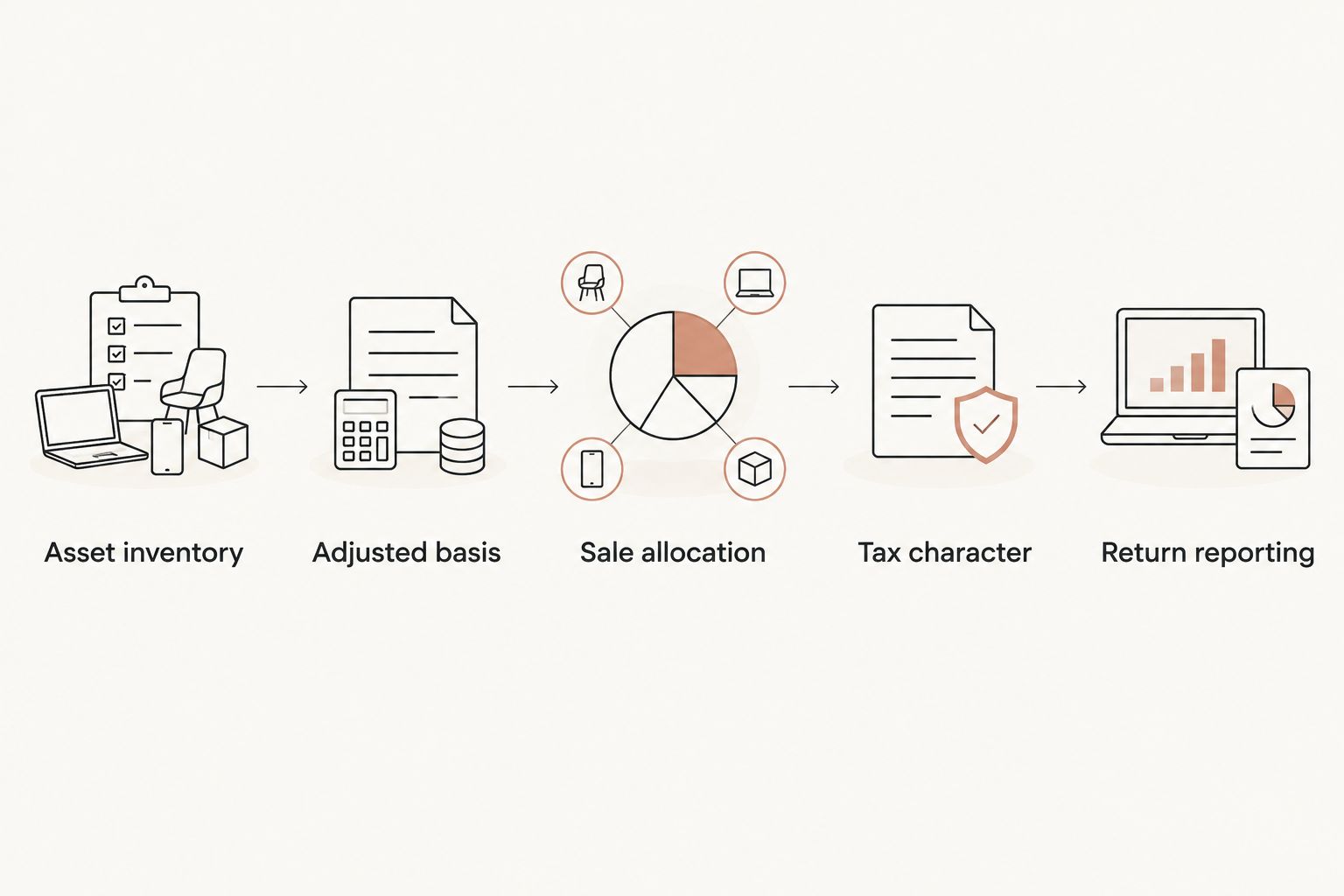
For a 2026 sale, organize the calculation in this sequence:
- Asset inventory: Reconcile the study, depreciation schedules, later purchases, and assets previously removed from service.
- Adjusted basis: Confirm original allocated basis, capitalized additions, and depreciation allowed or allowable.
- Sale allocation: Support the consideration and selling-cost allocation for each asset category.
- Tax character: Calculate Section 1245 recapture, applicable Section 1250 recapture, unrecaptured Section 1250 gain, and remaining gain separately.
- Return reporting: Have your CPA complete the applicable Form 4797 and Schedule D calculations and review related limitations.
Virtual Cost Segregation's residential cost segregation studies provide component classifications and cost sources for CPA implementation. The study is a supplementary report, not a tax return or CPA service; your CPA applies the report when filing.
The benefit is a documented basis for depreciation and later reconciliation. The limitation is equally important: an engineering-based study does not determine your sale allocation, personal tax bracket, or ability to use a loss.
Common errors that distort the benchmark
Applying 25% to every dollar of depreciation. Section 1245 recapture uses ordinary income rates. Certain accelerated Section 1250 depreciation also requires an ordinary-income calculation.
Treating 37% as everyone's recapture rate. That is the top ordinary federal benchmark, not a universal assessment. Calculate ordinary recapture alongside the owner's other taxable income.
Ignoring depreciation you did not claim. Allowed-or-allowable depreciation generally matters in basis and disposition calculations. Skipping deductions is not a reliable way to avoid sale consequences.
Using a study as the sale valuation. Cost allocation and sale allocation answer different questions. Preserve documentation for both rather than carrying an unsupported percentage into the sale return.
For implementation context, review the guide to cost segregation and depreciation recapture when selling a rental.
FAQ
What are depreciation recapture rates by asset class in 2026?
Section 1245 recapture is taxed at ordinary income rates, up to 37%, while eligible unrecaptured Section 1250 gain has a maximum federal rate of 25%. Accelerated Section 1250 depreciation can also create ordinary recapture, so land improvements need a separate calculation.
Is rental property depreciation recapture always taxed at 25%?
No. The 25% ceiling applies to eligible unrecaptured Section 1250 gain, not all depreciation-related gain. Qualifying furniture and equipment generally fall under Section 1245 ordinary-income recapture rules.
Do five-year assets have a different recapture rate from seven-year assets?
Not simply because their recovery periods differ. If both assets are Section 1245 property, the same ordinary-income recapture framework applies, with the amount limited by depreciation and recognized gain.
Are fifteen-year land improvements always taxed at 25% when sold?
No. Section 1250 land improvements depreciated faster than straight-line can produce ordinary recapture for excess depreciation. Remaining eligible depreciation-related gain can fall under the unrecaptured Section 1250 rules.
Can I owe recapture when I sell an appliance below its original cost?
Yes, if the sale produces gain over the appliance's adjusted tax basis. Depreciation reduces basis, so a sale below original cost can still produce Section 1245 recapture.
Does bonus depreciation change the recapture rate?
Bonus depreciation changes the timing and amount of depreciation, not the asset's recapture framework. Asset classification and recognized gain determine the applicable sale treatment.
Does Virtual Cost Segregation calculate and file my sale taxes?
No. Virtual Cost Segregation provides engineering-based residential cost segregation studies, while your CPA applies the report and prepares the applicable tax filings. General benchmarks do not replace a calculation based on your facts.
One last thing
Depreciation you were entitled to claim can matter even when you never claimed it. Before selling, ask your CPA to reconcile allowed-or-allowable depreciation against the actual return history, not just the latest spreadsheet.
That reconciliation belongs before the 2026 sale calculation. It prevents an understated basis adjustment from making a headline tax estimate look better than the return supports. This article provides general educational guidance; your CPA should apply current law to your facts.