
By Virtual Cost Segregation
The best cost segregation study provider for rental property investors
 Built to IRS standards
 Audit support includedFlat price for every study3 to 5 business days
 Virtual Cost Segregation is best for residential rental owners who need an engineering-based study their CPA can apply to a tax return. This 2026 guide compares that service with other study providers, CPA-led planning, DIY calculators, and standard depreciation so you can choose the right next step without confusing a savings estimate with a completed study.
- Virtual Cost Segregation suits residential rental owners seeking engineering-based cost segregation without a site visit.
- CPA-led planning determines whether accelerated depreciation produces usable deductions for your tax situation.
- DIY calculators estimate potential benefits; they do not replace property-specific classification and cost documentation.
- Compare study scope, source documentation, CPA responsibilities, and audit support before changing providers.
Why this matters
A cost segregation study changes the timing of depreciation deductions. It does not determine whether you can use those deductions against wages, rental income, or another income source.
For a residential investor, the important comparison is not simply provider versus provider. You need to distinguish the engineering report, the tax-planning decision, and the return preparation. Virtual Cost Segregation supplies the study; your CPA applies it to your facts and filing requirements.
That distinction matters in 2026. A larger projected deduction is not automatically a better outcome if loss limitations postpone its use or your ownership plans change the economics.
Cost segregation alternatives at a glance
Compare the actual deliverable before comparing promises. A property-specific report, a planning consultation, and a calculator answer different questions.
| Option | Best for | Main deliverable | Practical limitation |
|---|---|---|---|
| Virtual Cost Segregation | Owners of residential rentals with 1 to 4 units | Engineering-based study built to IRS Audit Technique Guide criteria | Your CPA must apply the report and prepare the return |
| Another engineering-based provider | Owners comparing study methodology and scope | Property-specific asset classification and cost analysis, subject to the engagement | Verify documentation, timing, and support rather than assuming equivalent scope |
| CPA-led tax planning | Owners unsure whether accelerated deductions are usable | Analysis of income, participation, loss limitations, and filing requirements | A planning engagement is not automatically an engineering study |
| DIY calculator | Owners screening potential benefits before ordering | An estimate based on entered assumptions | Does not establish property-specific recovery periods or cost allocations |
| Standard depreciation | Owners whose CPA recommends keeping the existing approach | Depreciation under the applicable asset classifications | Does not replace a component-level cost segregation analysis |
Choose a study when you need documented classifications. Choose tax planning when you need to establish whether those classifications help your return. Often, you need both.
1. Virtual Cost Segregation: best for residential rental studies
Virtual Cost Segregation provides engineering-based cost segregation studies for residential rental property with 1 to 4 units, including short-term and long-term rentals. The study is purchased online, requires no site visit, and is delivered in 3 to 5 business days.
The report supplements your CPA's work rather than replacing it. Audit support is included, but return preparation and application of the study remain your CPA's responsibility.
Where the service shines
- Residential scope matches single-family rentals and small residential rental properties.
- Engineering-based analysis follows the IRS Audit Technique Guide's criteria.
- No site visit is required.
- The stated delivery period is 3 to 5 business days.
- A free manual savings estimate is available through a website inquiry or email.
Where the service falls short
- It is not a CPA service and does not prepare your tax return.
- A study alone does not establish material participation or make a rental loss deductible against W-2 income.
- Estimates are planning figures, not promises of tax benefits.
- Your CPA still needs to evaluate acquisition dates, rental use, basis, and filing treatment.
| Dimension | Engineering-based study | Estimate-only approach |
|---|---|---|
| Purpose | Document property-specific classifications | Screen potential benefits |
| Cost support | Component costs and their sources | Assumptions entered into the estimate |
| Filing role | Supplementary report for the CPA | Preliminary planning information |
| Tax eligibility | Requires separate CPA evaluation | Requires separate CPA evaluation |
Best for: Residential rental owners who have a CPA and need a documented study rather than another estimate.
Verdict: Buy when your CPA has reviewed the deduction's usefulness and you need the engineering report to implement the plan.
2. Another engineering-based provider: best for comparing scope
Another engineering-based study provider is a reasonable alternative when you want to compare engagement terms or the proposed analytical approach. Ask each provider the same questions so differences in scope do not disappear behind similar-looking savings projections.
Do not assume that a lower fee means weaker work or that a higher fee means better documentation. Examine what the engagement actually includes.
Where this option shines
- You can compare written methodologies and proposed deliverables.
- You can ask how component costs connect to closing records, invoices, and other property evidence.
- You can clarify support responsibilities before ordering.
Where this option falls short
- An engineering-based label does not answer every question about the engagement.
- Delivery timing and support need confirmation in writing.
- A provider's projected deduction does not establish your ability to use a loss.
| Dimension | What to request | Why it matters |
|---|---|---|
| Methodology | Explanation of classification and costing | Shows how conclusions are reached |
| Source records | Required property documents | Connects allocations to evidence |
| CPA handoff | Description of the final deliverables | Helps your CPA plan implementation |
| Support | Written explanation of included assistance | Establishes responsibilities before purchase |
Best for: Owners who want to compare documented study scope before selecting a provider.
Verdict: Hold until you have a written scope and your CPA confirms that the proposed deliverable meets the filing need.
3. CPA-led planning: best for testing deduction usefulness
CPA-led planning is the right starting point when your biggest uncertainty is tax eligibility rather than asset classification. Your CPA can review participation, passive activity treatment, existing depreciation, and the interaction with other deductions.
For a high W-2 earner, that review comes before treating a projected rental loss as a wage offset. Cost segregation creates depreciation deductions; the applicable tax rules determine how you use them.
Where this option shines
- It connects the proposed study to your actual return.
- It addresses participation and loss limitations before you order.
- It identifies whether the implementation involves current-year depreciation or an accounting-method change.
Where this option falls short
- Tax planning does not automatically include engineering-based asset analysis.
- Your CPA still needs reliable classifications and cost support to implement a study.
- You must clarify whether the engagement includes planning, return preparation, or both.
Best for: Owners who have not established whether accelerated depreciation creates a usable current deduction.
Verdict: Buy the planning engagement first when deduction eligibility remains unresolved.
4. DIY calculators: best for preliminary screening
A DIY calculator helps you explore assumptions before committing to a study. Treat its output as a starting question for your CPA, not as the depreciation schedule you should file.
The limitation is property specificity. An estimate cannot establish which installed components have a particular recovery period without examining their function and supporting records.
Where this option shines
- You can explore how changing assumptions affects a projection.
- You can decide which questions deserve a manual review.
Where this option falls short
- The output depends on the inputs and assumptions.
- It does not substitute for component-level documentation.
- It does not establish participation, bonus eligibility, or loss deductibility.
Best for: Owners deciding whether to investigate cost segregation further.
Verdict: Skip as a substitute for a completed engineering-based study.
5. Standard depreciation: best for an intentional decision to wait
Keeping standard depreciation is an option, not a failure to optimize. Ask your CPA to compare the timing benefit of a study with your expected use of deductions and ownership plans.
For a long-term residential rental, the building generally uses a 27.5-year recovery period. Under the short-term rental classification described here, average stays under 30 days call for a 39-year building recovery period, including arrangements subject to the 7-day average-stay rule.
Where this option shines
- It avoids ordering a study before the tax analysis is complete.
- It keeps the decision tied to deduction usefulness rather than projected size.
Where this option falls short
- It does not identify shorter-life components through a cost segregation analysis.
- Waiting does not eliminate the need to review correct depreciation treatment.
Best for: Owners whose CPA recommends postponing a study after evaluating the facts.
Verdict: Hold when the current benefit does not support ordering now.
Why owners reconsider their current approach
A useful reason to change is a mismatch between what you need and what you currently have. An estimate-only approach stops being enough when your CPA needs supported asset classifications for implementation.
Use these decision points rather than assuming any particular provider has a problem:
- You have a savings projection but need a property-specific report.
- You need clarity on component cost sources and classification reasoning.
- You want the study provider's and CPA's responsibilities separated in writing.
- You need a delivery schedule that fits your CPA's filing workflow.
- You need an explanation of included audit support.
For a 2026 decision, ask your CPA to identify the missing deliverable first. Switching firms without defining the gap can leave the same implementation problem unresolved.
Check the tax facts before choosing a provider
Acquisition and service dates
For eligible property acquired and placed in service after January 19, 2025, the restored bonus depreciation rate is 100%. Both conditions matter, and your CPA must review acquisition rules, including relevant contracts.
That rule applies to eligible assets, not the building structure or land. Ordering a study in 2026 does not reset a property's acquisition date.
A home purchased before January 20, 2025 and later converted to a rental does not receive the restored rate merely because of the conversion. Have your CPA confirm the applicable treatment from the purchase history.
Participation records
The short-term rental rule uses an average guest stay of 7 days or less, together with material participation. One commonly used participation test requires more than 100 hours and more participation than any other individual, including a property manager.
Logging 100 hours alone is not enough. Real estate professional status is not required for this short-term rental pathway, but your CPA must apply the rules to your facts.
Asset classification
Cost segregation can identify eligible 5-, 7-, and 15-year assets even without bonus depreciation. Classification depends on asset function, documentation, placed-in-service timing, and taxpayer facts.
Do not assume that an entire amenity receives one recovery period. Its equipment, structural work, and site improvements can require separate analysis.
Build a CPA-ready handoff
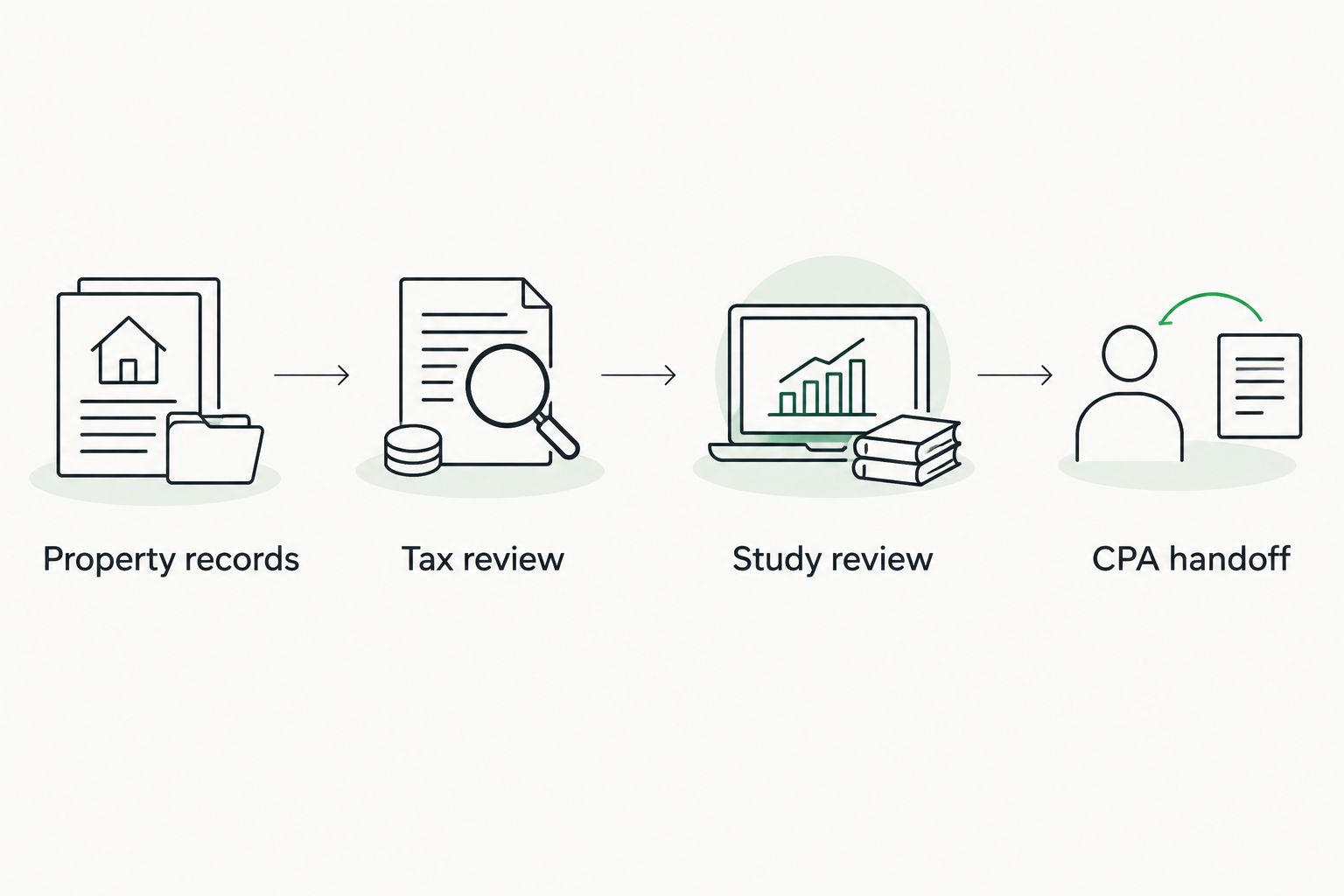
Before ordering in 2026, align the property records with the filing decision. Use this sequence to keep the study and tax work connected:
- Property records: Assemble closing documents, acquisition agreements, improvement invoices, and the existing depreciation schedule.
- Tax review: Ask your CPA to evaluate deduction usefulness, participation, basis, and timing.
- Study review: Confirm the engineering scope, cost sources, delivery expectations, and included support.
- CPA handoff: Deliver the completed report and supporting records before return preparation is finalized.
For a look-back study, missed depreciation is claimed on the current return through Form 3115 and the applicable Section 481(a) adjustment; prior returns are not amended for that catch-up process. Your CPA determines the applicable procedure and files Form 3115. The study provider can supply the form on request, but filing remains the CPA's task.
Staying with your current provider can be the right call
Keep your current provider when its documented scope meets your property needs and your CPA can use the resulting report. There is no reason to restart solely because another estimate shows a larger deduction.
In 2026, compare the evidence behind the allocation and the completeness of the handoff. A usable, supported report matters more than a larger preliminary projection.
FAQ
What's the best cost segregation alternative for a residential rental owner?
Virtual Cost Segregation is best for owners of residential rentals with 1 to 4 units who need an engineering-based study without a site visit. Your CPA applies the report and determines the tax treatment.
Should I talk to my CPA before buying a study?
Yes. Your CPA should review basis, acquisition dates, rental use, participation, and loss limitations before you treat projected depreciation as a usable tax deduction.
Can a calculator replace a cost segregation study?
No. A calculator estimates potential benefits from assumptions; an engineering-based study documents property-specific classifications and component costs.
Does cost segregation automatically offset my W-2 income?
No. Depreciation deductions offset W-2 income only when the applicable tax rules permit their use. The short-term rental pathway requires an average guest stay of 7 days or less and material participation, subject to your facts and other limitations.
What bonus depreciation rule matters for a 2026 study?
Eligible property acquired and placed in service after January 19, 2025 qualifies for the restored 100% bonus depreciation rate. The study date does not replace either condition, and the building structure does not qualify.
Can I order a study for a rental I already own?
Yes. A look-back study can support claiming missed depreciation on the current return through Form 3115 and the applicable Section 481(a) adjustment, rather than amending prior returns for that catch-up process. Your CPA determines the procedure and files the form.
How long does the residential study take?
The stated delivery period is 3 to 5 business days, with no site visit required. Coordinate the study delivery with your CPA's return-preparation schedule.
One last thing
Ask your CPA two separate questions: how much depreciation the study identifies, and how much of the resulting deduction you can use now. Those answers are not interchangeable.
An illustrative assumption of 25% reclassified and a 37% tax bracket is only a planning scenario, not a property result. The actual allocation, allowable deduction, and tax benefit depend on the completed analysis and your return.