
By Virtual Cost Segregation
The best cost segregation study provider for rental property investors
 Built to IRS standards
 Audit support includedFlat price for every study3 to 5 business days
Instead of repeatedly copying study totals into rental bookkeeping, use a CPA-reviewed handoff to connect your cost segregation report with the records you maintain in Landlord Studio. Keep purchase and improvement transactions separate from tax depreciation, then reconcile the final schedule to your property records before filing your 2026 return.
- For cost segregation Landlord Studio workflows, reconcile property records before your CPA implements depreciation.
- Virtual Cost Segregation provides residential cost segregation studies; your CPA applies the report when filing.
- Do not enter reclassified asset basis as another cash expense.
- Keep the study, supporting invoices, and approved depreciation schedule together.
Why this matters
Cost segregation changes the timing of depreciation deductions. It does not create another purchase, another payment, or another operating expense. Mixing those concepts can duplicate costs and distort the rental income you use to evaluate a property.
Virtual Cost Segregation is best for residential rental owners seeking an engineering-based cost segregation study for CPA implementation. The service covers residential rentals of 1 to 4 units, including short-term and long-term rentals. Learn about Virtual Cost Segregation before assembling the handoff.
Treat this as a document-and-reconciliation workflow, not an automated import recipe. The steps below assign responsibility for the study, bookkeeping, and tax schedule without assuming a particular Landlord Studio subscription, screen layout, or integration.
Before you start
- Access: Have access to your Landlord Studio property records and a secure way to exchange documents with your CPA. Agree on who can change bookkeeping records and who approves tax adjustments.
- Materials: Gather the final study, closing statement, land allocation, acquisition documents, placed-in-service evidence, improvement invoices, and existing depreciation schedules. Include personal-use information where applicable.
- The gotcha: A study's reclassified basis is not a new expense. Before changing any record, ask your CPA whether the change belongs in bookkeeping, the tax depreciation schedule, or a separate reconciliation.
Use current law and the taxpayer's actual circumstances throughout this process. This guide provides general educational guidance, not individualized tax advice.
Property records and source documents
Start with one property and one agreed reporting period. A clean 2026 handoff is easier to review than a mixed folder containing several addresses, draft studies, and unidentified invoices.
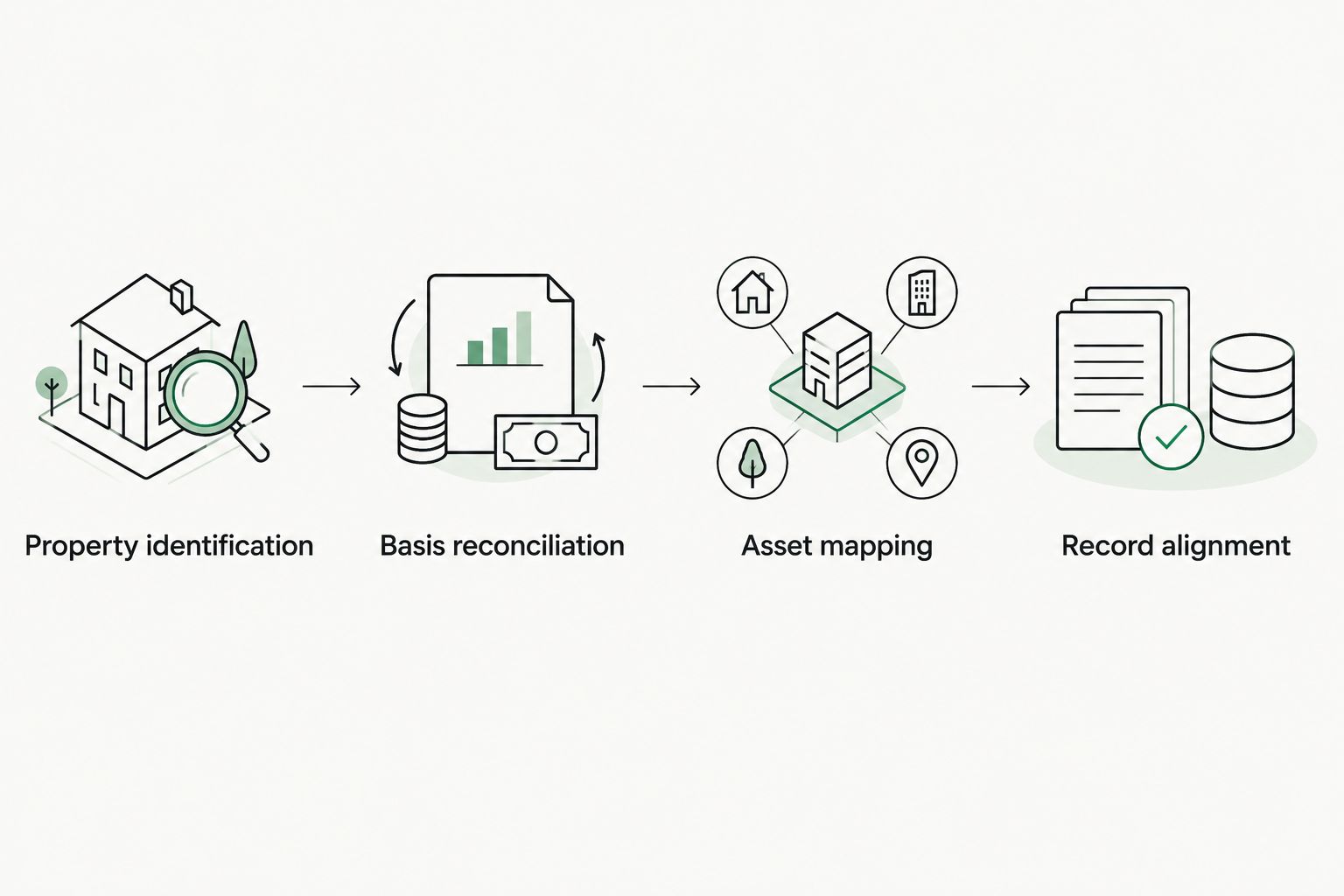
Property identification
- Identify the property associated with the study. Match its address and ownership details to the records you maintain for that rental.
- Confirm the reporting period with your CPA. Separate current-year transactions from historical acquisition costs and previously depreciated assets.
- Preserve an unchanged copy of the records being reviewed. Keep the version you supplied to the CPA separate from later corrections.
- Name the final study and supporting files consistently. Include the property identifier, document type, and relevant tax year in your own file names.
Expected result: Your CPA can identify the correct property, taxpayer, reporting period, and final report without interpreting an unlabeled collection of files.
Basis reconciliation
- List the property's acquisition costs and subsequent improvements in a working schedule outside your live bookkeeping records.
- Separate land from depreciable property. Land is not depreciable, so it should not become part of the study's depreciable asset total.
- Match study totals to the CPA-approved basis. Explain closing adjustments, separately purchased furnishings, and later improvements rather than forcing totals to agree.
- Flag every asset already recorded separately. Appliances or furnishings purchased outside the real estate acquisition need special attention to prevent duplicate basis.
- Leave unresolved differences visible. Ask the study provider or CPA to resolve the source of each difference before implementation.
Expected result: Every dollar assigned to study assets traces to an identified cost source, and no acquisition or improvement appears twice.
A payment date does not necessarily establish when an asset was ready and available for rental use. Keep invoices and placed-in-service evidence together, but record those dates separately.
CPA classification and depreciation approval
The next step is tax classification, not data entry. Virtual Cost Segregation supplies the engineering-based study; your CPA determines how its findings apply to your return. The study is supplementary documentation, not a return filed with the IRS.
Use this responsibility table to keep each part of the workflow in its proper place.
| Workflow component | Best for | Advantage | Limitation |
|---|---|---|---|
| Landlord Studio records | Rental owners organizing property bookkeeping | Provides the property records used in the reconciliation | Bookkeeping entries do not establish tax eligibility |
| Engineering-based cost segregation study | Residential owners documenting asset allocations | Supports component-level cost and classification analysis | Does not determine whether you can currently use a tax loss |
| CPA-approved depreciation schedule | Tax implementation and annual continuity | Applies recovery periods, elections, and taxpayer-specific rules | Requires complete source documents and ownership history |
Asset mapping
- Give your CPA the final study and reconciled basis schedule. Identify anything still awaiting clarification.
- Ask your CPA to map the study's components to the tax asset register. Preserve the connection between each asset and its supporting report reference.
- Confirm recovery periods, depreciation methods, conventions, and placed-in-service dates. Do not assign one treatment to every item sharing an invoice.
- Ask your CPA to review personal use, ownership percentage, prior depreciation, and applicable limitations before approving deductions.
Expected result: You have an approved tax asset schedule, not just a list of amounts copied from a report.
A long-term rental building generally uses a 27.5-year recovery period. A short-term rental building with average stays under 30 days uses a 39-year recovery period under the classification addressed here, including the 7-day-average STR framework. Have your CPA confirm the property's treatment from its actual use.
Cost segregation can identify components with 5-, 7-, and 15-year recovery periods. Classification depends on function and documentation; the building structure itself does not qualify for bonus depreciation.
Bonus eligibility
- Supply acquisition documents, including relevant contracts, alongside placed-in-service evidence.
- Have your CPA establish eligibility separately for the assets involved. Do not substitute the study completion date for the acquisition or service date.
- Document the bonus depreciation treatment and any elections in the approved tax workpapers.
- Keep federal and state calculations distinct where their treatment differs.
Expected result: Your 2026 depreciation schedule reflects documented eligibility rather than a rate selected from a bookkeeping category.
Under current law, eligible property acquired and placed in service after January 19, 2025 can qualify for 100% bonus depreciation, subject to applicable requirements. That rate has no scheduled end date. Converting a previously purchased home to rental use does not reset its acquisition date; ask your CPA to establish the applicable treatment.
Bookkeeping reconciliation and final handoff
Once your CPA approves the tax schedule, decide what your property bookkeeping should show. Do not assume the tax deduction belongs among ordinary cash operating expenses.
Record alignment
- Ask your CPA whether your bookkeeping should retain cash-only reporting or include approved noncash adjustments.
- Keep the original acquisition and improvement records intact. Do not create another payment to match a depreciation deduction.
- If your CPA requests an adjustment, follow the approved accounting treatment. Use a method supported by your account rather than forcing the amount into an unrelated expense category.
- Reconcile property income and expenses to the information supplied for filing. Explain noncash depreciation and tax-only adjustments separately.
- Save the final reconciliation with the study and approved asset schedule.
Expected result: Your operating records explain actual rental activity, while the tax workpapers explain depreciation and other return adjustments.
Before filing, obtain confirmation that the CPA used the final study rather than an estimate or draft. Virtual Cost Segregation offers manual savings estimates, but estimates are planning figures, not the final depreciation schedule.
For the return-level process, see how CPAs implement a cost segregation study on Form 4562. Your CPA applies current law to your facts and handles filing.
Second workflow: update records after a look-back study
A look-back study addresses property already placed in service and depreciated on earlier returns. Preserve the historical records before making any changes to the current-year handoff.
- Give your CPA the prior depreciation schedules and the new study. Identify previously separated furnishings, improvements, and any disposed assets.
- Ask your CPA to evaluate the accounting-method change and calculate the Section 481(a) adjustment.
- For the look-back workflow, missed depreciation is claimed on the current return with Form 3115; prior returns are not amended.
- Keep the catch-up adjustment separate from current-year operating expenses and ordinary annual depreciation in the reconciliation.
- Retain both the historical schedule and the replacement schedule approved for continued use.
Expected result: Your 2026 handoff preserves the property's history while explaining the current-return adjustment and future depreciation schedule.
Virtual Cost Segregation provides Form 3115 on request; your CPA handles filing. Do not replace historical purchase transactions merely to make bookkeeping resemble the new tax schedule.
This variant also needs a written explanation of what changed. A later reviewer should be able to distinguish a correction to depreciation from a new property expenditure.
Troubleshooting
The study total does not match your records
Compare the scope before comparing totals. One figure might include land, separately purchased furnishings, or improvements excluded from the other. Reconcile each difference to source documents and obtain approval before changing basis.
Rental expenses increased after entering the study
Check whether reclassified basis or depreciation was recorded as another cash payment. Preserve the original transaction, identify the duplicate entry, and ask your CPA how to correct it. A tax allocation does not create a second expenditure.
The same appliance appears in two schedules
Compare the appliance's invoice with the acquisition allocation and existing asset register. Ask your CPA to establish whether the study includes that cost or whether it was purchased separately. Keep one supported basis treatment, not overlapping deductions.
The expected deduction is larger than the usable loss
Separate depreciation calculations from loss limitations. Basis, at-risk rules, passive activity rules, personal use, and other limitations affect the deduction available on the return. A completed study does not establish that a loss offsets wages.
The final report arrived after the CPA started filing
Identify which version the CPA used and pause implementation until the differences are reconciled. Keep draft and final files clearly separated. If a return has already been filed, let your CPA determine the appropriate correction procedure rather than rewriting bookkeeping history.
Customize your workflow
For a residential rental portfolio, repeat the process by property before combining information for filing. Use consistent document names and reconciliation categories, but preserve separate basis, service dates, and asset histories.
For a short-term rental, add guest-stay records and participation logs to the CPA handoff. The STR framework uses average guest stays of 7 days or less and material participation; real estate professional status is not required for that framework. A commonly used participation test requires more than 100 hours and more time than any other individual, including a property manager. Hours alone do not establish eligibility.
For renovations, track new invoices separately from the original acquisition. Ask your CPA to review capitalization, asset classification, and replaced components before updating depreciation. Keep 2026 improvements distinguishable from assets already included in the study.
FAQ
How do I use a cost segregation report with Landlord Studio?
Reconcile the study to your property records, then give the final report and supporting documents to your CPA. Keep tax depreciation separate from cash transactions and enter only adjustments your CPA approves.
Should I enter the study's reclassified basis as an expense?
No. Reclassified basis allocates existing property costs among assets; it is not another payment or operating expense. Your CPA determines the depreciation treatment.
Does this workflow require an automatic report import?
No. This document-based workflow uses a reconciled source-cost schedule, the final study, and CPA approval. It does not depend on an automatic connection between the study provider and Landlord Studio.
Who files the cost segregation report with the IRS?
The study itself is not filed with the IRS. Your CPA uses it as supporting documentation when preparing the applicable tax forms and depreciation schedules.
What happens when the study covers a rental I already own?
For a look-back study requiring an accounting-method change, missed depreciation is claimed on the current return with Form 3115, and prior returns are not amended. Your CPA evaluates the requirements and calculates the Section 481(a) adjustment.
Will cost segregation automatically offset my W-2 income?
No. The ability to use a rental loss against W-2 income depends on your activity classification, participation, and other tax limitations. Your CPA must evaluate those facts separately from the study.
Which records should I keep after the CPA finishes?
Keep the final study, source documents, approved depreciation schedule, and bookkeeping-to-tax reconciliation together. Preserve earlier schedules when a look-back study changes the property's depreciation treatment.
One last thing
The most useful control is a basis reconciliation, not another expense category. Before closing your 2026 workflow, ask your CPA to confirm that the study reallocates documented costs without duplicating assets already on the depreciation schedule.
Keep that confirmation with the final files. It gives next year's preparer a clear starting point when furnishings are replaced, improvements are added, or the property is sold.