
By Virtual Cost Segregation
The best cost segregation study provider for rental property investors
 Built to IRS standards
 Audit support includedFlat price for every study3 to 5 business days
Instead of manually reconciling a cost segregation report with Baselane records at tax time, use a CPA-reviewed handoff that connects each property’s bookkeeping to its depreciation schedule without treating depreciation as a bank expense. This 2026 workflow keeps the engineering report, property transactions, and filed tax calculations aligned.
- For cost segregation report Baselane workflows, reconcile property records first, then let your CPA implement depreciation.
- Virtual Cost Segregation is best for residential rental owners seeking an engineering-based study for CPA implementation.
- Keep depreciation separate from cash expenses so your records do not deduct the same acquisition costs twice.
- For look-back studies, your CPA handles Form 3115 and the current-return catch-up, not amended prior returns.
Why this matters
A cost segregation study changes depreciation timing, not the amount you paid for the property. Your bookkeeping records explain the transactions. The engineering report supports asset classifications. Your CPA determines how those classifications affect the return.
Virtual Cost Segregation provides engineering-based cost segregation studies for residential rentals with 1 to 4 units. The study is a supplementary report your CPA applies when filing, not a tax return or a substitute for tax advice.
The practical risk is duplication. If an improvement already appears in your records, importing or re-entering its study allocation as another paid expense creates a second record of the same underlying cost. Build the connection through a reconciliation, not a second payment entry.
For your 2026 filing process, keep these responsibilities separate:
| Record or system | Best for | Strength | Limitation |
|---|---|---|---|
| Engineering-based cost segregation report | Supporting asset classifications | Documents the allocation and its supporting analysis | Does not determine whether you can currently use every deduction |
| Baselane bookkeeping records | Organizing property-level financial activity | Provides the transaction side of the reconciliation | Transaction categorization alone does not establish depreciation eligibility |
| CPA-maintained depreciation schedule | Applying tax treatment | Tracks basis, recovery periods, depreciation, and adjustments | Depends on complete acquisition and prior-year records |
Use the report to support the tax schedule, and use Baselane records to reconcile the underlying costs. Do not treat either record as a replacement for the other.
Before you start
- Gather the property records. Have access to your Baselane account, the final engineering report, closing statement, improvement invoices, acquisition documents, and placed-in-service evidence. For an existing rental, include prior depreciation schedules.
- Agree on responsibility. Identify who maintains the tax asset schedule, who reviews property bookkeeping, and who approves corrections. Your CPA should approve tax treatment before you change records to match a proposed deduction.
- Resolve the noncash gotcha. Depreciation does not create a bank withdrawal. Do not manufacture a transaction to make a tax deduction appear in cash records; ask your CPA whether separate noncash accounting entries belong in your books.
Use the workflow below as a records-and-approval process. Keep tax asset calculations in the CPA-maintained schedule rather than making the process depend on a particular Baselane screen, import format, or automation.
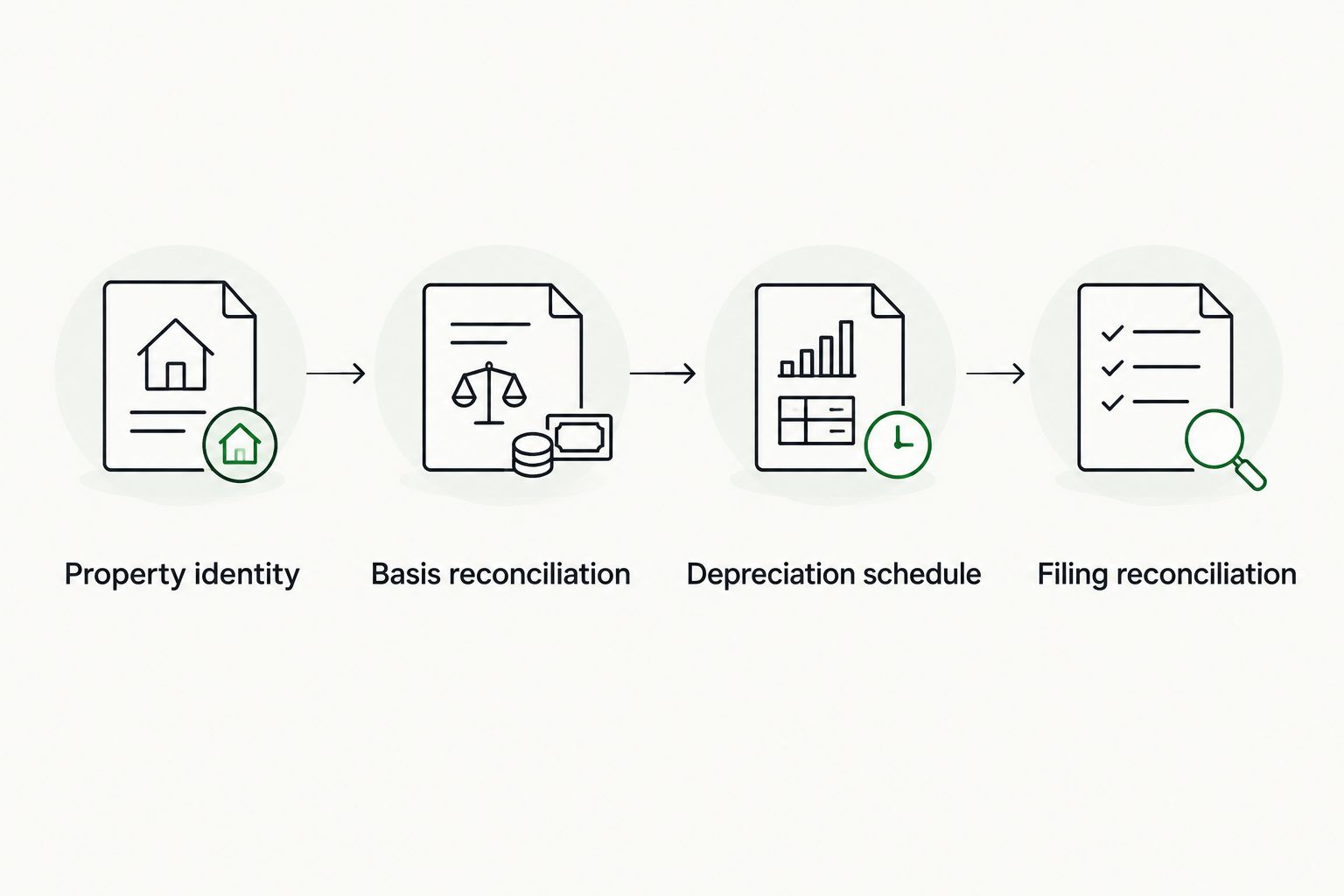
Property identity and source records
- Choose the property. Match the rental address and legal owner across the report, closing documents, and bookkeeping records. Resolve abbreviated addresses or ownership differences before matching amounts.
- Establish the date record. Record the acquisition date and the date the property became ready and available for rent. Keep those dates separate from the report delivery date and the date you started collecting documents.
- Assemble the source packet. Include the purchase documents, land allocation support, improvement invoices, and existing depreciation schedule. Identify personal-use periods or an owner-occupied portion for CPA review.
- Preserve the starting records. Retain the financial records and depreciation schedule used before implementation. Keep the final study separately from drafts so reviewers can identify the version used for filing.
Expected result: You have one identifiable property, a documented ownership history, and a source packet that explains the amounts being reconciled.
Do not substitute the loan balance for property basis. Financing and tax basis answer different questions, and principal payments do not create a new depreciable asset each time you make them. Ask your CPA to resolve basis questions before allocating costs among assets.
Basis reconciliation
- Create a reconciliation worksheet. Use columns for source document, description, recorded amount, study allocation, prior depreciation, and unresolved difference. This worksheet sits beside your bookkeeping records; it is not a new list of paid expenses.
- Separate land. Identify the nondepreciable land amount before comparing the report’s depreciable allocations with the purchase records. Ask your CPA to approve the allocation support.
- Match improvements. Connect each renovation or separately purchased asset to its invoice and existing record. Mark items that were already deducted or already included in an asset schedule for review.
- Resolve differences. Explain differences caused by land, personal use, timing, prior deductions, or omitted invoices. Do not force totals to agree by adding an unsupported miscellaneous expense.
Expected result: The study allocations reconcile to CPA-approved depreciable basis, and each difference has an explanation rather than a balancing entry.
A practical duplicate-cost check
An appliance purchased separately and an appliance included in an acquisition allocation can create overlapping records if nobody checks the source. Ask whether the study already includes the item and whether the prior schedule already depreciates it.
The same check applies to improvements. A contractor invoice supports what you paid, but it does not establish that the entire invoice belongs in one recovery period. Classification depends on function, documentation, placed-in-service timing, and the taxpayer’s facts.
CPA depreciation schedule
- Send the reconciled packet. Provide the final report, source worksheet, prior depreciation schedules, and unresolved questions together. Ask your CPA to acknowledge which report version will support the return.
- Approve asset treatment. Have your CPA review basis, recovery periods, depreciation methods, conventions, and federal and state treatment. Do not assign every component the same treatment simply because the assets appear in one study.
- Confirm the filing route. Distinguish a first-year implementation from a look-back accounting-method change. Your CPA determines the applicable forms and filing requirements.
- Return approved adjustments to bookkeeping. Make only the corrections your CPA identifies. Keep a written distinction between a transaction correction, a capitalization adjustment, and a noncash depreciation entry.
Expected result: Your CPA has an approved tax asset schedule, while your property records retain an accurate history of actual financial activity.
Virtual Cost Segregation supplies the engineering-based study; your CPA applies it to your tax facts. Audit support is included, but tax filing and taxpayer representation remain separate professional responsibilities.
Recovery periods are not bookkeeping categories
A study can identify assets with recovery periods of 5 years, 7 years, or 15 years, subject to their classification and supporting facts. Selecting an expense category in bookkeeping does not establish one of those recovery periods.
The building structure never qualifies for bonus depreciation. Your CPA must also confirm the correct building recovery period for the rental’s use rather than assuming every residential house receives identical tax treatment.
For 2026 planning, eligible property acquired and placed in service after January 19, 2025 can qualify for 100% bonus depreciation, subject to the remaining requirements. Both dates matter, and the restored rate has no scheduled end date.
A home acquired before January 20, 2025 does not obtain a new acquisition date when converted to rental use. Have your CPA confirm the applicable treatment instead of applying the rule for a new purchase.
Filing reconciliation and record retention
- Compare approved totals. Match the CPA’s final asset basis to the reconciled study amounts. Explain any tax adjustments that do not appear in the engineering report.
- Separate cash and tax views. Keep depreciation out of comparisons intended to show cash movement. If your books include depreciation, identify it as a noncash item when reviewing property performance.
- Store the implementation record. Retain the final report, approved asset schedule, source documents, reconciliation worksheet, and filing-related correspondence in a secure property file.
- Record the next review trigger. Flag later improvements, replacements, changes in use, or a sale for CPA review. Do not overwrite the original study when a later event changes the schedule.
Expected result: You can trace a filed depreciation amount back through the approved schedule to the report and underlying property records.
The 2026 close should end with an explainable reconciliation, not merely matching totals. A reviewer should understand why the numbers agree and why any remaining differences are legitimate.
Update the workflow when an existing rental gets a look-back study
A look-back study needs historical reconciliation, not a new acquisition entry. Keep the original acquisition and placed-in-service dates, then compare the revised classifications with depreciation already claimed.
For a look-back accounting-method change, missed depreciation is claimed on the current return through Form 3115 and a Section 481(a) adjustment; prior returns are not amended. Your CPA determines the adjustment and applies the current filing procedures to your facts.
- Collect prior depreciation schedules and identify the amounts already claimed.
- Reconcile the look-back study to the original basis and subsequent capital additions.
- Have your CPA calculate the catch-up adjustment and continuing depreciation schedule.
- Keep the catch-up calculation separate from current-year bank transactions and operating expenses.
Best for: Owners implementing a study after the rental’s first filing year. The benefit is a coordinated catch-up and continuing schedule; the limitation is the need for reliable historical records and CPA implementation.
Virtual Cost Segregation provides Form 3115 on request; your CPA files it. Do not confuse receiving the form with completing the accounting-method-change process.
Troubleshooting
The study total does not match the purchase amount
Compare like amounts first. The purchase amount can include land or other items outside the report’s depreciable allocation. Reconcile those differences against the closing statement and CPA-approved basis before changing records.
Property expenses suddenly increase after implementation
Check whether study allocations were entered as new expenses even though the underlying purchase or improvement was already recorded. Ask your CPA to correct duplicates without deleting the source evidence or losing the transaction history.
The report and prior asset schedule both include furniture
Identify whether each furniture item came with the property or was purchased separately. Reconcile the item descriptions and cost sources, then have your CPA remove overlapping basis from the tax schedule.
The tax deduction does not match the cash-flow result
Separate depreciation and other noncash adjustments from actual cash activity. Then ask your CPA whether loss limitations, personal use, state differences, or other tax rules explain the remaining difference. A study allocation is not the same as a currently usable deduction.
A renovation happened after the study
Keep the renovation invoices and its own placed-in-service evidence. Ask your CPA whether the work creates additional assets, affects an existing asset, or requires disposition analysis. Do not silently add the renovation to an older study allocation.
Customize your workflow
Add a property-specific review whenever you acquire assets, complete substantial work, replace components, or change rental use. Preserve the original source documents and record the reason for each approved adjustment.
For a first-year rental, focus on complete acquisition records and the initial asset schedule. For an established rental, prioritize historical depreciation and the look-back reconciliation. Do not automate tax classifications before your CPA approves the underlying treatment.
The next step is a coordinated client-to-CPA handoff, with the report, source packet, and open questions delivered together. This keeps the 2026 implementation from becoming a series of disconnected requests.
FAQ
How do I use a cost segregation report with Baselane?
Reconcile the report to your property bookkeeping, then send the approved source packet to your CPA for depreciation implementation. Do not enter the report’s asset allocations as new cash expenses.
Should I enter the full cost segregation deduction as a Baselane expense?
Do not create a paid expense for depreciation. Depreciation is noncash, and your CPA should determine whether any separate accounting adjustment belongs in your books.
Can Baselane bookkeeping replace a cost segregation study?
Bookkeeping does not replace an engineering-based cost segregation study. Transaction records document financial activity, while the study supports asset classifications and your CPA determines tax treatment.
Who applies a Virtual Cost Segregation report to my return?
Your own CPA applies the report when filing. Virtual Cost Segregation provides the engineering-based study and audit support, not a CPA filing service.
What happens if I already filed returns for the rental?
For a look-back accounting-method change, your CPA claims missed depreciation on the current return using Form 3115 and a Section 481(a) adjustment; prior returns are not amended. Provide the historical asset schedules so depreciation already claimed is included in the calculation.
Does recording depreciation mean I can offset W-2 income?
Recording depreciation does not establish that a rental loss can offset W-2 income. Your CPA must review activity classification, material participation, loss limitations, and your other tax facts.
Which records should I keep after the workflow is complete?
Keep the final engineering report, source documents, reconciled basis worksheet, CPA-approved depreciation schedule, and filing-related correspondence. Preserve later improvement and disposition records separately so changes remain traceable.
One last thing
Ask for a written reconciliation, not just a deduction total. A correct-looking tax number can still hide duplicated basis or an unsupported date. The strongest handoff lets your CPA trace every allocation to a cost source without turning depreciation into a second payment.
This workflow is general educational guidance for residential rental owners and tax professionals. Apply current law to the property’s facts with your own CPA before changing bookkeeping or filing treatment.