By Virtual Cost Segregation
The best cost segregation study provider for Airbnb hosts
 Built to IRS standards
 Audit support includedFlat price for every study3 to 5 business days
 Airbnb owners in Texas, Florida, Nevada, Washington, Tennessee, Wyoming, South Dakota, and Alaska ask a fair question before writing a check for a study: does cost segregation still work if the state doesn't tax my income anyway? Yes, but the math runs differently than it does in California or New York, and knowing the difference decides whether the study pays for itself in year one.
- Cost segregation for Airbnb owners in no income tax states still delivers a federal-only deduction, no state layer to add on top.
- A $500,000 short-term rental with 25% reclassified at 100% bonus depreciation creates roughly $125,000 in first-year deductions.
- At the 37% federal bracket, that's about $46,250 in federal tax savings with zero state offset in Texas, Florida, or Nevada.
- OBBBA restored 100% bonus depreciation for property acquired and placed in service after January 19, 2025, which matters more in these states, not less.
- Skip providers charging a percentage of savings; a flat $2,200 fee protects the full federal benefit when there's no state deduction cushioning the cost.
Who this is for
This is written for Airbnb and VRBO owners who bought or operate in a state with no personal income tax, along with high-W2-earner investors weighing whether the short-term rental loophole is worth pursuing when there's no state tax bill to offset. If you're deciding between a property in Nashville and one in Sacramento, or you already own in Texas and want to know if a cost segregation study still clears the bar, this guide is built for that exact decision.
Why this matters
Cost segregation reclassifies parts of a rental property, cabinets, flooring, appliances, land improvements, into 5, 7, and 15-year property instead of the standard 27.5-year residential schedule. That reclassification lets you take a large depreciation deduction in year one instead of spreading it out over decades. In a state with a 9% or 13.3% income tax, that deduction offsets both state and federal liability. In Texas or Florida, it only offsets federal liability. That's a real difference, but it's not a disqualifying one, and a lot of owners walk away from the cost segregation study for Airbnb and short-term rentals assuming the missing state benefit means the whole thing isn't worth it. It usually still is.
Run the numbers on a $500,000 short-term rental (building value only, land excluded). A typical cost segregation study reclassifies around 25% of that value, roughly $125,000. Under the One Big Beautiful Bill Act, bonus depreciation is back to 100% for property acquired and placed in service after January 19, 2025, so that entire $125,000 is deductible in year one, not spread over five years. At the 37% federal bracket, that's about $46,250 in federal tax savings. No state tax means no extra layer on top, but it also means you're not losing anything to a state that doesn't tax income in the first place.
What to look for in cost segregation for Airbnb owners in no-income-tax states
Federal-only benefit calculation
Ask any provider to show you the federal-only savings number before you sign anything. In a no-income-tax state, that federal figure is the entire benefit, so it has to be calculated cleanly, not padded with a hypothetical state number that doesn't apply to you.
STR loophole eligibility
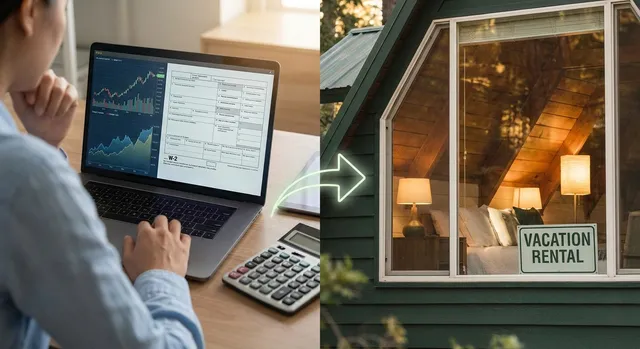
The short-term rental loophole is what lets active W-2 earners use these deductions against ordinary wage income, not just rental income. That requires material participation, average guest stays of seven days or less, and real documentation. The STR loophole explained for W2 earners breaks down the hour thresholds and the paper trail examiners actually ask for.
Placed-in-service date
Property acquired and placed in service after January 19, 2025 qualifies for 100% bonus depreciation under OBBBA. Property placed in service earlier may land on a different bonus percentage schedule, so the date on your closing documents changes the entire deduction calculation, not just a footnote.
Property type and land value ratio
A beach house on stilts and a suburban Airbnb duplex don't reclassify the same way. Land improvements, decking, driveways, landscaping, pools, tend to run higher in vacation markets, which usually pushes the reclassified percentage up, not down.
Flat-fee versus percentage-fee providers
When there's no state tax layer boosting your total savings, a percentage-of-savings fee model eats a bigger relative slice of a smaller total benefit. A flat fee keeps the entire federal deduction working for you instead of a provider.
Audit-defensible documentation
An engineering-based study with a complete report holds up under IRS review in a way a spreadsheet estimate does not. The IRS's own Cost Segregation Audit Technique Guide lays out what examiners look for, and a report built to that standard is the difference between a deduction you keep and one you have to support without support.
Top scenarios for no-income-tax state owners
The beach rental play (Florida). Gulf Coast and Atlantic-side Airbnb owners in Florida sit on properties with heavy outdoor and structural components, pools, decking, hurricane-rated windows, that reclassify well above the 25% average in a lot of cases. A property acquired and placed in service in 2026 locks in 100% bonus depreciation with no state tax dilution either way. Check the specifics on the cost segregation guide for Florida STR owners. Buy.
The volume play (Texas). Investors running three or four short-term rentals across Austin, San Antonio, or the Hill Country get the loophole to scale, each property's reclassified deduction stacks against the same W-2 income. Texas has no state tax to offset, so the entire benefit runs federal, which is exactly what the Texas residential rental cost segregation guide is built around. Buy.
The loophole stack (Nevada and Washington). High-income W-2 earners buying a first short-term rental in Nevada or Washington to run the STR loophole against salary income get the cleanest version of this strategy: no state tax to complicate the return, and a straightforward federal deduction against wages once material participation is documented. Consider, contingent on hitting the hour thresholds.
The cabin rental case (Tennessee and Wyoming). Mountain and lake cabin owners in these states often carry higher furniture and personal property allocations than a standard suburban rental, which can push reclassified value past 25%. The tradeoff is seasonality: occupancy swings affect the average rental period test used to qualify for the loophole in the first place. Consider, and verify your average stay length before ordering a study.
“Cost segregation doesn't create a state tax break you don't have. It front-loads a federal deduction you already earned.”
What to avoid
- Percentage-of-savings pricing. Without a state tax layer to pad the total benefit, a fee tied to a percentage of savings takes a bigger bite out of a purely federal number. A flat $2,200 fee keeps the math simple.
- Desktop-only estimates with no site data. A study built entirely off a floor plan without any property-specific detail is easier for an examiner to challenge, and in a no-income-tax state you don't have a second layer of savings to fall back on if part of the deduction gets disallowed.
- Assuming no state tax means no benefit. This is the most common mistake. The federal-only benefit on a $125,000 reclassification is still $46,250 at the 37% bracket, whether you're in Texas or Connecticut. Comparing what this looks like in a taxed state is worth reading in the cost segregation guide for high-tax-state Airbnb owners before you decide the strategy isn't for you.
Get your no-income-tax-state estimate
Flat $2,200 fee, IRS-compliant report, no site visit required.
Verdict comparison
| Scenario | State tax offset | Typical % reclassified | Bonus depreciation | Verdict |
|---|---|---|---|---|
| Florida beach rental | None | 25-30% | 100% (post 1/19/2025) | Buy |
| Texas multi-property STR | None | 25% | 100% (post 1/19/2025) | Buy |
| Nevada/Washington first STR | None | 20-25% | 100% (post 1/19/2025) | Consider |
| Tennessee/Wyoming cabin | None | 25-30%, seasonal | 100% (post 1/19/2025) | Consider |
| High-tax state comparison | State + federal | 25% | 100% (post 1/19/2025) | See linked guide |
FAQ
Does cost segregation still work in a state with no income tax?
Yes. Cost segregation reduces federal taxable income regardless of state tax law, so owners in Texas, Florida, Nevada, and other no-income-tax states still get the full federal deduction. The only difference is there's no state tax layer to offset on top of it.
Is cost segregation worth it for Airbnb owners in Texas or Florida?
Usually, yes. A $500,000 rental with 25% reclassified at 100% bonus depreciation creates about $46,250 in federal tax savings at the 37% bracket, entirely independent of state tax status.
How much does a cost segregation study cost in 2026?
Virtual Cost Segregation charges a flat $2,200 fee that includes audit support, with no percentage-of-savings model that would eat into a purely federal benefit.
Does the short-term rental loophole require living in a taxed state?
No. The STR loophole depends on material participation and average guest stays of seven days or less, not on state tax residency. It works the same in Wyoming as it does in New York.
What's the difference between cost segregation savings in a high-tax state versus a no-tax state?
In a high-tax state, the deduction offsets both state and federal liability, producing a larger total dollar benefit. In a no-tax state, the same deduction only offsets federal liability, which is still a meaningful number on its own.
When does 100% bonus depreciation apply in 2026?
Bonus depreciation is 100% for property acquired and placed in service after January 19, 2025 under the One Big Beautiful Bill Act, and that rate carries into 2026 for qualifying property.
Do I need to live in the state where my Airbnb is located to claim the loophole?
No. Material participation is based on hours spent managing the property, not physical residency in the property's state.
Can cost segregation offset W-2 income in a no-income-tax state?
Yes, if the STR loophole requirements are met. The reclassified depreciation offsets federal wage income the same way it would in any state, since the loophole is a federal tax mechanism.
One last thing
Owners in no-income-tax states sometimes skip cost segregation assuming the missing state deduction means the study isn't worth the fee. Run the federal-only number first: on a typical $500,000 short-term rental, $46,250 in federal savings at the 37% bracket covers a $2,200 flat fee more than twenty times over, tax status of the state has nothing to do with that ratio.