By Virtual Cost Segregation
The best cost segregation study provider for rental property investors
 Built to IRS standards
 Audit support includedFlat price for every study3 to 5 business days
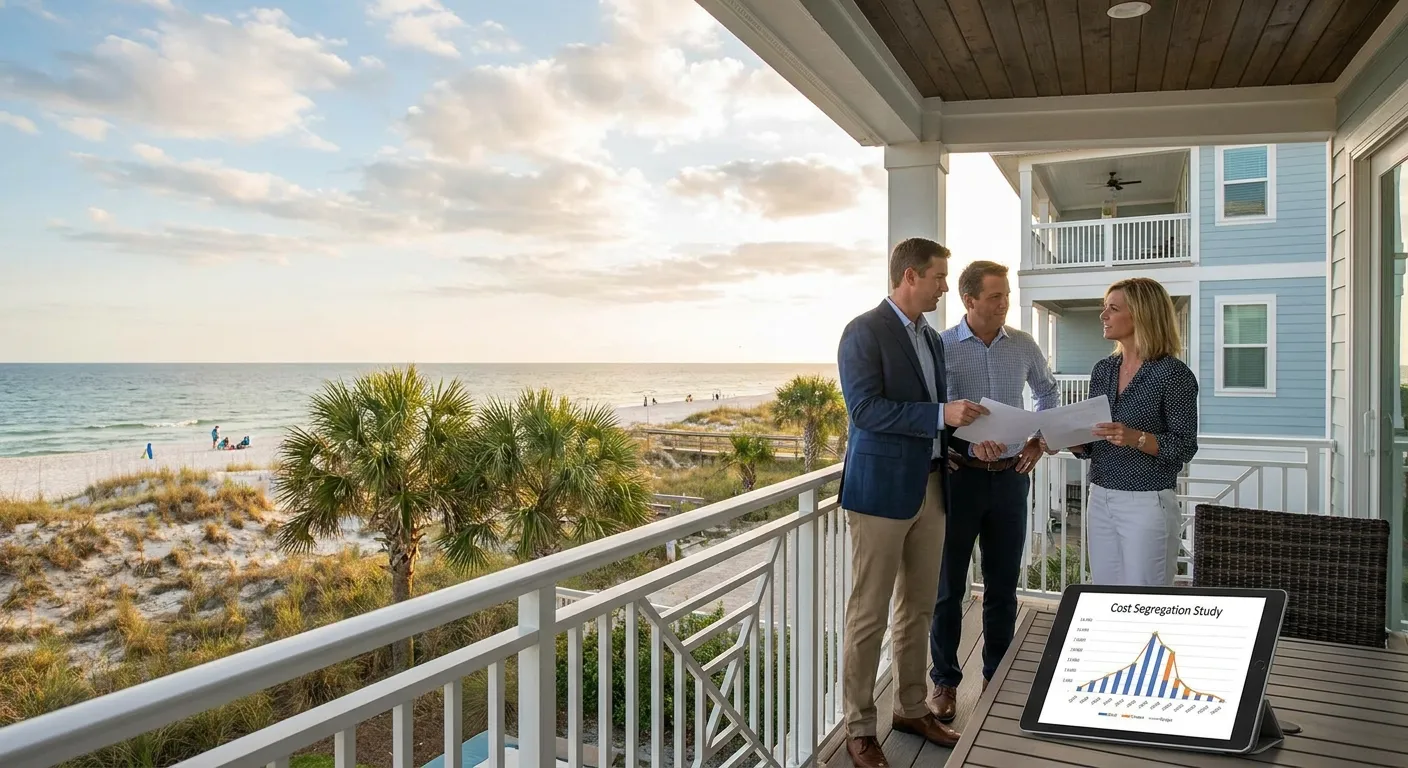
 Gulf Coast beach rental owners running Airbnb or VRBO units from the Florida Panhandle to South Padre Island can reclassify 20 to 45 percent of a property's cost basis into 5, 7, and 15-year buckets with a cost segregation study, turning a 27.5-year depreciation schedule into a first-year deduction under 100 percent bonus depreciation in 2026.
- Cost segregation gulf coast beach rental studies reclassify 20-45% of basis into fast depreciation buckets. Buy for active 2026 STR owners.
- Florida and Texas beach rentals skip state income tax, so the federal deduction is the whole benefit. Buy.
- Louisiana, Mississippi, and Alabama beach rentals still owe state tax; model both before ordering. Consider.
- Properties owned for years qualify for catch-up depreciation via Form 3115, no amended return needed. Buy.
- Commercial beachfront condotels and hotels are outside residential cost segregation scope. Skip.
Why this matters
A beach rental on the Gulf Coast is furniture-heavy, storm-hardened, and often elevated on pilings, which means far more of its cost basis sits in short-life assets than a standard inland single-family rental. Decking, exterior stairs, HVAC mini-splits, hurricane-rated windows, dock structures, and furnishings all qualify for 5, 7, or 15-year depreciation instead of the standard 27.5-year residential schedule.
Under the One Big Beautiful Bill Act, bonus depreciation is restored to 100 percent for property acquired and placed in service after January 19, 2025. That means a beach rental purchased and placed in service in 2026 can write off the entire reclassified 5, 7, and 15-year portion in year one, not spread over five to fifteen years. For a W-2 earner in the 37 percent bracket who also qualifies for the STR loophole through material participation, that deduction offsets active rental income and, in many cases, W-2 income too. The full mechanics are in the Florida short-term rental cost segregation guide, which applies to any Gulf state rental with a similar coastal asset mix.
Who this is for
This guide is for owners of Airbnb, VRBO, or self-managed short-term rentals on the Gulf Coast, think Destin, Panama City Beach, Gulf Shores, Orange Beach, Galveston, or South Padre Island, who are high W-2 earners looking to accelerate depreciation against ordinary income. It also applies to long-term residential rental owners in the same markets who want faster deductions without the STR material participation requirement. It does not apply to owners of beachfront hotels, condotels, or other commercial coastal properties; those fall outside residential cost segregation entirely.
What to look for in cost segregation for Gulf Coast beach rental owners
Engineering-based classification, not a desktop guess
A beach house on pilings has structural and finish components that generic databases miss: elevated foundations, breakaway walls, exterior stairwells, and storm shutters. An engineering-based study that itemizes these components, without requiring a site visit, produces a defensible, itemized report instead of a rough percentage estimate.
Coastal-specific asset capture
Decking, outdoor kitchens, dock and boardwalk structures, hurricane-rated windows, and the furniture package that makes a listing bookable all belong in 5, 7, or 15-year classes. Missing these on a Gulf Coast property leaves real dollars on the 27.5-year schedule for no reason.
Placed-in-service timing
The January 19, 2025 OBBBA cutoff determines whether a property gets 100 percent bonus depreciation or falls under older phase-down rules. A beach rental acquired and placed in service in 2026 clears that bar cleanly; one bought before January 20, 2025 needs a separate calculation.
STR loophole material participation
To offset W-2 income, the rental needs an average guest stay under seven days and the owner needs to clear one of the material participation tests, commonly the 100-hour test. A beach rental that runs mostly week-long summer bookings can miss the seven-day average; shoulder-season weekend stays usually fix that.
State tax layer
Florida and Texas have no state income tax, so a federal-only deduction is the full benefit. Louisiana, Mississippi, and Alabama beach rentals carry a state tax layer on top, which changes the math on how much the accelerated deduction is actually worth per dollar of taxable income offset.
Flat-fee pricing and turnaround
A $2,200 flat-fee study with a 3 to 5 business day turnaround and audit support built in beats a percentage-of-savings fee structure that scales with property value for no added engineering work.
Top picks for Gulf Coast beach rental owners
Pick 1: Florida Panhandle new-build or recent renovation. The highest-upside pick. New construction and full renovations on the Gulf Coast typically reclassify 30 to 45 percent of cost basis because so much of the build is new decking, HVAC, and hurricane glazing. No state income tax in Florida means the federal deduction is the entire benefit. See the Florida short-term rental cost segregation guide for state-specific detail. Buy.
Pick 2: A beach rental owned for several years with no prior study. The catch-up pick. Owners who bought a Gulf Coast rental in 2020 or 2021 and never ran a study can still capture missed depreciation through Form 3115 without amending prior tax returns, per the guide to using cost segregation on a property you've owned for years. This recovers years of deductions in a single filing. Buy.
Pick 3: A beach rental in Louisiana, Mississippi, or Alabama. The double-layer pick. State income tax on top of federal changes the net value of the deduction, so the high-tax state Airbnb cost segregation guide walks through modeling both layers before ordering a study. Still worth it for most active STR owners, but run the numbers first. Consider.
Pick 4: A beach rental acquired through a 1031 exchange. A cost segregation study on 1031 replacement property still reclassifies the stepped-up basis into faster buckets, even though part of the basis carries over from the relinquished property. This works well for owners swapping an inland rental for Gulf Coast beachfront. Buy.
Pick 5: A single Airbnb run by a W-2 physician or executive spouse. If material participation and the seven-day average stay test are both met, the reclassified deduction offsets W-2 income directly, which is the entire point of the STR loophole for high earners. This scenario has the highest tax-bracket payoff of the five. Buy.
Get a flat-fee cost segregation quote
$2,200 flat fee, 3-5 business day turnaround, no site visit required.
What to avoid
- Beachfront condotels and hotel-style units. These are commercial property types and fall outside residential cost segregation scope entirely, regardless of how the listing looks on a booking site.
- Desktop percentage estimates with no site-specific detail. A generic "25 percent reclassified" number without itemized components for decking, hurricane windows, and furnishings will not hold up the same way in an audit as an engineering-based report.
- Ignoring the average-stay math. A Gulf Coast rental booked mostly in month-long winter snowbird stays can fail the seven-day average test even if it's listed as a short-term rental, which knocks out the W-2 offset angle entirely.
Verdict comparison
| Scenario | Typical reclassification | State tax layer | Verdict |
|---|---|---|---|
| Florida/Texas new build | 30-45% | None | Buy |
| Owned for years, no prior study | 20-35% | Varies | Buy |
| Louisiana/Mississippi/Alabama rental | 20-35% | Yes | Consider |
| 1031 exchange replacement property | 20-30% | Varies | Buy |
| Single W-2 owner, material participation met | 25-40% | Varies | Buy |
FAQ
Does cost segregation work on a Gulf Coast beach rental?
Yes, cost segregation applies to any residential short-term or long-term rental on the Gulf Coast, including elevated beach houses, condos, and single-family units used as Airbnb or VRBO listings. Engineering-based studies typically reclassify 20 to 45 percent of the property's cost basis into faster depreciation classes.
Is bonus depreciation still 100 percent in 2026?
Yes, under the One Big Beautiful Bill Act, bonus depreciation is restored to 100 percent for property acquired and placed in service after January 19, 2025, which covers any Gulf Coast beach rental purchased or placed in service in 2026.
Do I need a site visit for a beach house on pilings?
No, an engineering-based cost segregation study can be completed without a site visit using property records, photos, and construction documentation, even for elevated coastal structures.
Does the STR loophole work on a beach rental with seasonal weekend stays?
It depends on whether the average guest stay stays under seven days across the year and whether the owner clears a material participation test such as the 100-hour test. Month-long winter rentals can push the average stay above seven days and disqualify the property.
How much does a cost segregation study cost for a beach rental?
Virtual Cost Segregation offers a flat fee of $2,200 for residential short-term and long-term rental studies, with a 3 to 5 business day turnaround and audit support included.
Does state income tax change the value of the deduction?
Yes, Florida and Texas have no state income tax, so the federal deduction is the entire benefit for beach rentals in those states. Louisiana, Mississippi, and Alabama add a state tax layer on top, which changes the net dollar value of the accelerated deduction.
Can I run a cost segregation study on a beach rental I've owned for five years?
Yes, a study on a property owned for years can capture missed depreciation through Form 3115 in the current tax year without amending prior returns.
Does cost segregation apply to beachfront condotels?
No, condotels and hotel-style beachfront units are commercial property types and fall outside residential cost segregation scope.
One last thing
The seven-day average stay test trips up more Gulf Coast owners than the material participation test does. A property with a strong summer season of week-long bookings can still fail if a handful of month-long winter stays pull the yearly average above seven days, which means the STR loophole math needs checking every year, not just once at purchase.