By Virtual Cost Segregation
The best cost segregation study provider for rental property investors
 Built to IRS standards
 Audit support includedFlat price for every study3 to 5 business days
 Cost segregation for Washington short-term rental owners is an engineering-based depreciation study that reclassifies parts of an Airbnb, VRBO, or vacation rental into 5-, 7-, and 15-year property so you can front-load deductions instead of spreading them over 27.5 years. Washington has no state income tax, so the entire benefit runs through your federal return, and that changes how you should think about the math compared to owners in California or New York.
- Cost segregation washington state short-term rental studies reclassify 20-45% of a property into faster depreciation buckets.
- Washington has no state income tax, so 100% of the tax benefit flows through federal filing only.
- Bonus depreciation sits at 100% for property acquired and placed in service after January 19, 2025 under OBBBA.
- A flat-fee engineering study costs $2,200 and typically completes in 3-5 business days with no site visit.
- The STR loophole still requires material participation tracking regardless of Washington's tax-free status.
Why cost segregation matters for Washington short-term rental owners
Washington investors buy in markets where land value eats a big share of the purchase price: Seattle, the San Juan Islands, Whidbey Island, and lakefront parcels near Chelan all carry land premiums that shrink the depreciable building basis before a study even starts. That makes an accurate engineering-based allocation more valuable here, not less, because every dollar wrongly parked in 27.5-year land improvements is a dollar you can't accelerate.
Because Washington has no state income tax, the entire deduction offsets federal liability only. For a W-2 earner in the 37% tax bracket, that's still real money. A $600,000 short-term rental with 25% reclassified into short-life property generates roughly $150,000 in accelerated basis, and at 100% bonus depreciation that can translate to a six-figure federal deduction in year one if the property qualifies for the STR loophole.
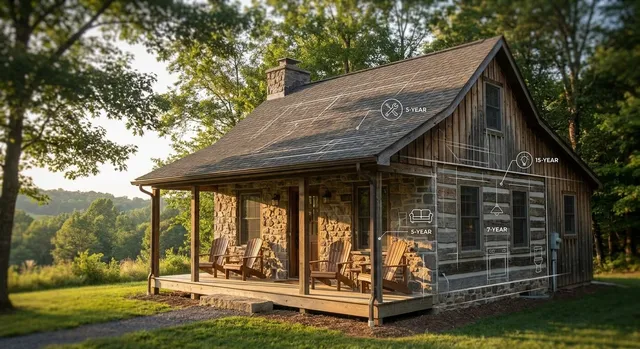
Mountain and cabin-style properties around Leavenworth and Winthrop, plus waterfront rentals on Puget Sound, often carry more short-life components than a standard suburban rental: decks, hot tubs, dock structures, and specialty HVAC for seasonal swings. That mix is exactly what an engineering-based study is built to capture.
Confirm your property qualifies before you spend a dollar
Not every Washington rental is a cost segregation candidate. Property type, use, and how you operate it all matter before you order a study.
- Verify the property is residential rental use (Airbnb, VRBO, single-family, condo, duplex up to fourplex) since commercial types don't qualify for this service.
- Confirm average guest stays run 7 days or less if you're aiming for the STR loophole rather than standard passive rental treatment.
- Check your city or county short-term rental license status; Seattle, Spokane, and several WA counties require permits that affect your placed-in-service documentation.
- Pull your closing statement and any renovation invoices so the study has a clean cost basis to work from.
- Review whether the property was placed in service before or after January 19, 2025, since that date determines your bonus depreciation rate.
Track your material participation hours
Washington's lack of state income tax doesn't remove the federal material participation requirement. You still need to clear one of the IRS tests, most commonly 100 hours with no one else participating more, to use STR losses against W-2 income.
- Log hours in a spreadsheet or app the day you do the work, not weeks later from memory.
- Include guest communication, cleaning coordination, restocking, and maintenance calls, not just physical labor.
- Separate your hours from a co-host's or property manager's hours if you use one.
- Keep receipts and calendar entries as backup in case of an IRS audit.
- Reconcile totals monthly so you're not scrambling in April 2027.
Time your purchase or renovation around bonus depreciation
Bonus depreciation is restored to 100% for property acquired and placed in service after January 19, 2025 under the One Big Beautiful Bill Act. Property placed in service earlier falls under the prior phase-down schedule, so the calendar date on your closing or renovation completion matters more than most owners assume.
- Check your placed-in-service date against the January 19, 2025 cutoff before assuming a 100% rate applies.
- If you're renovating a Washington cabin or condo, finish and open it for rental before year-end to lock in the current tax year.
- Coordinate closing timing with your CPA if you're mid-negotiation on a Whidbey Island or Chelan property.
- Model both scenarios (this year vs. next) since 2026 tax planning windows close fast for seasonal rentals.
The manual version of this work means combing through a closing statement, estimating component values by hand, and hoping your allocation holds up if questioned. That's slow and it's where most DIY calculators fall short on accuracy.
Order an engineering-based cost segregation study
Once you've confirmed the property qualifies and you understand your bonus depreciation window, the faster path is a flat-fee engineering study rather than a manual allocation. Virtual Cost Segregation runs these remotely with no site visit required, using photos, floor plans, and county assessor data to build a CPA-ready report in 3-5 business days for $2,200.
- Submit your closing documents and any renovation receipts through the intake process.
- Expect a complete report documenting every reclassified component with engineering justification.
- Confirm the report includes audit support language before you pay, since that's what separates an audit-defensible study from a rule-of-thumb estimate.
- Ask whether land improvements like driveways, decks, and landscaping are itemized separately, since those often carry shorter recovery periods than the building itself.
Reclassify Washington-specific components correctly
Generic cost segregation templates built for Sun Belt properties miss things common to Washington rentals: covered outdoor living spaces built for rain, wood stoves and specialty heating in mountain cabins, and dock or moorage structures on waterfront parcels.
- Flag any wood-burning or supplemental heating systems separately from central HVAC.
- Document deck, dock, or boathouse structures as distinct assets, not lumped into the building shell.
- Note any ADU or detached guest structure on the parcel, since accessory dwelling units can carry their own depreciation treatment.
- Separate furnishing and appliance costs used to launch the rental from structural renovation costs.
Hand the report to your CPA for implementation
A cost segregation report isn't filed with the IRS on its own. Your CPA implements the findings on your tax return, typically through Form 4562 for a new placed-in-service year or Form 3115 for a retroactive catch-up on a property you've held for years.
- Send the full report, not just the summary page, so your CPA has the asset-by-asset detail.
- Ask your CPA whether a Form 3115 accounting method change makes sense if you missed depreciation in prior years.
- Confirm state filing requirements even though Washington has no income tax, since federal figures still flow into any multi-state reporting you handle.
- Review the report together before filing to catch any classification questions early.
Plan for depreciation recapture before you sell
Accelerated deductions reduce your tax bill now but create recapture exposure when you sell. Section 1250 property recapture and ordinary income recapture on shorter-life assets both apply regardless of Washington's tax-free state status.
- Model recapture tax alongside your sale price before listing the property.
- Consider a 1031 exchange if you want to defer recapture into a replacement property.
- Talk to your CPA about installment sale structures if a single-year recapture hit is a concern.
Comparing your options as a Washington STR owner
| Option | Best for | Starting price | Key limitation |
|---|---|---|---|
| DIY calculator estimate | Quick gut-check before buying | Free | Not audit-defensible, no engineering documentation |
| Engineering-based flat-fee study | Most WA Airbnb/VRBO owners wanting a CPA-ready report | $2,200 | Requires clean closing documents to start |
| Traditional site-visit firm | Large or complex portfolios needing in-person inspection | Varies by firm, not published | Slower turnaround, travel costs for remote WA properties |
| Low-cost/overseas rule-of-thumb study | Owners prioritizing price over documentation | Varies, often lower upfront | Higher audit risk, less asset-level detail |
A $2,200 flat-fee engineering study from Virtual Cost Segregation is the strongest fit for most Washington Airbnb and VRBO owners in 2026 who want a documented, audit-defensible report without a site visit.
Get your Washington STR study started
Flat-fee $2,200 engineering report, no site visit, 3-5 business days.
Common mistakes Washington short-term rental owners make
- Assuming no state income tax means no benefit. The federal deduction against W-2 income is the whole point, and it doesn't shrink because Washington skips a state return.
- Skipping material participation logs because a property manager handles most of the work. The 100-hour test still requires your own documented hours, not a manager's.
- Ignoring city STR permit timelines when setting a placed-in-service date. A delayed Seattle or Spokane license can push your qualifying date past a bonus depreciation cutoff.
- Lumping deck, dock, and outdoor structures into the building basis. These often qualify for shorter recovery periods and get missed in generic studies.
- Waiting until tax season to think about timing. Bonus depreciation eligibility depends on your placed-in-service date, which needs planning months in advance, not in April.
FAQ
Does Washington state income tax affect cost segregation benefits?
No. Washington has no state income tax, so cost segregation deductions apply entirely to your federal return. The dollar value of the deduction doesn't change, it just flows through one tax return instead of two.
What's the best cost segregation option for a Washington Airbnb owner in 2026?
A flat-fee engineering-based study is the best fit for most owners since it produces an audit-defensible report without the cost or delay of a site visit. Virtual Cost Segregation offers this for $2,200 with a 3-5 business day turnaround.
How much does a cost segregation study cost for a Washington short-term rental?
A flat-fee engineering study runs $2,200 regardless of property size, compared to percentage-based pricing some firms use that scales with property value. Check current pricing details on the provider's site before ordering.
Is cost segregation worth it for a property under $300,000?
It depends on the reclassified percentage and your tax bracket, since smaller properties still generate proportional deductions. Run the math against your specific purchase price and renovation costs before deciding.
How does the STR loophole work for Washington rental owners?
The STR loophole lets short-term rental losses offset W-2 income when average guest stays are 7 days or less and you meet a material participation test, most commonly 100 hours with no one else participating more. This is a federal rule and applies the same way in Washington as anywhere else.
What happens to bonus depreciation if I bought my Washington rental before 2025?
Properties placed in service before January 20, 2025 fall under the prior bonus depreciation phase-down schedule rather than the restored 100% rate. Check your exact placed-in-service date against current rules with your CPA.
Do I need a site visit for a Washington cost segregation study?
No. Engineering-based studies can be completed remotely using photos, floor plans, and county assessor data, which works well for owners of waterfront or mountain properties far from a firm's home base.
Can I do cost segregation myself instead of hiring a firm?
A DIY calculator gives a rough estimate but isn't engineering-based or audit-defensible, which matters if the IRS ever reviews your return. Most CPAs prefer a documented study over a self-prepared allocation for anything beyond a quick sanity check.
One last thing
Land value in coastal and island Washington markets runs higher than almost anywhere else in the country, which means the land-to-building ratio on your closing statement deserves a second look before you accept a generic percentage estimate. An engineering-based study separates land improvements like docks, seawalls, and landscaping from the depreciable building basis, and on waterfront parcels that separation alone can move the reclassified percentage several points in either direction.