
By Virtual Cost Segregation
The best cost segregation study provider for rental property investors
 Built to IRS standards
 Audit support includedFlat price for every study3 to 5 business days
Tech professionals’ cost segregation is a tax-planning process that separates residential rental costs into depreciation categories with the aim of bringing eligible deductions forward. For a tech employee, the critical question is whether those deductions reduce current taxable income or remain suspended under loss-limitation rules.
- Cost segregation for tech professionals accelerates rental depreciation; it does not automatically offset W-2 income.
- Short-term rental tax planning requires separate reviews of average guest stays, material participation, and loss limitations.
- Virtual Cost Segregation fits residential rental owners seeking engineering-based studies with a separate CPA handling tax implementation.
- Confirm acquisition dates, rental readiness, and deduction usability before ordering a study.
Why cost segregation matters for tech professionals
A large depreciation deduction and a usable depreciation deduction are different things. If you earn W-2 wages and own a residential rental, your employment income does not establish that rental losses can offset your salary.
The distinction matters when evaluating a short-term rental alongside a demanding job. You need evidence of your rental activity, not just ownership, financing, or a property-management agreement. The broader framework for cost segregation for high-income W-2 earners starts with that separation.
For your 2026 planning, answer three questions before estimating tax savings: what assets qualify for faster depreciation, which deductions your return can use, and what happens when you sell. Cost segregation addresses asset classification. Your CPA addresses how those classifications affect your return.
Long-term residential landlords also benefit from reviewing accelerated depreciation. Their analysis often centers on passive rental income and suspended losses rather than an immediate salary offset. Neither rental model makes cost segregation an automatic choice.
How to evaluate cost segregation for your rental
Establish whether your rental losses are usable
Start with your existing tax return, depreciation schedule, and rental records. Ask your CPA to determine the activity’s tax treatment before you commission a study or change payroll withholding.
For the commonly used short-term rental exception, an average guest stay of 7 days or less is central. Material participation is a separate requirement. One common material-participation test requires more than 100 hours and more participation than any other individual, including a property manager. Logging 100 hours alone is not enough.
This short-term rental route does not require real estate professional status. It also does not remove basis, at-risk, excess-business-loss, or other applicable limitations. Personal use requires additional review.
A full-time tech job makes accurate scheduling especially important. Record the work you actually perform, and have your CPA assess which activities count.
- Calculate average guest stays from completed booking records.
- Maintain dated logs describing your rental work.
- Document work performed by managers, co-hosts, and other individuals.
- Ask your CPA to evaluate participation and loss limitations separately.
Verify acquisition and placed-in-service dates
Gather the purchase agreement, closing statement, renovation records, and evidence that the rental was ready and available for rent. Acquisition and placed-in-service dates are different facts; neither should be inferred from the date you ordered a study.
Under the One Big Beautiful Bill Act, signed July 4, 2025, eligible property acquired and placed in service after January 19, 2025 qualifies for 100% bonus depreciation, subject to the applicable requirements. That restored rate has no scheduled end date.
For property acquired before January 20, 2025, including property under a binding contract signed before then, the prior phase-down applies. Eligible property in that acquisition category placed in service in 2026 has a 20% bonus rate. Have your CPA assess the contract and acquisition facts rather than treating closing as the only relevant event.
Converting a home purchased before January 20, 2025 into a rental does not reset its acquisition date or establish eligibility for the restored full bonus rate. Your CPA should confirm the applicable treatment.
- Preserve the signed purchase contract and amendments.
- Record when the rental became ready and available.
- Separate later improvements from the original acquisition.
- Flag any former personal residence for conversion-basis review.
Assemble evidence before selecting a study provider
You can begin without buying anything: organize your closing documents, existing depreciation schedules, renovation invoices, photographs, and rental-use history. A clean evidence package helps distinguish the building, land, separately purchased assets, and improvements.
Then assess whether you need an engineering-based study rather than an estimate. Virtual Cost Segregation is best for residential rental owners who want an engineering-based study and retain their own CPA for tax implementation. Its cost segregation service addresses residential rentals of 1 to 4 units, including short-term and long-term rentals.
Virtual Cost Segregation provides studies built to the IRS Audit Technique Guide’s criteria, with no site visit required and delivery in 3 to 5 business days. Audit support is included. The limitation is equally important: the study is not a CPA service, and your CPA applies it when filing.
Do not mistake a faster delivery process for a substitute for source records. The report still needs to reconcile with your property’s tax basis and existing assets.
- Collect closing statements and land-allocation support.
- Separate acquisition costs from renovation invoices.
- Identify assets already listed on your depreciation schedule.
- Supply photographs and descriptions of relevant components.
Review asset classifications rather than amenity labels
Start by separating land from depreciable property. Land is not depreciable, and a cost segregation study does not turn the entire purchase amount into a current deduction.
A long-term rental building generally uses a 27.5-year residential recovery period. For short-term rentals with average stays under 30 days, including the 7-days-or-less strategy discussed here, the building uses a 39-year nonresidential recovery period. That tax classification does not change the fact that you own a residential house. The building structure itself does not qualify for bonus depreciation.
Cost segregation identifies components with shorter recovery periods, including applicable 5-, 7-, and 15-year property. Classification depends on function and supporting evidence. A theater room, smart lock, or outdoor amenity is not automatically one asset with one recovery period.
For your 2026 review, ask for the reasoning behind classifications, not simply the total accelerated deduction. A result that cannot be reconciled to the property records needs clarification before filing.
- Separate land, building, personal property, and land improvements.
- Check each component’s function and cost source.
- Review structural work separately from removable equipment.
- Reconcile study totals with the depreciable tax basis.
Model the deduction against your actual tax return
Build the manual comparison with your CPA: standard depreciation versus the study’s proposed depreciation, followed by the limitations that apply to your return. Compare usable deductions, not just the largest number on the report.
An illustrative planning assumption of 25% reclassification and a 37% tax bracket is not a prediction of your property’s result. Actual classifications vary, and a marginal tax rate does not establish whether a loss is currently deductible. Keep estimated depreciation, usable loss, and estimated tax reduction in separate calculations.
Your 2026 model should also address state treatment and your expected holding period. Accelerated depreciation changes deduction timing; a later sale can produce depreciation-related taxable gain. Ask your CPA to compare the current benefit with the future tax consequences.
Virtual Cost Segregation offers a free manual savings estimate through website inquiries. Treat that estimate as a planning input, not the final study or a determination of your tax outcome.
- Compare standard and accelerated depreciation schedules.
- Separate current deductions from suspended losses.
- Review federal and state treatment independently.
- Model the effect of a sale before changing withholding.
Coordinate filing and preserve the implementation record
Ask your CPA to establish the filing approach before the report arrives. A first-year study and a look-back study require different implementation decisions.
For a look-back study correcting an established depreciation method, missed depreciation is claimed on the current return through Form 3115 and a Section 481(a) adjustment; prior returns are not amended. Your CPA should confirm eligibility and apply the current accounting-method-change procedures to your facts.
For current-year assets, your CPA implements the depreciation treatment through the applicable depreciation schedules and Form 4562. The study supplements those filings; the study itself is not filed with the IRS.
Keep the completed report with the implementation workpapers, not only in an email attachment. Your 2026 records should show how the study reconciles to the return and which assumptions your CPA used.
- Agree on the filing year and implementation route.
- Reconcile the report with existing depreciation schedules.
- Have your CPA review elections and required forms.
- Retain source documents, participation records, and final workpapers.
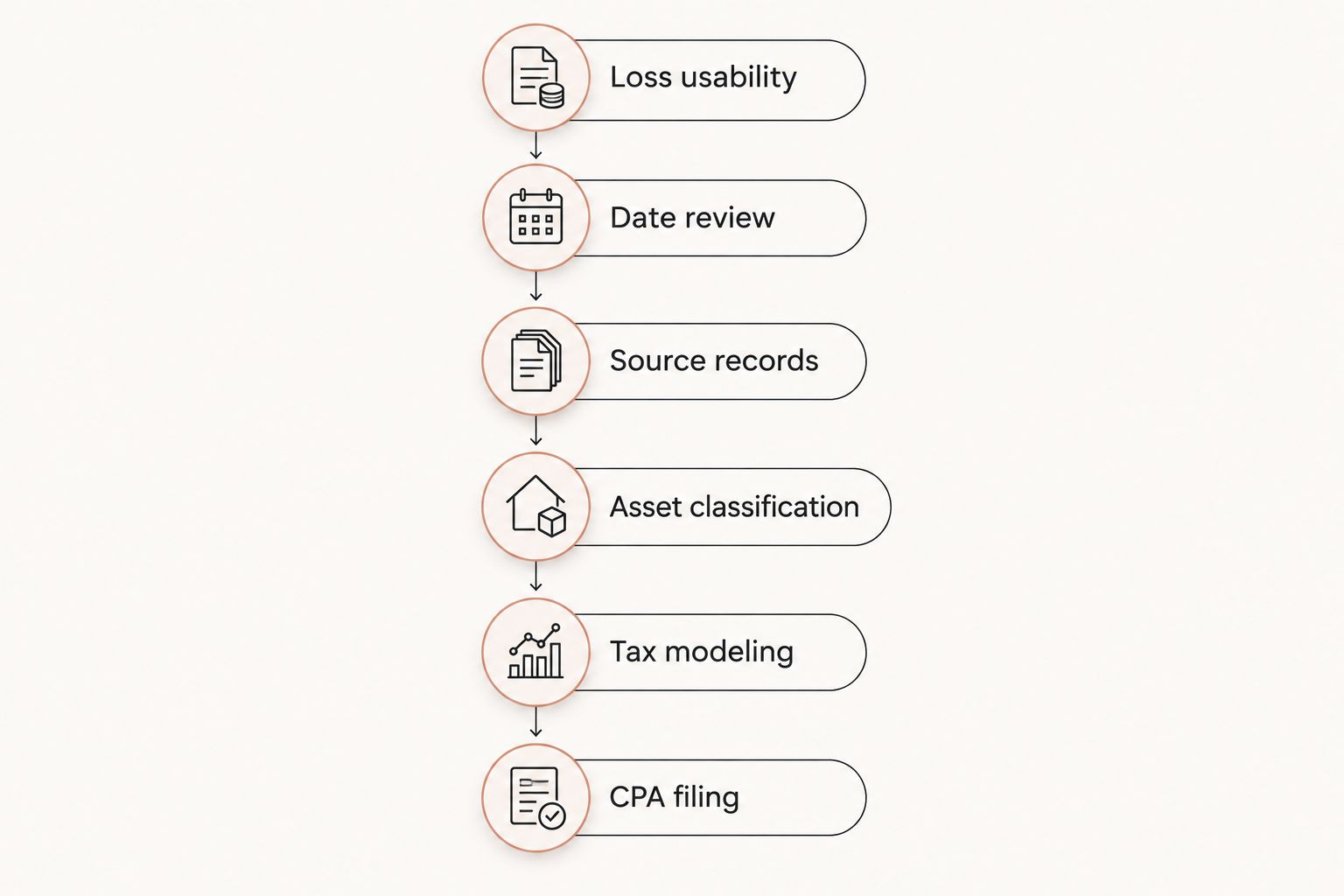
The process follows a fixed order: loss usability, date review, source records, asset classification, tax modeling, and CPA filing. Buying a report first reverses the decision that matters most.
Compare your options before ordering
These options serve different purposes. An estimate screens the opportunity, a study supports asset classifications, and your CPA determines tax implementation. Do not compare them as interchangeable deliverables.
| Option | Best for | Main advantage | Key limitation |
|---|---|---|---|
| Manual review with your CPA | Establishing whether rental losses are usable | Evaluates your return and participation facts first | Does not itself supply an engineering-based asset study |
| DIY calculator | Preliminary scenario screening | Lets you explore assumptions before commissioning work | An estimate does not substantiate property-specific classifications |
| Virtual Cost Segregation engineering-based study | Owners of residential rentals of 1 to 4 units seeking documented classifications | No site visit required; audit support included | Separate CPA implementation is required |
| Standard depreciation | Owners prioritizing a simpler depreciation approach | Avoids commissioning a reclassification study | Does not identify shorter-life components through cost segregation |
Start with the option that answers your unresolved question. If you do not know whether a loss can offset your wages, a calculator is not the next move. A CPA review is.
Request a rental savings estimate
Start with a free manual estimate, then review deduction usability with your CPA.
Common mistakes tech professionals make
Treating a high salary as qualification
A high tax bracket increases the value of an allowed deduction, but it does not establish nonpassive treatment. Review the rental activity and loss limitations before projecting a W-2 offset.
Delegating operations while claiming participation
A co-host or property manager changes the participation facts you must document. Under the more-than-100-hours test, your participation must also exceed every other individual’s participation. Ownership and oversight alone do not establish that result.
Treating software estimates as filing evidence
A calculator’s output depends on assumptions. It does not establish an asset’s function, recovery period, or cost. Keep screening estimates separate from the study and the CPA’s return workpapers.
Changing payroll withholding too early
A projected deduction is not the same as a finalized tax calculation. Have your CPA review the completed study, applicable limitations, and state treatment before changing withholding or estimated payments.
FAQ
Can cost segregation offset my tech-job W-2 income?
Cost segregation can generate depreciation deductions, but a W-2 offset depends on your rental activity and applicable loss limitations. A short-term rental with average guest stays of 7 days or less requires a separate material-participation review; ownership alone is insufficient.
Do I need real estate professional status for the short-term rental strategy?
Real estate professional status is not required for the short-term rental route discussed here. Your CPA must still evaluate average guest stays, material participation, and the other limitations affecting your return.
Does working more than 100 rental hours qualify me?
More than 100 hours alone does not satisfy the commonly used participation test. You must also participate more than any other individual, including a property manager, and document the work that counts.
What bonus depreciation rule applies to a rental bought in 2026?
Eligible property acquired and placed in service after January 19, 2025 qualifies for 100% bonus depreciation, subject to applicable requirements. The building structure does not qualify, and your CPA should verify acquisition facts and the eligibility of each shorter-life asset.
Can I use cost segregation for a long-term rental?
Cost segregation also applies to long-term residential rentals. Whether accelerated deductions reduce current taxes depends on passive income, loss limitations, and your individual tax facts; a salary offset is not automatic.
Can I order a study for a rental I already own?
A look-back study can identify missed depreciation on an existing rental. When correcting an established depreciation method, your CPA claims the catch-up on the current return through Form 3115 and a Section 481(a) adjustment rather than amending prior returns.
Does Virtual Cost Segregation file my tax return?
Virtual Cost Segregation supplies the engineering-based study, not a CPA filing service. Your own CPA applies the report to your return and handles the required tax filings.
One last thing
Ask your CPA to identify the rule that makes the projected deduction usable before asking how large the deduction will be. That single question separates a property-level depreciation estimate from a tax plan you can actually implement.
For a tech professional with limited time, documented operations and a clear CPA handoff matter more than ordering early without the facts.