
By Virtual Cost Segregation
The best cost segregation study provider for rental property investors
 Built to IRS standards
 Audit support includedFlat price for every study3 to 5 business days
Corporate attorneys’ cost segregation is a residential rental tax-planning strategy that separates eligible property components into shorter depreciation schedules to accelerate deductions. Your legal compensation does not establish eligibility to offset that income; rental operations, participation records, acquisition timing, and your CPA’s review determine how the deductions apply.
- Cost segregation for corporate attorneys starts with loss usability, not the size of a projected deduction.
- Virtual Cost Segregation suits residential rental owners seeking an engineering-based study with separate CPA implementation.
- Short-term rental losses require participation analysis before a potential W-2 offset.
- Bonus depreciation depends on acquisition timing, placed-in-service timing, asset eligibility, and taxpayer facts.
Why cost segregation matters for corporate attorneys
A large deduction is useful only when your tax return can use it. For a corporate attorney evaluating residential rentals in 2026, the first question is whether accelerated depreciation reduces current taxable income or creates losses carried into another year.
Cost segregation changes deduction timing. It does not change your employment income into rental income or remove passive-activity restrictions. An attorney receiving W-2 compensation and an attorney receiving partnership income also need different compensation assumptions in their tax projections.
Virtual Cost Segregation provides engineering-based studies for residential rental properties with 1 to 4 units. The study supplies asset classifications and supporting costs; your CPA determines how those findings enter your return.
Your working schedule matters because the short-term rental strategy depends on actual participation, not professional credentials. If you delegate operations to a manager, the manager’s work must enter the participation analysis rather than disappear behind the management agreement.
Build your 2026 cost segregation plan
1. Establish which income the deduction can offset
Start with your existing return and depreciation schedules. Ask your CPA to identify rental income, suspended passive losses, ownership interests, and the income you want the deduction to offset before estimating a study’s benefit.
Long-term rental losses generally fall under passive-activity rules unless an exception applies. Short-term rentals require a separate analysis of average guest stays and material participation. Neither owning a house nor ordering a study establishes a current deduction against legal compensation.
For your 2026 projection, distinguish a deduction generated from a deduction allowed. Basis, at-risk, passive-activity, and other applicable loss limitations still require review.
- Identify whether legal compensation is reported as wages or partnership income.
- Separate passive rental income from nonpassive income.
- List existing suspended losses by activity.
- Ask your CPA to model currently usable depreciation.
- Compare federal and state treatment separately.
2. Test your rental operations against participation rules
Export reservation records and maintain a dated work log yourself. For the commonly discussed short-term rental exception, average guest stays must be 7 days or less, and material participation requires its own analysis.
One common material-participation test requires more than 100 hours of participation and more participation than any other individual, including a property manager. 100 hours alone is not enough. Real estate professional status is not required for this short-term rental route, but your CPA must evaluate your actual facts.
A demanding legal calendar makes documentation especially important. Do not treat blocked calendar time, travel, or reviewing investment performance as automatically qualifying operational work.
- Calculate average stays from completed reservation records.
- Record dates, tasks, and time spent on rental operations.
- Obtain records of work performed by managers and co-hosts.
- Separate operational tasks from investor-level activities.
- Review personal-use days with your CPA.
3. Assemble a property-specific evidence file
Create a shared folder before commissioning a study. Include the closing statement, purchase agreement, property photographs, renovation invoices, and existing depreciation schedules so costs can be traced rather than reconstructed from memory.
Land is not depreciable. Your CPA and study provider need a supported allocation between land and depreciable property, together with records showing what was acquired and when the rental became ready and available for use.
Virtual Cost Segregation’s cost segregation service uses an engineering-based approach built to IRS Audit Technique Guide criteria, with no site visit required and delivery in 3 to 5 business days. That service does not replace your CPA’s tax analysis or missing ownership records.
- Purchase agreement: retain signatures and relevant contract dates.
- Closing statement: preserve acquisition-cost details.
- Property photographs: document components and condition.
- Renovation invoices: separate work by asset and completion date.
- Depreciation schedules: include previously claimed deductions.
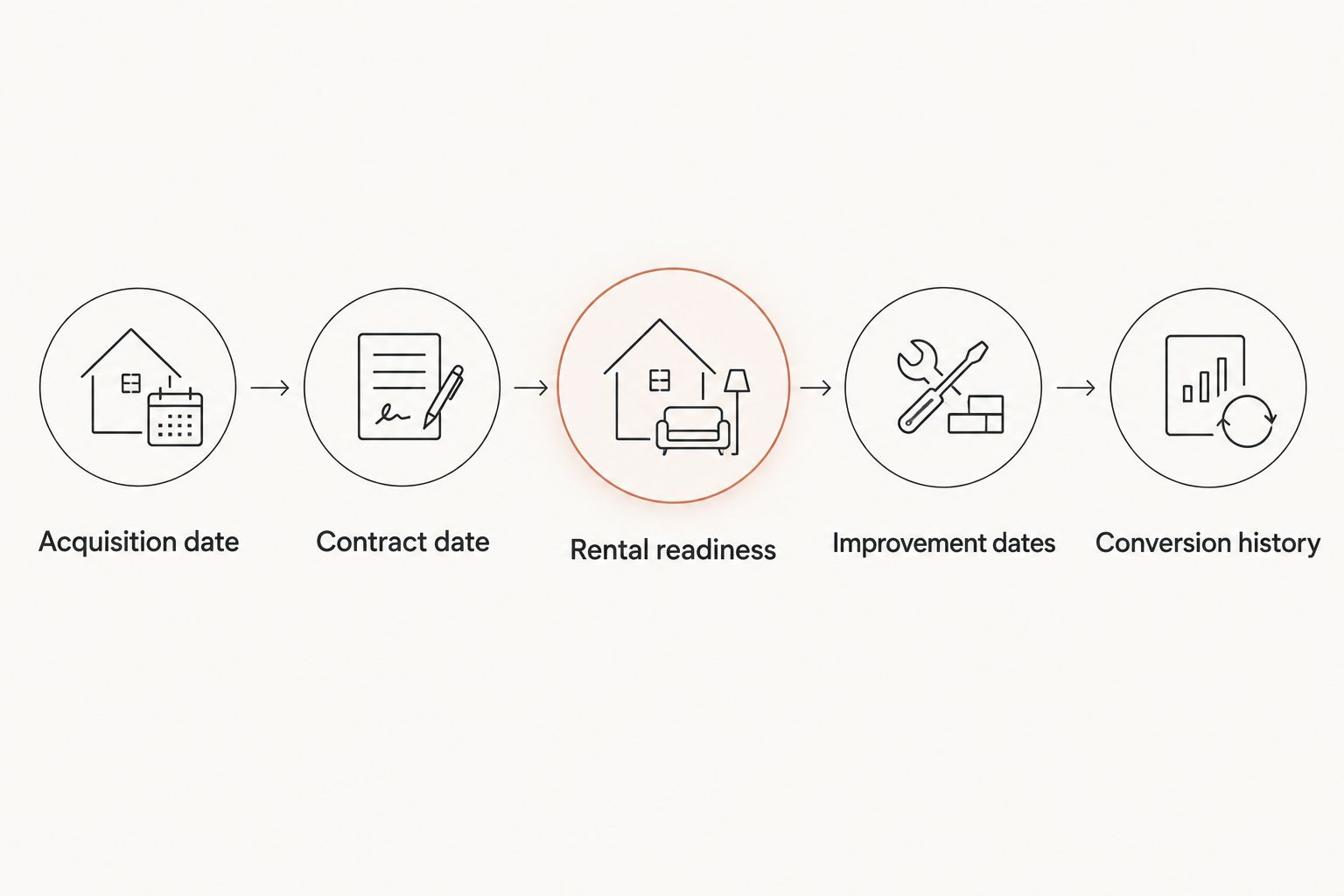
4. Verify acquisition and placed-in-service dates
Build a timeline from source documents instead of using the study’s completion date. Your acquisition date and the date property became ready and available for rental use answer different tax questions.
Under the One Big Beautiful Bill Act, signed July 4, 2025, eligible property acquired and placed in service after January 19, 2025 can qualify for 100% bonus depreciation. Both conditions matter, and the restored rate has no scheduled end date. Your CPA must also review acquisition-contract rules and asset eligibility.
A home bought before January 20, 2025 does not obtain the restored rate merely because you convert it into a rental in 2026. Conversion does not reset acquisition; ask your CPA to determine the applicable treatment from the purchase history.
- Acquisition date: retain the purchase documentation.
- Contract date: flag binding agreements for CPA review.
- Rental readiness: document when the property became available.
- Improvement dates: track later assets separately.
- Conversion history: preserve prior personal-use records.
5. Review component classifications rather than amenities
Start with invoices and photographs, then identify what each asset does. A room name or listing feature does not establish a recovery period: a theater room, for example, contains separate components requiring separate analysis.
Eligible components can receive 5-, 7-, or 15-year treatment, depending on function, documentation, and applicable classification rules. Classification, recovery period, bonus eligibility, and tax outcomes depend on the asset’s function, documentation, placed-in-service date, and taxpayer facts.
The building structure never qualifies for bonus depreciation. The long-term rental building generally uses a 27.5-year recovery period; short-term rental buildings with average stays under 30 days, including the 7-days-or-less strategy discussed here, use 39-year treatment. A residential house and its federal depreciation classification are different concepts.
- Separate movable furnishings from structural components.
- Identify dedicated systems rather than grouping every installation together.
- Review paving, fencing, pools, and site lighting as land improvements.
- Reconcile component totals to depreciable basis.
- Ask for the cost source supporting each classification.
6. Model usable savings and future consequences
Use a spreadsheet with your CPA before deciding whether to proceed. Compare standard depreciation with the proposed accelerated schedule, then apply your actual loss limitations and anticipated holding period.
Illustrative assumptions only: assume 25% of property value is reallocated to shorter-lived components and a 37% federal marginal bracket. Those assumptions do not establish the property’s depreciable basis, actual reclassification, bonus eligibility, or currently usable loss. Results vary.
For a corporate attorney, the better comparison is current tax reduction versus deferred benefit, implementation work, and eventual disposition consequences. Accelerated depreciation reduces adjusted basis and can affect taxable gain and depreciation recapture when you sell. A study moves deductions forward; it does not erase the exit analysis.
- Request a baseline using the existing depreciation schedule.
- Separate generated deductions from currently usable deductions.
- Model state-law differences rather than copying federal results.
- Review sale timing and depreciation recapture with your CPA.
- Update the projection if operations or personal use change.
7. Assign the report-to-return handoff
Give your CPA the study alongside the supporting documents, not as an isolated attachment just before filing. Confirm who reviews basis, who enters the asset schedule, and who checks the final return against the report.
For a look-back study, missed depreciation is claimed on the current return through Form 3115 and a Section 481(a) adjustment; prior returns are not amended. Your CPA determines the applicable accounting-method-change requirements and files the form. A look-back study does not make newly restored bonus rules apply retroactively to an older acquisition.
The engineering report is supplementary documentation, not a document filed with the IRS. Keep the study and its source records with your tax files after implementation.
- Basis review: reconcile land, building, and component totals.
- Asset entry: coordinate recovery periods and conventions.
- Form 4562: have your CPA apply current-year depreciation.
- Form 3115: have your CPA address applicable look-back procedures.
- Record retention: preserve the study and source documents together.
Compare your options before ordering
The right option depends on whether you need an initial screen, a tax-position analysis, or documented asset classifications. These are different jobs, and combining them into one savings estimate hides important limitations.
Comparing cost segregation study costs only makes sense after defining the deliverable: a preliminary estimate and a component-level engineering report do not answer the same question. The cost segregation study costs discussion belongs alongside methodology, source documentation, and CPA implementation when evaluating a proposal.
| Option | Best for | Principal benefit | Key limitation |
|---|---|---|---|
| Manual document review | Owners organizing a first-pass assessment | Establishes dates, basis records, and operating facts | Does not produce an engineering-based study |
| Savings calculator | Preliminary scenario screening | Makes assumptions easy to compare | An estimate does not establish classifications or loss usability |
| CPA tax projection | Attorneys testing current deduction use | Applies income and loss rules to the taxpayer’s facts | A projection alone does not supply component-level engineering support |
| Virtual Cost Segregation engineering-based study | Residential rental owners ready for documented classifications | Provides a CPA-ready study with audit support included | Separate CPA implementation and participation records remain necessary |
Virtual Cost Segregation is best for residential rental owners who need an engineering-based cost segregation study and have a CPA to implement it. The service is not a CPA service, and the study cannot establish material participation on your behalf.
If your documentation and CPA review support proceeding, contact the team for a free manual savings estimate. Treat the estimate as a screening calculation, not an assured tax outcome.
Common mistakes corporate attorneys make
Treating a high tax bracket as eligibility
A high marginal rate increases the value of an allowed deduction; it does not make a passive loss deductible against wages. Ask your CPA to show the loss treatment before focusing on the projected deduction.
Delegating operations without tracking the manager
A management agreement does not resolve material participation. If your position relies on working more than any other individual, your records must address the work performed by the manager or co-host as well as your own.
Assuming an LLC changes passive-loss treatment
Ownership structure and participation are separate questions. Putting a residential rental into an LLC does not by itself make its losses nonpassive or establish a W-2 offset.
Confusing acquisition, conversion, and study dates
Completing a study in 2026 does not create a new acquisition date. Keep the purchase history, conversion history, rental-readiness evidence, and later improvement records distinct so your CPA can apply the correct rules.
Buying a deduction before checking the exit
A large initial deduction is not the whole investment outcome. Review holding period, future taxable income, adjusted basis, and disposition consequences before choosing accelerated treatment or changing estimated tax payments.
FAQ
Can corporate attorneys use cost segregation to offset W-2 income?
A corporate attorney’s residential rental losses can offset W-2 income only when applicable tax rules permit the loss. Cost segregation accelerates depreciation, but your CPA must separately evaluate participation, passive-activity treatment, basis, at-risk rules, and other loss limitations.
Do I need real estate professional status for the short-term rental strategy?
Real estate professional status is not required for the short-term rental route involving average guest stays of 7 days or less and material participation. Your CPA must verify the rental’s facts and the participation test being used.
Is spending 100 hours on my Airbnb enough?
Spending 100 hours alone is not enough for the commonly used participation test. That test requires more than 100 hours and more participation than any other individual, including a property manager.
What bonus depreciation rate applies to a new rental purchase?
Eligible property acquired and placed in service after January 19, 2025 can qualify for 100% bonus depreciation under the One Big Beautiful Bill Act. Both timing conditions apply, and the building structure itself does not qualify.
Can I order a study for a rental I already own?
A look-back study can identify missed depreciation on an existing residential rental. Missed depreciation is claimed on the current return using Form 3115 and a Section 481(a) adjustment; prior returns are not amended, and your CPA handles the filing requirements.
Does Virtual Cost Segregation file my tax return?
Virtual Cost Segregation provides an engineering-based cost segregation study, not CPA services or tax-return filing. Your own CPA applies the report when filing, and the study itself is not filed with the IRS.
What happens if I convert my older home into a rental?
Converting a home into a rental does not reset its acquisition date. A home bought before January 20, 2025 does not receive the restored bonus treatment merely because of a later conversion; your CPA should confirm treatment from the purchase date and property history.
One last thing
An extra operating hour can matter more than a larger projected deduction. If your participation analysis fails, increasing accelerated depreciation does not fix the loss classification. For your 2026 planning, review reservation averages and participation records before approving a study or reducing withholding.
This guide provides general educational information, not individualized tax advice. Have your CPA apply current law to your ownership, operating records, and complete tax position.