By Virtual Cost Segregation
The best cost segregation study provider for rental property investors
 Built to IRS standards
 Audit support includedFlat price for every study3 to 5 business days
 Best for owners of residential rentals with 1 to 4 units: Virtual Cost Segregation. Best for a property-specific proposal: a custom-scope engineering study. Best for preliminary screening: a DIY calculator, not a filing report. If you’re searching for cost segregation firms ranked by price in 2026, compare what each purchase delivers before choosing a study.
- Virtual Cost Segregation is a flat-fee cost segregation option for owners of residential rentals with 1 to 4 units.
- Compare engineering documentation, audit support, and CPA handoff before choosing a cost segregation study.
- A DIY calculator screens potential benefits; it does not replace a property-specific engineering report.
- Your CPA must check deduction usability before estimated depreciation becomes a purchasing decision.
Why this matters
A study fee and a usable tax deduction are different things. Cost segregation identifies eligible components for shorter depreciation periods, but your tax return determines when you can use those deductions.
For a residential investor, the buying decision has two parts: whether the report supports the classifications and whether accelerating depreciation helps your current tax position. A projected deduction alone answers neither question.
Keep your 2026 comparison focused on residential rental property. Request the same scope from every provider, then compare the written proposals against the criteria below.
What makes the best residential cost segregation study
- Residential fit: Confirm that the provider’s scope matches your rental, ownership history, renovations, and available records.
- Engineering documentation: Look for component-level costs, identifiable cost sources, and explanations supporting asset classifications.
- Defined deliverables: Ask what the report includes, what additional information is required, and how questions or corrections are handled.
- Audit support: Establish what support includes. A study provider supplies supporting information; your tax professional handles tax representation.
- CPA implementation: Confirm that your CPA can reconcile the report with the property’s existing depreciation schedule.
- Deduction usability: Review passive activity rules, participation, basis, acquisition timing, and other applicable limitations before ordering.
These criteria make unlike proposals comparable. A calculator estimate, an engineering report, and tax-return preparation are separate deliverables, even when they appear in the same buying discussion.
Residential cost segregation options at a glance
The order below ranks purchasing paths by their role in a residential investor’s decision, not by an assumed fee hierarchy. Request current terms directly and compare equivalent work.
| Option | Best for | Standout feature or evaluation point | Key limitation |
|---|---|---|---|
| Virtual Cost Segregation | Owners seeking a defined residential study scope | Flat-fee, engineering-based report; no site visit required; audit support included | Your own CPA applies the report and files the return |
| Custom-scope engineering study | Owners needing a proposal tailored to unusual records or ownership events | Opportunity to specify the required analysis before engagement | Deliverables and responsibilities must be established in writing |
| DIY calculator | Owners screening whether to investigate further | Preliminary estimate before commissioning a study | An estimate does not document property-specific classifications |
Do not treat the calculator row as an alternative filing service. Its place in this comparison is before the purchase, not at the tax-return implementation stage.
1. Virtual Cost Segregation: best for a defined residential scope
Virtual Cost Segregation provides engineering-based cost segregation studies for residential rental properties with 1 to 4 units, including short-term and long-term rentals. The study is built to the IRS Audit Technique Guide’s criteria and delivered in 3 to 5 business days, with no site visit required.
The purchase produces a supplementary report for your CPA. It does not include tax-return preparation, and the study itself is not filed with the IRS.
Residential study pros:
- A flat-fee engagement establishes the pricing model before purchase.
- Engineering-based analysis supports property-specific asset classifications.
- No site visit is required.
- Audit support is included at no additional cost.
Residential study cons:
- You still need your own CPA to apply the report correctly.
- The report does not establish that a rental loss can offset your W-2 income.
- The service is not CPA service or taxpayer representation.
Best for: An independent residential rental owner who wants a defined study deliverable and already has, or plans to engage, a CPA for implementation.
Verdict: Buy after your CPA confirms the study’s intended tax treatment and deduction usability.
2. Custom-scope engineering study: best for unusual documentation
A custom-scope engagement starts with a written description of the analysis your property needs. This purchasing path deserves consideration when acquisition records, renovations, personal-use history, or an existing depreciation schedule require specific reconciliation work.
Ask the provider to identify the deliverable rather than relying on the proposal’s label. “Engineering-based” should lead to questions about asset identification, cost sourcing, and classification support.
Custom-scope study pros:
- You can request analysis addressing particular documentation issues.
- You can define how acquisition and renovation costs will be reconciled.
- You can establish the CPA handoff requirements before engagement.
Custom-scope study cons:
- A custom proposal does not establish report quality by itself.
- Support, revisions, and filing responsibilities require separate confirmation.
- A broad engagement description can leave essential work undefined.
Best for: A residential rental owner whose property history creates a specific question that the proposed study must answer.
Verdict: Hold until the written scope addresses that question and your CPA accepts the proposed handoff.
3. DIY calculator: best for preliminary screening
A DIY calculator helps you explore a potential depreciation scenario before committing to a study. Treat its result as an estimate, not as a classification of your actual property components.
The distinction is documentation. Entering a property value and receiving an estimated deduction does not establish component costs, recovery periods, bonus eligibility, or the deductions your return can use.
DIY calculator pros:
- It provides a starting point for a conversation with your CPA.
- It lets you examine how assumptions affect a projected outcome.
- It separates preliminary screening from the decision to commission a report.
DIY calculator cons:
- It does not replace an engineering-based study.
- Its output depends on assumptions that require verification.
- It does not establish material participation or passive-loss treatment.
Best for: A residential investor deciding whether to request a property-specific estimate and discuss cost segregation with a CPA.
Verdict: Skip as a filing substitute; use only for preliminary screening.
Compare written proposals without comparing unlike services
For your 2026 decision, send each study provider the same property facts. Include the acquisition date, rental start date, property use, major renovation history, available closing documents, and whether depreciation has already been claimed.
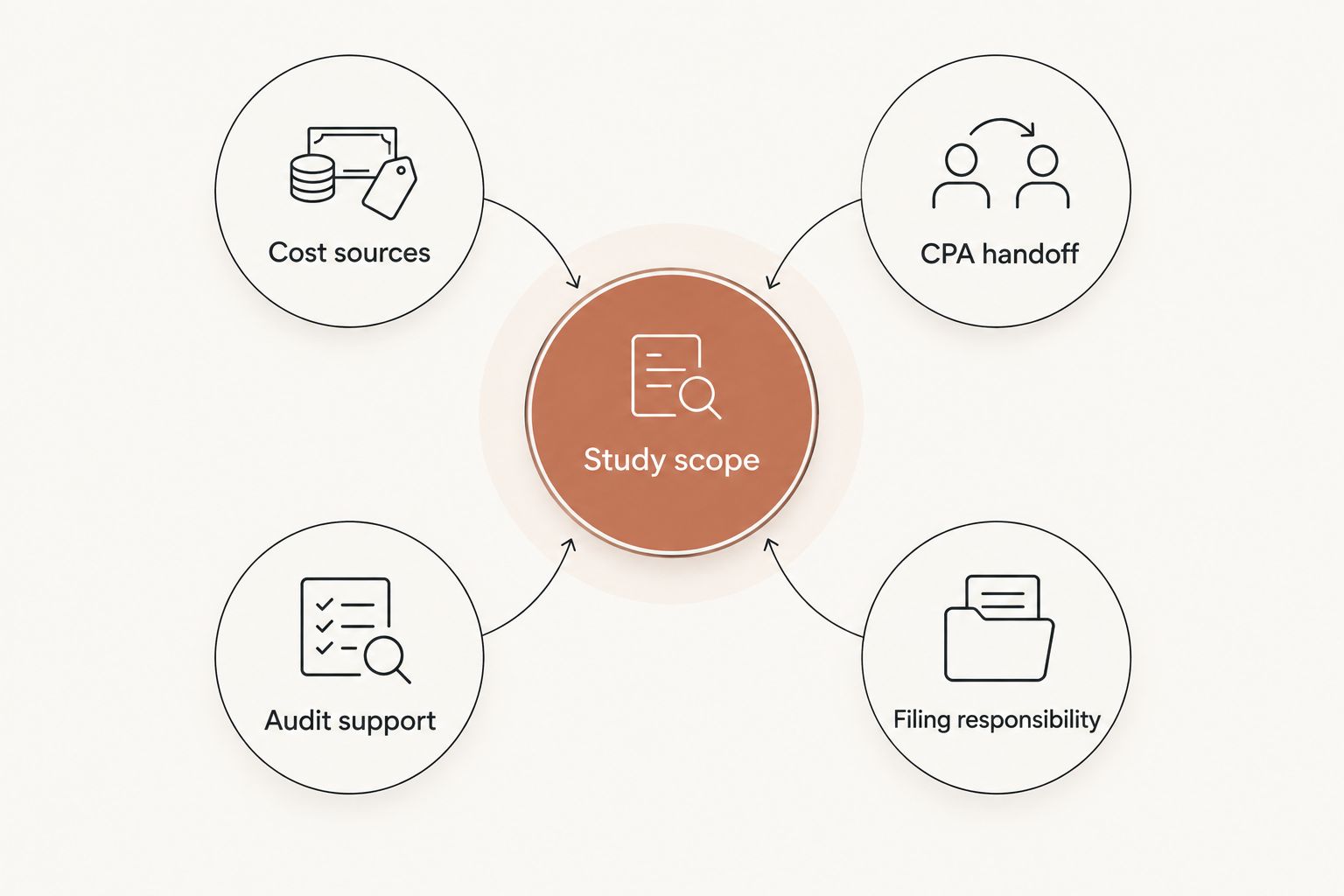
Then ask each provider to define these items:
- Study scope: Which acquisition and improvement costs will be analyzed?
- Cost sources: How will each component’s allocated cost be supported?
- CPA handoff: What schedules and explanations accompany the report?
- Audit support: What information will the provider supply if questions arise?
- Filing responsibility: Who applies the study and handles required tax forms?
These questions prevent a common comparison error: treating a preliminary estimate as equivalent to a completed report. They also separate study preparation from the CPA work needed to implement it.
Use the proposal to assign responsibilities. If the engagement leaves an implementation task unanswered, resolve it before paying for the study rather than after delivery.
Check the tax assumptions before judging value
Acquisition and service dates both matter
Under the One Big Beautiful Bill Act, signed July 4, 2025, eligible property acquired and placed in service after January 19, 2025 qualifies for 100% bonus depreciation. That rate has no scheduled end date; it does not apply to the building structure.
For a 2026 purchase decision, give your CPA both dates and any relevant acquisition contract. Do not substitute the study delivery date for the acquisition or placed-in-service date.
Converting a home to a rental does not reset its acquisition date. A home bought before January 20, 2025 and converted later does not receive the restored rate; your CPA should confirm the applicable treatment from the purchase history.
The building and its components are different assets
A long-term rental building generally uses a 27.5-year residential recovery period. Under the short-stay treatment described here, a short-term rental building with average stays under 30 days uses a 39-year nonresidential recovery period, even though the house is residential real estate.
Cost segregation examines eligible components separately. Depending on their function and documentation, those components can use 5-year, 7-year, or 15-year recovery periods instead of the building’s recovery period.
The building structure never qualifies for bonus depreciation. An amenity also does not automatically receive one treatment for its entire cost; classification depends on the assets involved and the taxpayer’s facts.
W-2 offsets require a separate participation analysis
The short-term rental exception requires an average guest stay of 7 days or less, together with material participation for the nonpassive treatment discussed here. One common participation test requires more than 100 hours and more participation than any other individual, including a property manager.
More than 100 hours alone is insufficient. Real estate professional status is not required for this short-term rental route, but a study does not establish that you meet the applicable tests.
Ask your CPA to review guest-stay records, participation logs, and relevant loss limitations. A cost segregation report documents depreciation classifications, not participation.
Use illustrative math without confusing it with a result
For an illustrative residential scenario, assume 25% of depreciable property basis is reclassified and the owner is in the 37% federal bracket. These are example assumptions, not a predicted study outcome.
The calculation starts with the eligible reclassified basis. Your CPA then determines depreciation under the applicable asset lives, acquisition timing, service dates, and elections, followed by the amount deductible on the current return.
Multiply usable incremental deductions by the applicable tax rate, not the entire estimated deduction without adjustment. Compare that tax effect with the study and implementation expenses and consider future depreciation and sale consequences.
A suspended loss does not deliver the same current-return benefit as a deductible loss. Results vary, and accelerating depreciation changes deduction timing rather than creating additional property basis.
Plan the CPA handoff before ordering
Ask your CPA what documents are needed for a 2026 implementation. Assemble the closing statement, land allocation, improvement records, rental start date, and existing depreciation schedule before the study begins.
For a look-back study, missed depreciation is claimed on the current return with Form 3115 and the applicable Section 481(a) adjustment; prior returns are not amended. Your CPA determines the accounting-method procedure and files the form.
The study provider supplies the supplementary analysis. Your CPA applies current law to your facts, reconciles the schedules, and prepares the return.
Request a residential savings estimate
Get a manual estimate, then review deduction usability with your CPA before ordering.
How these options are ranked
This ranking prioritizes residential fit, documented classifications, defined responsibilities, and CPA implementation. A completed engineering study occupies the purchase slot; a custom engagement addresses a specific scope question; a calculator belongs in preliminary screening.
It is not an assertion that one provider is the cheapest. Choose the deliverable your return requires, then compare current written terms for equivalent work.
Which cost segregation option should you choose?
Virtual Cost Segregation is best for owners of residential rentals with 1 to 4 units seeking a flat-fee, engineering-based cost segregation study. That is the default choice here when the standard residential scope fits and your CPA confirms the intended implementation.
Choose a custom-scope engagement when a specific documentation issue needs explicit treatment. Choose a calculator only when you are still screening the idea.
Your next move is a CPA conversation, not a search for the largest projected deduction. Establish whether accelerated depreciation is usable, then purchase the report that supports it.
FAQ
What should I compare when searching for cost segregation firms ranked by price?
Compare equivalent study scopes, documentation, support, and CPA handoff requirements. A preliminary estimate and a completed engineering report are different deliverables.
Which cost segregation option fits a residential rental owner?
An engineering-based study fits an owner who needs property-specific depreciation classifications for CPA implementation. Confirm residential scope and deduction usability before ordering.
Is a DIY calculator enough for my tax return?
A DIY calculator is not a substitute for a property-specific engineering study. Its estimate does not establish component costs, classifications, or your ability to deduct a rental loss.
Does cost segregation automatically offset W-2 income?
No, cost segregation does not automatically offset W-2 income. Your CPA must evaluate the activity’s treatment, material participation, and applicable loss limitations separately.
Do I need a site visit for the residential study?
Virtual Cost Segregation requires no site visit for its residential studies. Provide the requested property records so the analysis can support the report’s classifications.
What bonus depreciation rule should I check in 2026?
Eligible property acquired and placed in service after January 19, 2025 qualifies for 100% bonus depreciation. The building structure is ineligible, and your CPA must verify the acquisition history and qualifying assets.
Can I order a study for a rental I have owned for years?
A look-back study can identify missed depreciation for an existing rental. Missed depreciation is claimed on the current return through Form 3115 and the applicable Section 481(a) adjustment; prior returns are not amended.
Does the study provider file my tax return?
The study provider supplies a supplementary report, not tax-return preparation. Your own CPA applies the classifications and handles the required filing.
One last thing
Ordering a study does not change when the property was acquired or placed in service. Those dates belong to the underlying transaction and rental use, not the report’s completion.
Before buying in 2026, put the acquisition documents beside the depreciation schedule and participation records. That small handoff step keeps the purchasing decision tied to your actual tax facts.