By Virtual Cost Segregation
The best cost segregation study provider for rental property investors
 Built to IRS standards
 Audit support includedFlat price for every study3 to 5 business days
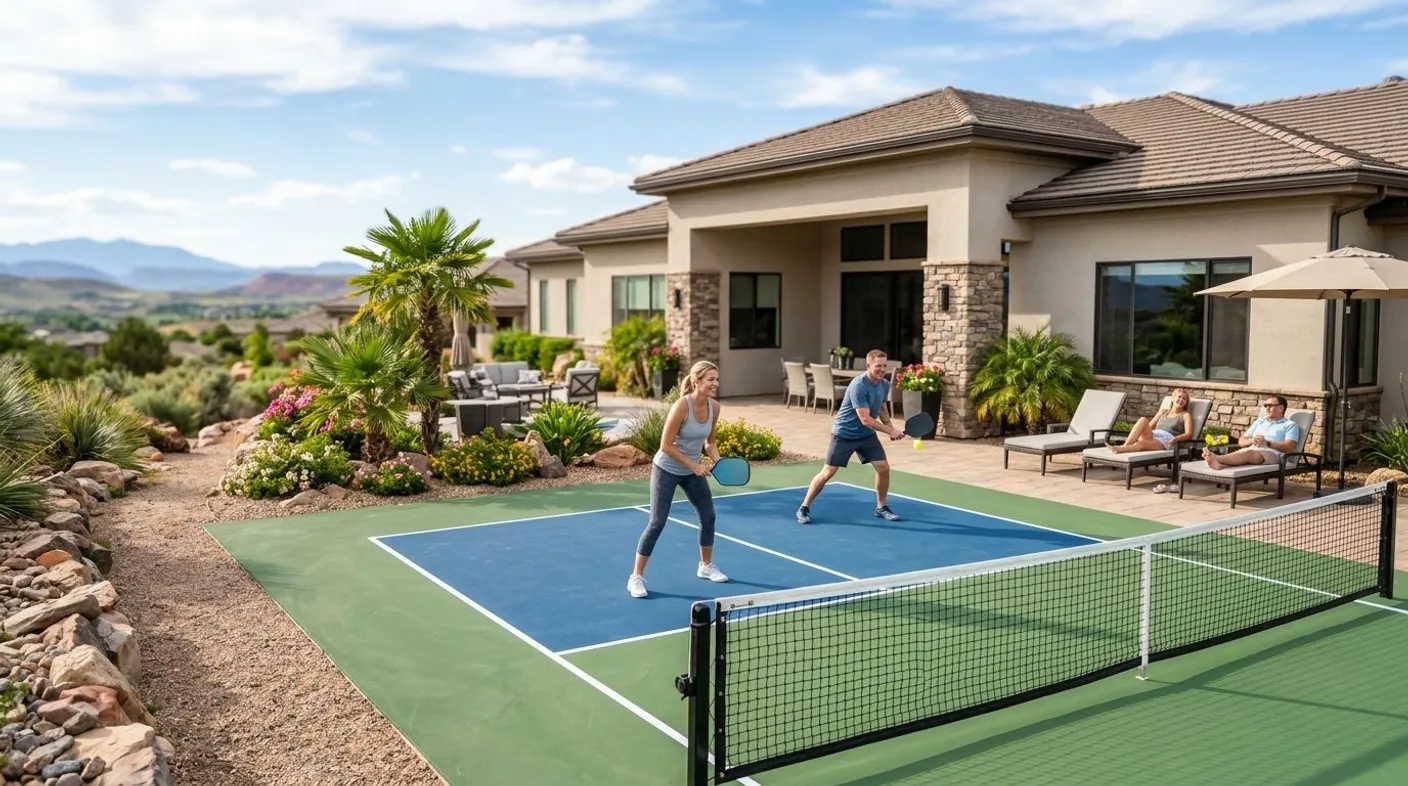
 Airbnb pickleball court owners can use cost segregation to split the court's surfacing, fencing, lighting, and site prep out of the standard 27.5-year residential rental schedule and into 5, 7, or 15-year property classes. That reclassification moves real dollars from a decades-long depreciation timeline into a single tax year, which matters most to hosts who built or bought a court specifically to compete for bookings.
What makes this segment different from a typical short-term rental owner is the amenity itself. A pickleball court is a mix of land improvement (paving, fencing, drainage) and, in some cases, shorter-life components like specialized lighting or removable net systems. Classification depends on how each piece was built, documented, and used, not on the fact that "pickleball court" appears on a listing description.
- Cost segregation benefits of Airbnb pickleball courts come from splitting surfacing, fencing, and lighting into 5, 7, or 15-year classes instead of 27.5 years.
- Under OBBBA, 100 percent bonus depreciation applies to qualifying property acquired and placed in service after January 19, 2025, including reclassified land improvements.
- A $200,000 reallocation on an $800,000 property at a 37 percent bracket can produce roughly $74,000 in year-one tax savings.
- Engineering documentation, not assumption, determines whether court components qualify for shorter recovery periods in 2026 filings.
- A flat-fee, engineering-based study with no site visit typically turns around in 3 to 5 business days.
Why cost segregation matters for Airbnb pickleball court owners
Hosts who add a pickleball court are usually chasing a specific booking premium, not building a commercial amenity. That means the court gets built once, financed as part of the property or a renovation, and then sits on the depreciation schedule for decades unless someone breaks it apart.
The how an Airbnb pickleball court may be classified in a cost segregation study guide breaks down which components typically qualify as land improvements versus structural elements tied to the building itself. That distinction is the entire ballgame for this segment: land improvements generally fall into a 15-year class, while structural components stay on the 27.5-year residential schedule.
For high W-2 earners running an active short-term rental, the math compounds. A property owner in the 37 percent bracket who reclassifies 25 percent of an $800,000 property basis, a reasonable average tied to a study result, moves roughly $200,000 into shorter recovery periods. At 100 percent bonus depreciation, that full $200,000 becomes a first-year deduction, producing an estimated $74,000 in tax savings in the year the study is implemented. That number is an example based on typical reclassification percentages, not a guarantee for any specific property.
Step-by-step: applying cost segregation to a pickleball court amenity
Inventory the court's individual components
Before anything gets classified, every physical piece of the court needs to be listed separately. Lumping "pickleball court" into one line item is the single most common reason these studies undervalue the amenity.
- Surfacing (asphalt base, acrylic coating, or modular tile)
- Perimeter fencing and windscreens
- Net posts, nets, and player benches
- Lighting poles, fixtures, and electrical runs
- Drainage work and site grading tied specifically to the court
Separate land improvements from building structure
Land improvements are physically distinct from the residence itself and generally recover over 15 years instead of 27.5. Fencing, paved surfaces, and drainage tied to outdoor recreation areas usually fall here, but the classification depends on how the item is documented, not on its label.
- Confirm the court sits on its own foundation, separate from the home's structural footprint
- Document fencing height, material, and installation method
- Photograph drainage and grading work before landscaping covers it
- Keep contractor invoices itemized by component, not as one "pickleball court" lump sum
The how to depreciate land improvements after cost segregation guide covers how these components get treated once a study assigns them a recovery period.
Confirm the property's placed-in-service date
Bonus depreciation eligibility hinges on timing, not on when the court itself was finished. Under OBBBA, 100 percent bonus depreciation applies to qualifying property acquired and placed in service after January 19, 2025.
- Check the closing date or renovation completion date against the January 19, 2025 threshold
- Separate the court's completion date if it was added after the property was already a rental
- Confirm whether the court addition counts as a new asset placed in service on its own timeline
- Review current guidance before assuming eligibility for a specific tax year
Document short-term rental status for the property
Cost segregation benefits stack differently depending on whether the property qualifies as an actively managed short-term rental. Average rental period, guest turnover, and owner participation all factor into how losses can be used.
- Track average guest stay length across the platform's booking history
- Log owner or manager hours spent on operations, maintenance, and guest communication
- Keep a record tying the pickleball court to marketing and pricing decisions
- Save platform calendar exports as backup for occupancy patterns
Order an engineering-based cost segregation study
This is where a manual component breakdown gets replaced with a documented, audit-defensible report. Virtual Cost Segregation runs these as flat-fee studies at $2,200, with no site visit required, and typically returns a 100-plus page report in 3 to 5 business days. The Airbnb and short-term rental cost segregation study page outlines what the engineering documentation covers for this property type.
- Submit closing documents, cost basis, and any court construction invoices
- Provide photos of the court and surrounding site work if available
- Review the draft component breakdown before it's finalized
- Confirm the report references the applicable placed-in-service date
Hand the report to your CPA for implementation
A cost segregation report is not filed with the IRS on its own. Your CPA applies the findings to Form 4562 and, where applicable, the depreciation schedule for the tax year the study covers.
- Send the full report, not just the summary page, to your CPA
- Confirm which components your CPA is applying under 100 percent bonus depreciation
- Ask whether a Form 3115 accounting method change applies if the property was placed in service in a prior year
- Keep the report on file as documentation in case of an IRS inquiry
Track future capital improvements to the court separately
If the court gets resurfaced, re-fenced, or upgraded with new lighting later, that work is a separate capital event, not an update to the original study.
- Keep contractor invoices for any court renovation separate from general property repairs
- Note the date any court component is replaced or upgraded
- Ask whether a partial asset disposition applies if the original surfacing is removed
- Revisit depreciation schedules with your CPA when major court upgrades happen
Comparing your options as a pickleball court owner
| Option | Best for | Cost basis | Key limitation |
|---|---|---|---|
| DIY percentage estimate | Owners testing rough ROI before committing | No cost, self-calculated | Not engineering-based, weak in an audit |
| Generic low-cost online study | Owners prioritizing speed over documentation | Varies by provider | Often skips component-level detail on amenities like courts |
| CPA estimate without engineering study | Owners with simple, low-value properties | Included in existing CPA fees | Lacks the audit-defensible detail examiners look for |
| Engineering-based study (Virtual Cost Segregation) | STR owners with amenities like pickleball courts, pools, or outdoor kitchens | Flat fee, $2,200 | Requires CPA implementation to apply results to a return |
Verdict: an engineering-based study is the only option on this list built to withstand IRS scrutiny on a component-heavy amenity like a pickleball court, and it's the right call for any owner who added the court specifically to drive bookings.
Get your pickleball court study started
Flat-fee engineering study, no site visit, 3 to 5 business day turnaround.
Common mistakes pickleball court owners make
- Treating the court as one line item. Lumping surfacing, fencing, and lighting into a single "court" cost hides the components that actually qualify for shorter recovery periods.
- Assuming automatic bonus depreciation eligibility. Classification and eligibility depend on documentation and placed-in-service date, not on the fact that a component sits outdoors.
- Ignoring the placed-in-service date of a mid-year court addition. If the court was built after the main property was already a rental, it may have its own timeline separate from the home.
- Skipping occupancy and participation logs. Owners who can't document active short-term rental status weaken their position on losses tied to the property.
- Using rule-of-thumb percentages instead of engineering documentation. A generic estimate rarely holds up the way an itemized, engineering-based breakdown does under review.
FAQ
Does a pickleball court qualify for cost segregation on an Airbnb property?
Components of a pickleball court, such as fencing, surfacing, and lighting, can qualify for reclassification into shorter recovery periods depending on documentation and function. Whether a specific component qualifies depends on the asset's construction and placed-in-service date, not on its label as a court.
Is pickleball court surfacing a land improvement or a structural component?
Surfacing and fencing tied to an outdoor court are generally treated as land improvements separate from the residence's structure. The exact classification depends on how the item is built, documented, and physically separated from the home.
How much does a cost segregation study cost for a property with a pickleball court?
Virtual Cost Segregation offers a flat fee of $2,200 for an engineering-based study on qualifying residential rental properties in 2026. The fee does not change based on the number of amenities on the property.
Can I get 100 percent bonus depreciation on a pickleball court built in 2026?
Under OBBBA, 100 percent bonus depreciation applies to qualifying property acquired and placed in service after January 19, 2025, which covers most 2026 construction. Eligibility still depends on the specific asset's classification and documentation.
Do I need a site visit for a cost segregation study on my short-term rental?
No. Virtual Cost Segregation performs engineering-based studies without a site visit, relying on documentation, photos, and cost basis records instead. This keeps the flat fee low and the turnaround to 3 to 5 business days.
What documents do I need before ordering a study for a property with a pickleball court?
Closing documents, itemized construction invoices for the court, and photos of the site work are the most useful records. Separating the court's costs from general property costs before ordering speeds up the classification process.
Does adding a pickleball court help qualify for the short-term rental loophole?
The court itself doesn't determine loophole eligibility. Average guest stay length and material participation hours are what matter, and the court is simply an amenity that may support occupancy and pricing.
Should I wait until the pickleball court is finished before ordering a cost segregation study?
Yes, in most cases. Ordering after the court and any other planned site work is complete lets the study capture the full component breakdown in one report instead of requiring a follow-up study later.
One last thing
Most owners assume the court's concrete or asphalt base is the expensive part. In practice, fencing, lighting, and drainage line items often add up to a meaningful share of the reclassified basis, and they get missed constantly when contractors bill the whole build as one "outdoor recreation" invoice. Ask for itemized invoices before the crew leaves the site, not after.