
By Virtual Cost Segregation
The best cost segregation study provider for rental property investors
 Built to IRS standards
 Audit support includedFlat price for every study3 to 5 business days
Yes, you can order a cost segregation study during renovation, but separate the decision to start the study from the date depreciation begins. Begin collecting acquisition records, construction invoices, and photographs now; finalize the study's renovation scope with documented costs and placed-in-service dates rather than treating unfinished work as a current deduction.
- A cost segregation study during renovation can begin before construction ends; unfinished improvements do not create immediate depreciation deductions.
- Separate acquisition costs, renovation costs, and placed-in-service dates to prevent duplicate depreciation.
- Virtual Cost Segregation provides engineering-based residential rental studies; your CPA determines how the report affects your return.
- Photograph components before demolition and preserve itemized contractor invoices throughout the renovation.
Can you order a cost segregation study during a renovation?
Yes. Start the documentation during construction, then coordinate the report's scope and completion with your study provider and CPA. An existing rental building and a new improvement can have different depreciation start dates, even when both appear in the same project records.
For a 2026 renovation, use this sequence:
- Establish existing basis. Gather closing documents, land allocation, prior improvements, and any depreciation schedules already in use.
- Define renovation scope. Identify what stays, what gets removed, and what you are adding. Ask whether the study will address the acquisition, improvements, or both.
- Preserve cost evidence. Save itemized invoices, contracts, change orders, and photographs before work conceals or removes components.
- Confirm service dates. Document when the rental and each separately completed improvement are ready and available for their intended use.
- Reconcile before filing. Have your CPA match the final report to the property ledger and depreciation schedule.
For an engineering-based report, the useful question is not simply whether construction has ended. It is whether the provider has sufficient evidence to identify, value, and classify the assets included in the report.
The guide to cost segregation studies for renovated and remodeled properties addresses that broader acquisition-and-improvement scope.
Why this matters
Renovations create overlapping records: the original purchase, assets removed from the house, replacement components, and work that remains unfinished. Combining those records into one undifferentiated total makes it harder to establish what you own and when depreciation starts.
A study order date is not a placed-in-service date. Paying a contractor, ordering appliances, or receiving the study does not by itself establish that an asset is ready and available for rental use.
This distinction matters for your 2026 return because asset classification, depreciation timing, and your ability to use a loss are separate decisions. A study supports the first decision; your CPA applies the tax rules to all three.
Should you start now or wait until the renovation ends?
The better timing depends on what you want the study to include. Starting the documentation early preserves evidence; waiting to finalize an improvement analysis allows actual costs and completed scope to replace preliminary estimates.
| Approach | Best for | Main advantage | Main limitation |
|---|---|---|---|
| Begin during renovation | Owners who need to preserve acquisition and construction evidence | Captures components before demolition or concealment | Unfinished scope and changing costs require reconciliation |
| Finalize after renovation | Owners seeking an analysis that includes completed improvements | Uses completed work and documented costs | Waiting to collect records can leave gaps |
| Separate existing assets from later improvements | Owners renovating a property already used as a rental | Keeps different asset histories and service dates distinct | Requires careful coordination across depreciation schedules |
These approaches are not mutually exclusive. You can collect records during demolition, analyze an existing rental separately, and address completed improvements once their costs and service dates are established.
Choose a documented scope, not an arbitrary construction milestone. Before ordering, ask what happens if you add work, cancel an improvement, or receive a revised contractor invoice after the report is completed.
What changes if the property was already a rental?
An existing rental brings a depreciation history into the renovation. Give the study provider and CPA the current asset schedule so they can distinguish previously depreciated property from newly added improvements.
A renovation does not automatically restart depreciation on everything you already own. Your CPA must evaluate the existing assets, any temporary withdrawal from rental use, and the treatment of new work separately.
If a look-back study identifies missed depreciation, the catch-up is claimed on the current return using Form 3115 and a Section 481(a) adjustment; prior returns are not amended for that catch-up. Your CPA determines eligibility, prepares the accounting-method implementation, and files the required forms.
Virtual Cost Segregation provides Form 3115 on request, but the client's CPA files it. The study itself is a supplementary report, not a tax return filed with the IRS.
What if you are renovating before the first rental use?
For a house undergoing its initial rental conversion, document when the property becomes ready and available to rent. A future listing, unfinished kitchen, or contractor's projected completion date is not a substitute for the actual facts.
Also distinguish the house's acquisition date from the improvement dates. Converting a personal home to a rental does not reset when you acquired the home, and the conversion basis requires a separate CPA review.
What should you document while contractors are working?
Ask for records that explain what the contractor installed, where it went, and what it cost. A payment description such as renovation draws does not identify the underlying assets.
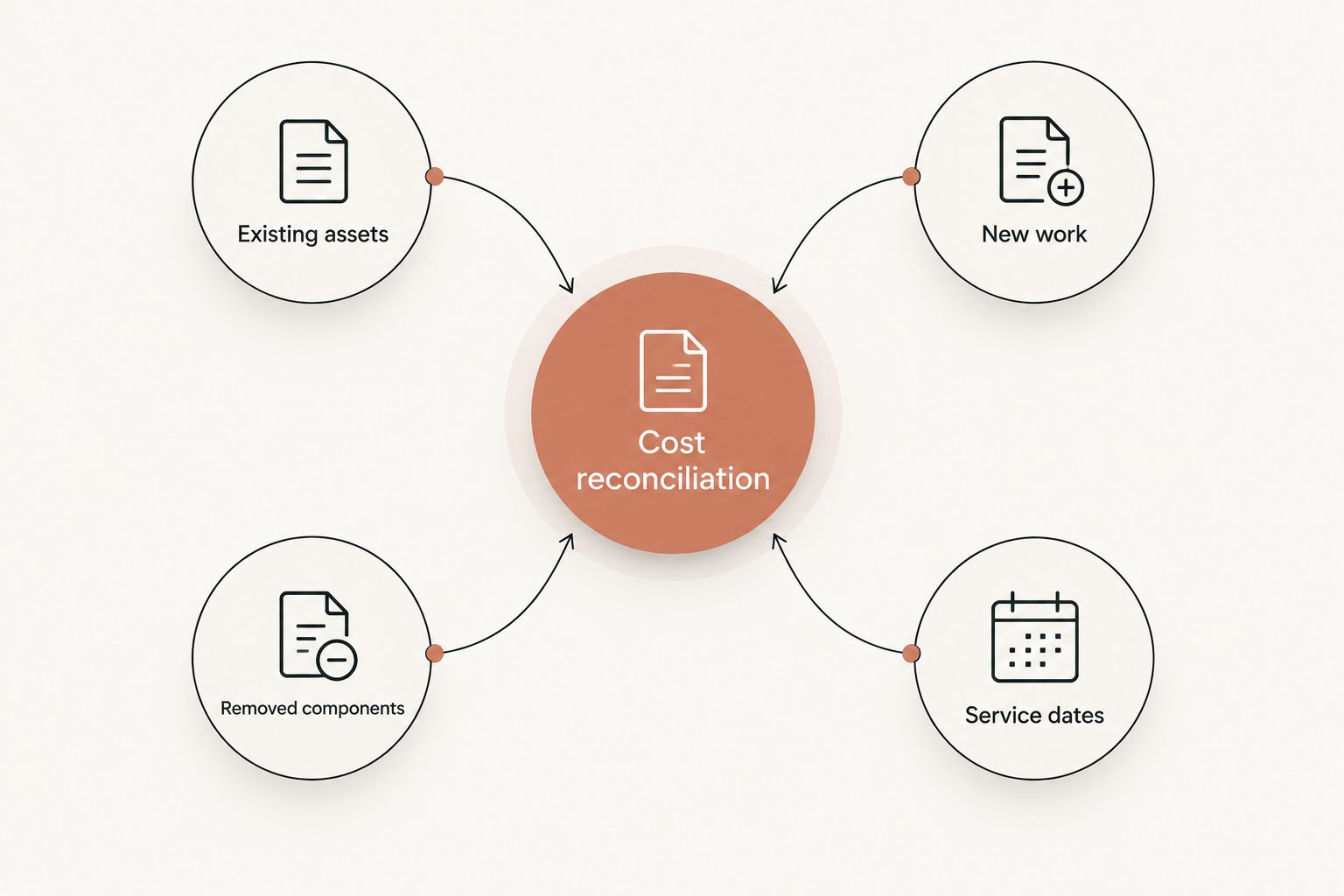
Organize your project file into these categories:
- Existing assets: Closing photographs, inspection records, prior depreciation schedules, and descriptions of components already present.
- New work: Itemized invoices separating materials, labor, installation, and identifiable project components.
- Removed components: Before-and-after photographs, demolition descriptions, and records showing what was replaced.
- Service dates: Installation records, completion evidence, and documentation of readiness for intended use.
- Cost reconciliation: Final invoices, credits, change orders, and a ledger connecting payments to the completed work.
Take photographs before walls close and before demolition removes identifiable components. Those images support the description of the work; they do not replace invoices or establish an asset's tax classification by themselves.
For a 2026 project, maintain this file throughout construction rather than reconstructing it when your CPA requests the tax documents.
Why study timing and tax results vary
The same construction schedule does not produce the same tax treatment for every owner. Review these factors before choosing when to finalize the report:
- Prior rental use: Existing depreciation records affect how your CPA implements a new study.
- Scope stability: Open change orders and incomplete work leave costs and asset descriptions unsettled.
- Acquisition timing: Purchase dates and binding-contract facts affect bonus depreciation eligibility.
- Asset function: A component's use and relationship to the building affect its classification.
- Readiness for use: The building and separate improvements can have different placed-in-service dates.
- Taxpayer limitations: Passive-activity, at-risk, basis, and other loss limitations affect when deductions are usable.
Construction completion is only one input. A completed renovation with incomplete records still leaves questions that a signed contractor invoice alone cannot answer.
Does every renovation component qualify for faster depreciation?
No. Cost segregation separates qualifying components from the building; it does not turn an entire renovation into short-life property.
Eligible assets can receive 5-, 7-, or 15-year recovery periods depending on their classification. The building structure itself does not qualify for bonus depreciation, and structural renovation work does not become eligible merely because it appears on an invoice beside appliances or furnishings.
A long-term rental building generally uses a 27.5-year recovery period. A short-term rental building with average stays under 30 days, including the 7-day-average STR strategy, uses a 39-year recovery period under the applicable transient-use treatment. Your CPA must apply the rules to the property's actual use.
For example, paving, fencing, pools, and site lighting can involve 15-year land improvements, but classification depends on the asset's function, supporting documentation, and taxpayer facts. Do not assign an entire outdoor renovation to one recovery period without reviewing its components.
Request a component-level explanation, not a blanket deduction for the renovation total. Even without bonus depreciation, qualifying shorter recovery periods can accelerate deductions compared with building depreciation.
Does ordering the study in 2026 determine bonus depreciation?
No. The study's order date does not establish bonus depreciation eligibility.
Under the One Big Beautiful Bill Act, signed July 4, 2025, qualifying property acquired and placed in service after January 19, 2025 is eligible for 100% bonus depreciation, subject to the applicable requirements. That restored rate has no scheduled end date.
For a renovation, have your CPA evaluate acquisition and contract timing for the relevant assets, their placed-in-service dates, and whether they are eligible property. The date you bought the house does not eliminate the need to analyze later improvements separately.
A home acquired before January 20, 2025 and converted to a rental later does not receive the restored full bonus rate merely because of the conversion. Its purchase date remains relevant; confirm the treatment with your CPA rather than applying the rule for a new acquisition.
Can renovation depreciation offset your W-2 income?
A cost segregation study does not, by itself, make rental losses deductible against W-2 income. The study identifies depreciation classifications; your participation and the applicable loss rules determine whether you can use the resulting deductions.
For the commonly discussed short-term rental strategy, average guest stays must be 7 days or less and the owner must materially participate. One common material-participation test requires more than 100 hours and more participation than any other individual, including a property manager; 100 hours alone is insufficient.
Real estate professional status is not required for that particular STR approach. Keep participation records separate from your renovation invoices, and have your CPA evaluate which activities count before treating construction involvement as qualifying participation.
When is Virtual Cost Segregation a fit?
Virtual Cost Segregation is best for residential rental owners seeking an engineering-based cost segregation study with CPA implementation. Its studies address residential rentals of 1 to 4 units, including Airbnb, VRBO, and long-term rentals, and are built to the IRS Audit Technique Guide's criteria.
No site visit is required, and audit support is included. The limitation is equally important: Virtual Cost Segregation is not a CPA service, and the report does not replace your CPA's review of service dates, bonus eligibility, or loss limitations.
During an active renovation, ask how the proposed scope handles unfinished work and later invoices before purchasing. You can request a free manual savings estimate, but estimates describe potential outcomes; actual study results and usable tax benefits vary.
Review your renovation study scope
Request a free manual savings estimate and discuss the records for your residential rental.
FAQ
Can I order a cost segregation study before my rental renovation is finished?
Yes, you can start a cost segregation study during renovation. Agree on the scope and preserve records now, then reconcile included improvements with documented costs and placed-in-service dates.
Do I have to finish every improvement before depreciation starts?
No, separately completed assets can have different placed-in-service dates. Your CPA must determine when each asset is ready and available for its intended use; the overall construction schedule alone does not decide this.
Can I depreciate an unfinished renovation because I already paid the contractor?
No, paying the contractor does not by itself start depreciation on unfinished improvements. Your CPA must establish the appropriate tax treatment and placed-in-service date.
Will the entire renovation receive a short depreciation life?
No, renovation costs require component-level classification. Qualifying assets can receive shorter recovery periods, while building components remain subject to the applicable building depreciation rules.
Can a study help if I have already depreciated the rental for years?
Yes, a look-back study can identify missed depreciation on an existing rental. The catch-up is claimed on the current return with Form 3115 and a Section 481(a) adjustment rather than amending prior returns for that catch-up; your CPA handles implementation.
Does Virtual Cost Segregation file my tax return?
No, Virtual Cost Segregation provides the engineering-based study, not CPA services. Your CPA applies the report to your return and files any required tax forms.
One last thing
Record what you remove, not just what you install. When a renovation replaces an existing component, your CPA needs enough information to assess whether a partial asset disposition applies and how to avoid duplicating basis.
Before demolition begins, send your CPA the existing depreciation schedule and a description of the planned removals. For a 2026 renovation, that early handoff preserves evidence that finished-room photographs cannot recreate.