By Virtual Cost Segregation
The best cost segregation study provider for rental property investors
 Built to IRS standards
 Audit support includedFlat price for every study3 to 5 business days
Yes, you can do multiple cost segregation studies on one property when later improvements, an incomplete earlier analysis, or a separate tax-basis event justify additional work. A second study does not let you deduct the same cost twice or restart depreciation on assets already depreciated. For a residential rental, the decision turns on what changed and how the new analysis reconciles with your existing depreciation schedule.
- Can you do multiple cost segregation studies on one property? Yes, but each analysis must reconcile with prior depreciation.
- New improvements can justify additional analysis; unchanged assets do not receive a fresh depreciable basis.
- Virtual Cost Segregation provides residential rental studies; your CPA determines the filing treatment.
- A look-back study uses Form 3115 to claim missed depreciation on the current return, without amending prior returns.
Why this matters
Ordering another report is not the same as creating another deduction. Your depreciation records must explain which assets remain, which costs were added, and which deductions you already claimed.
Virtual Cost Segregation provides engineering-based cost segregation studies for residential rentals of 1 to 4 units. Before ordering additional work in 2026, send your CPA the original report and current depreciation schedule. That comparison establishes whether you need new asset analysis, a correction, or simply continued depreciation.
Can you do more than one cost segregation study over time?
Yes. There is no general one-study-per-property rule, but additional analysis needs a defined purpose. The same address can contain original acquisition assets, later improvements, replacement assets, and costs that an earlier study classified incorrectly.
Study the change, not the address again. Start by distinguishing these situations:
| Approach | Best for | Benefit | Limitation |
|---|---|---|---|
| Supplemental improvement analysis | Documented additions after the original study | Separates new costs and service dates | Must exclude costs already in the original basis |
| Corrective study review | An incomplete or unsupported earlier analysis | Identifies classification and documentation issues | Your CPA must determine the correction procedure |
| Look-back study | Previously owned rentals with missed depreciation | Supports a current-return catch-up adjustment | Must account for depreciation already allowed or allowable |
| Continue the existing schedule | Unchanged property with a sound original study | Avoids unnecessary duplicate work | Does not analyze later improvements |
A new owner buying the property is a different situation from the same owner commissioning another report. The buyer's basis requires its own analysis. Transfers between related parties, gifts, inheritances, and entity changes have separate rules; do not treat every ownership change as a new purchase.
New improvements: analyze the added costs separately
A renovation after your original study can create a new group of depreciable assets. The analysis should identify the improvement costs, their functions, and when each asset became ready and available for rental use.
Keep the original acquisition schedule intact unless a supported correction or disposition changes it. Then connect the new asset schedule to invoices and project records. A second report should make that connection easier to follow, not replace the property's history with a fresh total.
For example, an Airbnb owner might install outdoor lighting and replace furnishings in 2026 after completing an earlier study. Those additions require their own classification review. They do not reopen every original building component for a second deduction.
Classification, recovery period, and bonus eligibility depend on each asset's function, documentation, acquisition timing, placed-in-service date, and taxpayer facts. An amenity's name alone does not establish its tax treatment.
Recommendation: scope additional work around documented new costs. Do not assume that the entire renovation belongs in a shorter recovery period.
An incomplete original study: review before replacing
A second engineering review can address omitted assets, unsupported allocations, or costs that do not reconcile with your tax records. First identify the problem. A different allocation is not automatically a better-supported allocation.
Ask whether the earlier report explains the asset classifications, cost sources, and allocation methodology. Compare its totals with the basis your CPA actually entered on the return. A sound report applied incorrectly calls for a different response than an unsupported report applied exactly as written.
A replacement report must reconcile its findings to the earlier study and depreciation claimed. It cannot simply ignore the old schedule because the new classifications produce larger deductions.
Recommendation: request a written explanation of each proposed change before commissioning a complete replacement. Your CPA should determine whether the issue involves an accounting-method change, an error correction, or another filing procedure.
A look-back study: catch up without duplicating deductions
A look-back study analyzes property you already placed in service. It can identify depreciation that should have been accelerated in earlier years, but the calculation must account for depreciation already allowed or allowable.
For a qualifying look-back accounting-method change, missed depreciation is claimed on the current return with Form 3115 and a Section 481(a) adjustment. Prior returns are not amended. The adjustment reconciles the old depreciation treatment with the corrected method; it is not a second deduction for the property's original cost.
A study completed in 2026 does not make every asset a 2026 acquisition. Historical acquisition dates, service dates, elections, and applicable law remain relevant.
If your original study was already implemented correctly, another look-back analysis needs a specific omission or classification issue to address. The passage of time alone does not establish missed depreciation.
Recommendation: have your CPA evaluate the existing accounting method before ordering a catch-up analysis. Confirm the applicable procedure and eligibility rather than assuming every revision belongs on Form 3115.
Why the need for another study varies
The right scope depends on the property's records and the event prompting the review. These factors determine whether additional engineering analysis serves a real purpose:
- New capitalized costs. Later improvements create costs that were not part of the original acquisition analysis.
- Original study quality. Missing cost sources or unexplained classifications require different work from a complete, reconciled report.
- Depreciation already claimed. Prior deductions affect the remaining basis and any catch-up calculation.
- Asset replacements. Removed components require attention alongside the newly installed assets.
- Acquisition and service dates. Different asset groups can have different depreciation treatment.
- Taxpayer circumstances. Loss limitations and ownership facts affect whether accelerated deductions produce a current tax benefit.
A refinance or higher appraisal, by itself, does not create new depreciable basis. Borrowed funds spent on qualifying improvements require analysis of those expenditures, not depreciation of the new appraised value.
How should you coordinate a second study with your CPA?
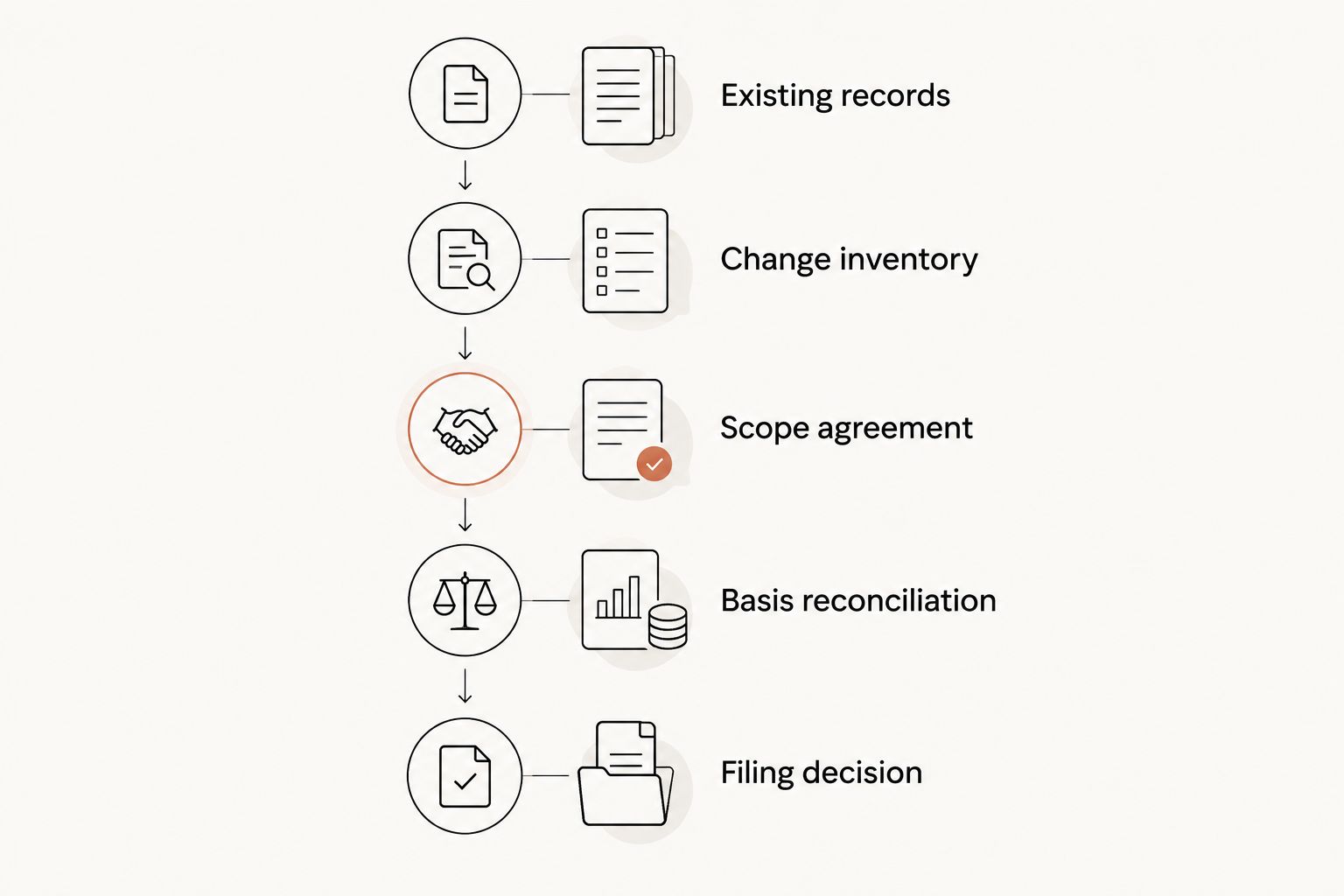
Start with the tax records, then define the engineering assignment. This order helps prevent a second report from creating conflicting asset schedules.
- Existing records. Gather the original study, depreciation schedules, closing records, and prior improvement schedules.
- Change inventory. List additions, replacements, disposals, and suspected omissions separately.
- Scope agreement. Identify exactly which costs and classifications the additional analysis will address.
- Basis reconciliation. Match the revised findings to existing assets and depreciation already recorded.
- Filing decision. Have your CPA determine the applicable forms, elections, and implementation procedure.
For a 2026 review, keep a reconciliation showing original basis, additions, asset removals, accumulated depreciation, and remaining basis. Each number should connect to a report, invoice, or tax schedule.
Your CPA also needs to distinguish repair expenses from capital improvements. Costs already deducted as repairs should not quietly reappear as depreciable assets in the new report. The tax treatment must remain consistent across your records.
Does a later study give old assets new bonus depreciation eligibility?
No. A later report does not reset an asset's acquisition or placed-in-service date. The date you commission the study is not the date you acquired the underlying property.
Under the One Big Beautiful Bill Act, qualifying property acquired and placed in service after January 19, 2025 is eligible for 100% bonus depreciation, subject to the applicable requirements. The building structure does not qualify. A later improvement must be evaluated using its own facts, including acquisition rules and service timing.
Converting a home purchased before January 20, 2025 into a rental does not reset its acquisition date, and the conversion does not qualify that home for the restored rate. Your CPA should confirm the applicable treatment using the purchase history.
Even without bonus depreciation, supported classifications can accelerate deductions through 5-, 7-, and 15-year recovery periods. A new study should therefore separate classification questions from bonus eligibility rather than treating them as the same decision.
Will a second study produce a deduction you can use now?
A second study can change depreciation without producing an immediately usable tax reduction. Passive activity rules, basis limits, at-risk rules, and other loss limitations still apply. Your CPA should evaluate the incremental deduction alongside your existing losses and income.
For a short-term rental, an average guest stay of 7 days or less and material participation are central to the commonly discussed W-2 offset strategy. One material-participation test requires more than 100 hours and more participation than any other individual, including a property manager. Logging 100 hours alone is not enough, and the strategy does not require real estate professional status.
Assessing cost segregation study costs alongside the incremental deduction helps distinguish worthwhile additional analysis from a duplicate report. Compare the after-limitation tax effect and timing benefit with the work required, not merely the size of the proposed reclassification.
Recommendation: ask your CPA to model the incremental result before ordering. Estimates are planning figures, not promised tax benefits, and results vary.
What should a residential rental study provider handle?
Virtual Cost Segregation is best for residential rental owners seeking engineering-based cost segregation analysis for their CPA to apply. Its studies follow the IRS Audit Technique Guide's criteria, require no site visit, and include audit support.
The boundary matters. Virtual Cost Segregation provides the supplementary report, not CPA services, and the study itself is not filed with the IRS. Your CPA applies the findings when filing and determines the correct treatment of a revised schedule.
For an established depreciation method that needs correction, discuss when a CPA should consider Form 3115 before implementation. Form 3115 is provided on request; the CPA files it.
The service does not remove your need for complete historical records or tax advice. Those are especially important when an earlier report already changed the property's depreciation.
FAQ
Can you do multiple cost segregation studies on one property?
Yes, multiple studies can address later improvements, omissions, or supported corrections on one property. Each analysis must reconcile with the existing depreciation schedule and avoid duplicate deductions.
Do I need a new cost segregation study every year?
No, an unchanged property with a sound study does not need an annual replacement report. Review additional analysis when documented improvements or specific classification issues arise.
Can I depreciate the same assets again with another study?
No, another study does not create new basis in the same assets. Your CPA must account for depreciation already allowed or allowable when applying revised classifications.
Does refinancing my rental justify another study?
Refinancing alone does not create new depreciable basis. If loan proceeds fund capital improvements, those expenditures require separate evaluation.
Do I amend old returns after a look-back study?
For a qualifying look-back accounting-method change, missed depreciation is claimed on the current return with Form 3115 and a Section 481(a) adjustment; prior returns are not amended. Your CPA determines whether that procedure applies.
Can Virtual Cost Segregation file my revised depreciation schedule?
No, Virtual Cost Segregation provides the engineering-based study, while your CPA applies it to your return. Form 3115 is provided on request, and the CPA files it.
Does replacing an asset automatically remove its old basis?
No, installing a replacement does not automatically remove the old component from your tax schedule. Your CPA should evaluate disposition treatment and any applicable election separately.
One last thing
A replacement project has two sides: the new asset and the old asset removed. An analysis that classifies the addition but ignores the removed component leaves your CPA with an incomplete implementation question.
Before your next 2026 renovation, preserve invoices, photographs, removal details, and the original study's component records. Ask your CPA about disposition treatment while the evidence is available, rather than trying to reconstruct the project after filing.
This is general educational guidance, not individualized tax advice. Apply current law to your property's records and your taxpayer facts with your CPA.