
By Virtual Cost Segregation
The best cost segregation study provider for rental property investors
 Built to IRS standards
 Audit support includedFlat price for every study3 to 5 business days
Yes. You can commission a cost segregation study for one residential rental building without studying every property in your portfolio. The selected property's basis, assets, and depreciation records must support the analysis independently; choosing one building does not let you transfer costs or deductions from other rentals.
- Partial cost segregation study one building portfolio: yes, you can select one rental without studying the others.
- Virtual Cost Segregation is best for residential rental owners seeking an engineering-based study for CPA implementation.
- Selecting one property does not override passive activity limits, bonus depreciation eligibility, or existing tax elections.
- Separate the selected building's basis from land, other buildings, and assets already depreciated separately.
Why this matters
Choose the property with the strongest usable tax benefit, not simply the largest purchase amount. A study accelerates eligible depreciation. Your ability to use the resulting deduction is a separate tax question.
For your 2026 planning, separate the decision into property scope, asset classification, and return implementation. Virtual Cost Segregation provides engineering-based residential studies, but your CPA determines how the findings apply to your return. Starting with one property keeps the initial scope focused; it does not resolve tax questions elsewhere in your portfolio.
Can you do a partial cost segregation on one building only?
Yes. Owning several rental homes does not require you to commission studies for all of them together. You can select one building and leave the other properties on their existing depreciation schedules, subject to your CPA reviewing those schedules for accuracy.
The word partial creates confusion because owners use it for different assignments. Define the scope before ordering anything.
| Scope | Best for | Main advantage | Main limitation |
|---|---|---|---|
| One-building study | Owners prioritizing one rental within a portfolio | Focuses documentation and analysis on the selected property | Does not identify missed opportunities at other properties |
| Portfolio-wide studies | Owners ready to evaluate several residential rentals | Allows coordinated review across properties | Requires records and implementation work for each property |
| Component-focused analysis | Owners examining a specific improvement or asset | Addresses a defined classification question | Does not replace a broader analysis of the building's depreciable basis |
A one-building study can be complete for that building even though it covers only part of your portfolio. A component-focused assignment has a narrower scope. Neither term means you can choose an unsupported percentage and move that amount into shorter recovery periods.
Specify the address, ownership entity, included assets, and excluded assets in the engagement scope. That definition matters more than whether someone labels the assignment partial.
One selected rental: keep the analysis property-specific
A selected rental needs its own starting basis and depreciation history. If you purchased it separately, the closing statement, acquisition records, land allocation, and improvement invoices establish the starting point for review.
If you acquired several homes together, allocate the acquisition basis among the properties before calculating the selected building's component costs. A portfolio purchase amount is not automatically the basis of the building you decide to study. The allocation needs support rather than a percentage chosen to maximize deductions.
Land remains nondepreciable. The analysis also needs to distinguish the building from separately purchased furnishings, later improvements, and assets already listed on your depreciation schedule.
For 2026, ask your CPA to reconcile the proposed study basis to the tax records before implementation. A technically sound classification still produces an incorrect deduction if the same appliance or improvement appears twice.
One building with shared assets: allocate before classifying
Selecting one building becomes more involved when a residential rental shares a driveway, fencing, site lighting, or other improvements with another rental. The study needs to identify which costs belong to the selected property and which require a supported allocation.
Do not assign the entire shared improvement to the building being studied merely because the other building is outside the engagement. Excluding a property from the study does not eliminate its share of a common asset.
The same discipline applies when records combine several renovation projects. Separate invoices by property where possible, then document the allocation method for costs that genuinely serve more than one property. Keep that method with the study and tax workpapers.
For owner-occupied portions or personal use, your CPA must also determine the rental-use allocation. A study does not convert personal-use costs into rental deductions.
Why the benefit of a one-building study varies
Two residential rentals with similar acquisition costs can produce different usable deductions. The difference is not necessarily study quality; the underlying assets and taxpayer circumstances matter.
- Depreciable basis: Land, personal-use portions, and amounts already expensed do not become new depreciable basis simply because you order a study.
- Asset composition: Supported classifications can identify eligible 5-, 7-, and 15-year property. Not every component qualifies for a shorter life.
- Acquisition and service dates: Bonus depreciation eligibility depends on both timing and the applicable acquisition rules, not the study delivery date.
- Prior depreciation: An existing rental requires reconciliation of deductions already claimed against the corrected asset schedule.
- Loss limitations: Passive activity, at-risk, and other applicable limitations affect whether accelerated depreciation reduces current taxable income.
- Ownership and holding plans: The taxpayer claiming depreciation, existing elections, and an anticipated sale affect implementation and the value of accelerating deductions.
A larger depreciation deduction is not automatically a larger current tax reduction. Ask your CPA to compare the usable deduction with the additional work required to implement the study.
How do you choose which rental to study first?
Use a property-by-property screening process rather than ranking rentals by purchase amount alone. For a 2026 decision, your CPA needs enough information to distinguish a promising study candidate from a deduction you cannot currently use.
- Confirm ownership. Identify the taxpayer that owns the rental and claims its depreciation. An address alone does not identify the correct return.
- Reconcile basis. Separate land, building costs, improvements, and assets already depreciated independently. Resolve a bundled acquisition allocation before proceeding.
- Check dates. Collect the acquisition agreement, closing information, and evidence of when the rental was ready and available for use.
- Review deductions. Compare current depreciation, potential shorter-life assets, and limitations on using additional losses.
- Plan filing. Decide how the CPA will implement the findings, including whether an accounting-method change is needed for an existing rental.
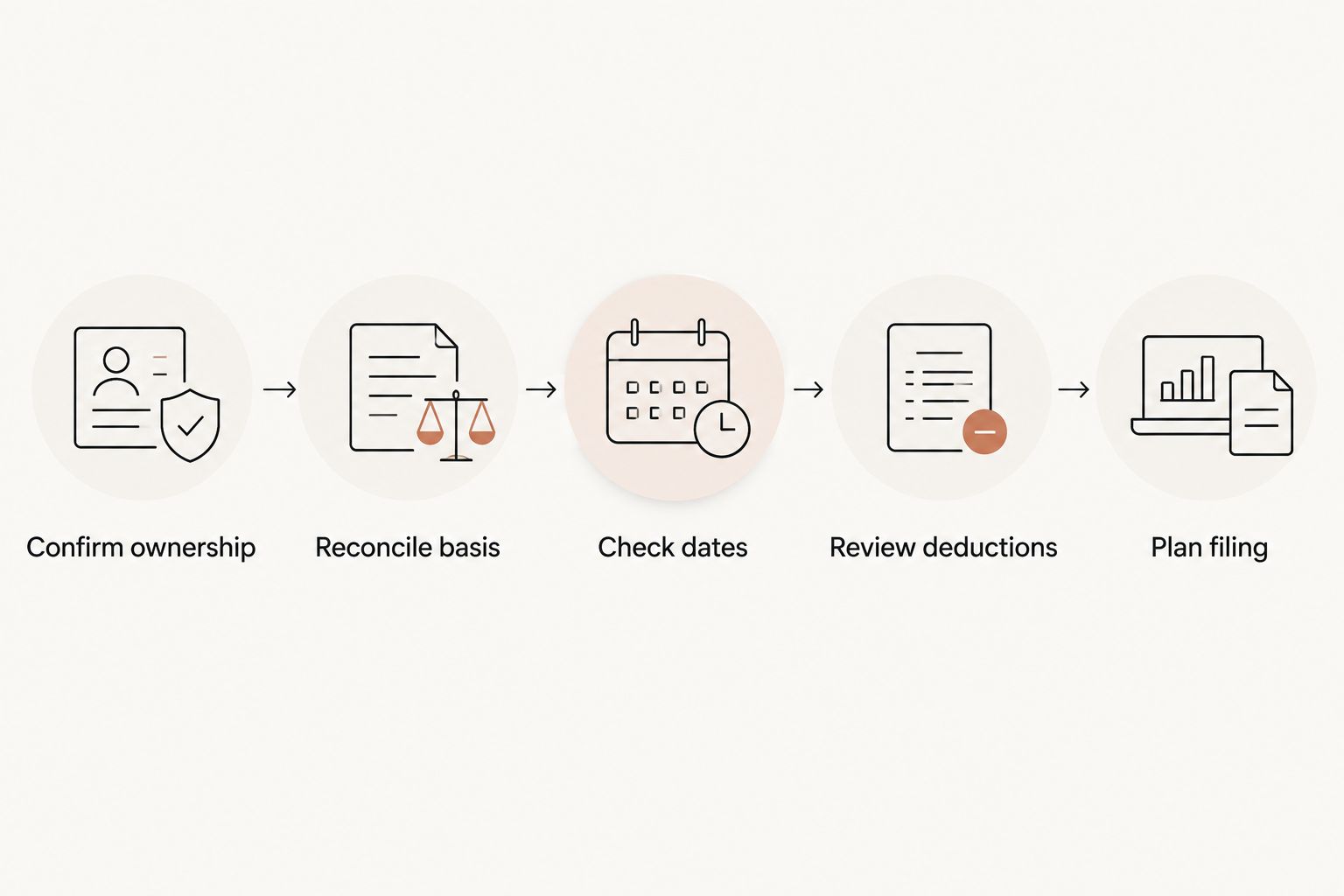
This process also exposes reasons to wait. Missing basis records, unresolved ownership questions, or a planned sale deserve attention before you commission the analysis. Waiting to resolve those issues is different from assuming cost segregation has no value.
Your screening should produce a clear answer: which rental, which taxpayer, which assets, and which filing path. Keep the remaining properties on a separate review list rather than assuming the selected building's results apply to them.
Does selecting one building change bonus depreciation eligibility?
Selecting one building does not change bonus depreciation eligibility. For 2026 planning, eligible property acquired and placed in service after January 19, 2025 qualifies for 100% bonus depreciation, subject to the remaining statutory requirements. The building structure itself does not qualify.
Ordering a study in 2026 does not create a new acquisition date or reset the original placed-in-service date. Those dates come from the property's history, not the report date.
A long-term residential rental building generally uses a 27.5-year recovery period. A short-term rental building with average stays under 30 days uses a 39-year recovery period under the applicable transient-use classification. Eligible components require separate analysis based on function and documentation.
Even without bonus depreciation, supported classifications into 5-, 7-, or 15-year property can accelerate deductions relative to the building's recovery period. Do not treat the entire renovation or amenity as one automatically eligible asset.
Can studying one Airbnb offset your W-2 income?
One Airbnb can generate depreciation deductions, but a study alone does not establish that those deductions offset W-2 income. The rental activity's treatment and your participation determine whether the resulting loss is passive or nonpassive.
The commonly discussed short-term rental route involves an average guest stay of 7 days or less and material participation. One material participation test requires more than 100 hours and more participation than any other individual, including a property manager. Logging 100 hours alone is not enough, and this route does not require real estate professional status.
Selecting one building for analysis does not itself create or change an activity grouping. Your CPA must examine existing elections and the facts of the activities involved. Do not assume hours or losses from another rental automatically transfer to the selected property.
For high earners, this is the critical distinction: identifying accelerated depreciation and establishing a usable nonpassive loss are separate tasks. Both need support.
How should your CPA implement a one-building study?
The CPA should reconcile the study to the selected property's existing depreciation schedule before entering new assets. Keep a clear bridge between original basis, shorter-life classifications, remaining building basis, and depreciation already claimed.
For a look-back study involving an established depreciation method, missed depreciation is claimed on the current return with Form 3115 through the applicable Section 481(a) adjustment; prior returns are not amended for that catch-up. Your CPA determines whether the accounting-method-change requirements apply and files the necessary forms.
Budgeting for cost segregation study costs should also account for the CPA's implementation work, including basis reconciliation and any accounting-method-change filing. Narrowing the study to one building does not eliminate those tasks.
The study is a supplementary report, not a tax return or CPA service. It is not filed with the IRS as a standalone study. Your CPA applies its findings when preparing the return and retains the supporting records with the tax workpapers.
For 2026 filing coordination, send the CPA the scope before the report is completed. That gives the CPA time to identify missing acquisition records, previously depreciated assets, and elections that affect implementation.
What should you request before commissioning the study?
Request a written scope that names the selected rental and explains how the analysis will reconcile to its depreciable basis. Ask how shared improvements, separately listed assets, and missing source documents will be handled.
Virtual Cost Segregation provides engineering-based cost segregation studies for residential rentals with 1 to 4 units, built to the IRS Audit Technique Guide's criteria. Delivery is 3 to 5 business days, no site visit is required, and audit support is included. The limitation is equally important: the service does not replace your CPA's return preparation or tax analysis.
Ask for a manual savings estimate before deciding. Treat that estimate as a screening tool, not a promised result. Actual classifications, deduction timing, and tax outcomes depend on the property and taxpayer facts.
A focused engagement works best when you can provide complete records for the chosen building. Narrow scope should mean fewer properties to analyze, not less support for the property included.
FAQ
Can I do cost segregation on just one house in my rental portfolio?
Yes. You can select one rental house without commissioning studies for the other properties. The selected home's basis, assets, and depreciation history must support its analysis independently.
Is a partial study the same as studying only part of a building?
No. A one-building study can cover the selected building fully while excluding the rest of your portfolio. A component-focused analysis examines a narrower set of assets and should have an explicitly defined scope.
Do I have to use the same depreciation treatment for every rental?
You do not have to commission cost segregation studies for every rental together. Each property's assets still require correct depreciation treatment, and your CPA must review any elections or accounting rules that apply across properties.
Can I study a rental I have owned for years?
Yes. A look-back study can identify missed depreciation on an existing rental. Where an accounting-method change applies, your CPA claims the catch-up on the current return using Form 3115 and Section 481(a), rather than amending prior returns.
Does ordering the study in 2026 reset bonus depreciation eligibility?
No. Ordering a study in 2026 does not reset acquisition or placed-in-service dates. Your CPA applies the eligibility rules to the underlying property's actual history.
Can I apply one rental's reclassification percentage to my other homes?
No. One rental's classifications do not establish the asset composition or basis of another rental. Each property needs support for the costs and recovery periods used on its depreciation schedule.
Does Virtual Cost Segregation file the study with my tax return?
Virtual Cost Segregation supplies a supplementary engineering-based report for your CPA to apply. The study is not filed with the IRS as a standalone report, and your CPA handles return implementation.
One last thing
Selecting one building is a scope decision, not a tax election. It does not move basis between properties, reset acquisition dates, or establish material participation.
Before ordering, ask your CPA to confirm the selected property's basis, usable deduction, and filing path. Those answers turn a one-building study into a coordinated tax-planning decision rather than an isolated report.