
By Virtual Cost Segregation
The best cost segregation study provider for rental property investors
 Built to IRS standards
 Audit support includedFlat price for every study3 to 5 business days
You cannot use a cost segregation study on land only to depreciate bare, unimproved land because land is not depreciable. A property without a building can still contain depreciable improvements, but those assets must be identified separately, used for an income-producing purpose, and placed in service. For a planned residential rental, buying the lot or installing improvements does not automatically start depreciation.
- A cost segregation study on land only cannot create depreciation deductions for bare land.
- Residential rental land improvements can have separate depreciable basis, subject to classification and placed-in-service requirements.
- Fencing, paving, and pools require asset-specific review; their costs do not automatically qualify for immediate deductions.
- Virtual Cost Segregation is best for residential rental owners seeking engineering-based asset classification, not bare-land deductions.
Can you do a cost segregation study on land with no building?
Not on bare land itself. Cost segregation identifies depreciable assets and assigns their costs to the appropriate recovery periods. It does not turn nondepreciable land into depreciable property.
The distinction is between the land and what has been installed on it. A residential rental parcel can include fencing, paving, site lighting, or a pool, each requiring a separate assessment of function, cost, and rental use.
| Property situation | Depreciation treatment | Practical next move | Main limitation |
|---|---|---|---|
| Bare lot held for a future rental house | Land itself is not depreciable | Preserve acquisition and development records | Plans for rental use do not create depreciable assets |
| Lot with improvements for an unfinished rental project | Improvements require separate classification and timing review | Document costs and intended functions | Completion alone does not establish that assets are placed in service |
| Existing residential rental with outdoor improvements | Qualifying improvements can have separate depreciable basis | Review each asset with your CPA | Not every outdoor cost belongs in the same category |
| Completed rental house and land | Allocate basis between nondepreciable land and depreciable assets | Evaluate a residential cost segregation study | The land allocation remains outside depreciation |
For 2026 planning, start with this question: What depreciable asset exists, and when was it ready and available for its intended rental use? The absence of a building does not answer either part.
Why this matters
A land-only purchase and a residential rental acquisition need different tax analysis. Applying a rental-house calculator to a vacant lot produces a misleading starting point because the calculator needs depreciable assets to classify.
Virtual Cost Segregation provides engineering-based cost segregation studies for residential rentals. Bare land is not a source of accelerated depreciation, so establish the asset inventory before evaluating a study.
For a residential investor, the useful distinction is not simply building versus no building. It is nondepreciable land versus identifiable depreciable property, followed by the separate question of whether depreciation has begun.
Bare land: no depreciation recovery period
Land does not have a depreciation recovery period. You retain its tax basis, but you do not deduct that basis annually through depreciation merely because you intend to earn rental income later.
Buying a lot in 2026 for a future Airbnb does not change that treatment. Neither does obtaining plans, arranging financing, or deciding to build a long-term rental house.
Do not apply a reclassification percentage to a bare lot. A percentage assumption cannot establish that depreciable assets exist, and it cannot substitute for an allocation supported by the property's facts.
Your immediate task is recordkeeping. Keep the closing statement, purchase agreement, appraisal information, and development invoices so your CPA can distinguish land acquisition costs from later construction and improvement costs.
Land improvements: potential 15-year property
Qualifying land improvements, including paving, fencing, pools, and site lighting, are generally 15-year property. Their treatment depends on what each asset does, the supporting documentation, and its use in the residential rental activity.
That does not mean every cost incurred outdoors belongs in a 15-year category. General land preparation, work associated with a building, and separately identifiable improvements require different analysis.
For example, an invoice describing site work does not establish the proper classification. Your CPA and study provider need to understand whether the work relates to the land, a particular improvement, or the building project.
The same caution applies to an amenity package. A single contract can combine several assets and installation tasks, so treating the entire contract as one depreciable item can obscure the correct allocation.
Review the underlying work, not just the invoice heading. A useful asset record explains what was installed, where it serves the rental, how its cost was determined, and when it became available for use.
A future rental building: separate from the land
Once a residential rental building is placed in service, its depreciable basis remains separate from the land. Cost segregation then evaluates whether particular components belong in shorter recovery periods rather than the building category.
A long-term rental building generally uses a 27.5-year recovery period. Short-term rental building classification requires separate analysis of the use and applicable transient-use rules; do not assume the long-term rental period applies to every Airbnb.
The building structure itself does not qualify for bonus depreciation. Identifying shorter-life assets does not change that rule or make the underlying land depreciable.
If you buy a lot and construct a rental house, preserve the construction cost breakdown from the beginning. Separating costs during the project is more useful than trying to reconstruct every expenditure from a single final total.
Why land-only cost segregation results vary
The land rule does not vary: land is nondepreciable. What varies is whether the parcel contains other assets that support a depreciation deduction and whether you can use that deduction.
- Asset function. Paving, fencing, and building-related work must be classified according to what they serve, not merely their outdoor location.
- Documented basis. Closing records, invoices, and supported allocations establish which costs belong to which assets.
- Placed-in-service timing. Purchasing or finishing an asset is not enough without readiness and availability for its intended income-producing use.
- Acquisition timing. Bonus depreciation eligibility depends on acquisition facts as well as the placed-in-service date.
- Rental and personal use. Personal use requires a separate review rather than treating every improvement as entirely rental-related.
- Taxpayer limitations. Passive activity, at-risk, and other applicable loss limitations affect whether accelerated deductions reduce current taxable income.
A study addresses asset classification and allocation. Your CPA applies the tax rules to your return; those are connected tasks, not interchangeable services.
How to review a vacant lot intended for a residential rental
Use this sequence before ordering a study or including depreciation in a 2026 tax projection. It separates the existence of an asset from its classification and deduction timing.
- Identify assets. List what actually exists on the parcel. Separate bare land from installed fencing, paving, lighting, and other improvements.
- Separate basis. Gather purchase records and construction invoices. Identify bundled charges that need a supported allocation.
- Confirm rental use. Explain how each asset serves the planned or operating residential rental. Flag personal use and assets associated with an incomplete project.
- Verify timing. Record acquisition dates and when each asset became ready and available for its intended use. Do not use the study delivery date as the depreciation start date.
- Review deductions. Ask your CPA to confirm classification, elections, and loss limitations before estimating a current tax benefit.
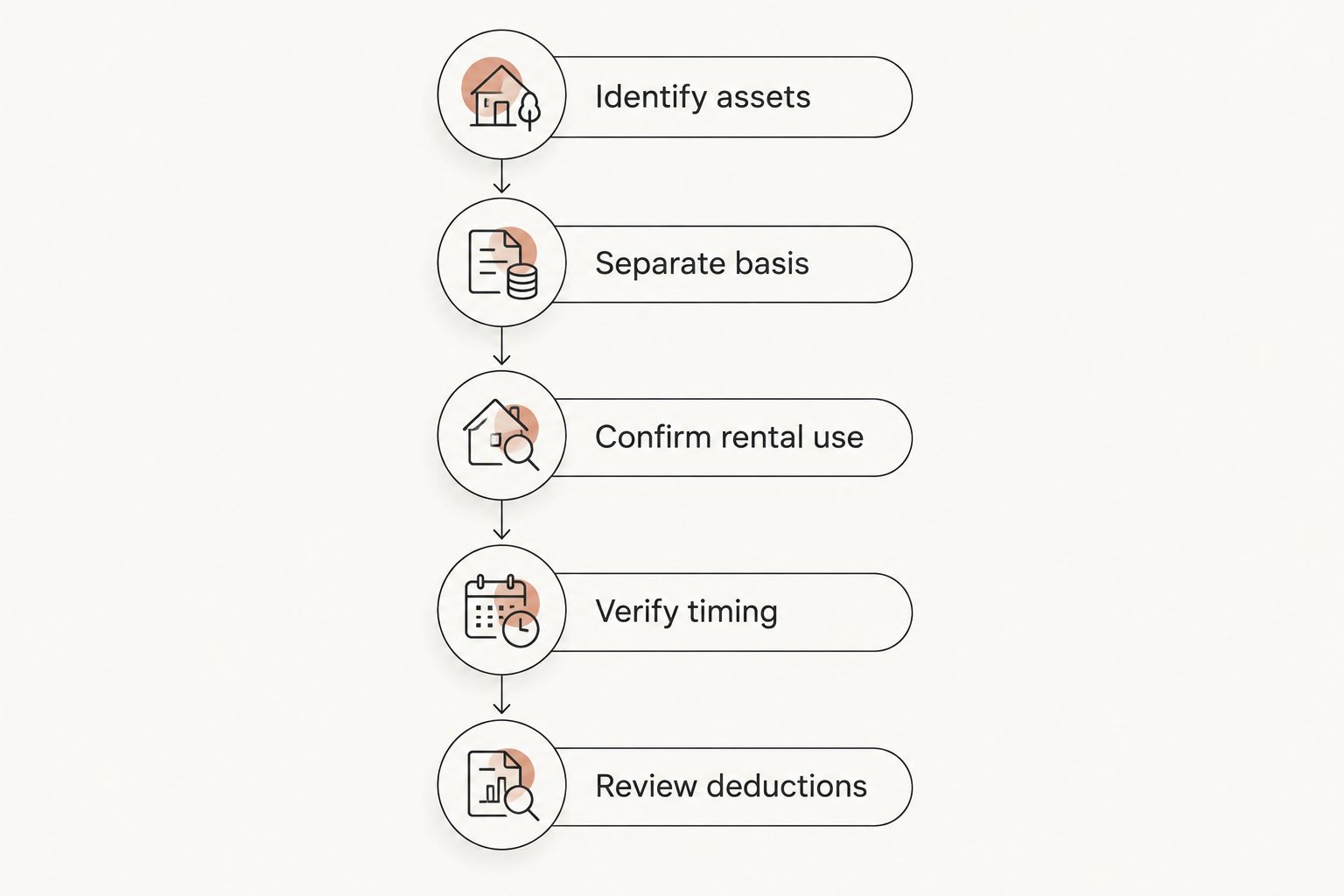
The sequence also tells you when to pause. If the parcel contains only land, stop the depreciation calculation and focus on preserving records for the future residential rental project.
If identifiable improvements exist, do not jump straight to a deduction amount. First establish their cost, classification, business use, and placed-in-service facts.
Does bonus depreciation change the land-only answer in 2026?
No. Bonus depreciation does not apply to land. It applies only to eligible depreciable property, so the asset must qualify before the bonus depreciation rules become relevant.
Under the One Big Beautiful Bill Act, eligible property acquired and placed in service after January 19, 2025 can qualify for 100% bonus depreciation. Both conditions matter, along with the other eligibility requirements; the restored rate has no scheduled end date.
A land purchase followed by later construction requires careful separation of the acquisition and installation facts for the relevant assets. Do not assume the closing date for the lot establishes the acquisition date of every later improvement.
Converting a previously personal property to rental use does not reset its acquisition date. For a home bought before January 20, 2025 and converted later, the conversion does not qualify it for the restored full bonus rate; have your CPA confirm the applicable treatment.
Even without bonus depreciation, correctly classified assets can receive shorter recovery periods. That benefit still requires depreciable property and does not extend to the land beneath it.
Can outdoor improvements offset your W-2 income?
Not automatically. Classifying an improvement as depreciable determines how its cost is recovered; it does not establish that the resulting loss can offset wages.
For short-term rentals, the commonly discussed nonpassive treatment requires an average guest stay of 7 days or less and material participation. One common material participation test requires more than 100 hours and more participation than any other individual, including a property manager.
A vacant lot intended for a future Airbnb does not establish those facts. Before projecting a W-2 offset, your CPA must review the operating activity, participation records, placed-in-service timing, and applicable loss limitations.
Keep the questions separate: is the asset depreciable, what deduction is permitted, and can you use that deduction now? A favorable answer to the first question does not settle the others.
When does an engineering-based study make sense?
A study becomes relevant when your residential rental has identifiable depreciable assets whose costs and recovery periods need support. A bare lot without depreciable improvements does not meet that starting point.
Virtual Cost Segregation is best for residential rental owners seeking engineering-based asset classification, not bare-land deductions. Its residential cost segregation studies are built to the IRS Audit Technique Guide's criteria, with no site visit required and audit support included.
The limitation is equally important: Virtual Cost Segregation provides a supplementary report, not a CPA service. Your CPA applies the report when preparing the tax return; the study itself is not filed with the IRS.
If the property has been a rental for years, a look-back study requires implementation review. Missed depreciation is claimed on the current return with Form 3115 rather than by amending prior returns, and your CPA determines the applicable accounting-method procedure.
For a 2026 decision, establish the depreciable asset inventory first and request an estimate second. Estimates are planning figures, and actual study results and tax benefits vary.
FAQ
Can I get a cost segregation study on land only?
A cost segregation study on land only cannot create depreciation deductions for bare land. Separately identifiable improvements require their own classification, basis, rental-use, and placed-in-service review.
Can land improvements qualify without a rental building?
Separately identifiable land improvements can be depreciable without a building, but they must be used in an income-producing activity and placed in service. Improvements for an unfinished residential rental project do not automatically satisfy those requirements.
Are fences and paving always 15-year property?
Qualifying fencing and paving are generally 15-year land improvements, but classification depends on function and documentation. Do not apply that treatment automatically to every charge in an outdoor construction contract.
Does buying land in 2026 give me a depreciation deduction?
Buying bare land in 2026 does not give you a depreciation deduction for the land. Preserve the acquisition records and separately track later residential construction and improvement costs.
Does bonus depreciation let me deduct the land purchase?
Bonus depreciation does not let you deduct the land purchase. Land is not depreciable, regardless of the bonus depreciation treatment available for other assets.
Should I order a study before building my rental house?
Preserve records before construction, but establish the depreciable assets and placed-in-service facts before relying on a study for deductions. Your CPA can help coordinate the study with the project's actual timeline.
Does Virtual Cost Segregation file my tax return?
Virtual Cost Segregation provides an engineering-based residential cost segregation report, not tax-return preparation. Your own CPA applies the report and handles the applicable filing requirements.
One last thing
A completed improvement and a deductible improvement are not necessarily the same thing. A fence can be physically finished while the planned residential rental remains unavailable for its intended use.
Before paying for a study, create an asset list with supporting costs and dates. If that list contains only land, preserve the records and revisit depreciation when the residential project has identifiable assets ready for rental use.