
By Virtual Cost Segregation
The best cost segregation study provider for rental property investors
 Built to IRS standards
 Audit support includedFlat price for every study3 to 5 business days
Yes. Cost segregation can reduce the 3.8% net investment income tax when accelerated depreciation creates an allowable deduction that reduces taxable rental income or lowers modified adjusted gross income. The deduction must survive the applicable loss limitations, and a suspended loss generally provides no current-year reduction. Your CPA must calculate both sides of the NIIT formula before treating a larger depreciation deduction as tax savings.
- Cost segregation and net investment income tax interact through allowable rental deductions and modified adjusted gross income.
- The 3.8% NIIT applies to the smaller of net investment income or income above your filing-status threshold.
- Suspended passive losses generally do not reduce current-year NIIT; deduction usability matters more than the study's allocation.
- Virtual Cost Segregation provides residential cost segregation studies; your CPA determines the deduction's NIIT treatment.
Why this matters
A rental depreciation deduction and an immediate tax reduction are different things. You need an allowable deduction, income against which it works, and a return showing that the deduction actually reduces the NIIT tax base.
For 2026 planning, ask your CPA to compare your return with and without accelerated depreciation. An engineering-based study from Virtual Cost Segregation supplies asset classifications and supporting costs, not a determination of your personal tax benefit.
Can cost segregation help reduce the net investment income tax?
Cost segregation helps reduce NIIT only when usable depreciation reduces an amount that controls the NIIT calculation. Under Internal Revenue Code Section 1411, NIIT equals 3.8% of the smaller of:
- Your net investment income.
- Your modified adjusted gross income, or MAGI, above the applicable filing-status threshold.
For most domestic individual taxpayers, NIIT MAGI is adjusted gross income, with specific adjustments where applicable. Your CPA should calculate it rather than substitute taxable income after the standard or itemized deduction.
| Filing status | NIIT MAGI threshold | What the threshold means |
|---|---|---|
| Married filing jointly or qualifying surviving spouse | $250,000 | Only MAGI above this amount enters the excess-MAGI calculation |
| Single or head of household | $200,000 | The excess is compared with net investment income |
| Married filing separately | $125,000 | The lower threshold applies to each separate return |
These individual thresholds are not indexed for inflation. The same thresholds apply in 2026.
Rental income generally enters net investment income unless an exception applies. Properly allocable, allowable depreciation can reduce the rental income included in that calculation. But shrinking net investment income does not necessarily reduce NIIT if excess MAGI remains the smaller amount.
How does depreciation reach the NIIT calculation?
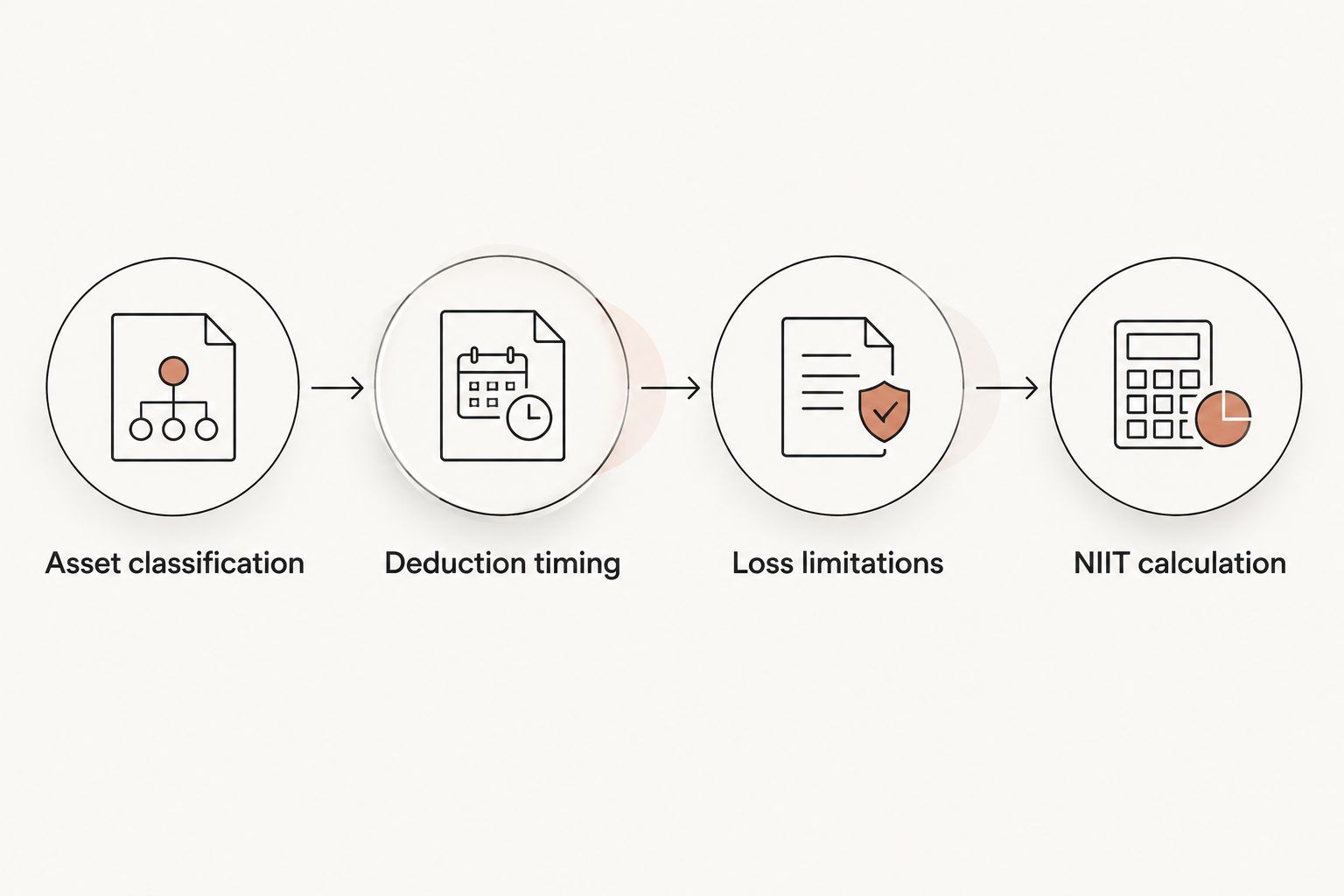
Your CPA needs to trace the deduction through the return, not multiply the study's reclassified basis by a tax rate. For a 2026 projection, use this sequence:
- Asset classification. Separate land, the building, and qualifying shorter-life components using supported costs and classifications.
- Deduction timing. Determine recovery periods, conventions, acquisition dates, placed-in-service dates, and applicable elections.
- Loss limitations. Apply basis, at-risk, passive activity, and other relevant restrictions before counting a current deduction.
- NIIT calculation. Recalculate net investment income and MAGI, then apply the smaller-amount rule on Form 8960.
The order matters. A study can identify shorter-life assets without producing an immediately usable loss, and an allowable loss can affect MAGI without being deductible directly against unrelated investment income.
Passive residential rentals: deductions against investment income
For a passive residential rental, allowable depreciation generally reduces the rental's net income. Because passive rental income generally falls within net investment income, this is the most direct connection between cost segregation and NIIT.
Best for: owners with taxable passive rental income and deductions they can currently use. Accelerated depreciation can reduce that income, subject to the applicable allocation and loss rules.
The limitation appears when depreciation creates a passive loss that cannot currently be deducted. High wages do not, by themselves, make that passive rental loss deductible against wages. A larger suspended loss is not the same as a smaller current tax bill.
| Rental situation | Potential benefit | Main limitation |
|---|---|---|
| Passive rental with positive taxable income | Allowable depreciation reduces rental income included in NII | NIIT still depends on excess MAGI |
| Passive rental creating a suspended loss | Unused deductions carry forward under applicable rules | Generally no current benefit from the suspended amount |
| Nonpassive rental trade or business | An allowable loss can reduce MAGI | The loss does not automatically offset unrelated NII directly |
Passive status is a tax classification, not a description of how busy you feel managing the property. Your CPA must apply the activity rules to your facts.
Nonpassive short-term rentals: the MAGI route
A qualifying nonpassive short-term rental trade or business can affect NIIT differently. Its income generally falls outside net investment income when the applicable trade-or-business and nonpassive requirements are satisfied, while an allowable loss can reduce adjusted gross income and therefore MAGI.
Best for: short-term rental self-operators whose CPA confirms nonpassive trade-or-business treatment and current loss deductibility. The potential NIIT benefit comes through lower excess MAGI, rather than an automatic offset against dividends or stock gains.
An average guest stay of 7 days or less is an exception to rental-activity treatment under the passive activity rules. Material participation must also be established; a common test requires more than 100 hours and more participation than any other individual, including a property manager. That test does not require real estate professional status.
Those facts do not, alone, settle every NIIT issue. The trade-or-business requirement, personal-use restrictions, and other loss limitations still matter. Never assume that an Airbnb listing or a participation log automatically removes income from NIIT.
Why the NIIT benefit varies
For 2026, the decisive factors are the ones connecting depreciation to an allowable deduction and then to Form 8960:
- Your filing status. The applicable MAGI threshold determines whether excess MAGI exists.
- Your income mix. Wages count toward MAGI but are not themselves net investment income; rental income, interest, dividends, and gains require their own treatment.
- Your activity classification. Passive rental treatment differs from qualifying nonpassive trade-or-business treatment.
- Your deduction limits. Basis, at-risk, passive activity, and excess business loss rules can delay use of deductions.
- Your asset eligibility. Land is not depreciable, the building does not qualify for bonus depreciation, and component treatment depends on function and documentation.
- Your timing. Acquisition, placed-in-service, and disposition dates affect deductions and the years in which they matter.
Have your CPA identify the controlling side of the NIIT formula before estimating savings. Reducing a number that does not control the formula can leave the tax unchanged.
How much NIIT can an additional deduction save?
The maximum direct NIIT reduction is 3.8 cents per $1 of additional allowable deduction when that dollar reduces the controlling NIIT base. The actual reduction is smaller or zero when thresholds, suspended losses, or the smaller-amount rule restrict the benefit.
For an illustrative high-earner calculation, assume a 37% marginal federal income tax bracket. An additional $1,000 deduction fully effective at that bracket produces $370 of regular federal income tax reduction. If the same deduction also reduces the controlling NIIT base dollar for dollar, the separate NIIT reduction is $38.
That arithmetic is not a study-result estimate. If illustrating asset reclassification, assume 25% of the property's depreciable value is reclassified, with land excluded; actual results vary. Reclassified basis is not automatically the same as an additional current-year deduction because timing, eligibility, and already scheduled depreciation must be considered.
Do not multiply the full reclassified allocation by 40.8% and call it savings. The regular income tax calculation and NIIT calculation require separate checks, and state taxes require separate analysis.
Does bonus depreciation change the NIIT answer?
Bonus depreciation changes deduction timing, not the NIIT rate. For eligible property acquired and placed in service after January 19, 2025, the 100% bonus depreciation rate can accelerate qualifying component deductions; the building structure remains ineligible.
For 2026 planning, your CPA must verify both dates, including relevant acquisition-contract rules. A home's conversion to rental use does not reset its acquisition date. For a home purchased before January 20, 2025 and converted later, do not assume eligibility for the restored rate; ask your CPA to determine the applicable treatment.
Cost segregation can still accelerate depreciation through supported 5-, 7-, and 15-year classifications without bonus depreciation. Asset function, documentation, and taxpayer facts control classification and eligibility. More depreciation available on paper still does not override passive activity or other deduction limits.
Can a look-back study reduce NIIT on the current return?
A look-back study can affect current-year NIIT when its catch-up depreciation produces an allowable adjustment relevant to that year's calculation. For an eligible accounting-method change, missed depreciation is claimed on the current return using Form 3115 and a Section 481(a) adjustment; prior returns are not amended for that catch-up.
Your CPA must determine the correct method-change procedure and how the adjustment enters the regular income tax and NIIT calculations. A negative adjustment is not automatically a fully usable deduction against wages or unrelated investment income.
For a 2026 look-back review, bring the original depreciation schedules, acquisition records, improvement invoices, and prior suspended-loss information. The historical records establish what was already deducted and prevent counting the same depreciation twice.
What should your CPA review before you order a study?
Request a comparison of regular federal income tax, NIIT, suspended losses, and remaining depreciable basis. The useful output is the change in tax, not just the amount moved into shorter recovery periods.
Give your CPA:
- Closing documents and the land allocation.
- Acquisition contracts and placed-in-service records.
- Existing depreciation schedules and improvement costs.
- Rental income, expenses, and personal-use records.
- Guest-stay records and participation logs where relevant.
- Filing status, projected MAGI, investment income, and loss carryforwards.
Your CPA then applies the study to the return, including Form 4562 and Form 8960 where applicable. The client-to-CPA handoff checklist explains the records to organize before filing.
Virtual Cost Segregation is best for residential rental owners seeking an engineering-based cost segregation study for their CPA to apply. Its studies serve residential rentals of 1 to 4 units, require no site visit, and include audit support. The limitation is clear: the study is not a CPA service, is not filed with the IRS, and does not determine whether you can currently use a deduction.
FAQ
Can cost segregation reduce the 3.8% net investment income tax?
Yes, cost segregation can reduce the 3.8% NIIT when allowable accelerated depreciation reduces the controlling amount in the NIIT formula. Your CPA must compare net investment income with MAGI above your filing-status threshold.
Do my W-2 wages count as net investment income?
W-2 wages are not net investment income, but they generally contribute to MAGI. Higher wages can therefore cause otherwise taxable investment income to become subject to NIIT.
Will a suspended rental loss lower my NIIT this year?
A suspended passive rental loss generally does not lower current-year NIIT. Your CPA must determine when the loss becomes allowable and how it enters the NIIT calculation in that year.
Does materially participating in my Airbnb eliminate NIIT?
Material participation alone does not settle NIIT treatment. Your CPA must also evaluate the short-term rental's activity classification, trade-or-business status, and the treatment of your other investment income.
Can I add 3.8% to my 37% bracket when estimating savings?
Do not automatically add 3.8% to a 37% bracket. An allowable deduction must independently reduce regular taxable income at that marginal rate and reduce the controlling NIIT base before both benefits apply.
Does cost segregation eliminate taxes when I sell my rental?
Cost segregation does not eliminate taxes on a rental sale. Accelerated depreciation reduces adjusted basis, and depreciation recapture and NIIT can affect the disposition-year calculation.
Does Virtual Cost Segregation file my NIIT return?
Virtual Cost Segregation provides a supplementary engineering-based study, not tax filing services. Your CPA applies the report, determines deduction eligibility, and completes applicable tax forms.
One last thing
Ask your CPA which side of the NIIT formula is smaller before discussing the study's tax benefit. That question separates a useful deduction from an impressive allocation that does not change your current bill.
Also request an ownership-period view. Accelerated depreciation brings deductions forward, reduces remaining basis, and can affect taxes when you sell. Evaluate the timing benefit alongside current deductibility and expected disposition treatment, not as permanent tax elimination.