
By Virtual Cost Segregation
The best cost segregation study provider for rental property investors
 Built to IRS standards
 Audit support includedFlat price for every study3 to 5 business days
Yes, cost segregation can cause alternative minimum tax (AMT) to become payable when accelerated deductions reduce your regular federal income tax below your tentative minimum tax. That does not mean the study automatically increases your total tax, and qualifying bonus depreciation generally does not require a separate AMT depreciation adjustment. For 2026 planning, your CPA should compare the complete return before and after the study, not treat every accelerated deduction as an AMT add-back.
- Can cost segregation trigger alternative minimum tax? Yes, but an AMT liability does not automatically mean higher total tax.
- Qualifying bonus depreciation generally receives the same depreciation treatment for regular tax and AMT.
- Virtual Cost Segregation provides residential rental studies; your CPA determines deduction usability and the AMT result.
- Compare total federal tax before and after cost segregation, including passive-loss limits and depreciation adjustments.
Why this matters
A deduction estimate is not a tax-savings calculation. Multiplying accelerated depreciation by your regular marginal rate leaves out AMT, suspended losses, and other return-level limits.
That distinction matters for high W-2 earners buying residential rentals. A technically correct depreciation deduction can produce a smaller current tax benefit than the headline calculation suggests. It can also remain suspended rather than reduce current income.
Virtual Cost Segregation provides engineering-based residential rental studies, while your CPA determines how those deductions affect your return. Keep those responsibilities separate when evaluating a study.
Can a cost segregation study trigger the AMT?
Yes. Cost segregation can change whether you owe AMT by changing the relationship between regular income tax and tentative minimum tax. A separate depreciation adjustment is another possible issue, but it is not automatic.
For individuals, Form 6251 calculates AMT. Broadly, AMT becomes payable when tentative minimum tax exceeds regular tax after the applicable adjustments and credits. Your CPA must calculate both systems rather than assume a lower regular-tax bill settles the question.
| Situation | Regular-tax treatment | AMT consideration | What it means for you |
|---|---|---|---|
| Qualifying bonus depreciation | Accelerates eligible asset deductions | Generally no separate depreciation adjustment for the qualifying bonus deduction | Bonus depreciation is not automatically added back |
| Depreciation with different regular and AMT methods | Uses the applicable regular-tax method | An adjustment can arise from the difference | Separate depreciation schedules matter |
| Rental loss suspended under passive-activity rules | Current deduction is limited | AMT passive-loss calculations can also require separate tracking | A study does not automatically create a usable current loss |
| Regular tax falls below tentative minimum tax | Regular liability decreases | AMT can become payable | Compare total tax, not just the AMT line |
The IRS Instructions for Form 6251 address depreciation and passive-activity adjustments separately. For your 2026 projection, have your CPA identify the actual adjustment, if any, rather than label the entire study amount an AMT preference.
An AMT line item is not the same as a tax increase
A return can show AMT after cost segregation while still showing lower total federal tax than the same return without the study. The additional AMT can absorb part of the regular-tax reduction without eliminating the benefit.
The correct comparison holds your other facts constant. Compare the complete return without accelerated depreciation against the complete return with it, including credits and loss limitations.
Bonus depreciation and AMT: separate the two questions
Bonus eligibility and AMT exposure are different calculations. First establish which assets qualify for accelerated deductions; then calculate how the allowed deductions affect both tax systems.
For eligible property acquired and placed in service after January 19, 2025, the restored 100% bonus depreciation rate applies under the One Big Beautiful Bill Act. Acquisition requirements include applicable binding-contract rules, so the closing date alone does not resolve every case.
Qualifying bonus depreciation generally receives the same depreciation treatment for regular tax and AMT. That does not make your entire return exempt from AMT. Other adjustments, exemptions, income, and credits still affect the result.
If an asset is not eligible for bonus depreciation, your CPA must review its regular-tax and AMT methods. Differences between those methods can create a depreciation adjustment even though a qualifying bonus deduction generally does not.
The building is not a bonus-depreciation asset
Cost segregation separates eligible components from the building; it does not turn the building structure into immediately deductible property. Land is not depreciable.
The building of a long-term residential rental generally uses a 27.5-year recovery period. Shorter-lived components can use 5-, 7-, or 15-year periods when their classification supports that treatment. Asset function, documentation, service dates, and your facts control the classification.
For 2026 planning, ask for an asset-level explanation. A single total labeled accelerated depreciation does not show which assets produce an AMT difference or why.
Why the AMT result varies
Your AMT result depends on the return, not merely the property value or study allocation. These factors deserve separate review:
- Depreciation method. Different regular-tax and AMT methods can produce an adjustment; qualifying bonus depreciation generally does not require that separate adjustment.
- Deduction usability. Passive-activity, basis, at-risk, and excess-business-loss rules can limit the current benefit before you reach the final tax comparison.
- Other AMT adjustments. State and local tax deductions and incentive stock option exercises are examples of items your CPA should review.
- Income and filing status. These affect the AMT exemption and its phaseout, as well as your regular-tax calculation.
- Tax elections. Elections affecting depreciation can change deduction timing and should be modeled rather than selected in isolation.
- Existing tax attributes. Suspended losses, separate AMT basis, and potential minimum-tax-credit carryforwards can change the result.
These factors explain why two owners with similar rental houses can receive different current tax benefits. Matching property values does not mean matching tax returns.
An illustrative deduction is not an AMT savings forecast
Assume, solely for illustration, that a residential rental has $400,000 of depreciable basis after excluding land. Assume a study reallocates 25% of that basis to shorter-lived components, producing $100,000 of reclassified basis. Actual study results vary.
If your CPA determines that the full $100,000 is currently deductible, simple multiplication at a 37% regular marginal rate produces $37,000. That $37,000 is an illustrative regular-tax calculation, not a forecast of your final savings.
The calculation does not establish bonus eligibility, prove that a rental loss offsets wages, or measure AMT. It also does not subtract the depreciation otherwise available without the study.
Your CPA should compare the incremental deduction against the no-study baseline and then calculate the complete return. If tentative minimum tax limits the regular-tax reduction, the current benefit is smaller than the simple multiplication suggests.
For a 2026 decision, use the difference in total projected tax as the savings estimate. Keep the reclassified basis, current deduction, and tax reduction on separate lines.
Check whether your rental loss can offset W-2 income
AMT is not the first hurdle if your rental loss is suspended. Cost segregation changes depreciation timing; it does not independently change a passive activity into a nonpassive one.
For the commonly discussed short-term-rental exception, average guest stays must be 7 days or less, and you must satisfy material participation to obtain the intended nonpassive treatment. One common material-participation test requires more than 100 hours and more participation than any other individual, including a property manager.
Logging 100 hours alone is not enough. This short-term-rental route does not require real estate professional status, but your CPA must evaluate the activity and your records before determining the tax treatment.
Long-term residential rental losses generally remain subject to rental passive-activity rules unless an applicable exception applies. A high salary does not itself make those losses deductible against wages.
For AMT purposes, passive-activity calculations can differ from regular-tax calculations when underlying deductions or basis differ. Give your CPA both the participation records and depreciation schedules.
How should your CPA check AMT before you order?
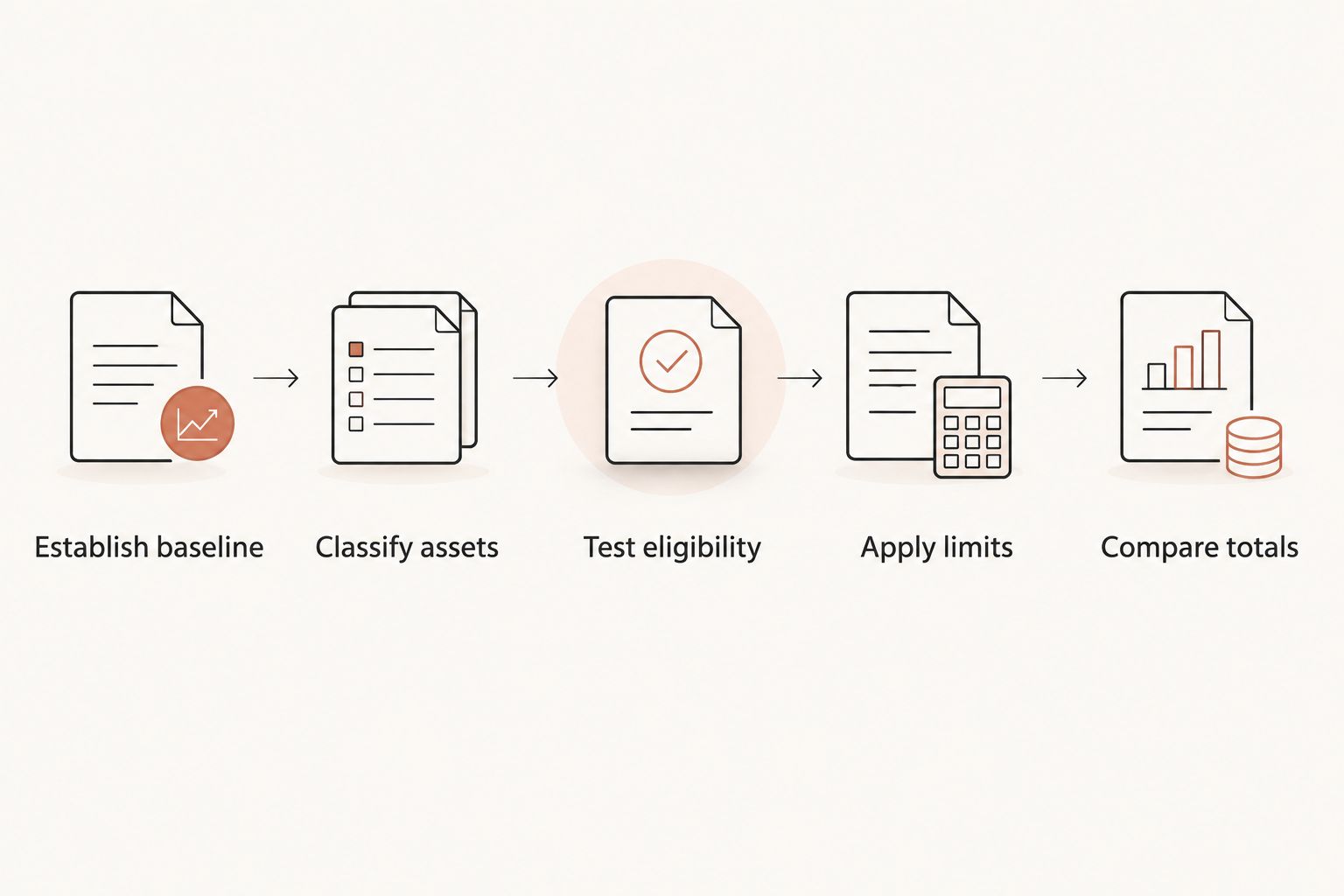
Ask for a before-and-after projection using the same income, filing status, and other assumptions. Change the depreciation treatment, then trace its effect through the return.
- Establish baseline. Calculate projected regular tax and tentative minimum tax without the proposed study deductions.
- Classify assets. Separate land, building basis, shorter-lived assets, and any components requiring different AMT treatment.
- Test eligibility. Confirm acquisition facts, placed-in-service dates, bonus eligibility, and applicable depreciation elections.
- Apply limits. Determine how much of the resulting loss is currently usable under the relevant limitation rules.
- Compare totals. Recalculate total federal tax and document the difference, including suspended amounts and separate AMT attributes.
Request a written explanation of any AMT adjustment. It should identify the affected assets and methods, rather than simply repeat the total accelerated-depreciation figure.
A study estimate can inform this projection, but it cannot replace the CPA's return-level analysis. Update the projection when your income or rental-use facts change.
What should the study provider supply?
Your CPA needs supported asset classifications and cost allocations that can be entered into depreciation software. Closing records, existing depreciation schedules, renovation invoices, and rental-use information help connect the study to your actual basis.
Virtual Cost Segregation is best for residential rental owners seeking an engineering-based study for their CPA to apply. Its studies address residential rental properties with 1 to 4 units and are built to the IRS Audit Technique Guide's criteria.
The service provides a CPA-ready report without a required site visit, with delivery in 3 to 5 business days and audit support included. The limitation is equally clear: the study is not a CPA service, is not filed with the IRS, and does not determine your final AMT liability.
A manual savings estimate is available on inquiry. Treat estimates as planning inputs, then have your CPA test the deductions against your return.
Does AMT mean I should skip cost segregation?
No. AMT exposure is a reason to model the study, not an automatic reason to reject it. Accelerated depreciation can still reduce total tax even when AMT absorbs part of the regular-tax benefit.
Cost segregation accelerates deductions rather than creating additional depreciable basis. Review current tax savings alongside future depreciation and potential recapture when you sell.
Can I claim missed depreciation without amending returns?
Missed depreciation from a qualifying look-back study is generally claimed on the current return through Form 3115 and a Section 481(a) adjustment; prior returns are not amended for that accounting-method correction. Your CPA determines the applicable procedure and files the form.
The CPA should also reconcile regular-tax and AMT depreciation histories. A catch-up deduction does not eliminate the need to calculate separate AMT amounts where required.
Will AMT automatically produce a future tax credit?
No. A minimum tax credit depends on the source of the AMT and the applicable credit rules; not every AMT payment creates a recoverable credit.
Have your CPA distinguish deferral items from exclusion items and evaluate Form 8801 where applicable. Do not count an assumed future credit as current cash savings.
FAQ
Can cost segregation trigger alternative minimum tax in 2026?
Yes, cost segregation can cause AMT to become payable if accelerated deductions reduce regular tax below tentative minimum tax. Compare total federal tax before and after the study to measure the actual benefit.
Is bonus depreciation automatically added back for AMT?
No, qualifying bonus depreciation generally does not require a separate AMT depreciation adjustment. Your CPA must still review other depreciation differences and the rest of your return.
Does owing AMT mean cost segregation increased my tax bill?
No, owing AMT does not establish that cost segregation increased your total tax. AMT can absorb part of a regular-tax reduction while the complete return still shows a net benefit.
Can an Airbnb depreciation loss offset my W-2 income?
An Airbnb loss can offset W-2 income only when the applicable activity and loss-limitation rules permit it. The commonly discussed short-term-rental route requires average guest stays of 7 days or less and material participation, not merely ownership.
Does cost segregation make a passive rental loss deductible?
No, cost segregation does not remove passive-activity limits. Your CPA must determine whether the loss is currently deductible or suspended.
Who calculates AMT after a residential cost segregation study?
Your CPA calculates AMT using your complete return and the study's asset information. Virtual Cost Segregation supplies the residential study, not individualized tax preparation.
What should I ask my CPA before buying a study?
Ask for a before-and-after projection showing regular tax, tentative minimum tax, total federal tax, and suspended losses. Request an explanation of any depreciation adjustment rather than assuming the full study deduction is added back.
One last thing
The most useful number is the change in total tax, not the amount labeled AMT. Ask your CPA to show the no-study and study scenarios side by side for 2026, with current savings separated from deductions carried forward.
This article provides general educational guidance, not individualized tax advice. Apply current law to your facts with your tax professional.